History
A Black Hills Timeline
The Black Hills are far younger than their rock: the dome began to rise about 60 to 65 million years ago, but the granite of Black Elk Peak (called Harney Peak until 2016) is about 1.7 billion years old. This timeline runs from that rock to today, through the treaties, the taking of the Hills, and the mines, parks and monuments, with links to the pages that tell each event in full.
How Old Are the Black Hills?
The rock is counted in billions of years, the mountains in tens of millions.
- About 2.5 to 1.7 billion years ago: The granite and metamorphic rock of the crystalline core form.
- About 60 to 65 million years ago: The Hills begin to rise into an elongated dome, probably until roughly 40 to 50 million years ago.
- About 58 to 46 million years ago: Magma cools underground in the northern Hills, later laid bare as Devils Tower, Bear Butte and Inyan Kara Mountain.
- Roughly 200,000 years ago: Mammoths are trapped in a sinkhole of warm spring water at what is now Hot Springs.
People in the Hills Before the Treaties
In Lakota accounts, the people began in the Black Hills, Hé Sápa, coming up into this world through the passage known today as Wind Cave. Archaeology and written records add dates of their own.
- At least 11,000 years ago: People are using the Black Hills, the archaeological record shows, and the plains around them for at least 15,000 years.
- Around 1650: By the Kiowa Tribe’s own history, the Kiowa live in the Hills with the Crow.
- Winter of 1775–76: In an 1886 federal reading of American Horse’s winter count, a Lakota record of the years, this is the winter Standing Bull found the Black Hills.
Treaties, Gold and War, 1851 to 1877
In 26 years the United States made two treaties with the tribes at Fort Laramie, sent soldiers into the Hills, and then took them.
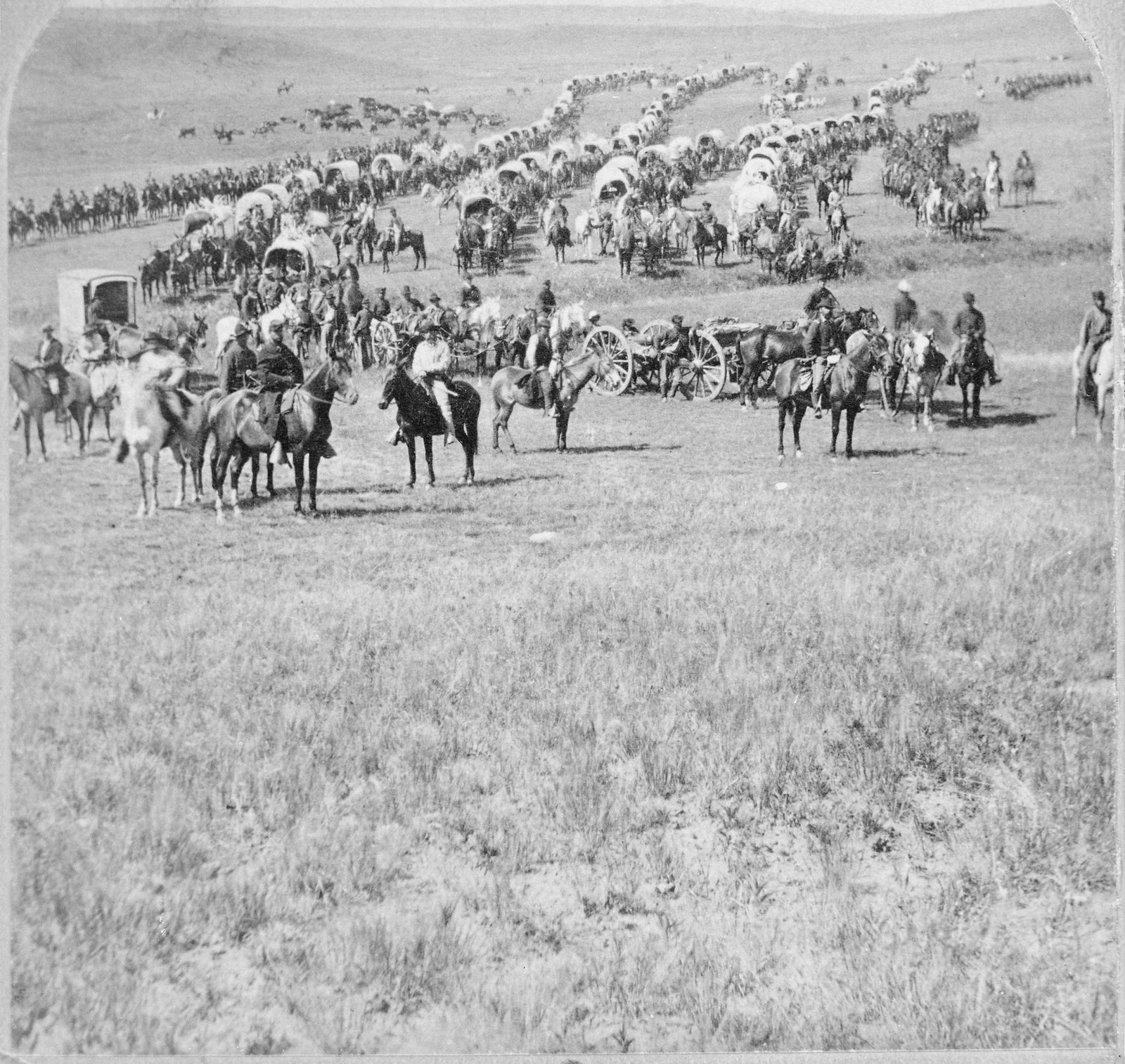
- September 17, 1851: The first Fort Laramie Treaty, or Horse Creek Treaty, is signed by the Lakota, Cheyenne, Arapaho, Crow and four other nations.
- 1866 to 1867: Red Cloud (Maȟpíya Lúta), the Oglala leader, and his Cheyenne and Arapaho allies fight Red Cloud’s War over the Bozeman Trail forts.
- April 29, 1868: The Fort Laramie Treaty of 1868 sets apart the Great Sioux Reservation, with the Black Hills inside it. Red Cloud signs on November 6.
- July 2 to August 30, 1874: Lt. Col. George Armstrong Custer leads an Army column through the Hills on treaty land, and its gold-seekers report gold.
- December 23, 1874: The Gordon Party reaches French Creek, opening the Black Hills gold rush.
- January 31, 1876: The deadline passes for bands wintering on their treaty hunting grounds to come in to the agencies or be treated as “hostiles,” and the 1876 war follows.
- April 9, 1876: Four prospectors stake the Homestake claim near present-day Lead.
- June 25 and 26, 1876: Lakota, Cheyenne and Arapaho warriors defeat Custer’s 7th Cavalry at the Battle of the Little Bighorn, which the Lakota call the Battle of the Greasy Grass.
- February 28, 1877: The 1877 Act takes the Black Hills from the tribes without the consent the 1868 treaty required.
- September 5, 1877: A soldier at Camp Robinson, Nebraska, bayonets Crazy Horse (Tȟašúŋke Witkó), and he dies that night.
Towns, Forest and Reservations, 1877 to 1899
Towns and mines grew on the taken land. On the reservations, federal rules made the Sun Dance an offense, and Congress cut away millions of acres more.
- September 26, 1879: Fire destroys downtown Deadwood, and merchants rebuild, much of it in brick and stone.
- March 30, 1883: Rules from the Commissioner of Indian Affairs, with no act of Congress behind them, make the Sun Dance an offense.
- March 2, 1889: Congress breaks up the rest of the Great Sioux Reservation and opens about 9.3 million acres to settlement.
- December 29, 1890: Two weeks after Sitting Bull is killed at Standing Rock, the 7th Cavalry kills Lakota men, women and children in the Wounded Knee Massacre. Estimates of the dead run from more than 153, the National Library of Medicine’s figure, to more than 300, the Interior Department’s in 2023.
- February 22, 1897: President Grover Cleveland proclaims the Black Hills Forest Reserve.
Parks, Monuments and Mount Rushmore, 1900 to 1941
The federal government set aside a cave and a tower of rock, and Mount Rushmore was carved to draw visitors.
- January 9, 1903: Wind Cave becomes the first national park in the world created to protect a cave.
- September 24, 1906: President Theodore Roosevelt proclaims Devils Tower the first national monument. More than 20 tribes hold it sacred.
- July 1, 1919: Custer State Forest becomes Custer State Park. Its bison herd had begun in 1914 with 36 animals.
- August 10, 1927: Mount Rushmore is dedicated, on land the 1868 treaty set apart for the tribes. Carving runs from October 4, 1927, to October 31, 1941.
- 1933 to 1942: Civilian Conservation Corps camps spread across the Hills; their dams, lakes and stone buildings are still there.
- January 8, 1934: Commissioner John Collier’s order on religious liberty sets aside the rules against the Sun Dance.
- August 14, 1938: The first Sturgis Motorcycle Rally is a race at the Sturgis fairgrounds, put on by J.C. “Pappy” Hoel and the Jackpine Gypsies.
- January 25, 1939: Badlands National Monument is established. It becomes a national park on November 10, 1978.
War, Missiles and Protest, 1942 to 1999
World War II and the Cold War brought an air base and missiles, and treaty claims were pressed in protests and in court.
- January 1942: Rapid City Army Air Base is established. As Ellsworth Air Force Base from 1953, it runs 150 Minuteman missiles from 1963 to 1991.
- 1942: The War Department takes 341,726 acres of the Pine Ridge Reservation for an aerial gunnery range, and 125 families have to leave.
- June 3, 1948: Crazy Horse Memorial is dedicated, by its own account. Henry Standing Bear, a Brulé Lakota, invited the sculptor; Lakota people disagree about the carving.
- August 29, 1970: Activists led by United Native Americans camp on top of Mount Rushmore to protest that it stands on treaty land.
- June 9, 1972: Rapid Creek tears through Rapid City at night, in a flood that kills 238 people across the Black Hills.
- February 27 to May 8, 1973: Oglala Lakota people led by American Indian Movement members occupy Wounded Knee for 71 days, protesting tribal government corruption and broken treaties.
- June 30, 1980: The Supreme Court rules that the 1877 Act was a taking that had to be paid for, with interest. It orders no land returned, and the tribes refuse the award.
What Has Changed Since the 1990s?
Beetles and fire have thinned the forest, the gold mine has become a laboratory, and the names of two landmarks have gone before federal panels.
- About 1996 to 2016: Mountain pine beetles kill about 8.6 million ponderosa pines.
- August 24, 2000: The Jasper Fire burns 83,508 acres, including about 90 percent of Jewel Cave National Monument.
- December 14, 2001: The Homestake Mine’s last ore comes out. In 2006 the mine is donated to the state, for what is now the Sanford Underground Research Facility (SURF).
- 2012: Four tribes buy land on Reynolds Prairie, which the Lakota call Pe’ Sla. On December 2, 2016, the Interior Department upholds trust status for 2,022.66 acres.
- August 11, 2016: Over South Dakota’s objection, the U.S. Board on Geographic Names renames Harney Peak Black Elk Peak, for the Oglala Lakota holy man.
- 2024 to 2026: A federal committee urges renaming Devils Tower as Bear Lodge in 2024; a 2025 bill to keep the name was still in committee in November 2026.
Connected
- How the Black Hills FormedThe dome, its four rings of rock and how old each one is.
- The Fort Laramie Treaties of 1851 and 1868The two treaties, Red Cloud’s War and the Great Sioux Reservation.
- The 1876 War and the Taking of the HillsHow the Hills were taken, from the Custer Expedition to the 1877 Act.
- The 1980 Ruling and Land BackWhat the Supreme Court decided, and why the tribes refuse the money.
- The Black Hills Gold RushThe Gordon Party, the placer camps and the miners on treaty land.
- The Homestake Mine and Sanford LabThe gold mine from its 1876 claim to the physics lab in its tunnels.
- The National Forest and the CCCThe 1897 forest reserve, Case No. 1 and the CCC camps.
- Mount Rushmore and Crazy Horse MemorialThe two carvings and how tribes and tribal members see them.
Further reading
- History and Culture, Rosebud Sioux Tribe
- Who Was Sitting Bull?, Sitting Bull College
- Sacred He Sapa Restoration Act Strategy Session, Standing Rock Sioux Tribe
- Little Bighorn Battlefield National Monument, National Park Service
Sources
- Horse Creek Treaty. National Park Service, Fort Laramie National Historic Site.
- Treaty of Fort Laramie (1868), with transcript. National Archives, Milestone Documents.
- United States v. Sioux Nation of Indians, 448 U.S. 371. Supreme Court of the United States, 1980 (Legal Information Institute, Cornell Law School).
- Little Bighorn Battlefield National Monument. National Park Service.
- 1890: U.S. Cavalry massacres Lakota at Wounded Knee. Native Voices timeline, National Library of Medicine.
- 16 U.S.C. § 141, Establishment; Boundaries (Act of January 9, 1903, ch. 63, 32 Stat. 765). Legal Information Institute, Cornell Law School.
- FAQs. USDA Forest Service, Black Hills National Forest.
- The Proclamation of National Monuments Under the Antiquities Act, 1906-1970 (Ronald F. Lee). National Park Service.
- Memorial History. National Park Service, Mount Rushmore National Memorial.
- Fire. National Park Service, Jewel Cave National Monument.
Last reviewed: