History
Stagecoaches and Railroads
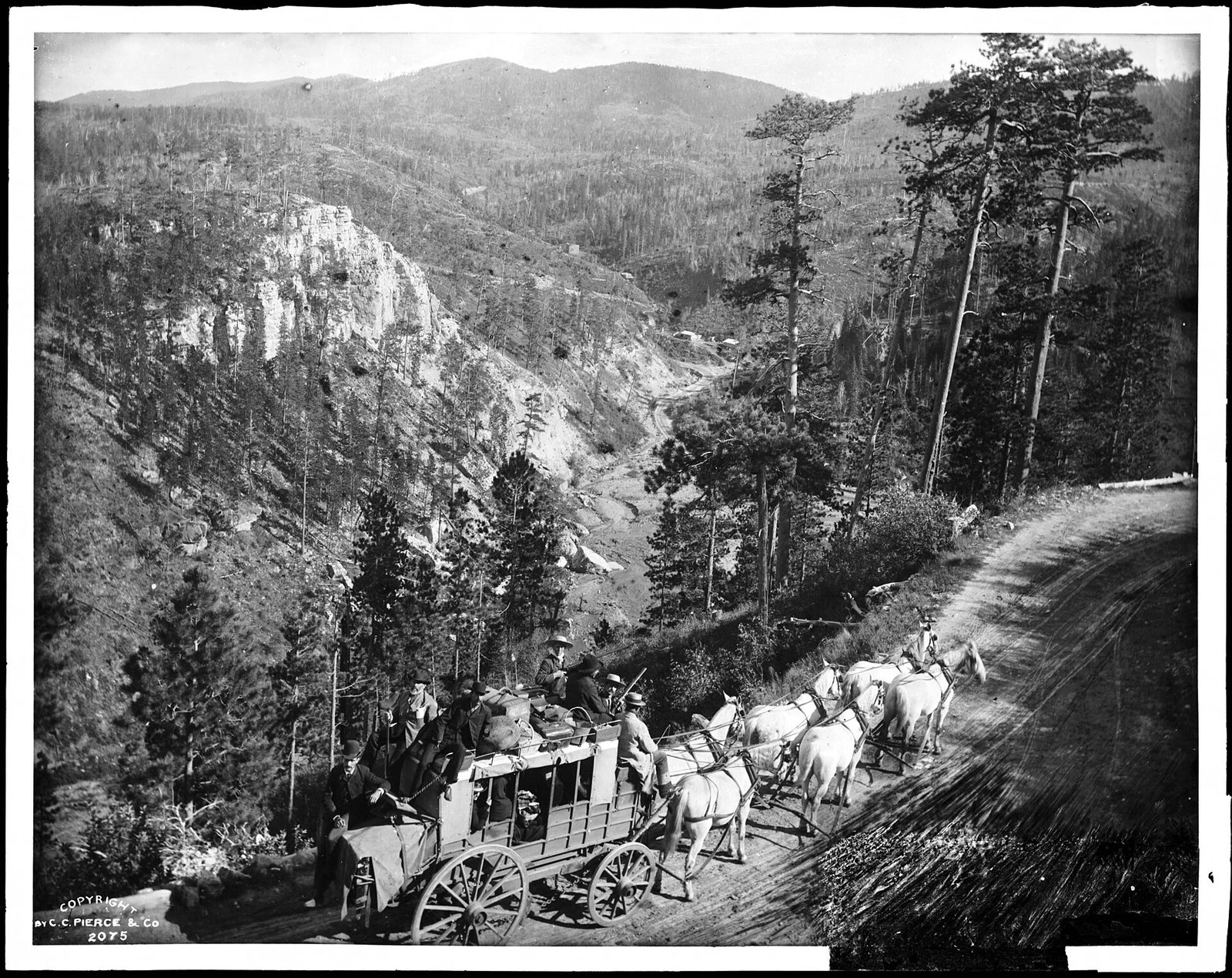
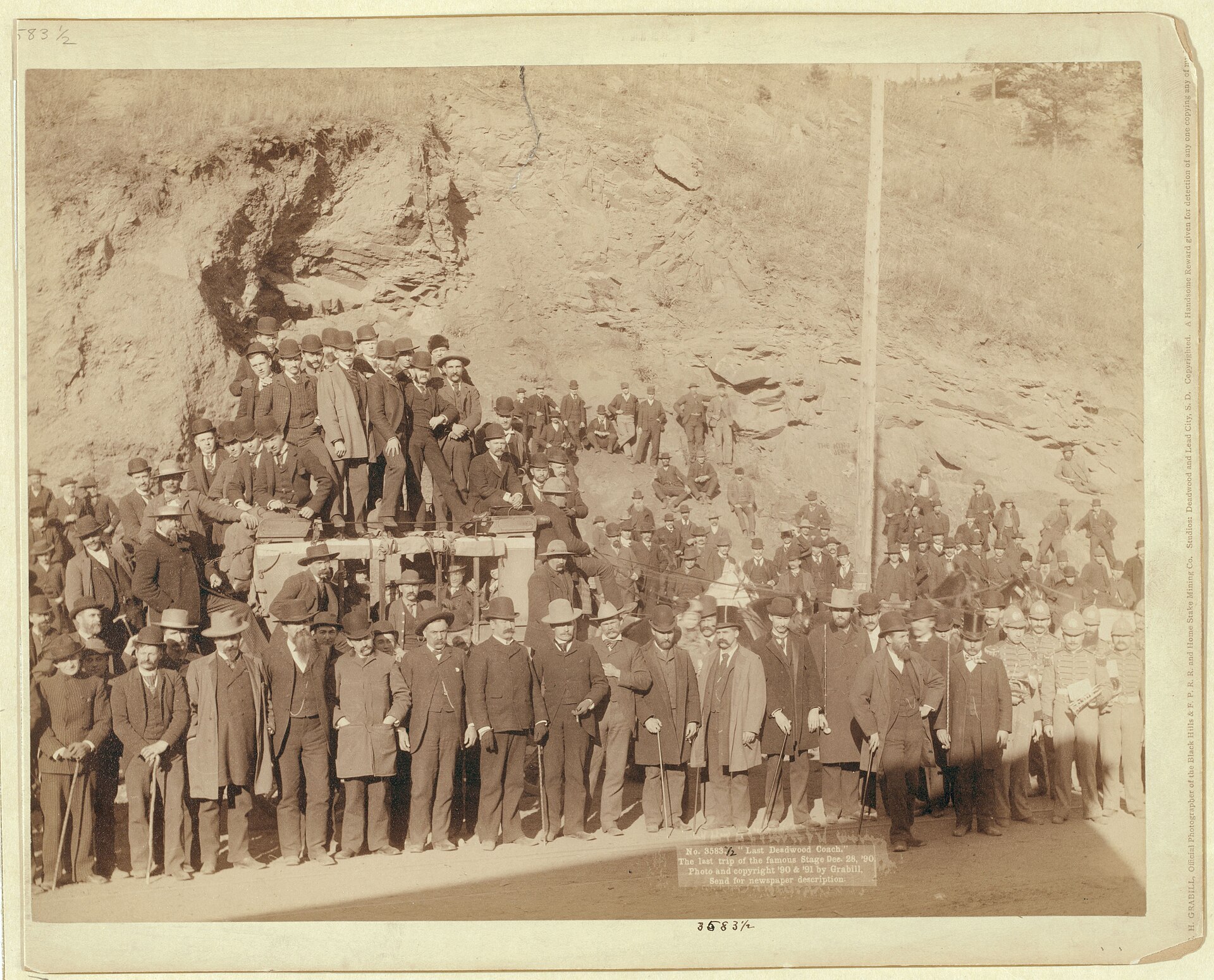
On December 28, 1890, John C. H. Grabill photographed a stagecoach so hemmed in by a crowd of men that it barely shows, and titled the picture “The last trip of the famous stage.” The City of Deadwood’s timeline gives the same date for the arrival of the Fremont, Elkhorn and Missouri Valley Railroad in Deadwood. Since 1876, people, mail, gold and freight had moved in and out of the Black Hills by stagecoach and in wagons behind oxen and mules. The railroads of the 1880s and 1890s replaced those roads, and some of their old lines now carry hikers, cyclists and tourist trains.
Four Roads to the Gold Camps
Stagecoaches reached the Black Hills from Cheyenne, Wyoming, and Sidney, Nebraska, both on the Union Pacific Railroad; from Bismarck, then the western end of the Northern Pacific; and from Fort Pierre, where Missouri River steamboats landed supplies for the gold rush. All of these roads ran into the Hills, which the 1868 treaty had set apart for the tribes; how they were taken from the tribes is told on The 1876 War and the Taking of the Hills.
A Cheyenne company had coaches running north by March 1, 1876, by way of Fort Laramie. The National Park Service’s history of Fort Laramie counts 266 miles from Cheyenne to Deadwood. The company’s coaches were Concords, built in New Hampshire, seating nine inside and as many on the roof, behind six horses. The National Register listing for two of the line’s Wyoming stations dates the route from 1876 to 1887.
Sidney’s road was shorter and less dangerous than its rivals’, according to a University of Nebraska–Lincoln summary drawn from Norbert Mahnken’s 1949 history of the trail. In the spring of 1876 Henry T. Clarke bridged the North Platte near Bridgeport, Nebraska, and charged tolls of $2 to $6, the Nebraska State Historical Society says. The summary puts the route at about 267 miles, with two stage companies, Marsh and Stephenson and Gilmer and Salisbury, running up to three coaches a day to Deadwood.
The northern road opened in 1877. A company formed by the Northern Pacific and a Minnesota firm sent its first coaches out of Bismarck on April 11, 1877, the State Historical Society of North Dakota records, and soon ran daily over the 240 miles. State markers along the route put a typical run at 36 hours and a one-way ticket at $23. In 1880 the Chicago and North Western Railroad reached Pierre, and the company moved most of its equipment there to run a shorter line. A state marker at the Oahe Dam, in Stanley County, calls that stretch of the Missouri the rush’s railhead from 1880 to 1886.
Mail, Gold and Armored Coaches
Besides passengers, the stages carried mail and gold. By the Nebraska summary’s account, gold worth thousands of dollars went south to the railroad at Sidney every week. Robbers began stopping the Sidney stages in 1877, the summary says, and in 1878 Luke Voorhees of Gilmer and Salisbury had the same New Hampshire builders make an armored coach, Old Ironsides. In the summary’s telling, six to eight guards rode with it, an 800-pound safe sat inside behind half-inch steel and porthole windows, and in three years on the Sidney road only one robbery of it succeeded. The road agents and the Cheyenne road’s treasure coach have their own page, Outlaws and the Sundance Kid.
The Park Service history of Fort Laramie counts Calamity Jane among the famous names of those years, but it calls her stage driving and her other roles at the fort only “alleged.” Many of the stories she told about herself are unproven, and the record contradicts some of them.
Bull Trains and Mule Teams
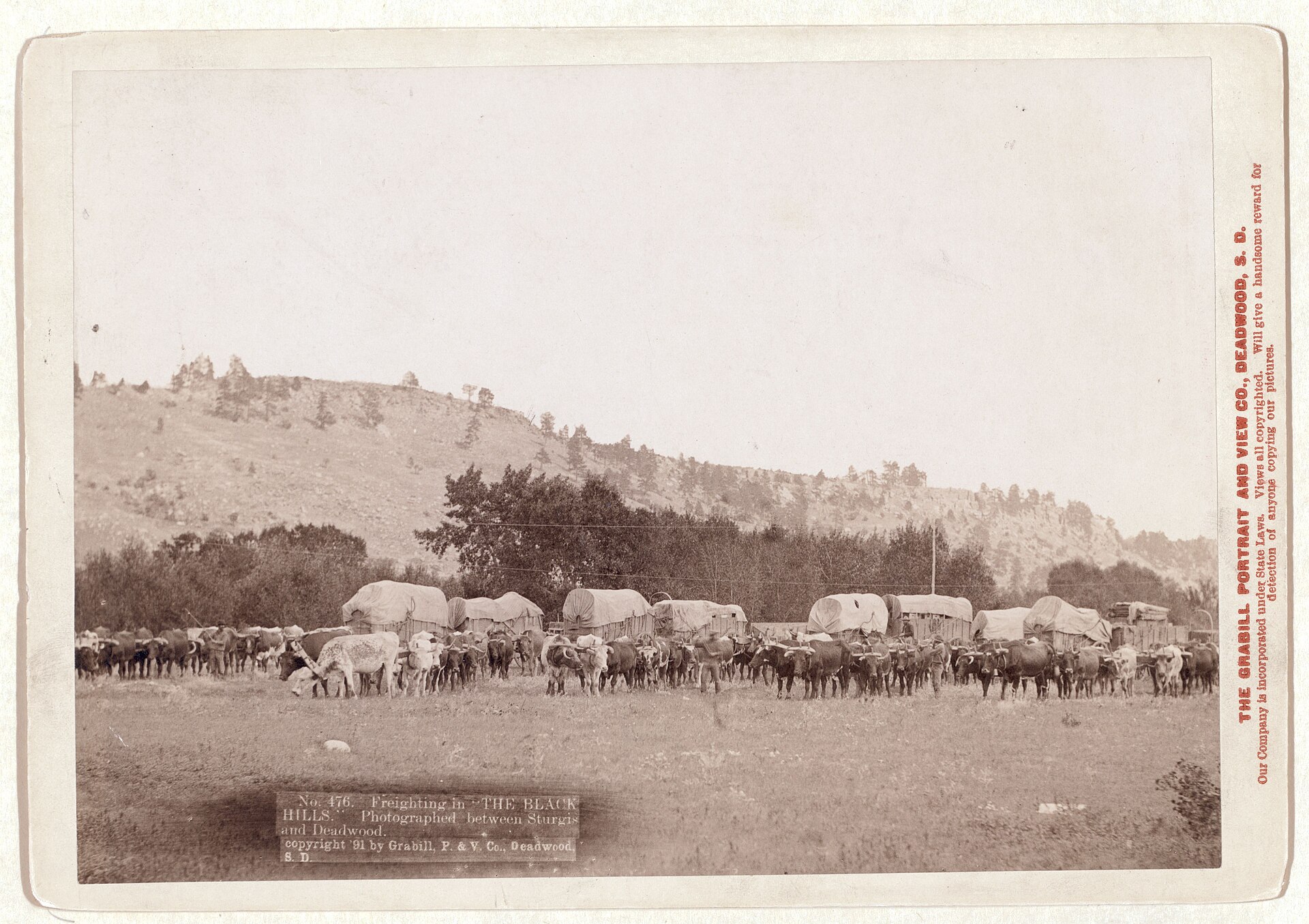
Freight wagons brought the camps their food, furniture and mining tools. Ox teams hauled the heavy loads, mining machinery among them, and mule outfits the lighter ones, a state marker says. The drivers were called bullwhackers, for the way they beat the oxen along, and some were women. Ox trains from Pierre, Bismarck and Sidney unloaded at Hay Camp, in what is now Rapid City, and a downtown marker says the wide streets there were needed for turning wagons and ox teams.
Totals for the Sidney road in its busiest years, 1878 and 1879, vary by source: about 20 million pounds in the Nebraska summary, about 22 million by the Nebraska State Historical Society, and more than 25 million past a single station, by the estimate on a 2008 marker at the site of the Wood stage station, south of Hot Springs. A seat on a freight wagon to Deadwood cost $10, the summary says, against $25 by coach. When the rails reached Pierre in 1880, the big freighters shifted their business there, and traffic on the Sidney road fell away.
When Did the Railroads Reach the Black Hills?
The railroad reached Rapid City in 1886, and by January 1891 two railroads ran into Deadwood. In Rapid City, a downtown marker says, the railroad’s arrival ended the freight-wagon era and brought depots, warehouses and hotels.
To the north, the Fremont, Elkhorn and Missouri Valley reached Whitewood in November 1887, the first railroad into the northern Hills from the east, a state marker there says. For three years no track ran beyond Whitewood. Then the Elkhorn line pushed on to Belle Fourche and up a branch to Deadwood, which it reached on December 28, 1890.
The Burlington came from the south. In 1890 it built a terminal south of the Cheyenne River, and Edgemont grew up beside it that summer; the name means “edge of the mountains,” a marker in town says. About a thousand people built its 114 miles of track from Edgemont to Deadwood in 255 days, starting on May 15, 1890, and finishing on January 24, 1891, according to a Mickelson Trail sign that stood at the Deadwood trailhead.
Mine Railroads and the Canyon Line
The first railroads inside the Hills were narrow-gauge lines serving mostly mining and timber, South Dakota Public Broadcasting notes. A state marker calls the Black Hills and Fort Pierre the first railway of any kind in the Black Hills. The Homestake Mining Company organized it in 1881 to haul supplies to its mine at Lead, the Burlington’s records at the Newberry Library show, and its main line ran south from Lead to Piedmont, reached in 1891. Those records give 1929 for its official abandonment; the marker says the last train ran on March 20, 1930.
Ore from the Golden Reward mines in Ruby Basin also went by narrow-gauge railroad to a smelter near Deadwood, and the old grades can still be seen there.
One line climbed Spearfish Canyon. A Forest Service sign at Bridal Veil Falls says the Grand Island and Wyoming Central, a subsidiary of the Burlington and Missouri River Railroad, began running trains there in 1893. After the 1933 flood the line was abandoned, and its rails came up in 1934 and 1935. The Spearfish Canyon Scenic Byway follows the old grade, past former stops such as Savoy and Elmore. The creek, its power and the flood are followed on Spearfish Creek: Power, Rails and the 1933 Flood.
What the Railroads Changed
Rails ended the long hauls by stage and wagon, though not overnight. A state marker where three of the gold trails met, at Bear Butte Creek, says they began to fade after the railroads came in 1886, while settlers kept using parts of them, and that Interstate 90 now covers much the same ground between Rapid City and Whitewood. Ox trains still worked the road between Sturgis and Deadwood in 1891, when Grabill photographed them.
Whitewood became a shipping point, with 14 trains a day and lumber, livestock, grain and flour going out, the town’s marker says. One stage station became a ranch: in 1879 the Cheyenne River station near present-day Edgemont became the headquarters of the Anglo American Cattle Company’s TOT Ranch. The railroad’s part in Belle Fourche’s cattle trade is followed on Rails, Cattle and Belle Fourche.
From Rail Line to Trail
The railroad that then ran the line stopped its trains in two steps, north of Custer in 1983 and south of it in 1986, citing too little freight and high upkeep, the Mickelson Trail sign said. Gov. George S. Mickelson dedicated the first six miles of the trail in 1991; after his death in 1993 it was named for him. The George S. Mickelson Trail was completed in September 1998 and runs 109 miles from Edgemont to Deadwood on a former rail line, over more than 100 converted railroad bridges and through four rock tunnels. The Black Hills Central Railroad, by its own account, has run excursion trains since August 18, 1957, and now runs them on a branch the Burlington built from Hill City to Keystone. The trail’s highest point is at Dumont, at the top of its longest climb, about 16 miles up from Deadwood, by the state’s trail guide.
Connected
- The George S. Mickelson TrailThe 109-mile trail on the old rail grade from Edgemont to Deadwood.
- Hill City, South DakotaHome of the old Burlington branch to Keystone, still run by tourist trains.
- Rails, Cattle and Belle FourcheHow the railroad and the cattle trade met at Belle Fourche.
- Spearfish Creek: Power, Rails and the 1933 FloodThe canyon railroad and the flood that ended it.
- Outlaws and the Sundance KidThe road agents who robbed the stages.
- Deadwood’s Wild Years, 1876 to 1879The town the stage and freight roads supplied.
- Whitewood, South DakotaEnd of the Elkhorn line from 1887 until the tracks reached Deadwood.
- Edgemont, South DakotaThe town that grew up around the Burlington’s 1890 terminal.
Sources
- “Last Deadwood Coach.” The last trip of the famous stage Dec. 28, ’90. John C. H. Grabill, photograph; Library of Congress, Prints and Photographs Division, 1890.
- Freighting in “The Black Hills.” Photographed between Sturgis and Deadwood. John C. H. Grabill, photograph; Library of Congress, Prints and Photographs Division, 1891.
- Timeline of Deadwood, South Dakota. City of Deadwood.
- Fort Laramie Park History, 1834–1977, Chapter XIII: The Cheyenne-Deadwood Stage Road. National Park Service (online edition, NPS History).
- Cheyenne–Black Hills Stage Route Historic District (Rawhide Buttes and Running Water Stations), National Register of Historic Places nomination. Bill Barnhart, Wyoming Recreation Commission, 1969.
- South Dakota Historical Markers, numerical master list (markers 211, 378, 446, 474, 505, 698, 699, 700, 705 and 716). South Dakota State Historical Society.
- Marker Monday: Camp Clarke Bridge and Sidney Black Hills Trail. Lillian Nelms, History Nebraska (Nebraska State Historical Society), 2024.
- Sidney Black Hills Trail Summary. Digging In, Center for Digital Research in the Humanities, University of Nebraska–Lincoln; drawn from Norbert Mahnken, “The Sidney-Black Hills Trail,” Nebraska History, 1949.
- Bismarck-Deadwood Stage Trail Historic Marker. State Historical Society of North Dakota.
- Bullwhacker and Oxen. SD4History, State of South Dakota.
- Early Day Transportation (marker text). Rapid City Historic Preservation Commission and National Park Service, 1997; transcribed by the Historical Marker Database.
- Rapid City, South Dakota. Edward Patrick Hogan, Encyclopedia of the Great Plains, University of Nebraska–Lincoln.
- Track or Trail: Sweat Equity Played a Role (marker text). George S. Mickelson Trail; transcribed by the Historical Marker Database.
- George S. Mickelson Trail. South Dakota Game, Fish and Parks.
- Series 8 B3: Black Hills and Fort Pierre Railroad Company, 1881–1931. Chicago, Burlington and Quincy Railroad Company Records, Newberry Library.
- Railroad Development in the Black Hills (Images of the Past). Brian Gevik, South Dakota Public Broadcasting, 2016.
- Spearfish Canyon Through Time (marker text). Black Hills National Forest, U.S. Forest Service; transcribed by the Historical Marker Database.
- Spearfish Canyon. U.S. Forest Service, Black Hills National Forest.
- Learn Our History of Railroading in the Black Hills. Black Hills Central Railroad (the company’s own account).
- George S Mickelson Trail (trail guide map and elevation profile). South Dakota Game, Fish and Parks, 2026.
Last reviewed: