Towns
Deadwood, South Dakota
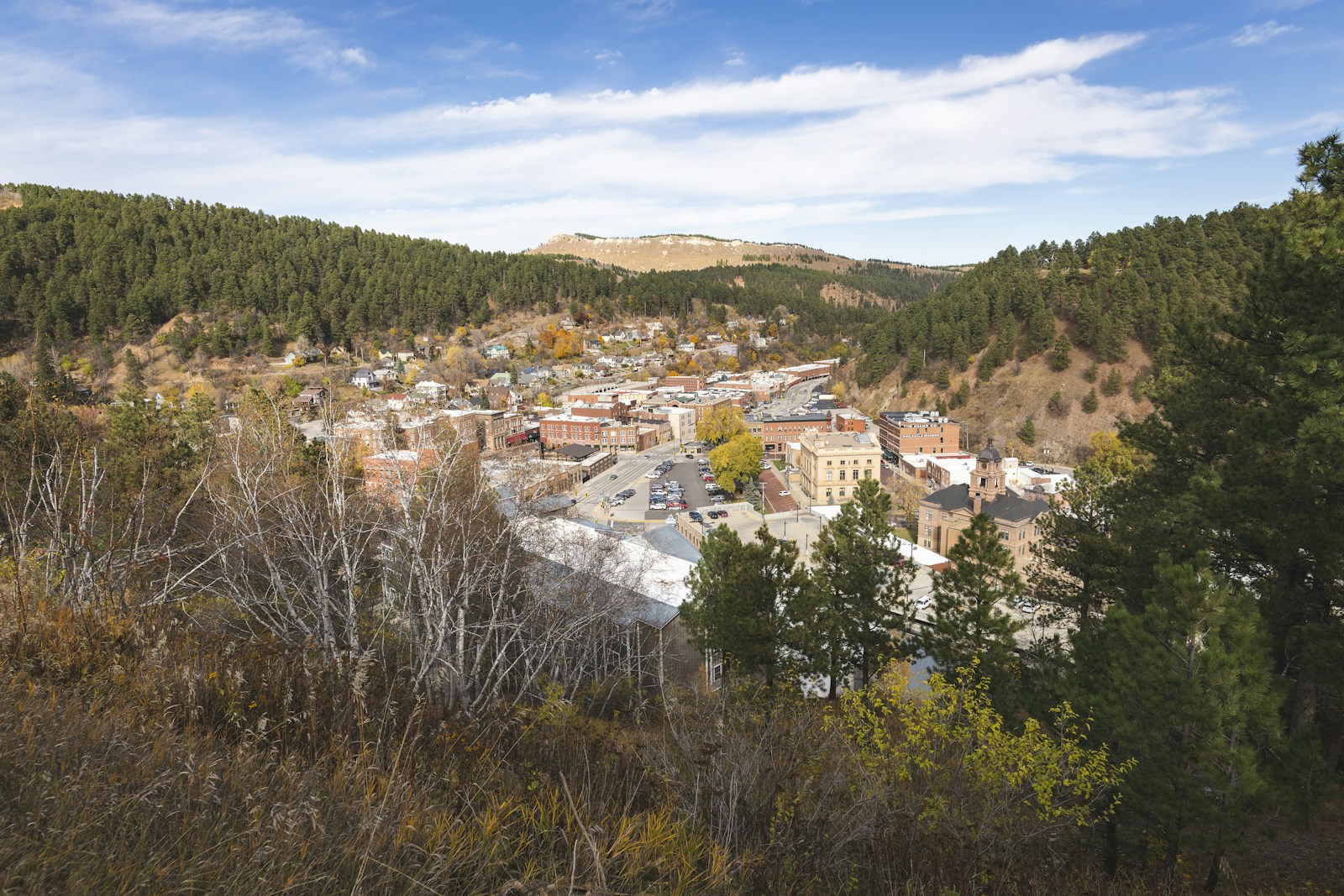
Deadwood has never had much flat ground to spare. The town fills a steep, narrow valley just below the meeting of Deadwood and Whitewood creeks, with its brick downtown on the valley floor and its houses terraced up the slopes. That steep ground has kept Deadwood from spreading much past its city limits, its landmark papers observe. Placer gold drew miners into that gulch in 1876. Fires, a great flood, a long slide as the mines closed and, from 1989, legal gaming shaped the town that stands there now, home to 1,156 people in the 2020 census.
Gold in the Gravel, Old Rock in the Walls
The gold that started Deadwood was placer gold: loose grains worn out of rock and caught in creek gravel, where a pan or a sluice could wash them free. Prospectors staked claims in the gulch in November 1875. A 1976 state marker near Central City, about 2 miles up the gulch, calls the narrow stretch from there down to Deadwood the richest placer ground in the Black Hills. By the fire of 1879 the placer gold was giving out, and hardrock mining was taking its place.
Deadwood sits where two of the rings of rock meet, the crystalline core and the layered rocks of the Limestone Plateau, in the gold country of the Northern Hills. U.S. 14A climbs to town from Sturgis through Boulder Canyon, crossing the layered rocks that wrap the Hills from younger to older, a 2010 School of Mines road log explains. The lowest of those layers is the one geologists call the Deadwood Formation, a mix of sandstone, shale and limestone with conglomerate at its base; its type locality, the exposure that defines it, is on Whitewood Creek just below town, where it is about 430 feet thick. Across Whitewood Creek, at the foot of the cliffs, the formation lies directly on metamorphic rock more than 1.8 billion years old, part of the crystalline core. Up Deadwood Creek the canyon walls are that older rock.
Younger rock cuts through it all. Magma rose into the northern Hills about 58 to 46 million years ago, and around Lead and Deadwood it pushed the ground up into a dome geologists name for the two towns. An early survey counted 22 dikes, sheets of igneous rock 10 to 100 feet thick, within one mile along Deadwood Gulch, a 1970 study for the USGS reported. Beside the road at Central City, rhyolite dikes from that time slice through the old metamorphic rock.
Gold moved at that time, too. Outside the Homestake Mine, most of South Dakota’s recorded gold through 1971 came from ore that hot fluids laid down in the Deadwood Formation during that early Tertiary igneous activity, the geologist James J. Norton wrote in a 1974 USGS review. The fluids most likely took that gold from far older Precambrian rock, nearby or far away, he added.
From Seven Camps to a Brick Town
In the spring of 1876 the Black Hills gold rush moved north from Custer and Hill City, and seven mining camps soon lined Deadwood Gulch. J. J. Williams and others laid out the Deadwood townsite in 1876, though the camps did not join as one municipality until February 1881. The town’s first years are told on Deadwood’s Wild Years, 1876 to 1879. Those camps grew on land the 1868 Fort Laramie Treaty had set apart for the tribes, and the 1877 Act took the Hills without the consent the treaty required (see The 1876 War and the Taking of the Hills).
Fire destroyed the downtown business district on September 26, 1879. Merchants rebuilt at once, much of it in brick and stone, and most of the old business blocks went up between that fire and the panic of 1893. A second mining boom, driven by new ways of treating low-grade ore, kept builders busy past 1900, and most of the town seen today was up by 1914, the 1989 amendment to the landmark nomination says.
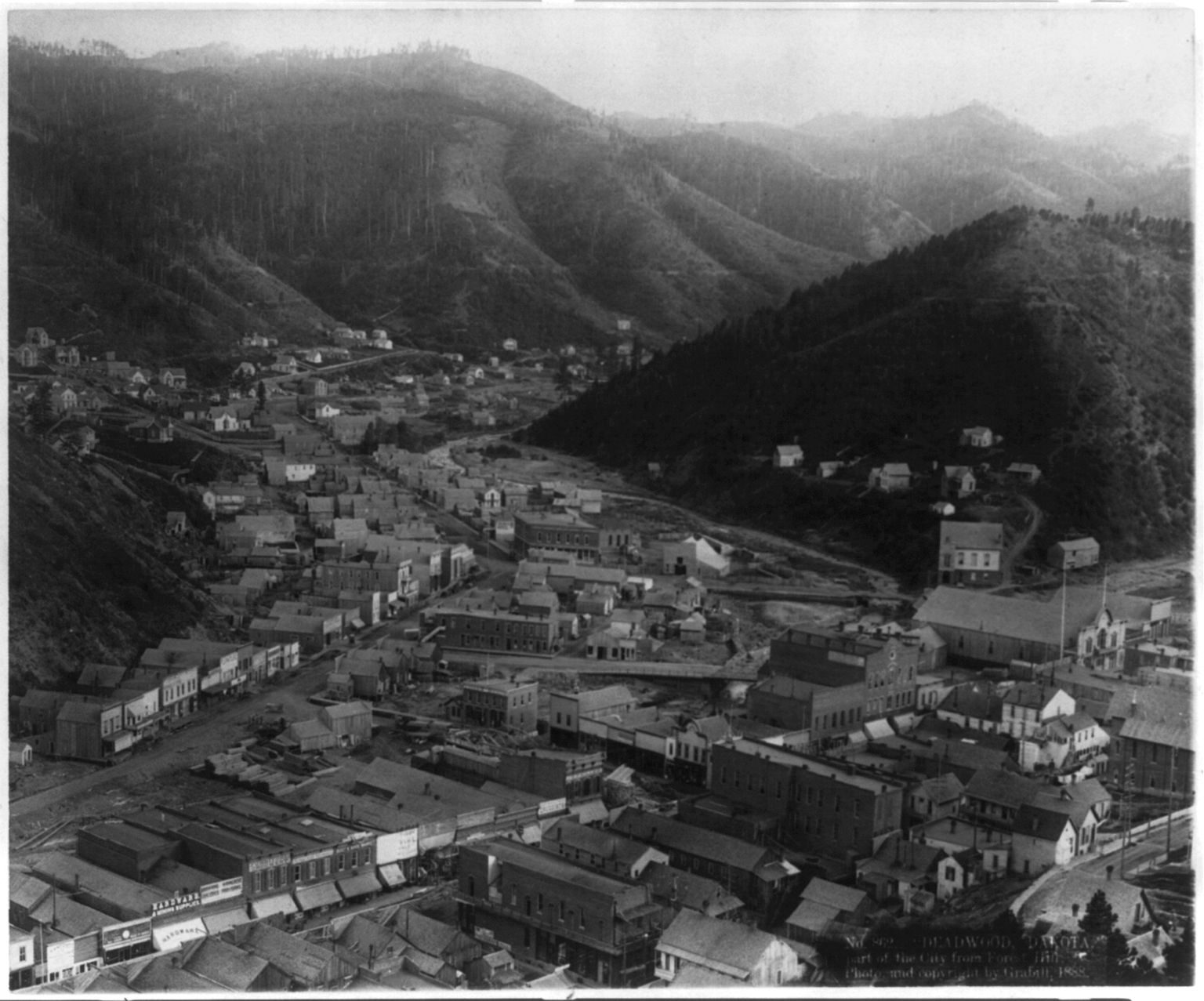
In May 1883 a flood fed by spring snowstorms swept through the gulch. The city’s timeline says the water carried off most of the town; the landmark nomination counts 150 buildings destroyed and three lives lost. Writing in 1972, the historian Kenneth Stewart cited a mining man of the time who judged that the flood ended placer mining at Central City, up the gulch, years early. On March 5, 1894, fire struck again and destroyed the Badlands, as the lower end of Main Street’s business district was called.
Most of the district’s mills and company towns lay outside Deadwood, which lived by serving them with hotels, saloons, stores and law offices, by the account of the 1989 amendment. By 1976, the original nomination noted, the town drew its share of mining wealth from the Homestake at Lead, about 3 miles away.
Two Graves on Mount Moriah
Lawrence County bought 4.6 acres for Mount Moriah Cemetery in the spring of 1878. Its best-known graves lie side by side. James Butler “Wild Bill” Hickok, shot by Jack McCall during a card game in the No. 10 Saloon on August 2, 1876, was moved there in August 1879, and Calamity Jane, born Martha Canary, was buried beside him after her death on August 1, 1903.
Both graves carry more legend than record. The tale that Hickok died holding aces and eights, the “dead man’s hand,” did not reach print until a 1926 biography, a True West column notes, and in South Dakota History in 1994 the historian James D. McLaird showed that Calamity Jane’s stories of Army scouting, carrying the mail and rescuing a stagecoach did not hold up. Their Deadwood years are told on Deadwood’s Wild Years.
Why Did Deadwood Turn to Gaming?
Deadwood turned to gaming to pay for saving its historic buildings when the town was short of money and its downtown was decaying. The slide had been long. As the district’s mines shut, most of them by the 1940s, visitors arriving by train and then by car became the town’s main trade, the Society of Architectural Historians’ guide says. Gambling was officially ended in 1947. The Deadwood fire of 1959 burned 4,550 acres, by the Forest Service’s count, and threatened the town; the architectural guide dates years of hard times from it. The Interior Department named Deadwood a National Historic Landmark in 1961.
In the mid-1980s the old commercial blocks were in poor shape, with storefronts boarded and facades decaying, South Dakota News Watch reported in 2019, and Tom Blair, the town’s mayor from 1984 to 1989, told the news service, “We were hurting for money and we were going downhill fast.” After fire destroyed three Main Street buildings on December 15, 1987, a loss the city’s timeline calls the rallying cry for legal gaming, state voters approved gaming for Deadwood in November 1988, the town’s voters followed in April 1989, and limited-stakes gaming opened on November 1, 1989. The state constitution sends the city’s net proceeds to the historic restoration and preservation of Deadwood; what that money has paid for, and what the town gave up, is taken up on How Gambling Saved Old Deadwood.
Deadwood Now, and the Towns Around It
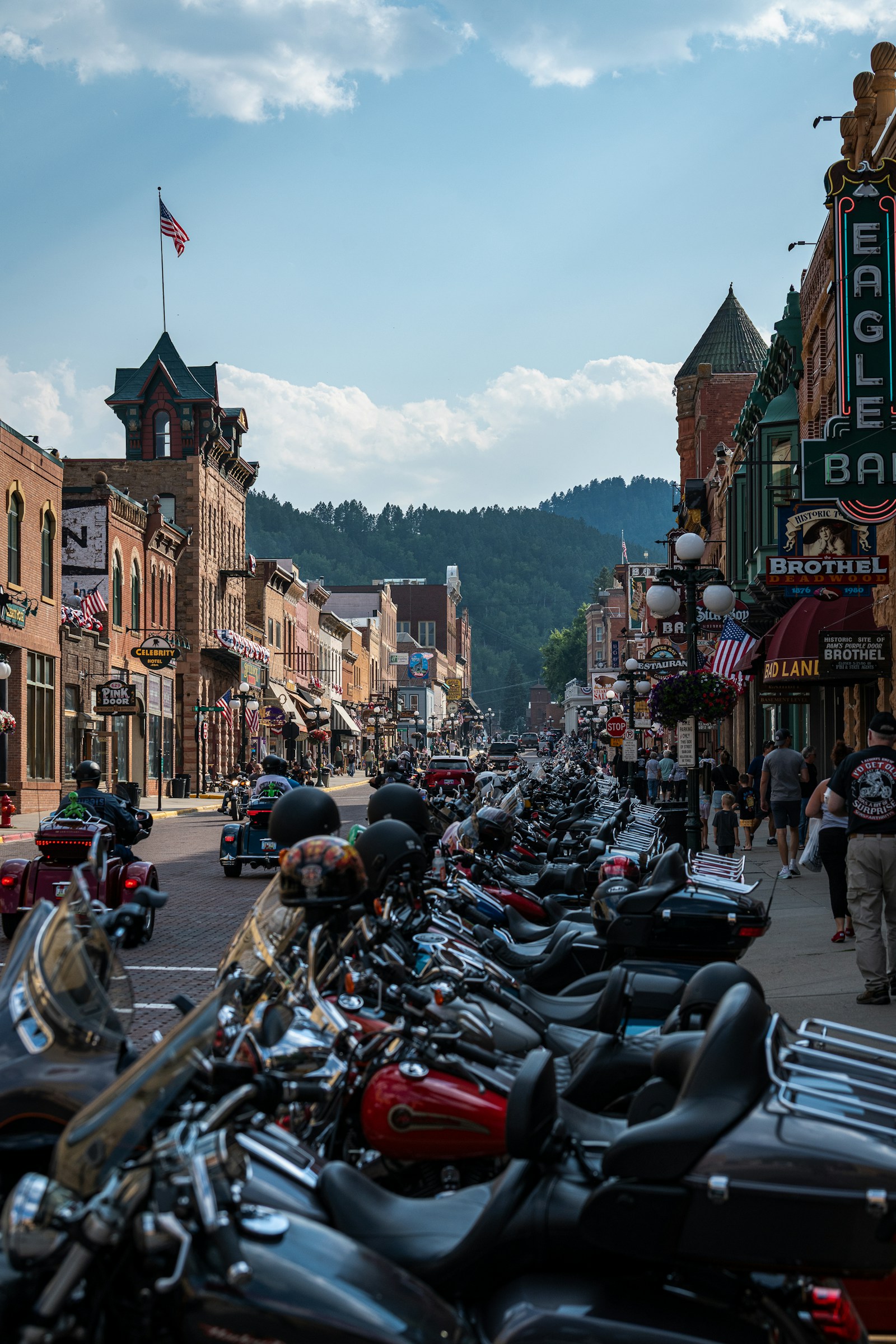
Gaming and tourism carry Deadwood now, and many of the people who work there live elsewhere: in 2019 Blair told News Watch that the town still relied on workers from Lead, Spearfish, Sturgis and Rapid City. Hundreds of jobs in the area went when the Homestake Mine closed, after its last ore came out on December 14, 2001, and News Watch linked the region’s loss of people to that closing. Wildfire came back from June 29 to July 8, 2002, when the Grizzly Gulch fire threatened the town and burned more than 11,000 acres.
Lead, which had 2,982 people in 2020, grew up over the Homestake, and the mine’s old tunnels now hold the Sanford Underground Research Facility (SURF). Up Deadwood Gulch lies Central City, which a public meeting organized as a town on January 20, 1877; by that summer about 3,000 people lived in and around it, Stewart wrote. About 5 miles southeast of Deadwood, in the canyon of Bear Butte Creek, lies Galena, a silver and lead camp whose mines had their best years from 1881 to 1883.
Deadwood is also the north end of the George S. Mickelson Trail, which runs 109 miles south to Edgemont on a former rail line and was completed in September 1998. Its longest climb starts here, out of the gulch toward Dumont.
Connected
- The Northern HillsThe gold country, canyons and plains around Deadwood.
- Gold and the Other MineralsPlacer gold, lode gold and the gold in the Deadwood Formation.
- Deadwood’s Wild Years, 1876 to 1879Hickok, Calamity Jane, Bullock and Chinatown, through the 1879 fire.
- The Black Hills Gold RushThe rush of 1874 to 1877 that filled the gulch.
- How Gambling Saved Old DeadwoodHow gaming money pays to keep the old town standing.
- Galena, South DakotaThe silver and lead camp on Bear Butte Creek, southeast of town.
- The George S. Mickelson TrailThe 109-mile trail that ends in Deadwood.
- Lead, South DakotaThe Homestake town, about 3 miles away.
Sources
- Deadwood Historic District, National Historic Landmark nomination. National Park Service, 1976, amended 1989.
- Timeline of Deadwood, South Dakota. City of Deadwood.
- A National Historic Landmark. City of Deadwood.
- Deadwood. SAH Archipedia, Society of Architectural Historians.
- South Dakota Constitution, Article III, Section 25. South Dakota Legislature.
- In 30 Years, Gaming Has Revitalized and Challenged Deadwood, by Tom Griffith. South Dakota News Watch, 2019.
- Black Hills National Forest Large Fire History, 1910–2024. USDA Forest Service, 2025.
- Gold in the Black Hills, South Dakota, and How New Deposits Might Be Found (Circular 699), by James J. Norton. U.S. Geological Survey, 1974.
- Ore Deposits in Rocks of Paleozoic and Tertiary Age of the Northern Black Hills, South Dakota, by Lewis H. Shapiro and John Paul Gries. U.S. Geological Survey Open-File Report, 1970.
- Geology of Area of the Homestake Gold Mine in Lead, South Dakota: Road Log, Field Trip 1, by Michael P. Terry and Colin J. Paterson, in Geologic Field Trips in the Black Hills Region, South Dakota (Bulletin 21). South Dakota School of Mines and Technology, 2010.
- Geolex: Deadwood Formation. U.S. Geological Survey, National Geologic Map Database.
- Second Deadwood Gold Discovery (marker 470). Lawrence County Historical Society, South Dakota Department of Transportation and South Dakota State Historical Society, 1976; transcribed by the Historical Marker Database.
- The Boom and Bust of Central City, by Kenneth Stewart. South Dakota History 2, no. 3, 1972; republished by South Dakota Public Broadcasting, 2023.
- Calamity Jane: The Life and the Legend, by James D. McLaird. South Dakota History 24, no. 1, 1994; republished by South Dakota Public Broadcasting, 2023.
- Did Wild Bill Hickok Really Have the Dead Man’s Hand of Aces and Eights When He Was Killed?, by Marshall Trimble. True West, 2015.
- Treaty of Fort Laramie (1868), transcript. National Archives.
- George S. Mickelson Trail. South Dakota Game, Fish and Parks.
Last reviewed: