Towns
Hot Springs, South Dakota
The House Veterans' Affairs Committee held a field hearing on rural veterans' care in Hot Springs on August 14, 2014, and Bryan Brewer, then president of the Oglala Sioux Tribe, was among the witnesses. He told the committee the area matters to Lakota culture for healing and for gathering traditional herbs and medicines, and said he spoke for the Rosebud and Cheyenne River tribes too. Warm springs explain most of Hot Springs, a town of 3,395 people in the 2020 census: the tribes who came to bathe, an 1880s spa, a veterans' sanitarium, and a far older spring-fed sinkhole that trapped mammoths.
Where Does the Warm Water Come From?
Most of the water comes from the Madison aquifer, held in the fractured top of the Madison Limestone, the rock that also holds Wind Cave. Rain, snowmelt and whole creeks sink into that limestone on the plateau ring of the Hills, travel outward and down beneath tighter layers that hold the water under pressure, and rise again at artesian springs around the edge (see The Limestone Plateau and the Caves). At Hot Springs, a 2002 U.S. Geological Survey study found, it climbs through the Minnelusa Formation and picks up some of that rock's minerals.
In a report dated April 1903, USGS geologists N.H. Darton and W.S. Tangier Smith put the springs of Hot Brook Canyon, just west of town, at 92 degrees, with plenty of water coming up through cracks in the limestone. The town lies in the Red Valley, a lowland worn into soft red beds and the third of the four rings described in How the Black Hills Formed. East of town rises the Hogback, the sandstone ridge of the outermost ring.
The springflow gathers in the Fall River, which the 2002 study found is almost entirely spring water. Its gauge at Hot Springs averaged about 24 cubic feet per second over most years from 1939 to 1998, and because nearly all of it is spring discharge, the flow barely changes month to month. Downtown, a visitor sees a small, steady river fed from below.
Lakota Healing Water and the Battle Mountain Story
The springs drew tribes long before the town. The Lakota and Cheyenne valued the healing power of the area's warm water "for centuries or longer," SDPB's 2015 history of the town's bathhouses says, and an 1879 expedition found lodge poles and tipi rings nearby. Settlers began taking up land around 1880, after the 1877 Act took the Hills without the consent the 1868 treaty required (The 1876 War and the Taking of the Hills). Lakota people kept coming. The town's first residents told of Lakota bathers camped along the river, and a Park Service study quoted by SDPB says Lakota went on traveling to the warm water at Hot Springs and Cascade Springs.
A popular story tells of a war over the springs. A state marker at Battle Mountain Avenue and Sherman Street, put up in 1990 by the city and two state agencies, says the Cheyenne held the springs until a "fierce conflict in about 1869" gave them to the Lakota. In the version SDPB calls popular history, the fight named Battle Mountain and closed in a truce. The marker credits tradition; neither it nor SDPB names a source, nor does a 1993 National Register document that mentions skirmishes for the springs. A 2015 Native Sun News column by James Giago Davies called it a battle that "never took place," also without evidence.
Early spa promoters told of an old woman whose aching legs were healed when she toppled into a pool, and credited the tale to tribal oral tradition; SDPB's history calls that credit unverifiable. The full thread is on Warm Water: The Springs, the Town and the Sanitarium.
A Spa Town Built From the Hogback
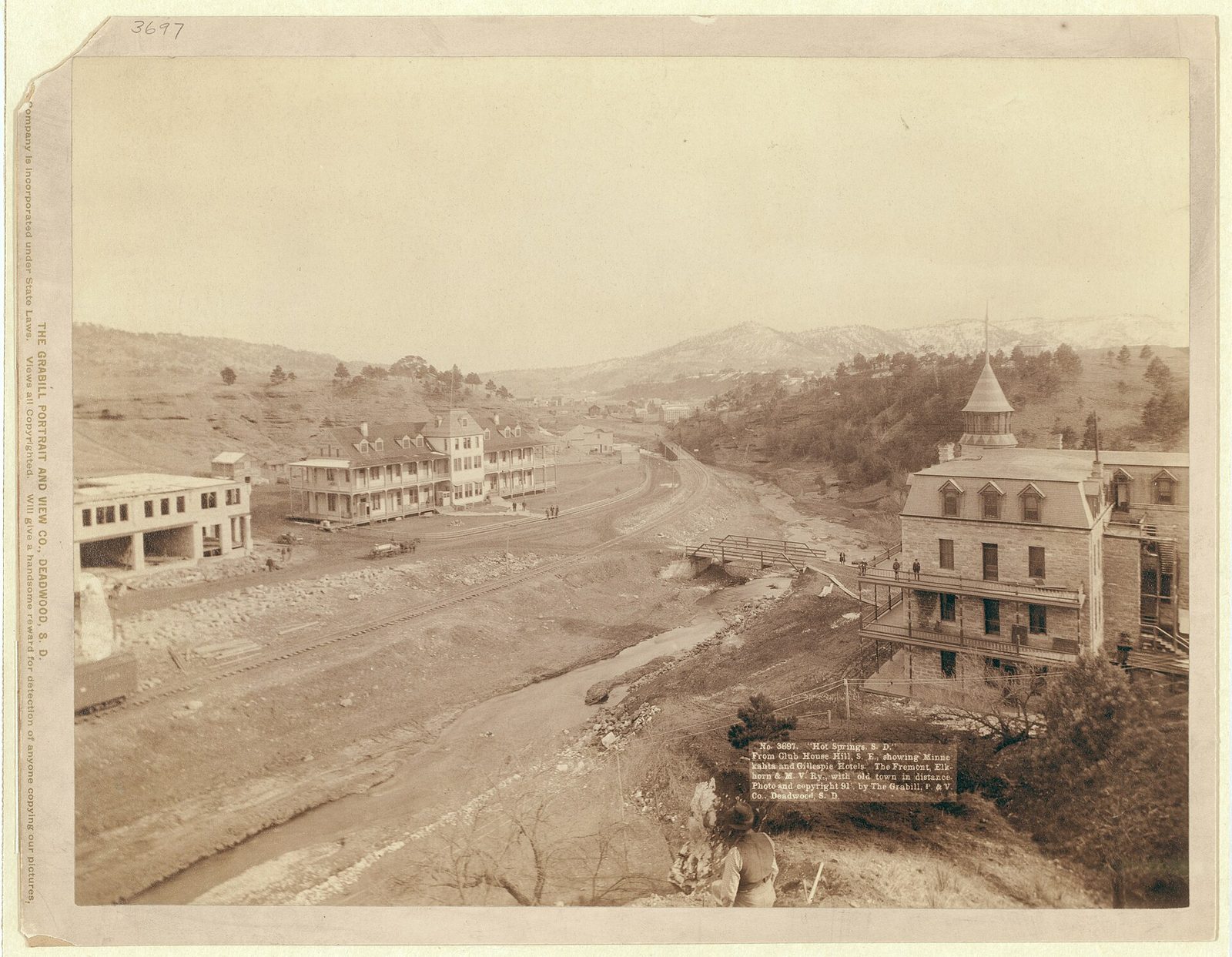
Hot Springs began as a plan to sell that water. In 1881 and 1882, the 1993 National Register document says, Fred T. Evans and two doctors bought out the first settlers at the springs to build a resort for invalids. An architectural history has Evans heading the reorganized town-site company from 1886. The railroad arrived in 1890, the year the town incorporated, and bathhouses were already open. By 1900, the Park Service says, health seekers were coming from across the region. The cures were the promoters' claim; the USGS record of the springs is temperature, volume and dissolved minerals.
After an earlier hotel burned in 1891, Evans put up the Evans Hotel in 10 months. The same history says its stone, pink sandstone of the Lakota Formation, came from the Fred Evans Quarry close by. A 1967 USGS survey by Don Wolcott found that most of the town's building stone came from the Fall River Formation, a light-brown sandstone, and some from the Unkpapa Sandstone, bright reddish brown to pink and violet. Both crop out in the Hogback east of town, and the Lakota and Fall River formations belong to the Inyan Kara Group, the rock of that outer ring. A town in the Red Valley was built from the ridge beside it. The Hot Springs Historic District, on the National Register since 1974, takes in roughly both sides of River Street, the city says.
Battle Mountain Sanitarium and the VA
Veterans came early. Local backers built a State Soldiers' Home, and starting in 1890, the Department of Veterans Affairs says, veterans joined politicians in a campaign to bring a national home to the town. Congress authorized one in 1902, and Battle Mountain Sanitarium took its first patient, a Civil War veteran from the national home at Marion, Indiana, in March 1907.
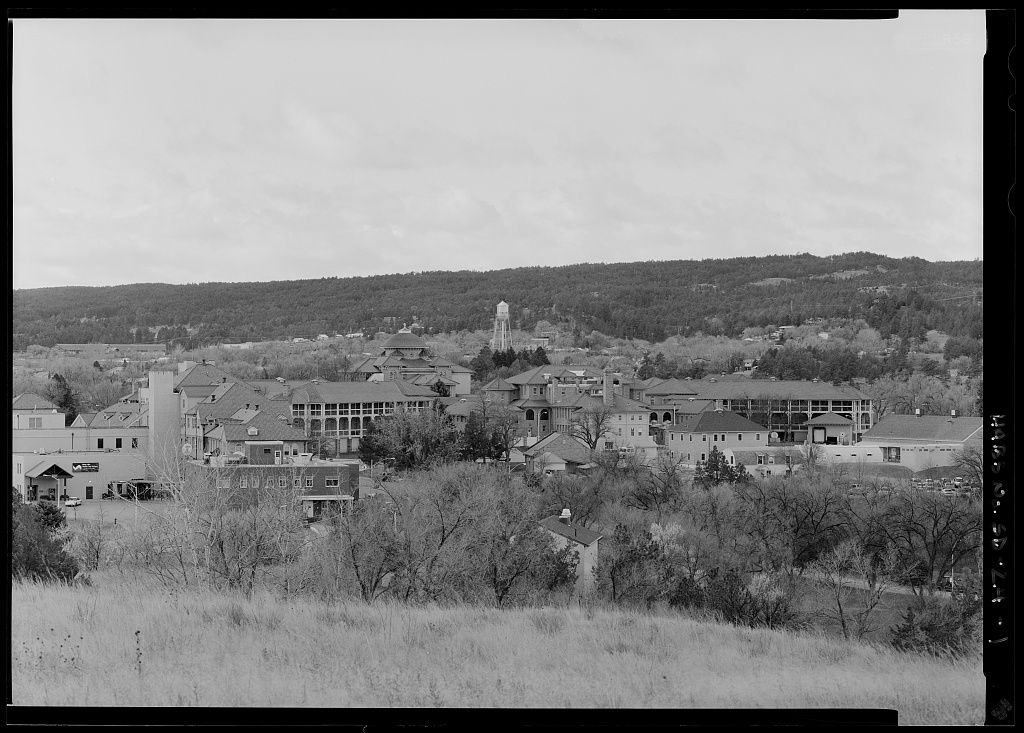
It belonged to the National Home for Disabled Volunteer Soldiers, the federal system for Union veterans, and the Park Service calls it the first and only branch built solely as a short-term sanitarium. It took veterans with lung and breathing problems, and by World War I tuberculosis care had become its main work. On a bluff above town, the Omaha architect Thomas Rogers Kimball set its pink sandstone wards around a circular courtyard like spokes. The sanitarium became a National Historic Landmark in 2011, and the city's own description goes further, calling it the oldest VA facility built solely for medical care.
The grounds are now the Hot Springs campus of the VA Black Hills Health Care System. In 2011 the VA proposed closing the medical center and opening an outpatient clinic in town instead. Residents feared for the "vitality and viability" of Hot Springs, the Park Service reported in 2014, while the VA's review was still under way. Brewer testified during that dispute, and he credited the Hot Springs VA with supporting traditional Lakota practices. In January 2017 the VA chose its plan: an outpatient clinic in one renovated building at Hot Springs and a residential treatment program in Rapid City. As of August 2023, South Dakota Searchlight reported, the Hot Springs hospital still offered inpatient care; senators had stalled a 2022 VA proposal to move it to Rapid City. In May 2026 the VA listed new maintenance projects for the campus, and that August a deputy VA secretary, Paul Lawrence, said there were no plans to close local facilities or reduce services, KOTA reported.
The Mammoth Site and the Country Around Hot Springs
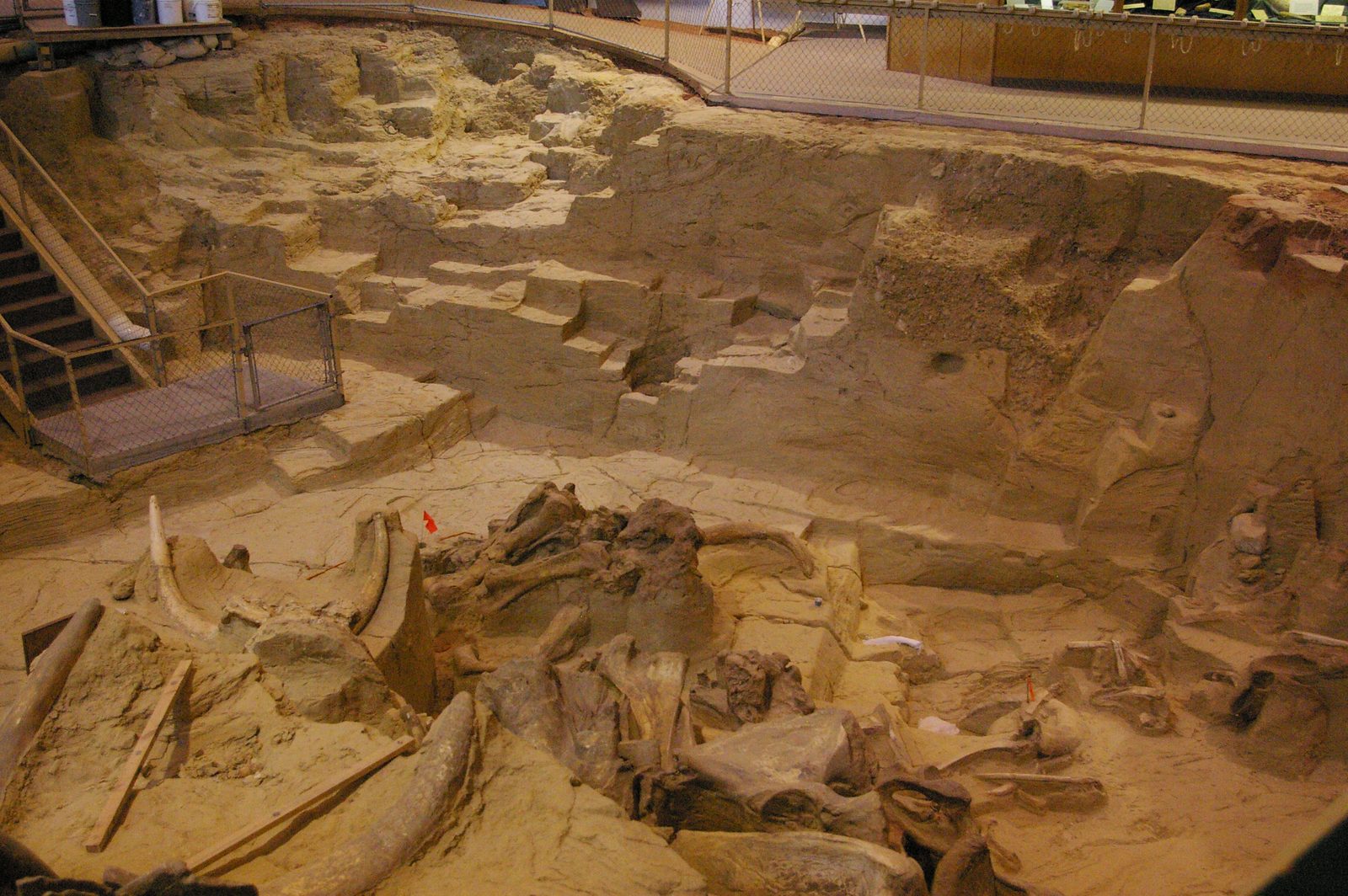
The warm water made a trap long before it made a town. Mammoths that entered a spring-fed pond in a sinkhole never got out, and more than 60 of them, most of them Columbian mammoths, have been found there. Luminescence work published in August 2026, led by Shannon Mahan of the USGS and Jim Mead of the Mammoth Site, places the bone bed between about 160,000 and 230,000 years old, roughly 200,000 years, replacing far younger radiocarbon ages (see Fossils and the Mammoth Site). George Hanson's blade uncovered a tusk there in June 1974, while he leveled ground for houses. The nonprofit Mammoth Site keeps an active dig under a roof over part of the sinkhole and calls itself "the world's largest mammoth research facility," a title of its own choosing.
The visitor center of Wind Cave National Park lies 11 miles north of town, off US 385. About 10 miles southeast lies Angostura Reservoir, made in 1949 when the Bureau of Reclamation dammed the Cheyenne River to water farms; the state's recreation area there follows 36 miles of shore (Lakes of the Black Hills). Around Hot Springs lie smaller towns of the Southern Hills: Buffalo Gap, which began as a station on the gold-rush stage road; Pringle, once called Point of Rocks; and Edgemont, begun in 1890 around a railroad terminal. In the same 2014 testimony, Brewer called Wind Cave "a sacred site to us Lakota." The Lakota emergence story tied to the cave belongs to Sacred Sites: Bear Butte, Devils Tower and Wind Cave.
Connected
- The Southern HillsThe warmer, drier end of the Hills, from Custer to Edgemont.
- The Limestone Plateau and the CavesThe Madison aquifer that feeds the town's springs.
- Fossils and the Mammoth SiteThe sinkhole's mammoths and the 2026 re-dating, told in full.
- Warm Water: The Springs, the Town and the SanitariumThe thread from tribal use of the springs to the spa and the veterans' hospital.
- Wind Cave National ParkThe cave and prairie park whose visitor center is 11 miles north.
- The Red ValleyThe ring of soft red beds the town sits in.
- How the Black Hills FormedThe four rings, including the Hogback that gave the town its building stone.
- Lakes of the Black HillsAngostura Reservoir, southeast of town on the Cheyenne River.
Sources
- Challenges in Rural America: Infrastructure Needs and Access to Care (field hearing, Hot Springs, August 14, 2014; testimony of Bryan Brewer, President, Oglala Sioux Tribe). U.S. House Committee on Veterans' Affairs, 2014.
- Hydrology of the Black Hills Area, South Dakota (Water-Resources Investigations Report 02-4094), by Daniel G. Driscoll, Janet M. Carter, Joyce E. Williamson and Larry D. Putnam. U.S. Geological Survey, 2002.
- Description of the Edgemont Quadrangle (Geologic Atlas Folio 108), by N.H. Darton and W.S. Tangier Smith. U.S. Geological Survey, 1904 (text dated April 1903).
- Geology of the Hot Springs Quadrangle, Fall River and Custer Counties, South Dakota (Bulletin 1063-K), by Don E. Wolcott. U.S. Geological Survey, 1967.
- History of the Hot Springs Bath Houses and Holistic Health Retreats, by Michael Zimny. South Dakota Public Broadcasting, 2015.
- Battle Mountain (state historical marker 509). City of Hot Springs, South Dakota State Historical Society and South Dakota Department of Transportation, 1990; transcribed by the Historical Marker Database.
- James Giago Davies: Border town shuns anything remotely Indian. Native Sun News, republished by Indianz, 2015.
- Wind Cave National Park Multiple Property Submission (National Register of Historic Places documentation), by Kenneth W. Karsmizki. National Park Service, 1993.
- Evans Hotel. SAH Archipedia, Society of Architectural Historians.
- VA Black Hills Health Care System, Hot Springs Campus, by Michelle L. Dennis. SAH Archipedia, Society of Architectural Historians.
- Battle Mountain Sanitarium, Hot Springs, South Dakota. National Park Service, 2024.
- Battle Mountain Sanitarium Faces Uncertain Future, by Dena Sanford. National Park Service, 2014 (page updated 2025).
- Secretary Salazar Designates 14 New National Historic Landmarks. U.S. Department of the Interior, 2011.
- Hot Springs National Cemetery (interpretive sign). U.S. Department of Veterans Affairs, National Cemetery Administration.
- Notice of Availability of a Record of Decision for the Reconfiguration of VA Black Hills Health Care System. U.S. Department of Veterans Affairs, Federal Register, 2017.
- With Reorganization Plans Squashed for Now, VA Celebrates New Rapid City Clinic, by Seth Tupper. South Dakota Searchlight, republished by Dakota News Now, 2023.
- Historic Preservation. City of Hot Springs.
- History. The Mammoth Site of Hot Springs.
- New Research Re-Dates The Mammoth Site. The Mammoth Site of Hot Springs, 2026.
- Age Reassignment Using Luminescence Dating for the Mammoth Site, Black Hills, South Dakota, USA, by Shannon A. Mahan, Jim Mead, Paul Hanson, Emma T. Krolczyk and Christopher Jass. Quaternary Research, 2026 (U.S. Geological Survey record).
- Directions. National Park Service, Wind Cave National Park.
- Angostura Recreation Area. South Dakota Game, Fish and Parks.
- Non-recurring Maintenance Projects (news release). VA Black Hills Health Care System, 2026.
- VA Official Says Care Expanding in Black Hills, New Health Records System Coming in 2027. News Radio KOTA, 2026.
Last reviewed: