Connections
Warm Water: The Springs, the Town and the Sanitarium
In April 1895 a Buffalo, New York, physician, J. W. Grosvenor, described Hot Springs, South Dakota, for his city's medical journal. The soldiers' home at Leavenworth, Kansas, had sent about 70 Civil War veterans to the springs, he wrote, and all but two came away cured; those two were much improved. The count and the cures were his claims, but they show what the town had chosen to be. Warm springs are why Hot Springs exists, and the same water ties together a healing place for the tribes, an 1880s resort for invalids, a veterans' sanitarium, and a VA hospital whose future has been fought over since 2011.
Why Does the Water Come Up Warm?
It has most likely been deep underground, where rock is warmer. Rain and snowmelt soak into the Madison Limestone where it lies bare on the high ring of the Hills, then flow down the tilted beds toward the plains, confined under less porous rock (see The Limestone Plateau and the Caves). Most of what rises at Hot Springs is Madison water, a USGS study of 2002 found, and on the way up it carries off minerals dissolved from the Minnelusa Formation.
In Madison wells the water typically warms 2°F for every 100 feet of depth, and more than twice as fast in parts of the west central and southwest, a 1997 review of South Dakota's geothermal resources reported; it put Madison water at about 86°F to 216°F. A 2018 bachelor's thesis at Gustavus Adolphus College pictured the springs as water that flows up from deep in the rock and brings its heat along. Unlike the USGS, it judged the town's central and northern springs likely to come from the Minnelusa or the Minnekahta, layers above the Madison, but could not settle it. None of these studies gives a depth.
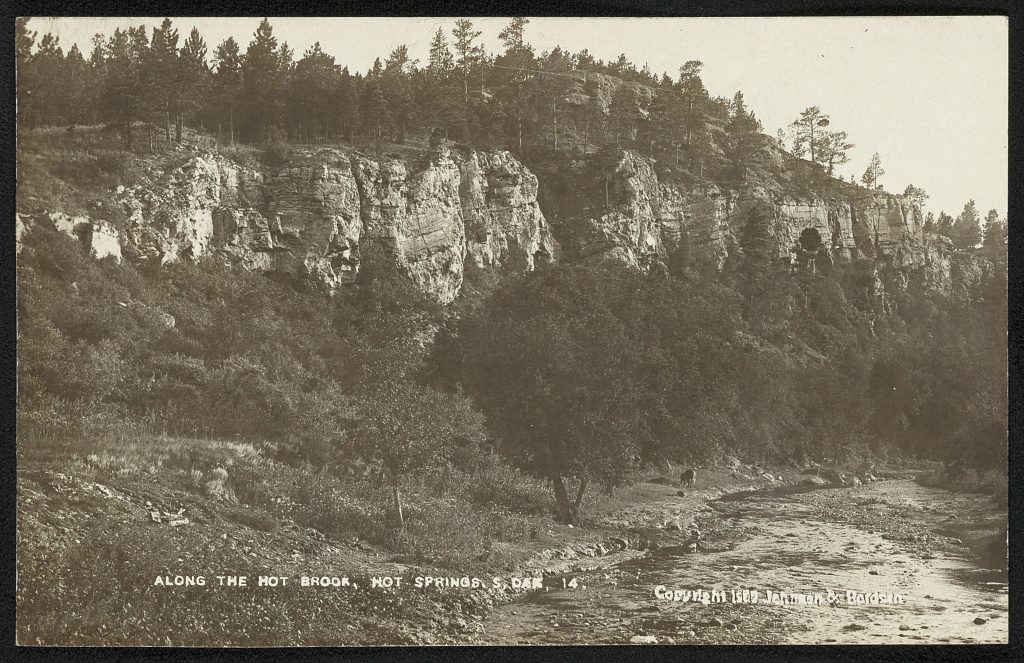
Readings from three eras, not all at the same springs, fall within about 4°F of one another. Grosvenor gave 94 to 96°F in 1895. In a USGS report dated April 1903, N.H. Darton and W.S. Tangier Smith gave 92 degrees for the springs in Hot Brook Canyon, a short way west of town, and the warmest spring sampled for the 2018 thesis read 33.2°C, about 92°F. Far earlier, warm spring water filled a sinkhole in what is now the town and trapped more than 60 mammoths (Fossils and the Mammoth Site).
A Healing Place Before the Town
The tribes knew the springs first. On August 14, 2014, Bryan Brewer, president of the Oglala Sioux Tribe at the time and speaking also for the Rosebud and Cheyenne River tribes, told the House Veterans' Affairs Committee, meeting in Hot Springs, that Lakota ancestors had been making their way to the area for thousands of years. In Lakota culture, he said, the area is valued for healing, and some traditional herbs and medicines are gathered there. He spoke of the area, not the springs by name; outside accounts tie the old use to the springs.
SDPB's 2015 history says the Lakota and Cheyenne have trusted the warm water to heal "for centuries or longer," and it credits a Park Service study with reporting lodge poles and tipi rings near the springs when Walter Jenney's party came through in 1879. A 1993 National Register document says the tribes sought the springs for their power to restore health. A 2003 study written for the National Park Service by a University of Minnesota team found that the Cheyenne and Lakota used the springs widely and camped near them, though it judged the springs' spiritual meaning not well documented before World War II; it also cites a report of Cheyenne people from Montana visiting one of their sacred springs near the town in 1940. The springs were in settlers' hands by 1881, after the 1877 Act took the Hills without the consent the 1868 treaty required (The 1876 War and the Taking of the Hills). Lakota bathers went on returning, SDPB says, quoting the Park Service.
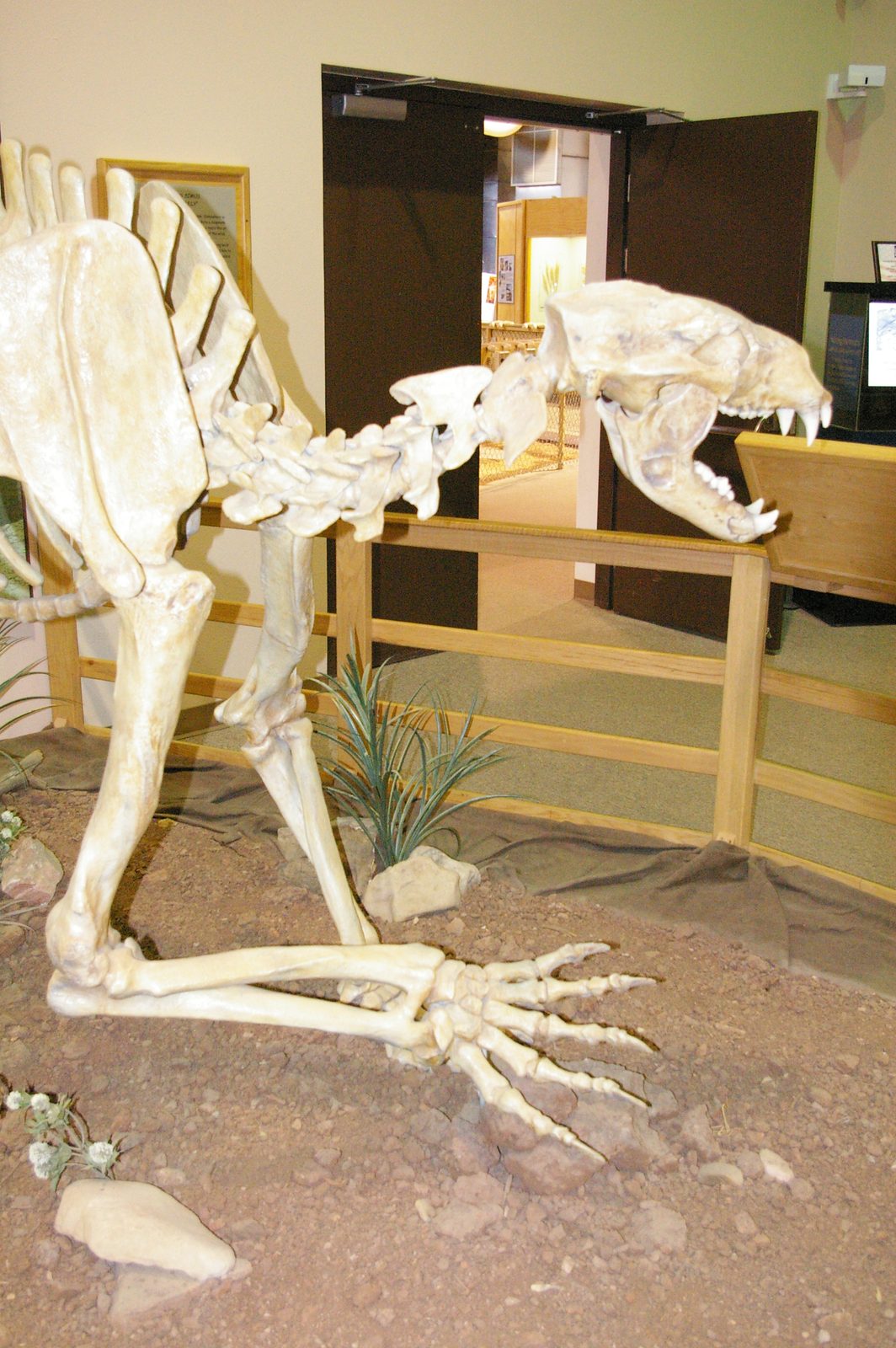
By the popular history SDPB recounts, Battle Mountain, above the town, is named for an 1869 skirmish between the Lakota and the Cheyenne over the springs that ended in a truce. The 1993 document mentions skirmishes over the springs but gives no source, and James Giago Davies, writing in Native Sun News in 2015, said no such battle was fought. None of the three offers evidence. The Park Service's 2003 study found no trace of the battle in either tribe's oral traditions or winter counts.
From a Resort to a Sanitarium
Hot Springs was planned around a cure. Fred T. Evans and two physicians, A. S. Stewart and R. D. Jennings, acquired the ground at the springs from its first claimants in 1881 and 1882, the National Register document says, and planned a resort, starting with a hotel and hospital for invalids. Bathhouses followed, and in May 1891 Evans opened the Evans Plunge, SDPB reports.
Grosvenor passed on the tribes' long use of the springs for healing, then called their cures "more or less legendary." His own claims went further: rheumatism, in his telling, was what the springs were best known for curing, and he believed they helped the kidneys, bladder, skin and digestion. His evidence was case stories and the resident doctors' records.
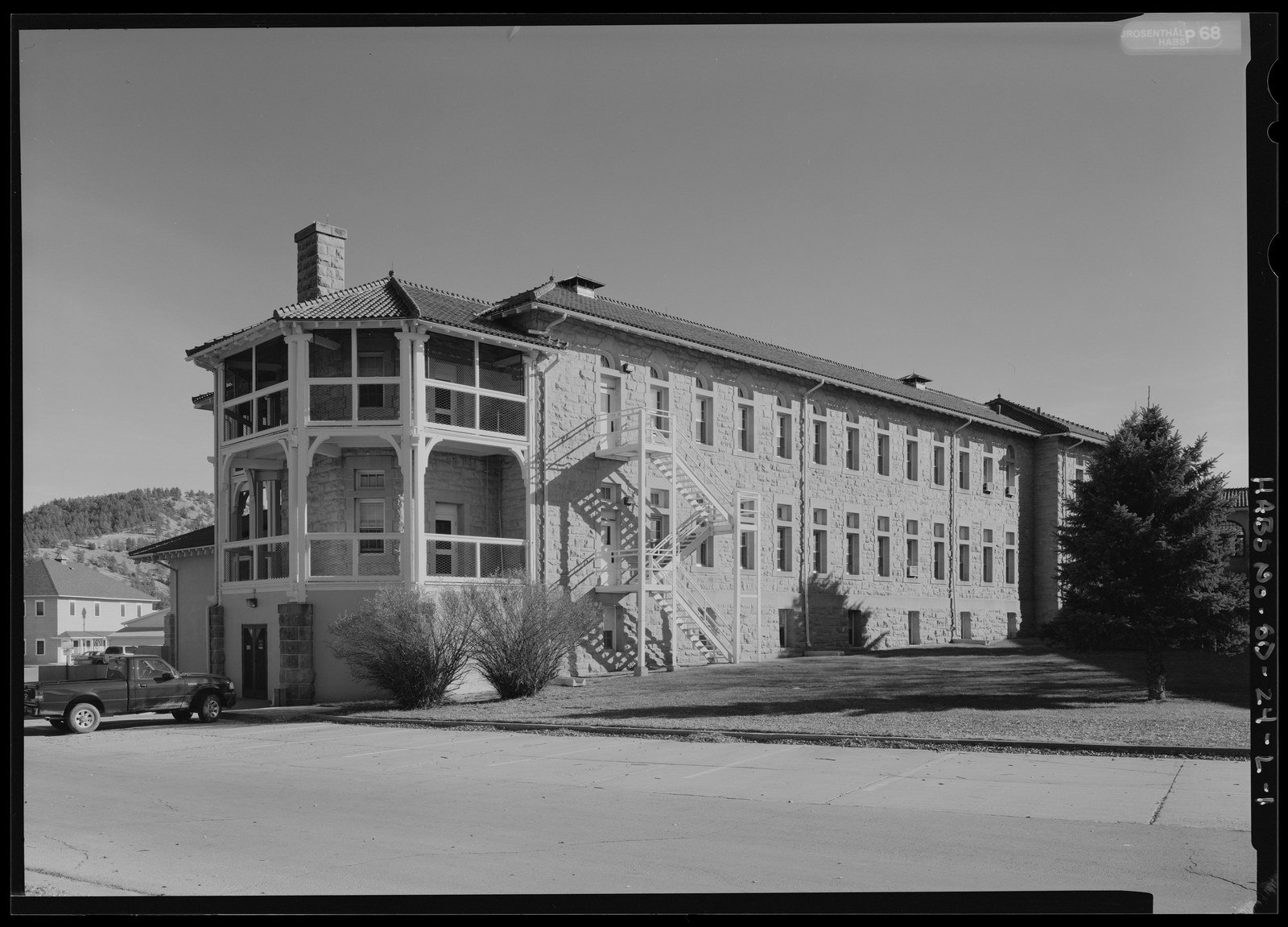
Veterans came next. Town businessmen started a State Soldiers' Home, the National Register document says, and from 1890, by the VA's account, veterans and politicians pressed for a national one. The Park Service tells of an inspector who toured the state home and was struck by "the therapeutic qualities of the water," and of 30 veterans from the national home's Western Branch who, it says, improved under the treatment there. Grosvenor's figure was about 70, and in 1895 he wrote as if a national sanitarium were already decided. Congress authorized one in 1902.
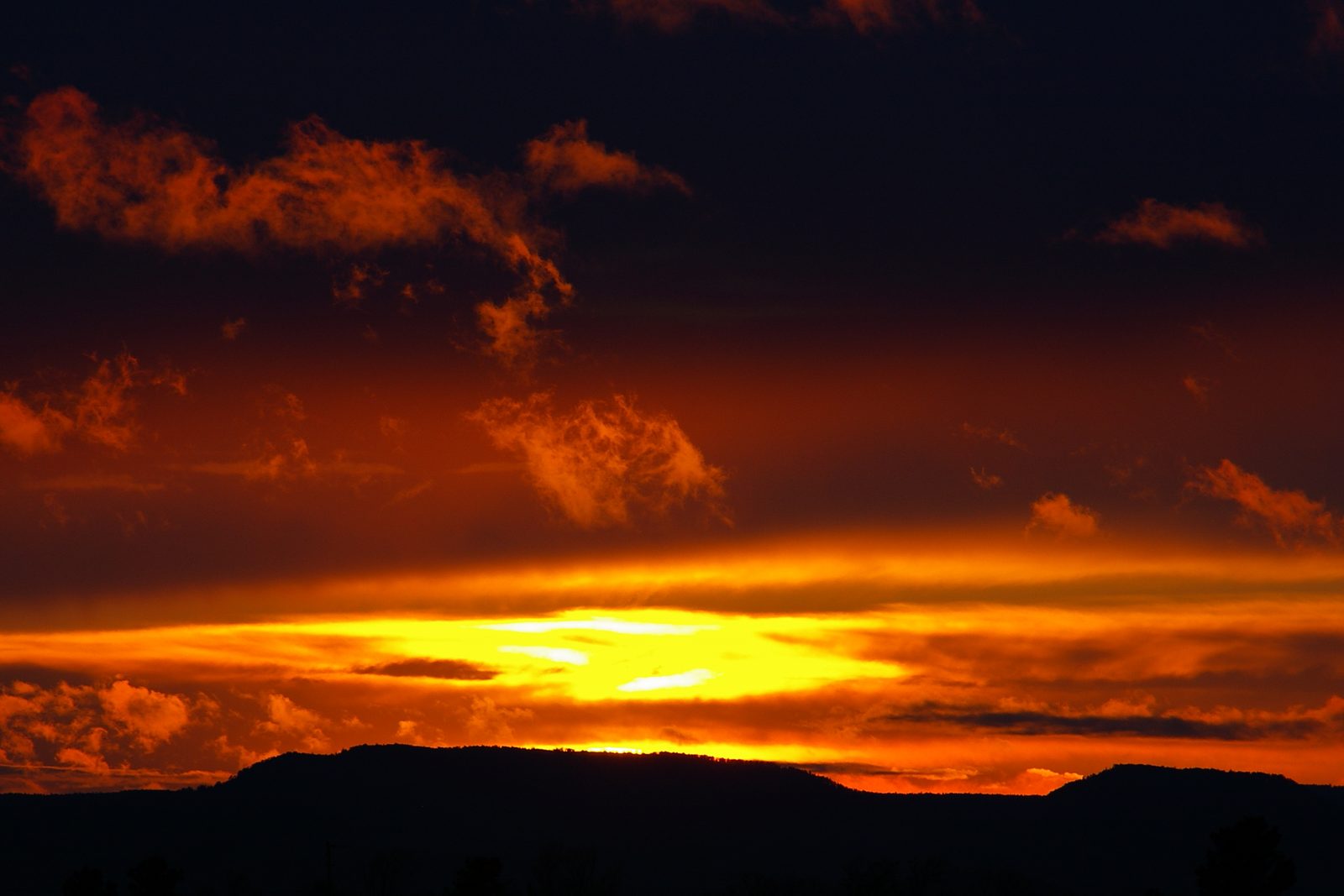
Battle Mountain Sanitarium's first patient, in March 1907, was a Civil War veteran transferred from the national home in Marion, Indiana. Its treatments used the springs. Patients soaked in the mineral water or drank it, the Park Service says, and the grounds had their own plunge bath.
The Hospital Outlasts the Water Cure
Medicine moved on from the water, and the hospital moved with it. Tuberculosis was the sanitarium's chief work by World War I, the Park Service says, and SDPB reports that it had capped its springs by 1926. In town, the geographer Martha Geores speculates in SDPB's history, trust in modern medicine wore away belief in the waters, and the 1950s polio epidemic turned many people away from the spas. Of the town's many bathhouses, only the Evans Plunge was still running by the 1970s.
The veterans' hospital kept the town's purpose, though a 2011 VA plan would have closed the medical center, the Park Service reported in 2014. Brewer, who said he had used the Hot Springs VA for more than 15 years, linked the hospital to the older meaning of the place at the hearing that year. The Lakota, he said, saw it as fitting that veterans' care was placed in an area of such beauty and healing power, and veterans had come there "for care, for healing, for camaraderie."
The VA's January 2017 decision called for an outpatient clinic at Hot Springs, dialysis included, with residential treatment in Rapid City. Inpatient care was still offered at Hot Springs in August 2023, South Dakota Searchlight reported, after senators halted the VA's 2022 recommendation to send it to Rapid City. As of March 2026, KOTA reported, dialysis at the Hot Springs VA Medical Center had been paused since October 2025, to return after repairs to the dialysis water system, expected to end in June.
The Park Service, in an April 2024 update, said most of the sanitarium's buildings still do the jobs they were built for.
Connected
- Hot Springs, South DakotaThe town the springs made, with the sanitarium, the legend and the Mammoth Site.
- The Limestone Plateau and the CavesThe Madison Limestone and the aquifer that feeds the warm springs.
- Fossils and the Mammoth SiteThe spring-fed sinkhole that trapped mammoths long before the town.
- The 1876 War and the Taking of the HillsHow the land around the springs was taken from the tribes in 1877.
- The Southern HillsThe warmer, drier end of the Hills, where the town sits.
Sources
- Challenges in Rural America: Infrastructure Needs and Access to Care (field hearing, Hot Springs, August 14, 2014; testimony of Bryan Brewer, President, Oglala Sioux Tribe). U.S. House Committee on Veterans' Affairs, 2014.
- Hydrology of the Black Hills Area, South Dakota (Water-Resources Investigations Report 02-4094), by Daniel G. Driscoll, Janet M. Carter, Joyce E. Williamson and Larry D. Putnam. U.S. Geological Survey, 2002.
- South Dakota Geothermal Resources, by John W. Lund. GHC Bulletin, Geo-Heat Center, Oregon Institute of Technology, 1997.
- A Geochemical Investigation of the Influence of the Hot Springs on the Fall River in Hot Springs, SD (bachelor's thesis), by McKenzie Perry. Gustavus Adolphus College, 2018.
- Description of the Edgemont Quadrangle (Geologic Atlas Folio 108), by N.H. Darton and W.S. Tangier Smith. U.S. Geological Survey, 1904 (text dated April 1903).
- History of the Hot Springs Bath Houses and Holistic Health Retreats, by Michael Zimny. South Dakota Public Broadcasting, 2015.
- Wind Cave National Park Multiple Property Submission (National Register of Historic Places documentation), by Kenneth W. Karsmizki. National Park Service, 1993.
- James Giago Davies: Border town shuns anything remotely Indian. Native Sun News, republished by Indianz, 2015.
- Hot Springs, South Dakota; A Health Resort, by J. W. Grosvenor. Buffalo Medical and Surgical Journal, 1895 (National Library of Medicine, PubMed Central).
- Battle Mountain Sanitarium, Hot Springs, South Dakota. National Park Service, 2024.
- Hot Springs National Cemetery (interpretive sign). U.S. Department of Veterans Affairs, National Cemetery Administration.
- Battle Mountain Sanitarium Faces Uncertain Future, by Dena Sanford. National Park Service, 2014 (page updated 2025).
- Notice of Availability of a Record of Decision for the Reconfiguration of VA Black Hills Health Care System. U.S. Department of Veterans Affairs, Federal Register, 2017.
- With Reorganization Plans Squashed for Now, VA Celebrates New Rapid City Clinic. South Dakota Searchlight, 2023.
- Dialysis Services at Hot Springs VA Medical Center Set to Return Over Summer, by Blake Troli. KOTA Territory News, 2026.
- South Dakota Leaders Raise Concerns Over Pause of Dialysis Service at Hot Springs VA Medical Center, by Blake Troli. Dakota News Now, 2026.
- The Home of the Bison: An Ethnographic and Ethnohistorical Study of Traditional Cultural Affiliations to Wind Cave National Park, Volume 1, by Patricia C. Albers and others. University of Minnesota for the National Park Service, 2003 (online edition, NPS History), pp. x, 54, 484–485.
Last reviewed: