Connections
Uranium, the Cold War and the Missiles
By the Energy Department's count, the uranium mill at Edgemont left 2 million dry short tons of tailings, the ground-up rock left over from milling, and 1.625 million of those tons are "Federal-related," the waste of uranium sold to the federal government. That share, about 81 percent, is the firmest tie between Edgemont, a railroad town at the Black Hills' southwest edge, and the Cold War that put Ellsworth Air Force Base's missiles beneath western South Dakota's plains. Followed from the uranium of Edgemont to the air base beside Box Elder and the preserved missile silo near Wall, the thread comes down to one question: whether anything joins them besides the years they shared.
Who Bought Edgemont's Uranium?
Mostly the Atomic Energy Commission (AEC), in the early atomic years the country's only buyer of uranium ore. The commission was part of the story within months of the discovery. The discovery was Jerry G. Brennan's, in June 1951: the Rapid City man turned up uranium about 8 miles north of Edgemont, in Craven Canyon. When U.S. Geological Survey geologists looked over the canyon that November, they counted at least 28 claims, and their 1952 report notes that the work was done for the AEC.
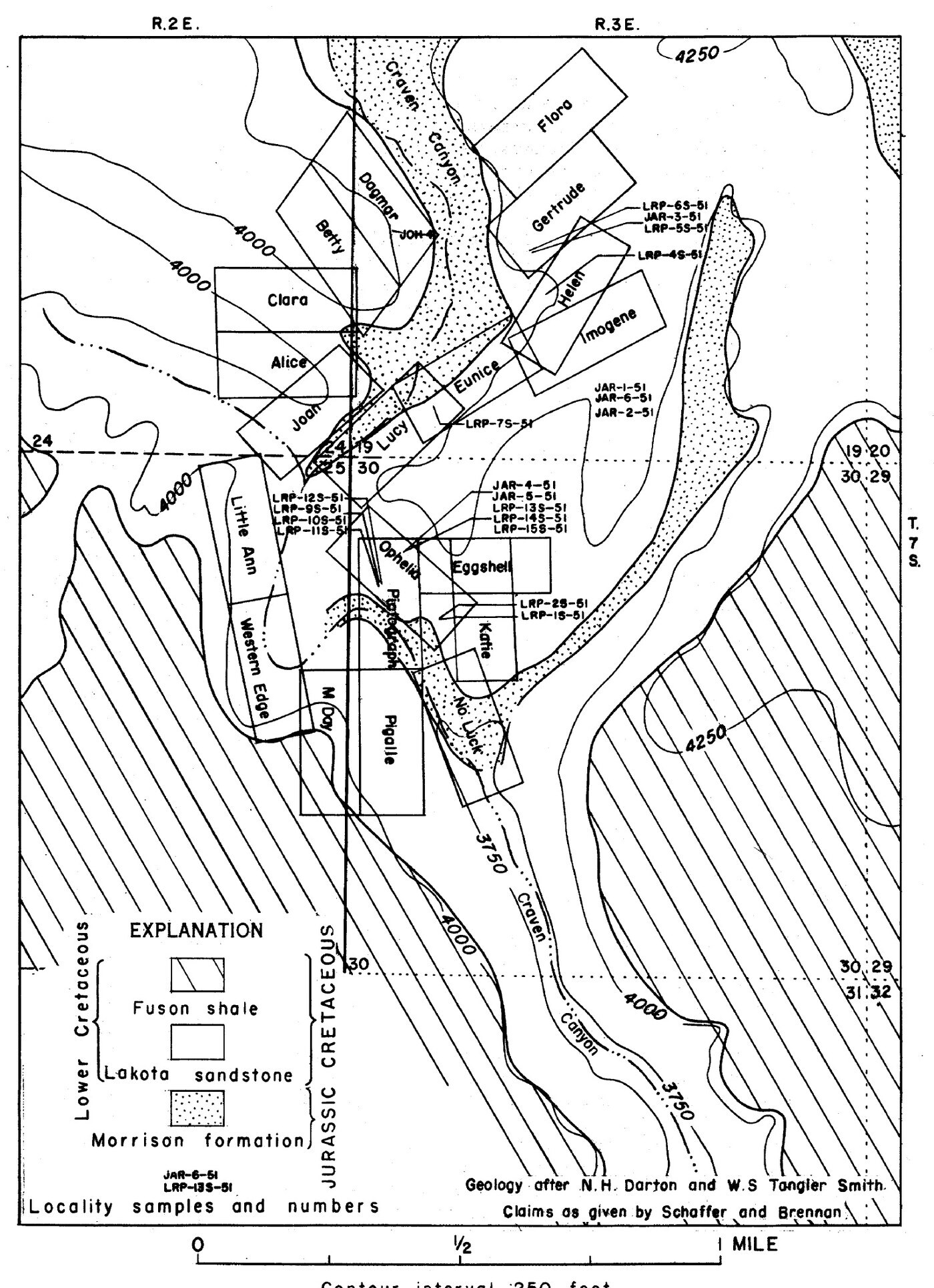
A 1955 USGS bulletin dates the AEC's buying station at Edgemont to December 1952; before then, most of the district's ore went by rail to be milled in Colorado. In 1956 a mill went up in town. Until it closed in 1972 it drew most of its ore from the Black Hills of South Dakota and Wyoming. The state's mines show up in the national tally, too: an Energy Department inventory for Congress in 2014 counts 155 South Dakota mines among the 4,225 thought to have sold ore to the AEC between 1947 and 1970, the year those sales ended.
The cleanup later put a figure on the government's part. Under the Energy Policy Act of 1992, Congress agreed to repay a share of the cleanup costs at licensed mills that had sold uranium to the government, and the Energy Department set each mill's share by the portion of its tailings tied to those sales. For Edgemont the portion was the 81 percent. The Tennessee Valley Authority, which bought the idle mill in 1974 and never ran it, received about $25.1 million, and the department's 2024 status report lists the Edgemont cleanup as complete.
Weapons, Reactors and Where the Record Stops
What the government did with uranium in general is clearer than what it did with Edgemont's. In a 2021 report the Congressional Research Service said the larger part of the country's uranium concentrate from before 1971 "primarily supported the development of nuclear weapons and naval reactors," the reactors that power the Navy's nuclear submarines and ships. Other AEC programs used some of it. Civilian nuclear power took most of the output after 1971. A 1989 report by the General Accounting Office, the auditing arm of Congress, put it more briefly: in the early atomic years the AEC, then the only buyer of uranium ore, used it for defense. Edgemont's federal sales fall in the earlier period, since the AEC's buying ended in 1970, two years before the mill shut.
That is as far as the record goes. The Energy Department's numbers show who bought the mill's uranium. They don't show where it went. The federal reports that deal with the mill, from the Energy Department, the Geological Survey and Congress, stop at the sale: none follows its uranium into any particular weapon or reactor, and none connects it with the warheads on the Minuteman missiles in South Dakota's silos. The link between Edgemont and the missile field is the era and the buyer: the same federal government, arming for the Cold War, bought most of the town's uranium and ran the missiles. It is not a traced path from Craven Canyon to a launch tube.
Two Army Posts From the Same Year
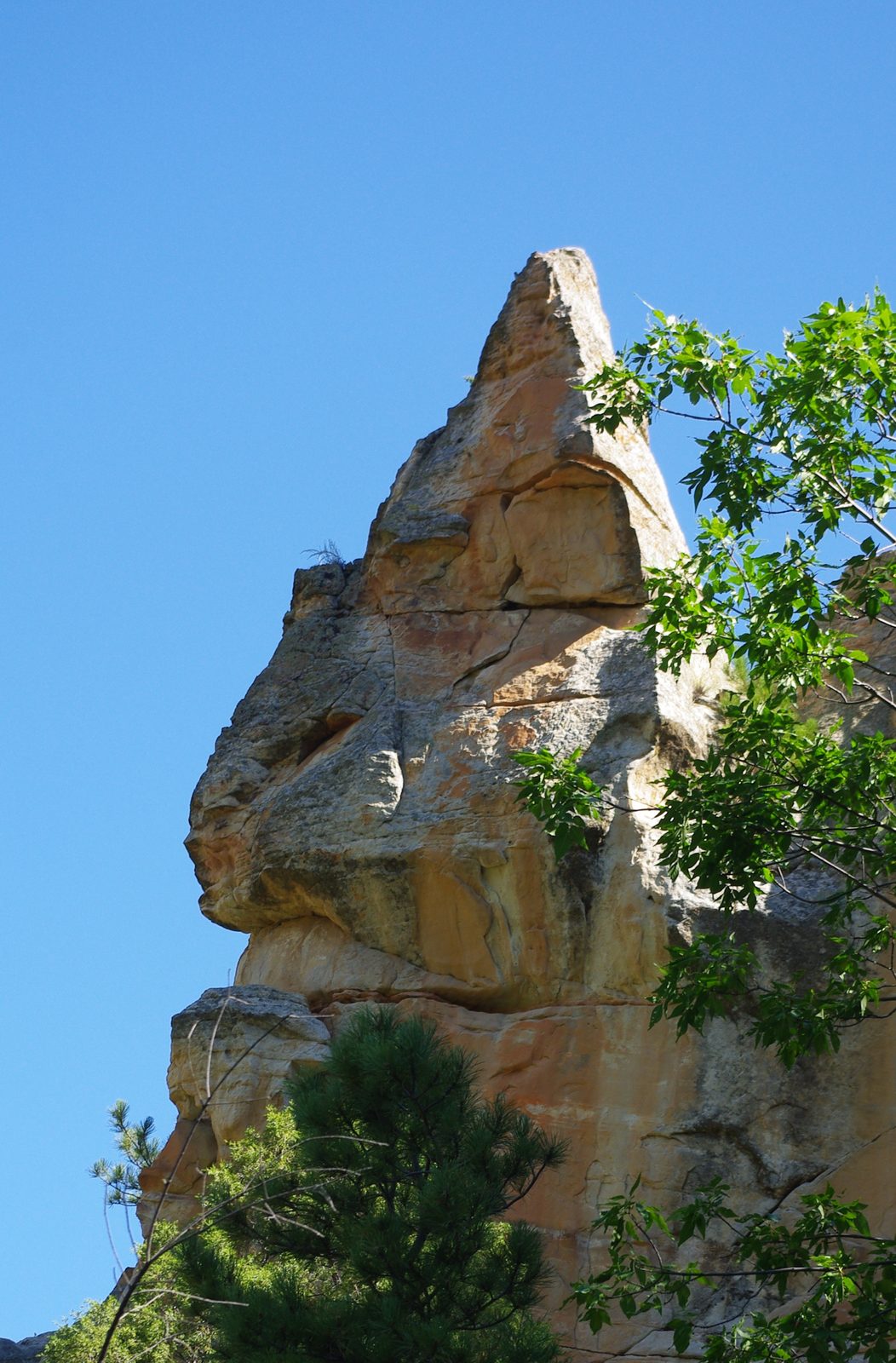
The two places were tied to defense before the uranium turned up, and those ties began in the same year. In January 1942 the War Department founded Rapid City Army Air Base, the future Ellsworth, as a training field for B-17 bomber crews (see Ellsworth and the Minuteman Missiles). In the spring the Army began work on the Black Hills Ordnance Depot, a munitions store on 21,000 acres of treeless hills near Edgemont, with its own town, Igloo. The shared year is the link here, not a cause: each post was built for its own part of World War II.
The Cold War then sent the two posts in opposite directions. Ellsworth took on missiles. In December 1961 the Air Force accepted a Titan I missile complex there, and from 1963 to 1991 the base's crews ran 150 Minuteman missiles in silos spread over western South Dakota. The depot went the other way. Defense Secretary Robert McNamara announced its closing in April 1964, and the last of it shut by the summer of 1967. "It was just like the town had a heart attack," Clarence Anderson told South Dakota Public Broadcasting in 2016, and he estimated that Edgemont lost almost half its people. The uranium mill outlasted the depot by five years.
The Silo Near Wall and the Base That Stayed
One of those 150 silos is still open to view. The survivor is Delta-09, off Exit 116 of Interstate 90, 6 miles east of Wall. It was handed to the Strategic Air Command on November 1, 1963, and the Park Service counts it among Ellsworth's earliest Minuteman sites. Its alert ended in September 1991, when the country stood down every one of its 450 Minuteman IIs. The START arms treaty of 1991 meant the end for the rest: by 1996 the field's other 149 silos had been shut and destroyed (the implosions are told on Ellsworth and the Minuteman Missiles).
Public Law 106-115, approved on November 29, 1999, set Delta-09 and its launch control facility, Delta-01, aside as Minuteman Missile National Historic Site. The superlative in that law is Congress's own judgment: its findings call the two sites the "best preserved examples of the operational character of American history during the Cold War."
Edgemont's defense years ended one after another: the depot by 1967, federal ore buying in 1970, the mill in 1972. Ellsworth's went on. In a June 2021 decision the Air Force named it B-21 Raider "Main Operating Base #1," the first of three bases chosen for the new bomber, with Whiteman in Missouri and Dyess in Texas also slated for it, and the home of the bomber's training unit. At the 2020 census Box Elder, the city that adjoins the base, had 11,746 residents; Edgemont had 725.
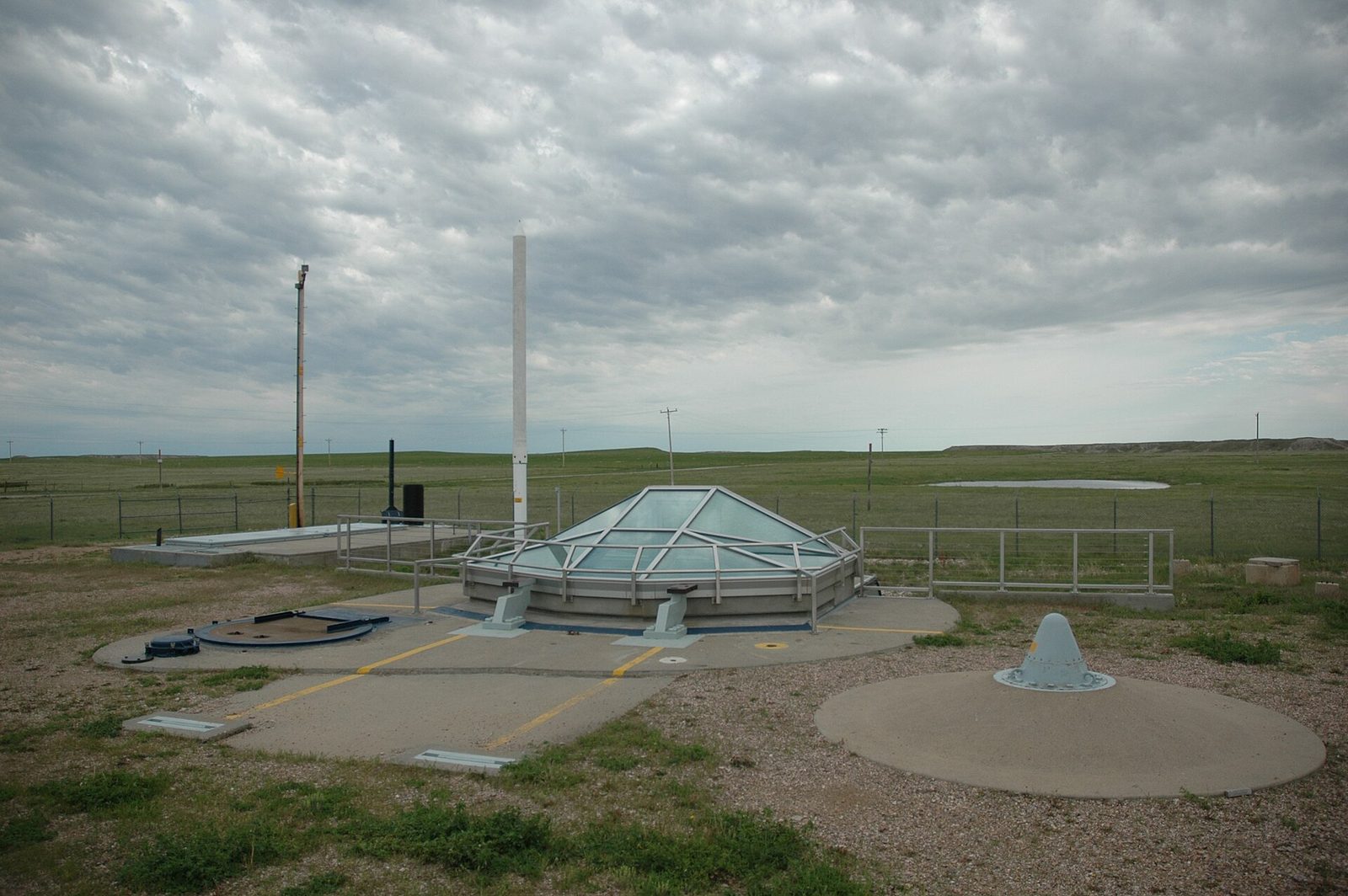
Both ends of the thread left something in the ground. In a cell south of Edgemont, 2 miles from where the mill stood, some 4 million tons of mill waste, the tailings among it, lie under 9 feet of cover in the Energy Department's care. East of Wall, beneath a glass and aluminum enclosure, the launch tube of Delta-09 has held a deactivated training missile since 2001.
Connected
- Edgemont, South DakotaThe uranium town: the 1951 find, the buying station and the mill of 1956 to 1972.
- Ellsworth and the Minuteman MissilesThe 1942 air base, its bombers and the 150-missile Minuteman field.
- Wall, South DakotaThe town 6 miles west of the preserved silo Delta-09.
- Box Elder, South DakotaThe city beside Ellsworth, growing as the B-21 comes.
- Gold and the Other MineralsThe Lakota sandstone that held the carnotite near Edgemont.
- The Badlands and WallThe country around the historic site east of Wall.
- Uranium Mining Around the Black HillsThe proposal near Edgemont, its permits and the aquifers.
Sources
- Title X, FY 2024 Status Report: Reimbursements to Licensees of Active Uranium and Thorium Processing Sites. U.S. Department of Energy, 2024.
- Long-Term Federal Management of Uranium Mill Tailings: Background and Issues for Congress (R45880), by Lance N. Larson. Congressional Research Service, 2021; copy published by EveryCRSReport.
- Date Extensions (House Report 106-886, on H.R. 2641). U.S. House of Representatives, Committee on Commerce, 2000.
- Uranium Enrichment: Some Impacts of Proposed Legislation on DOE's Program (GAO/RCED-89-170BR). U.S. General Accounting Office, 1989.
- Defense-Related Uranium Mines Report to Congress (DOE/LM-1473). U.S. Department of Energy, Office of Legacy Management, 2014.
- The Carnotite Prospects of the Craven Canyon Area, Fall River County, South Dakota (Circular 175), by L.R. Page and J.A. Redden. U.S. Geological Survey, 1952.
- Uranium Deposits in Fall River County, South Dakota (Bulletin 1009-G), by Henry Bell and W.E. Bales. U.S. Geological Survey, 1955.
- Edgemont, South Dakota, Disposal Site: Fact Sheet. U.S. Department of Energy, Office of Legacy Management, 2026.
- Igloo, South Dakota: The Utopia That War Built, by Michael Zimny. South Dakota Public Broadcasting, 2016.
- A History of the Ellsworth Air Force Base. South Dakota Public Broadcasting, 2023.
- Minuteman Missile Visitor Center Opens in Philip, S.D., by Denise Jenson. Air Force Global Strike Command, 2016.
- Delta-09. National Park Service, Minuteman Missile National Historic Site.
- START Treaty 1991. National Park Service, Minuteman Missile National Historic Site.
- Delta-01. National Park Service, Minuteman Missile National Historic Site.
- Public Law 106-115, Minuteman Missile National Historic Site Establishment Act of 1999. Copy posted by the Office of the Law Revision Counsel, U.S. House of Representatives.
- Ellsworth Officially Selected as First Base to Receive B-21s. Air Force Global Strike Command, 2021.
- 28th Bomb Wing Fact Sheet. U.S. Air Force, Ellsworth Air Force Base, 2025.
- QuickFacts: Box Elder City, South Dakota. U.S. Census Bureau, 2020 Census count.
Last reviewed: