Land and Water
Uranium Mining Around the Black Hills
On November 24, 2020, the Environmental Protection Agency exempted about 1,970 acres of underground sandstone, 13 miles northwest of Edgemont, from the federal protection given to sources of drinking water, so that a company could pump fluid through the rock to dissolve uranium. The project, Dewey-Burdock, lies in Custer and Fall River counties on the Wyoming line. This page covers its permits, the uranium mines before it, the case for and against, and this site's stand.
What Would Dewey-Burdock Do?
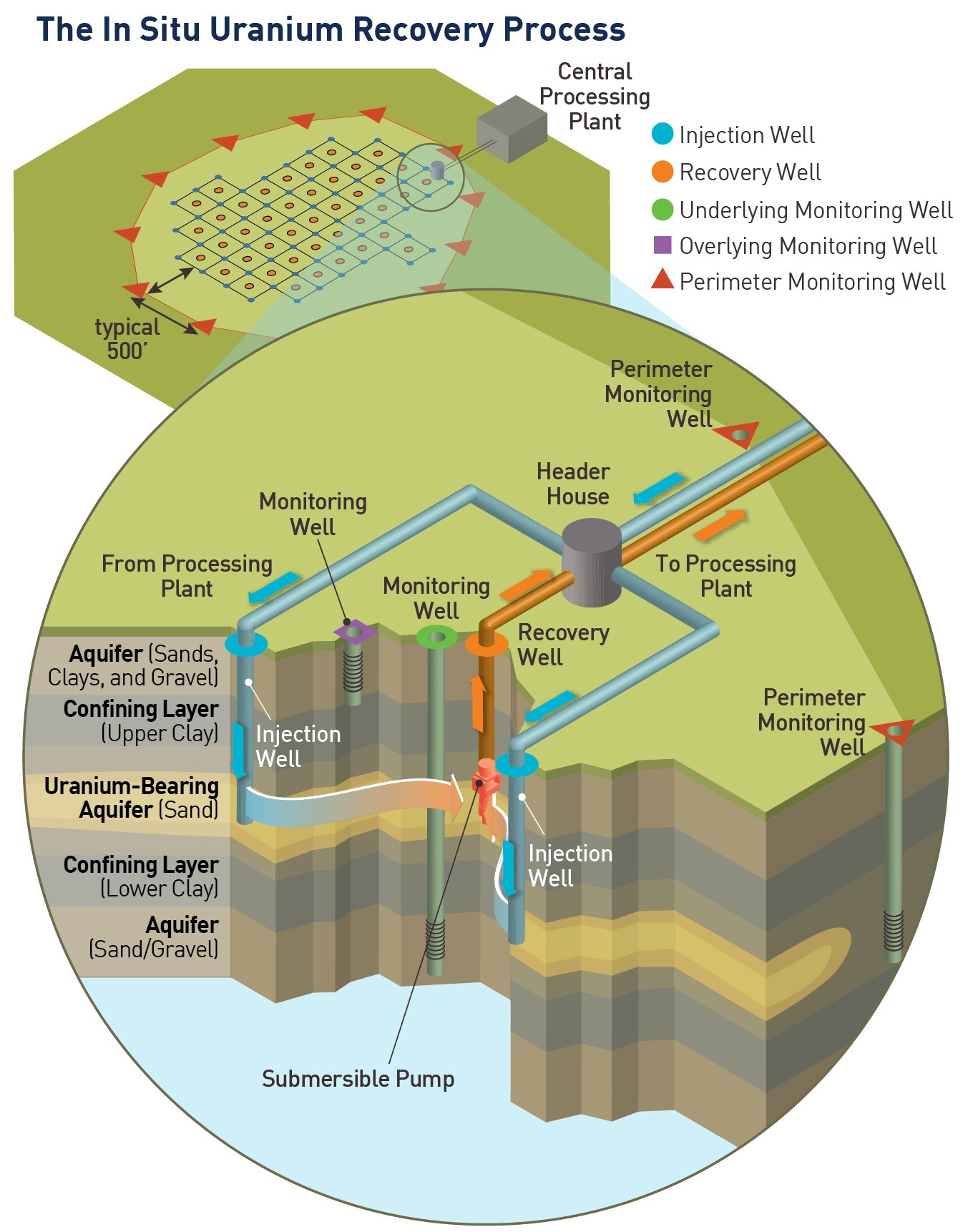
Dewey-Burdock would be an in-situ recovery mine: instead of digging out ore, it would dissolve the uranium where it lies and pump it up through wells. The fluid, EPA's decision says, is groundwater from the ore zone with oxygen and carbon dioxide added. The company expects about 1,461 injection wells and 869 production wells in 14 wellfields on a 10,580-acre project area. The applicant is Powertech (USA) Inc., a subsidiary of Texas-based enCore Energy, which acquired the project from Azarga Uranium in 2022.
The ore lies in the Fall River and Lakota sandstones of the Inyan Kara Group, on average 190 to 760 feet down and confined above and below by shale. The same sandstones held the carnotite found in Craven Canyon in June 1951 (see Gold and the Other Minerals). Far deeper lies the Madison aquifer (see Where the Hills' Water Comes From).
Where the Permits Stand, November 2026
The federal permits are in hand. The Nuclear Regulatory Commission licensed the project in 2014 and renewed the license on June 18, 2026, for a requested 20 more years. EPA's two injection permits, issued with the exemption in 2020, were appealed by the Oglala Sioux Tribe; the agency's appeals board sent them back in September 2024 to complete the record, then denied review on September 12, 2025, and they took effect October 25. On June 15, 2026, the Bureau of Land Management approved roads, monitoring wells and power lines on about 240 acres of federal land, but no mining. On June 30 the Federal Permitting Improvement Steering Council declared federal permitting complete.
The Tribe's petition against the exemption has been before the Eighth Circuit Court of Appeals since January 2021. On November 12, 2025, the Tribe, the Black Hills Clean Water Alliance and NDN Collective added the reissued permits to it, the latest step in the case confirmed as of November 2026. At the NRC, a licensing board admitted three of their contentions against the renewal in January 2025, and Powertech's appeal was on the Commission's agenda for June 15, 2026.
South Dakota's permits are still missing. The state review sat idle from 2013, and in 2021 the Water Management Board refused the company's request to restart its water-permit review while federal permits and lawsuits were pending. By July 2026 Powertech had applied for water from the Inyan Kara and Madison aquifers, billions of gallons a year, much of it to be treated and reinjected, the South Dakota Searchlight reported. The state's chief water-rights engineer recommended approval, and as of late October the board had set a hearing for December 2, 2026, in Pierre. No new state mine permit application had been filed as of July.
Near Craven Canyon, Clean Nuclear Energy Corp., a subsidiary of Canada's Nexus Uranium, wants to drill dozens of uranium exploration holes; its state permit hearing, halted by a lawsuit in May 2026, had no new date in late October (see Gold, Lithium and the New Mining Rush).
What the Old Mines Left
A mill at Edgemont ran from 1956 to 1972. Its waste, about 4 million tons, has lain since 1989 in a cell south of town, and the Energy Department expects its contaminants never to reach the aquifer below (see Edgemont, South Dakota). The mines are another matter. A 2014 Energy Department report counted 155 South Dakota mines among the 4,225 that sold ore to the Atomic Energy Commission, and could not confirm the reclamation status of about 85 percent nationwide (see Uranium, the Cold War and the Missiles).
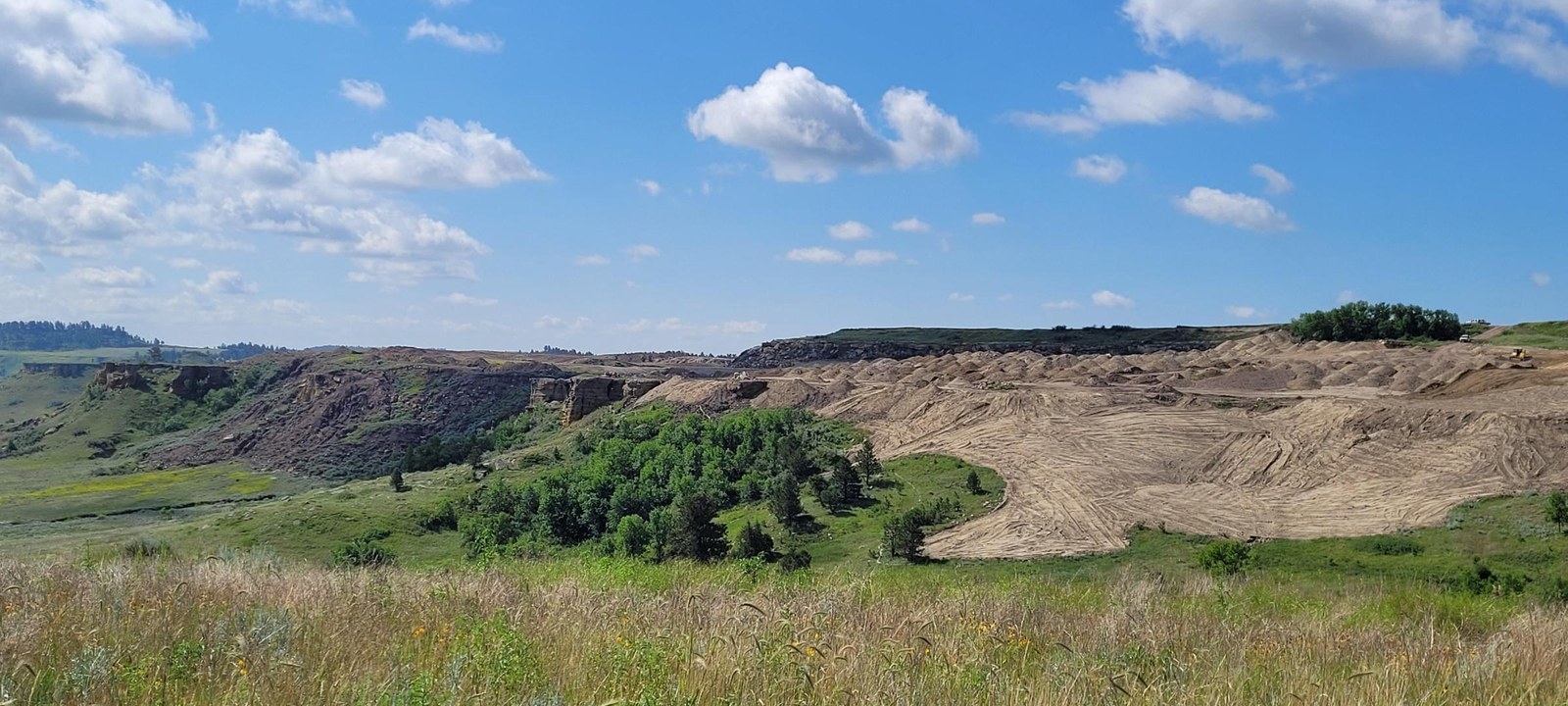
In the North Cave Hills of Harding County, miners from the mid-1950s pushed the tops off a dozen bluffs to reach lignite coal that held uranium, and quit by 1964. The Forest Service, cleaning up Riley Pass under the Superfund law, counts about 300 acres whose spoil carries arsenic, radium-226 and uranium, and calls the conditions an "imminent and substantial endangerment." Most of the smaller bluffs were reclaimed from 2010 to 2020, but in March 2026 the agency still listed about 65 percent of the disturbed acres as unreclaimed (see What the Old Mines Left Behind).
Why the Oglala Sioux Tribe Objects
The Oglala Sioux Tribe has fought Dewey-Burdock before the NRC's licensing boards, before EPA's appeals board and in two federal appeals courts. In 2024 its president, Frank Star Comes Out, framed the stakes as water: if a mine contaminated the aquifer, "that's our main water supply." EPA places the site 46 miles west of the Pine Ridge Reservation.
The Tribe has also argued that the NRC never properly weighed its cultural resources there. It refused to join an NRC field survey in 2013, objecting to its methods and timing. In 2022 the D.C. Circuit held that the NRC had still met its legal duties, while noting that no party questioned the Tribe's "outsized historical connection to the Dewey-Burdock area." The southern Hills were part of the land the 1877 Act took from the tribes without the consent the 1868 Fort Laramie Treaty required (see The 1876 War and the Taking of the Hills).
The Case for Mining It
Backers argue supply first. American nuclear plant owners bought 46.9 million pounds of uranium in 2025, and only 7 percent of deliveries came from the United States, against 32 percent from Canada and 28 from Kazakhstan, the Energy Information Administration reported in July 2026. The Permitting Council's director tied more domestic production to national security. Supporters also expect rural jobs; the 2026 BLM and Permitting Council announcements gave no number.
Mark Hollenbeck, a nearby rancher and former manager of the project, calls in-situ recovery the lowest-impact way to mine. The NRC's 2026 review found the ore zones cut off from neighboring aquifers by thick shale and found no significant impact. EPA found no public water system drawing on the Inyan Kara where its water flows from the site. Withdrawing a proposed groundwater rule for these mines in 2018, EPA called existing rules "sufficient to ensure the targeted protection of public health." In a June 2026 press release quoted by the Searchlight, William Sheriff, enCore's executive chair, cited the company's commitment to "always operate with best practices to protect the people, land, air, and water."
The Case Against, From the Record
The case against starts with water. The Inyan Kara here meets the federal definition of an underground source of drinking water, which is why EPA had to exempt it. EPA counted 19 wells within 1.2 miles of the project boundary that are or were used for drinking water, nine inside it. It found none drawing from the exempted rock.
Second, the record elsewhere: in 2015 EPA wrote that most in-situ sites "have been unable to meet restoration goals for all constituents." Third, the permit application lists 5,932 exploration drillholes in the project area, and EPA acknowledged "leaky historic drillholes" there; its rules don't require plugging them first, and it says the permit's conditions address them. Fourth, process: the NRC's own licensing board found the 2014 license was issued without the consultation with the Tribe the law required, though the license stayed in place and the NRC won in court in 2022.
Neither side's claim about local opinion fits Fall River County's 2022 vote. Hollenbeck told KOTA in April 2026 the project is "very much supported locally." Lilias Jarding of the Black Hills Clean Water Alliance said in July: "The people don't want this." In November 2022, 56 percent of the county's voters approved declaring uranium mining a nuisance; whether that can stop a mine was unclear, SDPB reported.
This site's position covers the Black Hills and the plains around them: the counties that touch the Hills, and the Cave Hills in Harding County. It does not reach Wyoming's Powder River Basin. Peninsula Energy's Lance Projects in Crook County sit at that edge, on the basin's eastern margin and the Black Hills uplift's western one, by the company's description; they resumed producing uranium in December 2024.
Connected
- Edgemont, South DakotaThe uranium town: the 1951 find, the mill and the disposal cell south of town.
- Uranium, the Cold War and the MissilesWho bought the district's uranium, and where the federal record stops.
- Gold and the Other MineralsThe sandstone uranium near Edgemont, among the Hills' other minerals.
- Where the Hills' Water Comes FromThe Madison and the other aquifers, and who drinks from them.
- What the Old Mines Left BehindRiley Pass, the old uranium mines and what their cleanup has cost.
- Gold, Lithium and the New Mining RushThe Craven Canyon drilling within the wider exploration wave.
- Who Decides, and How to Be HeardWhich agency or board rules on each uranium permit.
- Where This Site StandsThe site's four positions, this one among them.
Local organizations
- NDN Collective, which describes itself as “an Indigenous-led organization dedicated to building Indigenous power.”
- South Dakota Mineral Industries Association, the mineral industry’s membership association in South Dakota, which describes itself as “incorporated in the State of South Dakota as a Domestic Non-Profit Corporation.”
Further reading
- Supplemental Petition for Review, Oglala Sioux Tribe et al. v. EPA, No. 21-1167, Oglala Sioux Tribe, Black Hills Clean Water Alliance and NDN Collective (with EPA's 2020 aquifer exemption decision attached)
- Oglala Sioux Tribe Takes Steps to Protect Black Hills, ICT
- In re Powertech (USA) Inc., Order Denying Review, EPA Environmental Appeals Board
- Riley Pass Uranium Mine, USDA Forest Service, Custer Gallatin National Forest
Sources
- Supplemental Petition for Review, Oglala Sioux Tribe, Black Hills Clean Water Alliance and NDN Collective v. EPA (No. 21-1167), with Exhibit 1, EPA Region 8 Aquifer Exemption Record of Decision for the Dewey-Burdock In-Situ Recovery Project (November 24, 2020). U.S. Court of Appeals for the Eighth Circuit, filed 2025; copy in the EPA Environmental Appeals Board docket.
- In re Powertech (USA) Inc., UIC Appeal No. 25-01, Order Denying Review. U.S. Environmental Protection Agency, Environmental Appeals Board, 2025.
- Powertech (USA) Inc.; Dewey-Burdock Uranium In-Situ Recovery Project; License Renewal. U.S. Nuclear Regulatory Commission, Federal Register 91:151, 2026.
- Powertech USA, Inc.; Dewey-Burdock In Situ Uranium Recovery Project; Environmental Assessment, Finding of No Significant Impact, and Final Programmatic Agreement. U.S. Nuclear Regulatory Commission, Federal Register, 2026.
- Atomic Safety and Licensing Board Panel, In the Matter of Powertech (USA) Inc. (Dewey-Burdock In Situ Uranium Recovery Facility), Order (Notice of Hearing). U.S. Nuclear Regulatory Commission, Federal Register 90:39, 2025.
- Sunshine Act Meetings (affirmation session of June 15, 2026: Appeal by Powertech (USA) Inc. of LBP-25-3). U.S. Nuclear Regulatory Commission, Federal Register, 2026.
- Oglala Sioux Tribe v. U.S. Nuclear Regulatory Commission, 45 F.4th 291. U.S. Court of Appeals for the D.C. Circuit, 2022 (National Indian Law Library).
- BLM Approves Dewey-Burdock Uranium Project. Bureau of Land Management, 2026.
- Dewey-Burdock ISR Uranium Project Completes Federal Permitting. Federal Permitting Improvement Steering Council, 2026.
- Public Comment Period Opens as Company Seeks State Permits for Uranium Mine, by Meghan O'Brien. South Dakota Searchlight, as published by the Rapid City Post, 2026.
- Company Proposing Black Hills Uranium Mine Eyes State Permitting Restart After 13-Year Pause, by Makenzie Huber. South Dakota Searchlight, as published by KOTA Territory News, 2026.
- Proposed Black Hills Uranium Mine Gets Approval to Start Building Infrastructure on Portion of Site, by Meghan O'Brien. South Dakota Searchlight, 2026.
- Dewey-Burdock Uranium Project Debate Continues in the Black Hills, by Karli West. KOTA Territory News, 2026.
- Uranium Mining Declared a Nuisance in Fall River County, by Lee Strubinger. South Dakota Public Broadcasting, 2022.
- Oglala Sioux Tribe Takes Steps to Protect Black Hills, by Amelia Schafer. ICT, with the Rapid City Journal, 2024.
- EnCore Receives BLM Authorization for Dormant Uranium Project. American Nuclear Society, Nuclear Newswire, 2026.
- 2025 Uranium Marketing Annual Report. U.S. Energy Information Administration, 2026.
- Health and Environmental Protection Standards for Uranium and Thorium Mill Tailings (proposed rule). U.S. Environmental Protection Agency, Federal Register, 2015.
- Health and Environmental Protection Standards for Uranium and Thorium Mill Tailings (withdrawal of proposed rule). U.S. Environmental Protection Agency, Federal Register, 2018.
- Edgemont, South Dakota, Disposal Site: Fact Sheet. U.S. Department of Energy, Office of Legacy Management, 2026.
- Defense-Related Uranium Mines Report to Congress. U.S. Department of Energy, 2014.
- Riley Pass Uranium Mine. USDA Forest Service, Custer Gallatin National Forest, updated 2026.
- Mineral Resource Increases to 59.0Mlbs U3O8 at the Lance Project. Peninsula Energy Limited (the company's own account), 2026.
- Treaty of Fort Laramie (1868). National Archives, Milestone Documents.
Last reviewed: