Land and Water
Who Decides, and How to Be Heard
Under the 1872 Mining Law, valuable minerals on most federal land are “free and open to exploration and purchase.” That one sentence of federal law is where every question about mining on national forest land starts. This page sets out which body decides what for mines, uranium wells, oil pipelines, county land use and land return, and how a public comment period works. It names the agency and the law for each; it does not follow any single proposal.
Who Decides on National Forest Land?
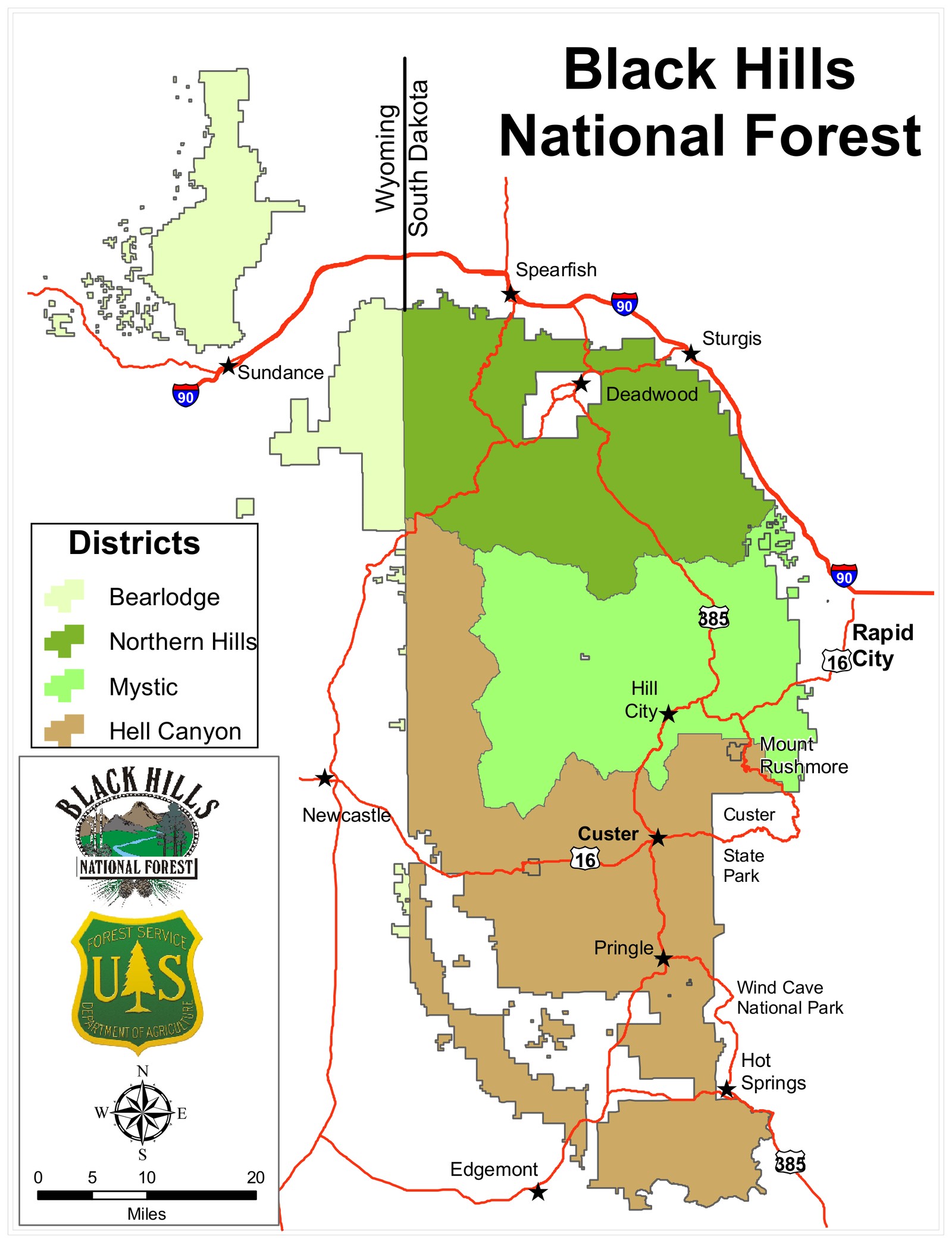
The U.S. Forest Service decides how surface use is carried out on Black Hills National Forest land. Its mining regulations acknowledge that the mining laws entitle operators to enter public land to search for minerals, and they set rules so that surface use minimizes adverse effects on forest resources. The same rules say they are not meant to manage the minerals themselves, which they leave to the Secretary of the Interior.
The steps run in a set order. A person who might cause significant disturbance of the surface files a notice of intent with the District Ranger, who decides whether a full plan of operations is needed. If operations will likely cause significant disturbance, the plan is required and work cannot begin until it is approved. After an environmental analysis, the Forest Service officer decides whether a full environmental statement is needed. The National Environmental Policy Act, for any major federal action that significantly affects the environment, requires that detailed statement.
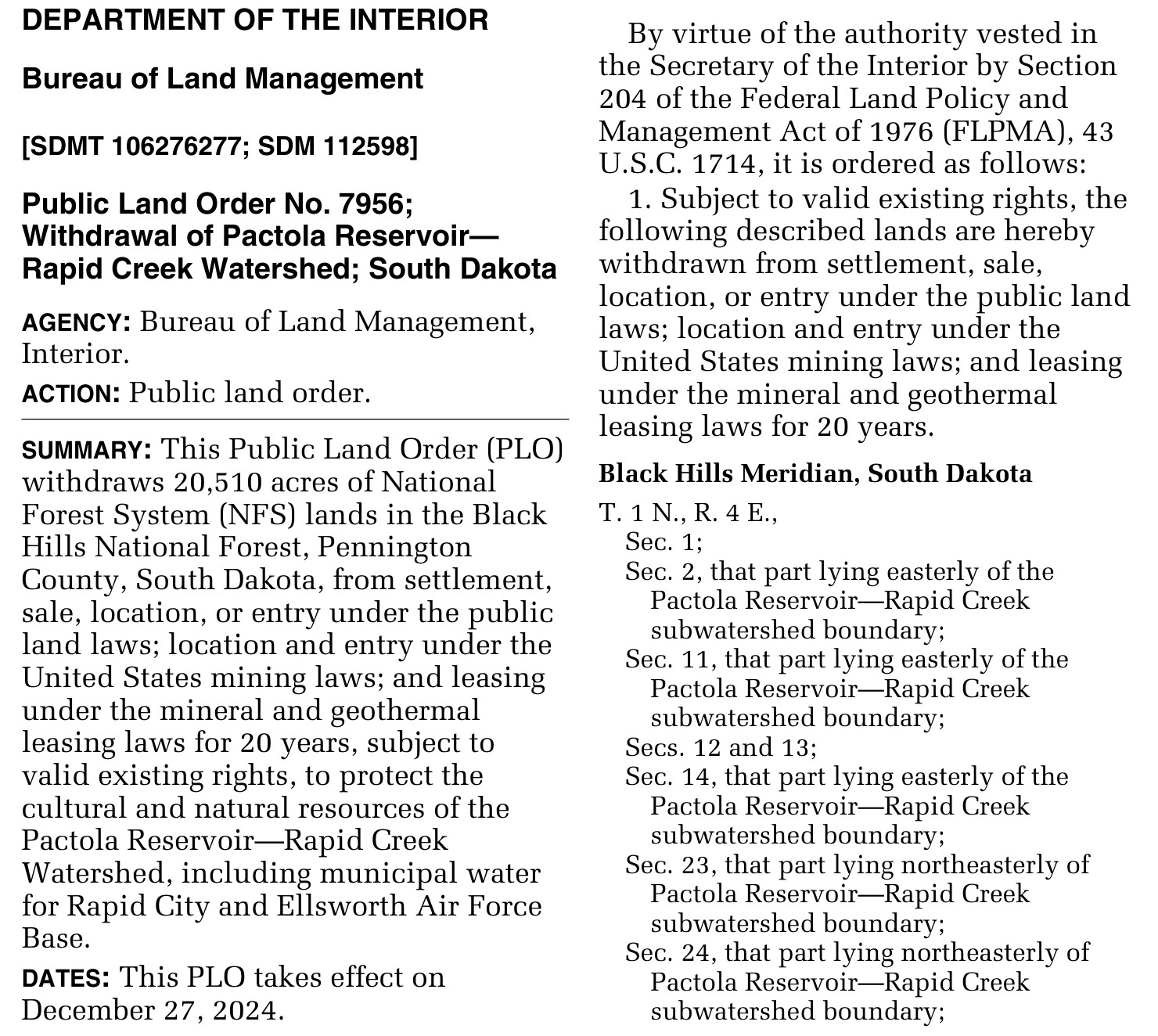
Within the executive branch, the Secretary of the Interior holds the authority to make, modify, extend or revoke withdrawals, which close land to new mineral claims. For land run by another agency, such as the Forest Service, the Secretary needs that agency head’s consent. A withdrawal of 5,000 acres or more lasts no more than twenty years, and Congress must be told. Smaller and emergency withdrawals follow different limits. Outside a withdrawal, the 1872 law is the starting point. The recent exploration wave is on Gold, Lithium and the New Mining Rush.
What Does the State Decide?
South Dakota’s Department of Agriculture and Natural Resources (DANR) runs a program that regulates mineral exploration, mining and oil and gas development statewide. Operators generally file an exploration notice of intent before exploring for metals such as gold and silver, and uranium exploration needs a separate permit.
Mine permits are the Board of Minerals and Environment’s territory. Under state law, the department’s secretary makes a recommendation on each permit; if nobody contests an approval, it becomes final. The board holds a contested-case hearing when the applicant or any person files a protest. Any person may file written objections to a mining permit, or statements in support, with the board. A county’s commissioners may ask that the hearing be held in their county.
Water is a separate door. A permit to appropriate water goes first to the state’s chief engineer, who recommends approval, denial or deferral. The Water Management Board holds a public hearing on contested applications and makes the final decision. A project that needs a water permit goes through this process separately from its mine permit.
Who Decides on Uranium Wells?
Three layers apply to in situ recovery, the method that dissolves uranium underground and pumps it up. The Nuclear Regulatory Commission (NRC) licenses uranium recovery facilities in South Dakota; its list of licensed sites includes the Dewey-Burdock project in Fall River and Custer Counties. In Agreement States such as Wyoming and Texas, the state does the licensing instead. The public can ask the NRC for a hearing.
The underground part belongs to the Environmental Protection Agency. An aquifer exemption lets EPA declare an aquifer one that does not and will not serve as a drinking-water source, so wells may inject into it. Injection can begin only after EPA approves the exemption and grants an underground injection control permit. In November 2020, EPA’s Region 8 issued such permits and an exemption for Dewey-Burdock. What has happened to them since is on Uranium Mining Around the Black Hills.
Who Decides on an Oil Pipeline?
No single agency does. The South Dakota Public Utilities Commission (PUC) grants, denies or conditions a state permit to construct a crude oil pipeline under the state’s facility-siting law, which counts a pipeline carrying liquid hydrocarbons as a transmission facility. The applicant carries the burden of proof, and one thing it must show is that the line will not seriously harm the environment or the social and economic conditions of current or expected residents. For the Dakota Access line, the commission said its authority was limited to issuing or denying that permit.
The Army Corps of Engineers decides on river crossings. It issues permits for work in navigable waters under the Rivers and Harbors Act and for discharges of fill under the Clean Water Act, after public notice and an opportunity to request a hearing. The Pipeline and Hazardous Materials Safety Administration (PHMSA) writes the federal minimum safety standards for pipelines. A state may not set its own safety standards for an interstate pipeline. More on the rivers is on Oil Pipelines and the Rivers.
What Do Counties Decide?
A board of county commissioners adopts a county’s zoning ordinance, which controls where buildings and land uses go, and can name uses that need approval case by case. The mining and pipeline permits above are issued by state and federal bodies; what a county controls through zoning is local land use. Whether a county’s ordinance also reaches a particular mine or pipeline depends on the ordinance and the land, and this page does not settle it. Voters can refer an ordinance or resolution of the board to a countywide vote by petition, with exceptions for measures needed to preserve public health or safety.
What Can Congress Do?
The Constitution’s Property Clause gives Congress the power to dispose of federal territory and property and to make the rules for it. Congress therefore holds the power to move national forest land into other hands, including tribal hands, by law. How bills for returning the Hills have fared, and who asks for what, is on Land Back in Plain Terms.
What Does Consultation with Tribes Require?
Federal agencies must consult tribes, and that duty is narrower than many people expect. Section 106 of the National Historic Preservation Act directs a federal agency, before approving funds or issuing a license for an undertaking, to consider its effect on historic property. A related section says that when an agency does so, it must consult any tribe that attaches religious and cultural significance to a property that may be affected. The rule that carries this out says consultation should begin early and apply to such properties wherever they are located. Where a tribe has taken over the state officer’s functions, the agency consults the tribal historic preservation officer. The statutes’ words are “take into account” and “consult,” not “consent.”
How Does a Public Comment Period Work?
The stages are much the same everywhere. Scoping comes first, while the agency decides what to study. A draft document follows, with a comment period. Then comes a decision, and sometimes a last review before it takes effect. The Forest Service calls that review an objection. Only a person who sent timely, specific written comments earlier can file one, whether the comments came at scoping or on a draft. Federally recognized tribes can instead rely on comments they made in consultation.
Specific comments matter: the Forest Service’s objection rule asks for specific written comments. Silence counts too, as the Corps treats it as no objection. EPA’s permit rules require public notice of a draft permit, with a stated way to comment or ask for a hearing. For rules, a federal agency must give interested persons a chance to submit written data, views or arguments.
Where Are Notices Posted?
Federal rule notices appear in the Federal Register. The Forest Service revised its objection rules in October 2026, so the forest’s own project pages are the place to see how notice of an objection period is given now. The Black Hills National Forest lists current projects on its own project pages, and you can sign up there for email updates. The NRC announces hearing and comment opportunities in the Federal Register or on its website.
Mine and water notices run in local newspapers; the application notice for a mine permit runs once a week for two consecutive weeks, and the Water Management Board’s notices are also posted on the department’s website. South Dakota law requires newspapers to place legal notices on a statewide website run by the state’s newspapers, so a notice that ran in any local paper can be searched in one place. DANR lists pending mine permits, pending exploration notices and contested cases on its minerals pages. Deadlines in these systems are short and change with the project, so the date in the notice itself is the one that counts.
The agency pages listed under Sources are the place to start.
Connected
- Uranium Mining Around the Black HillsThe Dewey-Burdock permits and their current standing.
- Gold, Lithium and the New Mining RushThe exploration wave, the 1872 law and the Pactola withdrawal.
- Oil Pipelines and the RiversWhere the PUC, the Corps and PHMSA each come in.
- Land Back in Plain TermsWhat Congress has been asked to do, and by whom.
- The 1980 Ruling and Land BackThe history behind the request to Congress.
Sources
- 30 U.S.C. § 22, Lands open to purchase by citizens. U.S. Code (Legal Information Institute, Cornell Law School).
- 36 CFR § 228.1, Purpose. Code of Federal Regulations, Forest Service (Legal Information Institute).
- 36 CFR § 228.4, Plan of operations: notice of intent. Code of Federal Regulations (Legal Information Institute).
- 36 CFR § 228.5, Plan of operations: approval. Code of Federal Regulations (Legal Information Institute).
- 42 U.S.C. § 4332, Cooperation of agencies; reports; availability of information. U.S. Code (Legal Information Institute).
- 43 U.S.C. § 1714, Withdrawals of lands. U.S. Code (Legal Information Institute).
- Project-Level Predecisional Administrative Review Process (final rule, 36 CFR part 218). Forest Service, Federal Register, 2026.
- Projects. Black Hills National Forest, U.S. Forest Service.
- Minerals, Mining, and Superfund Program. South Dakota Department of Agriculture and Natural Resources.
- SDCL § 45-6B-88, Rules on permits. South Dakota Codified Laws.
- SDCL § 45-6B-28, Objections and statements in support. South Dakota Codified Laws.
- SDCL § 45-6B-29, County request for hearing. South Dakota Codified Laws.
- SDCL § 45-6B-16, Notice of application. South Dakota Codified Laws.
- SDCL § 46-2A-2, Recommendation of chief engineer. South Dakota Codified Laws.
- SDCL § 46-2A-4, Notice and hearing on water applications. South Dakota Codified Laws.
- Backgrounder on Uranium Recovery. U.S. Nuclear Regulatory Commission.
- Locations of Uranium Recovery Facilities. U.S. Nuclear Regulatory Commission.
- Aquifer Exemptions. U.S. Environmental Protection Agency.
- EPA issues permits for Dewey-Burdock uranium recovery project near Edgemont, South Dakota. U.S. Environmental Protection Agency, 2020.
- 40 CFR § 124.10, Public notice of permit actions and public comment period. Code of Federal Regulations (Legal Information Institute).
- SDCL § 49-41B-2.1, Definitions. South Dakota Codified Laws.
- SDCL § 49-41B-22, Burden of proof. South Dakota Codified Laws.
- Dakota Access pipeline docket HP14-002: frequently asked questions. South Dakota Public Utilities Commission.
- 33 U.S.C. § 403, Obstruction of navigable waters generally. U.S. Code (Legal Information Institute).
- 33 U.S.C. § 1344, Permits for dredged or fill material. U.S. Code (Legal Information Institute).
- 33 CFR § 325.3, Public notice. Code of Federal Regulations, Army Corps of Engineers (Legal Information Institute).
- 49 U.S.C. § 60102, Purpose and general authority. U.S. Code (Legal Information Institute).
- 49 U.S.C. § 60104, Requirements and limitations. U.S. Code (Legal Information Institute).
- 49 CFR § 1.97, Pipeline and Hazardous Materials Safety Administration. Code of Federal Regulations (Legal Information Institute).
- SDCL § 11-2-1, Definitions. South Dakota Codified Laws.
- SDCL § 11-2-17.3, Conditional uses. South Dakota Codified Laws.
- SDCL § 7-18A-15, Referendum on county ordinances. South Dakota Codified Laws.
- Constitution of the United States, Article IV. Legal Information Institute, Cornell Law School.
- 54 U.S.C. § 306108, Effect of undertaking on historic property. U.S. Code (Legal Information Institute).
- 54 U.S.C. § 302706, Eligibility for inclusion on National Register. U.S. Code (Legal Information Institute).
- 36 CFR § 800.2, Participants in the Section 106 process. Code of Federal Regulations, Advisory Council on Historic Preservation (Legal Information Institute).
- 5 U.S.C. § 553, Rule making. U.S. Code (Legal Information Institute).
- SDCL § 17-2-1, Notices to be published in legal newspaper. South Dakota Codified Laws.
- South Dakota Public Notices. South Dakota NewsMedia Association.
Last reviewed: