The Tribes and Hé Sápa
The 1980 Ruling and Land Back
The final judgment came to $105,994,430.52. It was the federal award for the Black Hills, which Congress took from the Lakota and the other tribes of the Great Sioux Reservation in 1877. The tribes have refused the money ever since. Behind the judgment stands the Supreme Court’s 1980 decision in United States v. Sioux Nation of Indians, and after it a long fight over the land itself, carried on today by tribal governments, treaty councils and the Land Back movement.
What Did the Supreme Court Decide in 1980?
On June 30, 1980, the Supreme Court ruled 8 to 1 that the 1877 Act was a taking of tribal property under the Fifth Amendment, which the government had to pay for, with interest. The award was $17.1 million, the Indian Claims Commission’s value for the Hills as of February 28, 1877, plus 5 percent a year in interest from 1877, which brought the final judgment to about $106 million.
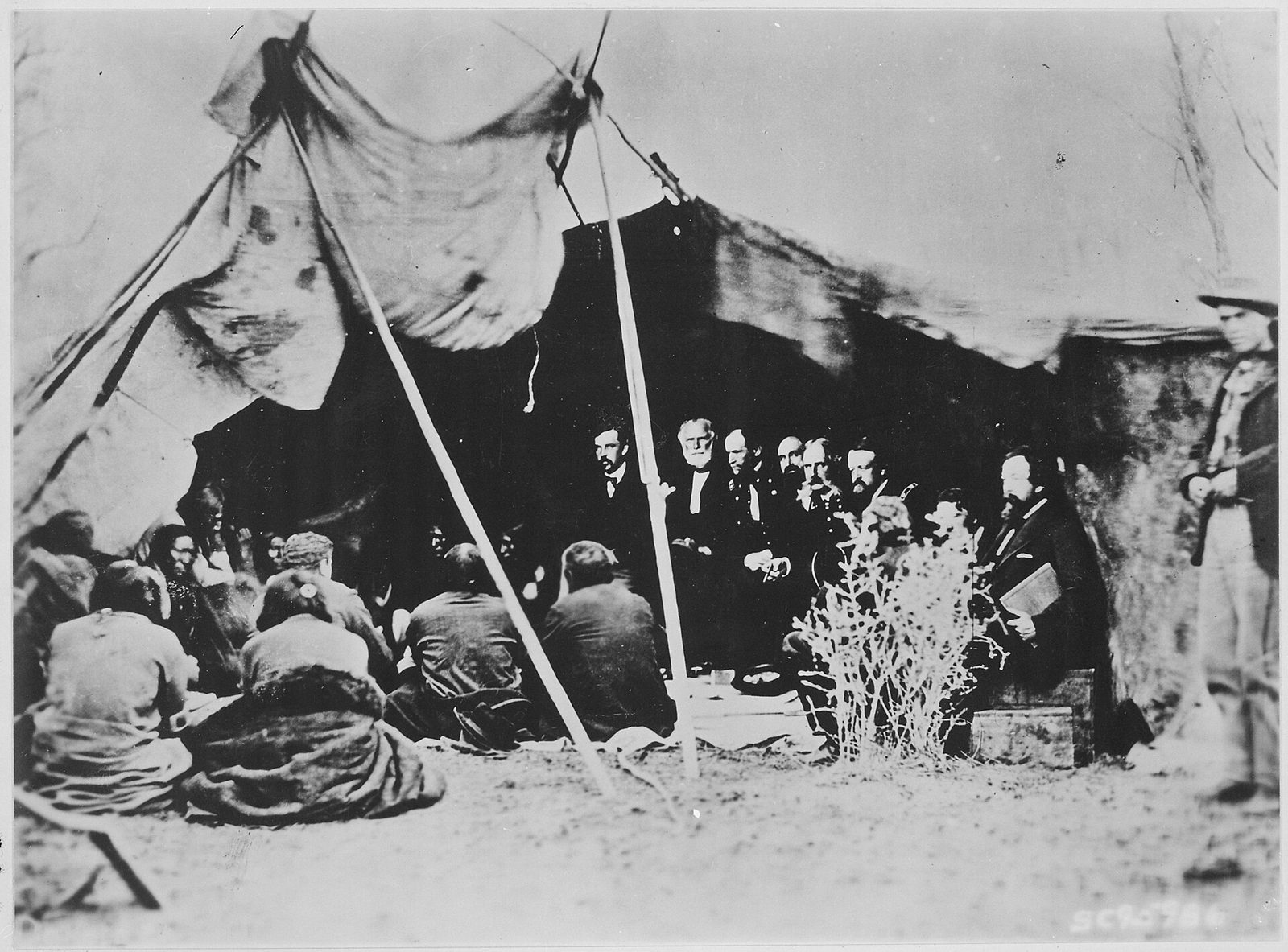
The Court did not call the taking theft. It did not rule the 1877 Act illegal or void, and it ordered no land returned. When the Oglala Sioux Tribe sued in 1980 for title to some 7 million acres of the Hills, the federal courts dismissed the suit, treating the Indian Claims Commission as “the exclusive remedy for such claims.”
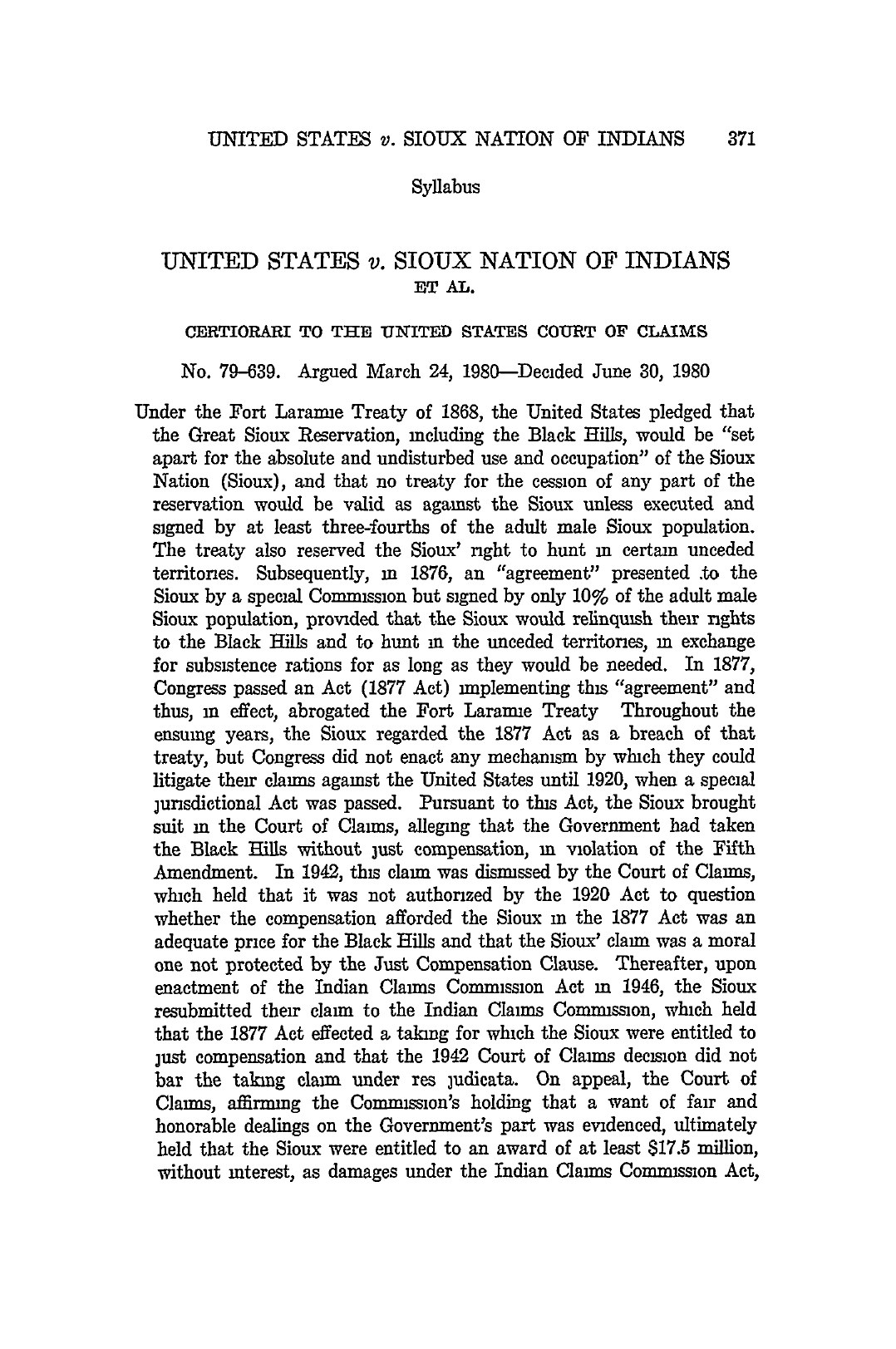
One line tied to the case is often credited to the Supreme Court: “A more ripe and rank case of dishonorable dealings will never, in all probability, be found in our history.” The Court of Claims wrote it in 1975; the Supreme Court only quoted it.
What the Record Shows
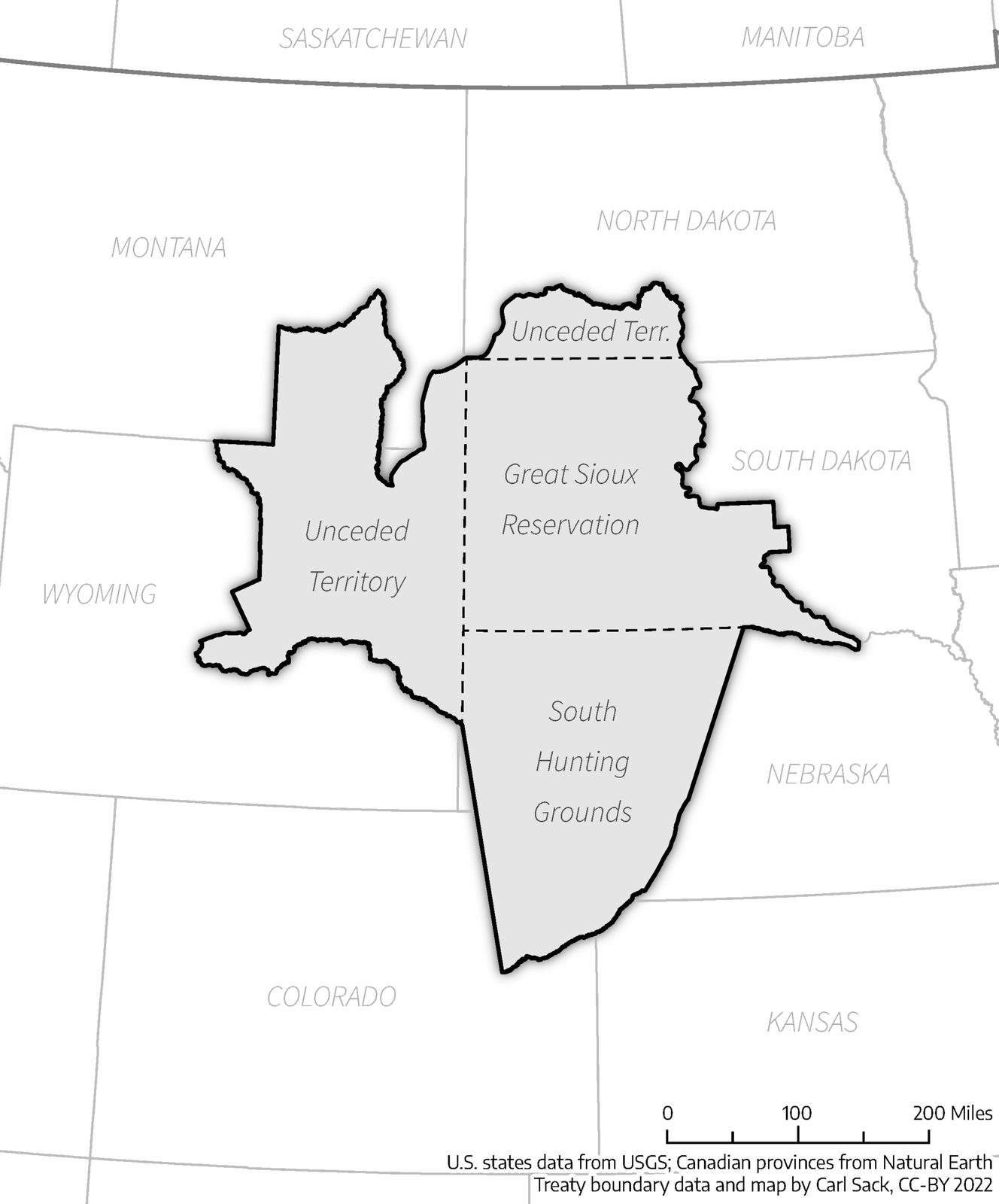
The 1868 Fort Laramie Treaty set the Great Sioux Reservation, the Black Hills among its lands, apart for the tribes’ “absolute and undisturbed use and occupation,” and its Article XII made any cession of that land invalid unless at least three-fourths of the adult men signed it. In August 1876, Congress barred any further money for the tribes’ food unless they first gave up the Hills and their land and claims outside the reservation. A federal commission then presented a cession agreement to chiefs and headmen only, and “it was signed by only 10% of the adult male Sioux population,” the Supreme Court found. Congress made it law anyway in the 1877 Act. In the Supreme Court’s own words, the Court of Claims had also remarked on “the pattern of duress practiced by the Government on the starving Sioux.”
Consent required from three adult men in four, given by one in ten, under a law that tied future food to giving up the land: on that record, the plain words are the accurate ones. The land was stolen. That judgment rests on the treaty, the statutes and the courts’ own findings of duress and dishonorable dealing, not on what the Supreme Court held. The full account is on The 1876 War and the Taking of the Hills, and the treaty’s terms are on The Fort Laramie Treaties of 1851 and 1868.
Why Won’t the Tribes Take the Money?
The tribes hold that taking the money would end their claim to the land. Oglala Sioux Tribe President Frank Star Comes Out said in 2025 that all the tribes have given the United States the same answer since 1980: “The Black Hills Are Not For Sale.” Gerald Clifford, a Lakota leader of the Black Hills Steering Committee, said in 1988 that accepting the award would “bless the taking of the Black Hills.”
The Interior Department holds the money in trust and invests it. The balance has never been made public. News reports put it at more than $1 billion as of 2010 to 2011; Ross Swimmer, the federal special trustee who oversaw it from 2003 to 2009, put it at $1 billion in 2011. A 2024 news report gave more than $2 billion, a figure no published account statement supports.
Some tribal members have sought their shares. A group of them sued, and a federal court dismissed the suit in 2011, noting that all the participating tribes had passed resolutions against any distribution.
The Bradley Bill of the 1980s
The Black Hills Steering Committee, set up by tribal councils and traditional groups, wrote a land-return bill, which Senator Bill Bradley of New Jersey introduced in 1985 as the Sioux Nation Black Hills Act, and again in 1987. It would have returned more than a million acres of federal land, mostly national forest, to be governed by a Sioux National Council. Mount Rushmore would have stayed federal, and the 1980 money would have paid for the lost use of the land since 1877, “and not for extinguishment of title.”
South Dakota’s congressional delegation opposed the bill, and the state Legislature and the councils of Lead, Deadwood and Custer passed resolutions against it. It never passed either house of Congress. The tribes were split too: a rival plan that added roughly $3 billion won only the Oglala council’s endorsement.
What Does Land Back Ask For Today?
In the Black Hills, Land Back asks for public land to go back to the tribes. NDN Collective, a Rapid City organization that calls itself “Indigenous-led,” runs the LANDBACK campaign there as part of a wider push to recover tribal ownership of tribal land across North America. On July 3, 2020, the day President Donald Trump visited Mount Rushmore, protesters blocked the road to the monument, and 21 people were arrested, including Nick Tilsen, then NDN’s president. Launching the campaign that October 12, Indigenous Peoples’ Day, NDN called for closing Mount Rushmore as a national monument; Tilsen asked that “all public lands in the Black Hills be returned to Indigenous people.”
In 2020 the National Congress of American Indians, a body of tribal governments, backed the tribes’ call for the United States to “begin the return of the Federal lands in the Black Hills” and asked the President to put the Black Elk Wilderness and Wind Cave under tribal management, Wind Cave as a tribal national park.
The newest effort is a draft bill its backers call the He Sapa Restoration Act, which would return federal land in the Black Hills to the Seven Council Fires, the Očhéthi Šakówiŋ, protect it from mining and other extraction, and guard drinking water. They say it “does not involve privately owned lands” and would not settle the tribes’ claims under the 1868 treaty. The Standing Rock Sioux Tribe’s council endorsed it in November 2024, and in June 2026 NDN Collective announced that all nine tribes in South Dakota had passed resolutions backing work on the legislation, which is still in early draft.
The Sicangu Treaty Council declined to support the draft. Its executive director, Philimon Two Eagle, a Brulé Lakota, said in 2024 that it could weaken the original treaties and would likely be “dead on arrival” in Congress. Only a new treaty could change the old ones, he argued, and true justice would mean settlers leaving the treaty lands.
Public Land, Private Land and the Objections
These proposals aim at public land, above all the Black Hills National Forest. Private land is left out. The Bradley bill protected it, a 2016 resolution in the South Dakota Legislature said private lands and homes may not be affected, and the current draft excludes it. None of these proposals would take anyone’s home.
Federal courts have treated the Black Hills claim as a claim for money, decided by the 1980 award; any other answer, a federal judge wrote in 2011, would have to come from Congress. PBS NewsHour reported in 2011 that President Barack Obama had offered to meet with the tribes on the claim if they first agreed on a single proposal to settle it in Congress.
South Dakota’s elected officials have repeatedly opposed land return. In February 2016 a state House committee voted 13 to 0 to kill that year’s resolution backing compensation and the return of select national forest land; House Minority Leader Spencer Hawley, a Democrat, granted that the state had a poor history with the tribes but called the resolution too “open-ended.” In 1988 Deadwood’s mayor, Tom Blair, said the region was “too far down the road to turn over the hills part and parcel.” Custer’s mayor, Annila Wright, feared for a town ringed by national forest that would have passed to the tribes, and many residents worried about being shut out of the Hills. Tribal members, for their part, needed permission to use ceremonial sites there. Cindy Reed, a rancher near Hot Springs, backed the bill: as landowners, she said, she and her husband believed a wrong had been done and had to be put right.
The question is still open. The money stays invested in an account the tribes refuse to touch, and the National Archives, describing the 1868 treaty, calls ownership of the Black Hills still disputed. The chain from gold to this standoff is laid out in Gold, a Broken Treaty and Land Back.
Connected
- The Fort Laramie Treaties of 1851 and 1868The treaty and the consent rule the taking broke.
- The 1876 War and the Taking of the HillsThe events of 1874 to 1877 that the 1980 ruling looked back on.
- Gold, a Broken Treaty and Land BackThe chain from Custer’s gold to the land claim, step by step.
- Mount Rushmore and Crazy Horse MemorialTribal views of the monument at the center of the 2020 protest.
- Wounded KneeThe 1890 massacre and the 1973 occupation, from Lakota accounts.
- Hé Sápa: Why the Hills MatterWhat the Hills mean in Lakota understanding.
- Land Back in Plain TermsThe court claim, the refused money and the call for land, kept apart.
Further reading
- Sacred He Sapa Restoration Act Strategy Session, Standing Rock Sioux Tribe
- Resolution PDX-20-019: Seeking Presidential Action to Achieve Justice and Reconciliation with Respect to Sacred Places in Indian Country, National Congress of American Indians
- He Sapa LANDBACK, NDN Collective
- Black Hills still not for sale, Oglala Sioux Tribe rejects FOIA request to unseal value, ICT
- Text of the Sioux Nation Black Hills Act (the Bradley bill), Indianz.com
Sources
- United States v. Sioux Nation of Indians, 448 U.S. 371. Supreme Court of the United States, 1980 (Legal Information Institute, Cornell Law School).
- Treaty of Fort Laramie (1868). National Archives, Milestone Documents.
- Oglala Sioux Tribe of the Pine Ridge Indian Reservation v. Homestake Mining Co., 722 F.2d 1407. U.S. Court of Appeals for the Eighth Circuit, 1983 (OpenJurist).
- Different Horse v. Salazar, No. CIV 09-4049. U.S. District Court for the District of South Dakota, 2011 (National Indian Law Library).
- Why the Sioux Are Refusing $1.3 Billion. PBS NewsHour, 2011.
- For Great Sioux Nation, Black Hills Can’t Be Bought for $1.3 Billion. Mike Fritz and Hari Sreenivasan, PBS NewsHour, 2011.
- Black Hills still not for sale, Oglala Sioux Tribe rejects FOIA request to unseal value. Talli Nauman, Buffalo’s Fire, published by ICT, 2025.
- The West: Battle for the Black Hills. Peter Carrels, Reason, 1988.
- Sioux turn to Congress to regain Black Hills land. South Dakotans split by bill to settle dispute. Candy Hamilton, Christian Science Monitor, 1988.
- Sioux Nation Black Hills Act (bill text). Indianz.com, posted 2020.
- Sioux Nation Black Hills Act: Hearing on S. 1453 (Senate Hearing 99-844). Senate Select Committee on Indian Affairs, 1986.
- Sioux Nation Black Hills Act (S. 705). Congressional Record Index, 1987.
- Setting record straight on the Black Hills Claim. Petra Wilson, Native Sun News (republished by Indianz.com), 2014.
- NDN Collective LANDBACK Campaign Launching on Indigenous Peoples’ Day 2020. NDN Collective, 2020.
- He Sapa LANDBACK. NDN Collective.
- All Nine South Dakota Tribes Pass Resolutions Supporting Developing Legislation to Return Federal Lands. NDN Collective, 2026.
- ‘Black Hills are not for sale’: South Dakota tribes unite behind federal land return proposal. Tamara Chibe, KOTA, 2026.
- Native leaders draft bill to regain some of sacred Black Hills. Amelia Schafer, ICT, 2024.
- Sacred He Sapa Restoration Act Strategy Session. Standing Rock Sioux Tribe, 2024.
- Resolution PDX-20-019: Seeking Presidential Action to Achieve Justice and Reconciliation with Respect to Sacred Places in Indian Country. National Congress of American Indians, 2020.
- House Concurrent Resolution 1010. South Dakota Legislature, 2016.
- South Dakota lawmakers kill bill to support return of land to tribes. Indianz.com, citing the Mitchell Daily Republic, 2016.
- Report on House Concurrent Resolution 1010 in the South Dakota Legislature. Courthouse News Service, 2016 (the page shows no date).
Last reviewed: