The Tribes and Hé Sápa
The Sun Dance
In March 2003, after a two-day meeting on protecting ceremonies at Eagle Butte, South Dakota, Arvol Looking Horse put in writing what the Sun Dance is for. The ceremony is held, said the 19th-generation Keeper of the Sacred White Buffalo Calf Pipe, “for the survival of the future generations to come, first and foremost.” The Sun Dance is a summer ceremony of prayer, fasting and sacrifice, held by the Lakota and by many other nations of the Plains, and it goes on today. For 51 years, from 1883 to 1934, federal rules made it an offense. On the ceremony itself, what follows keeps to what tribes and tribal members have made public. It also covers the ban, the Sun Dance’s return and the Wyoming mountain named for it.
What Is the Sun Dance For?
In the words of people who hold it, the Sun Dance is prayer offered through sacrifice, for others. Ivan F. Starr, writing from Oglala on the Pine Ridge Reservation in 2013, counted it among the seven Lakota ceremonies. He described dancers going without food or water to ask for help from relatives who have died, help they then carry to relatives still living. The National Park Service, describing the ceremony at Devils Tower, says its fasting and sacrifice bring renewal for each dancer and for the whole community.
Eagle Feather, a medicine man from St. Francis on the Rosebud Reservation, once answered white people who told him his people worship the sun: “we worship the same almighty God you worship.” A 1970 article in the Penn Museum’s magazine, Expedition, records his words. Dale Stover of the University of Nebraska at Omaha writes in the Encyclopedia of the Great Plains that the ceremony’s main purpose is sacrifice, given in return for help from spiritual powers so that families and the whole people do well.
The Sun Dance is not the Lakota’s alone. Stover places the Arapaho, the Northern and Southern Cheyenne, the three Blackfoot nations, and the Lakota and Dakota at its core, and names 15 more who took it up, among them the Kiowa, Crow, Shoshone, Ponca, Mandan, Hidatsa and Arikara. Several of those nations have documented ties to the Black Hills. The Crow ceremony ended in the 19th century, he writes, and was revived in 1941 in the Shoshone form.
Park Service records place a traditional Lakota Sun Dance at Devils Tower near the summer solstice, and modern ones there since 1983, though not every year. What the tower means to the tribes is told on Sacred Sites.
An Offense by Rule, Not by Law
The Sun Dance became a federal offense in 1883 through rules written in the Office of Indian Affairs, with no act of Congress behind them, as the Native American Rights Fund’s law library notes. In a letter dated December 2, 1882, Interior Secretary Henry Teller asked for an end to “the old heathenish dances, such as the sun-dance,” and said agents should be told to force a stop wherever the tribes would not give them up.
Commissioner of Indian Affairs Hiram Price answered with the “Rules Governing the Court of Indian Offenses,” dated March 30, 1883. The Sun Dance was among the offenses they listed, along with other dances. Courts of Indian Offenses at the agencies heard the cases, with judges from the tribe, chosen or approved by the agent. Punishments under the code included withholding rations and jail. Many leaders, political and spiritual, were jailed under the courts, according to a National Library of Medicine history.
The ban was a wrong. An agency of the United States made a sacred ceremony an offense on its own authority and backed the rule with the loss of food and with jail. It did not stop the Sun Dance. Many banned ceremonies had gone on in secret, the National Library of Medicine notes, and Starr writes that on Pine Ridge many Lakota kept up their ceremonies out of sight.
How Did the Ban End?
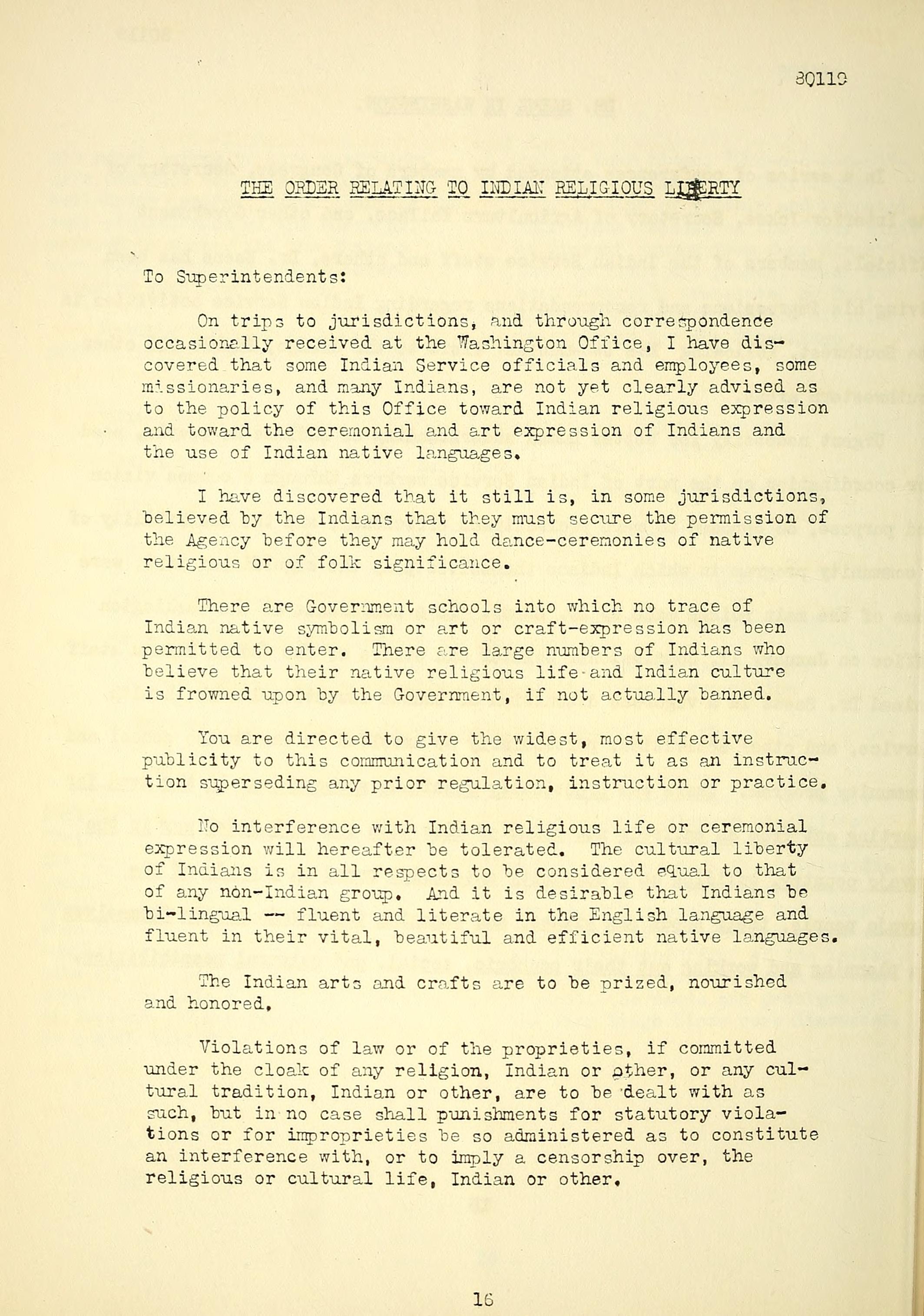
The federal rules against the Sun Dance were lifted in January 1934, not in 1978. Commissioner of Indian Affairs John Collier issued an order on religious liberty, Interior Secretary Harold Ickes approved it on January 8, 1934, and the federal newsletter Indians at Work printed it a week later. Collier noted that in some places people still thought they needed the agency’s permission to hold ceremonial dances. His order replaced every earlier rule and instruction on the matter and said: “No interference with Indian religious life or ceremonial expression will hereafter be tolerated.” It did not name the Sun Dance, but it set aside the rules that had. Full freedom to practice the ceremony, Stover writes, came back only after the middle of the 20th century.
On August 11, 1978, the American Indian Religious Freedom Act, a joint resolution of Congress, became law. It made it national policy to protect the tribes’ freedom to practice their traditional religions, ceremonies included, and it acknowledged that ceremonies had been “intruded upon, interfered with, and in a few instances banned.” It repealed no ban. Some accounts, including the Native American Rights Fund’s law library and a University of North Dakota archive record, say the prohibition lasted until 1978. The documents point to 1934, when the old rules were superseded.
When Did Public Sun Dances Return?
No single date marks the Sun Dance’s public return. Accounts from Pine Ridge and Yankton put the turning point in the 1970s. Starr writes that in the 1950s and 1960s the Sun Dance had been turned into a tourist event, with a fee at the gate and a powwow at night, and that the ceremony returned in strength in the mid-1970s. Looking Horse’s proclamation adds that in the early 1970s Frank Fools Crow and Looking Horse’s father, Stanley Looking Horse, opened the Sun Dance to dancers from other nations.
On the Yankton Sioux Tribe’s reservation, the first Sun Dance in more than 80 years was held June 22 to 25, 1976, as Fred Zephier Jr. recalled in a 2014 newspaper series by Vince Two Eagles. Fools Crow, a Lakota holy man, led the first two, and the tribal council gave $4,000 toward building the arbor.
Outside writers give earlier dates for the Lakota. Jeffrey Zelitch, author of the 1970 Penn Museum article, dated a revival to around 1934, in a changed form, and said the ceremony was held only now and then until about 1958 and every year at Pine Ridge after that. An online exhibition of the New-York Historical Society gives 1951 as the year Lakota public Sun Dances resumed.
Today the Sun Dance is held widely: Starr wrote in 2013 that nearly every extended family community holds one each year.
Who May Take Part?
Tribal members disagree, in public, over whether people from outside the tribes should take part in the Sun Dance. The Cheyenne River Sioux Tribe hosted the 2003 meeting at Eagle Butte, which drew spiritual leaders and bundle keepers of the Lakota, Dakota and Nakota, the Očhéthi Šakówiŋ, along with Cheyenne and Arapaho keepers. Looking Horse’s proclamation then declared that only tribal people would be allowed in the center of the Sun Dance or at the altar of the other sacred rites, and that no price should be charged to take part in any ceremony.
Responses split. Charmaine White Face, an Oglala Lakota writer, backed the proclamation as a call for respect after more than a century of forced assimilation, and noted that by the 1990s, international magazines were showing all-white Sun Dances held in Germany. “Only good can come out of having respect for sacred ways,” she wrote. Elders of the Afraid of Bear and American Horse Sun Dance, held each year in the Black Hills, disagreed, in a reply written for them by Tom Cook, a Mohawk from Akwesasne, married on Pine Ridge. They held that each extended family is sovereign in matters of religion, and that what counts is a person’s intent and the strength of their commitment, along with a family’s history with the elders. The purpose and reach of their prayers, they wrote, “can not always be limited by the color of skin nor national origin.” They also credited Looking Horse with starting the discussion, while disagreeing strongly with his first conclusions.
How Sundance Mountain Got Its Name
Sundance Mountain, an igneous mountain beside the town of Sundance, Wyoming, was named for ceremonies held on it, according to WyoHistory, the Wyoming State Historical Society’s online encyclopedia, which calls it a sacred site; a Wyoming State Library entry names the Sun Dance. The town, founded in 1879, took its name from the mountain, and a young Harry Longabaugh, jailed there from 1887 for horse theft, later carried it off as the Sundance Kid.
The town’s own story is on Sundance, Wyoming, and the chain of names on From the Sun Dance to the Sundance Kid. The name reaches a river too: the Park Service records a Lakota name for the Belle Fourche River, the Sun Dance River.
Connected
- Sundance, WyomingThe town named for Sundance Mountain.
- From the Sun Dance to the Sundance KidHow the ceremony’s name passed to a mountain, a town and an outlaw.
- Sacred Sites: Bear Butte, Devils Tower and Wind CaveDevils Tower, where Sun Dances are held again, and what it means to the tribes.
- Hé Sápa: Why the Hills MatterThe Hills in Lakota understanding.
- Who Lived in the Hills FirstThe Cheyenne, Arapaho, Kiowa, Crow and other nations tied to the Hills, several of which hold or have held Sun Dances.
- Devils Tower, Bear Butte and the Igneous Rocks of the HillsThe rock of Sundance Mountain, and why its origin is unsettled.
- The Wyoming Side of the HillsThe country around Sundance Mountain and Devils Tower.
Further reading
- Looking Horse Proclamation on the Protection of Ceremonies, Arvol Looking Horse, ICT
- Ivan F. Starr: Sharing what I have learned about the Sundance, Native Sun News, republished by Indianz.com
- Arvol’s proclamation causing pain and prayer, Charmaine White Face, ICT
- Mitakuye Oyasin: A response to the Looking Horse Proclamation, Tom Kanatakeniate Cook, for the elders of the Afraid of Bear/American Horse Sun Dance, ICT
- A Place of Reverence for Native Americans, National Park Service, Devils Tower National Monument
Sources
- Looking Horse Proclamation on the Protection of Ceremonies. Arvol Looking Horse, ICT (Indian Country Today), 2003.
- Ivan F. Starr: Sharing what I have learned about the Sundance. Ivan F. Starr, Native Sun News, republished by Indianz.com, 2013.
- Arvol’s proclamation causing pain and prayer. Charmaine White Face, ICT (Indian Country Today), 2003.
- Mitakuye Oyasin: A response to the Looking Horse Proclamation. Tom Kanatakeniate Cook, for the elders of the Afraid of Bear/American Horse Sun Dance, ICT (Indian Country Today), 2003.
- Vince Two Eagles: How Sundance returned to Yankton Sioux. Vince Two Eagles, republished by Indianz.com, 2014.
- The Rez of the Story: Sundance Traditions. Vince Two Eagles, with recollections by Fred Zephier Jr., Yankton Press & Dakotan, 2014.
- A Place of Reverence for Native Americans. National Park Service, Devils Tower National Monument, updated 2025.
- Sun Dance. Dale Stover, Encyclopedia of the Great Plains, University of Nebraska–Lincoln.
- The Lakota Sun Dance. Jeffrey Zelitch, Expedition 13:1, Penn Museum, 1970.
- The Sun Dance (Acts of Faith online exhibition). New-York Historical Society.
- Courts of Indian Offenses (from the Report of the Secretary of the Interior, 1883, with Henry Teller’s letter of December 2, 1882). Teaching American History.
- Report of the Commissioner of Indian Affairs, 1883 (excerpt). University of Idaho Library.
- Rules Governing the Court of Indian Offenses. Hiram Price, Office of Indian Affairs, 1883; record at University of North Dakota Scholarly Commons.
- Civilization Regulations and Policy. National Indian Law Library, Native American Rights Fund.
- 1883: Courts of Indian Offenses established. Native Voices timeline, National Library of Medicine.
- 1934: Commissioner calls for religious freedom for American Indians. Native Voices timeline, National Library of Medicine.
- Indians at Work 1:11, January 15, 1934 (“The Order Relating to Indian Religious Liberty,” pp. 16 to 17). Office of Indian Affairs, 1934; scan at Internet Archive.
- American Indian Religious Freedom (Public Law 95-341, 92 Stat. 469). U.S. Congress, 1978.
- Crook County, Wyoming. Nicole Lebsack, WyoHistory.org, Wyoming State Historical Society, 2014.
- Sundance (Wyoming place names). Wyoming State Library, Digital Collection Suite.
Last reviewed: