Connections
Gold, a Broken Treaty and Land Back
The Black Hills trust account’s statements have never been disclosed to the public, the Oglala Sioux Tribe’s treasurer, Cora White Horse, said in a notarized affidavit in 2025, when the tribe objected to a reporter’s request to the Interior Department for the latest one. The tribe’s president, Frank Star Comes Out, called the request an attempt to get the tribe to “implicitly accept the 1980 Black Hills Claim.” The account holds the award for land Congress took from the tribes in 1877. Behind it runs a chain of causes: creek gold, an Army expedition, a broken treaty, a war, a food law, a court ruling and Land Back.
Why Did Gold Matter So Much?
Gold mattered because almost anyone could get at it, and because the country needed it. No mill was needed for placer gold: weathering had already freed it from the rock and left it in creek gravel, ready for one miner and a pan. In 1874 the country had been in a deep depression for about a year and needed economic relief, Smithsonian Magazine notes.
An Expedition Into Land the Treaty Had Closed
For the Lakota, the breach began with the Army’s own march. The Custer Expedition of 1874 marched from July 2 to August 30, and in late July and early August its prospectors reported gold on French Creek, near present-day Custer. In 2023 testimony to the Senate, Cheyenne River Sioux Tribe Chairman Ryman LeBeau said the rush began because Custer brought newspaper reporters on what LeBeau called a secret expedition. In the Lakota view the march itself broke the treaty, the Supreme Court recorded; Fast Bear, a chief, later named Custer’s trail “that thieves’ road.”
The Fort Laramie Treaty of 1868 had made the Hills part of the Great Sioux Reservation, land set apart “for the absolute and undisturbed use and occupation of the Indians herein named.” Miners seeking gold rode with the column, the National Archives notes. President Ulysses S. Grant soon faced calls from the West, in its newspapers and in Congress, to annex the Hills, Smithsonian Magazine writes.
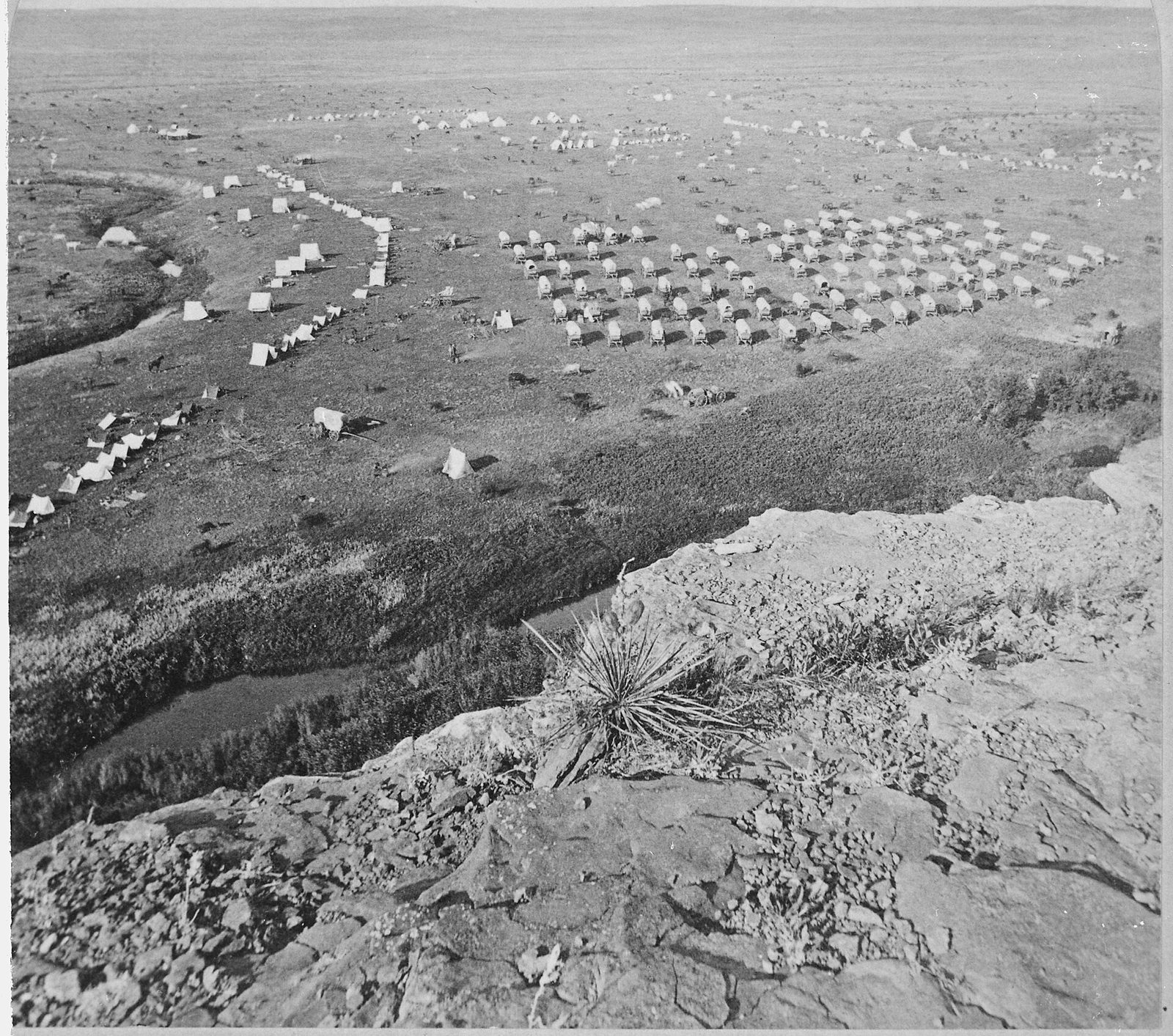
The Gordon Party of miners reached French Creek on December 23, 1874. In 1875 the tribes turned down a federal offer of $6 million for the Hills. That November Grant decided the Army would no longer oppose the miners, and The Black Hills Gold Rush follows them in.
A War, a Food Law and One Signature in Ten
The war left the bands dependent on government food, and Congress then made that food conditional. Bands off the reservation, many hunting in the treaty’s unceded territory, were ordered to report to the agencies by January 31, 1876, which that winter made impossible, the Supreme Court said. Grant began the war that January “to take the Black Hills without our consent or compensation,” LeBeau testified. Lakota, Cheyenne and Arapaho warriors won the Battle of the Little Bighorn, which the Lakota call the Battle of the Greasy Grass, on June 25 and 26, 1876. Those who surrendered later were stripped of weapons and horses, and from then on government rations were all that kept them fed, the Supreme Court recounted.
A law of August 15, 1876, as the Supreme Court quoted it, provided that “hereafter there shall be no appropriation made for the subsistence” of the bands unless they first ceded the Black Hills and their hunting grounds beyond the reservation. That fall a commission asked only chiefs and headmen to sign a cession agreement, and in the Rosebud Sioux Tribe’s history, Spotted Tail was “forced to sign.” Article XII of the treaty required “at least three fourths of all the adult male Indians” to sign any cession of reservation land. The agreement “was signed by only 10% of the adult male Sioux population,” the Supreme Court found.
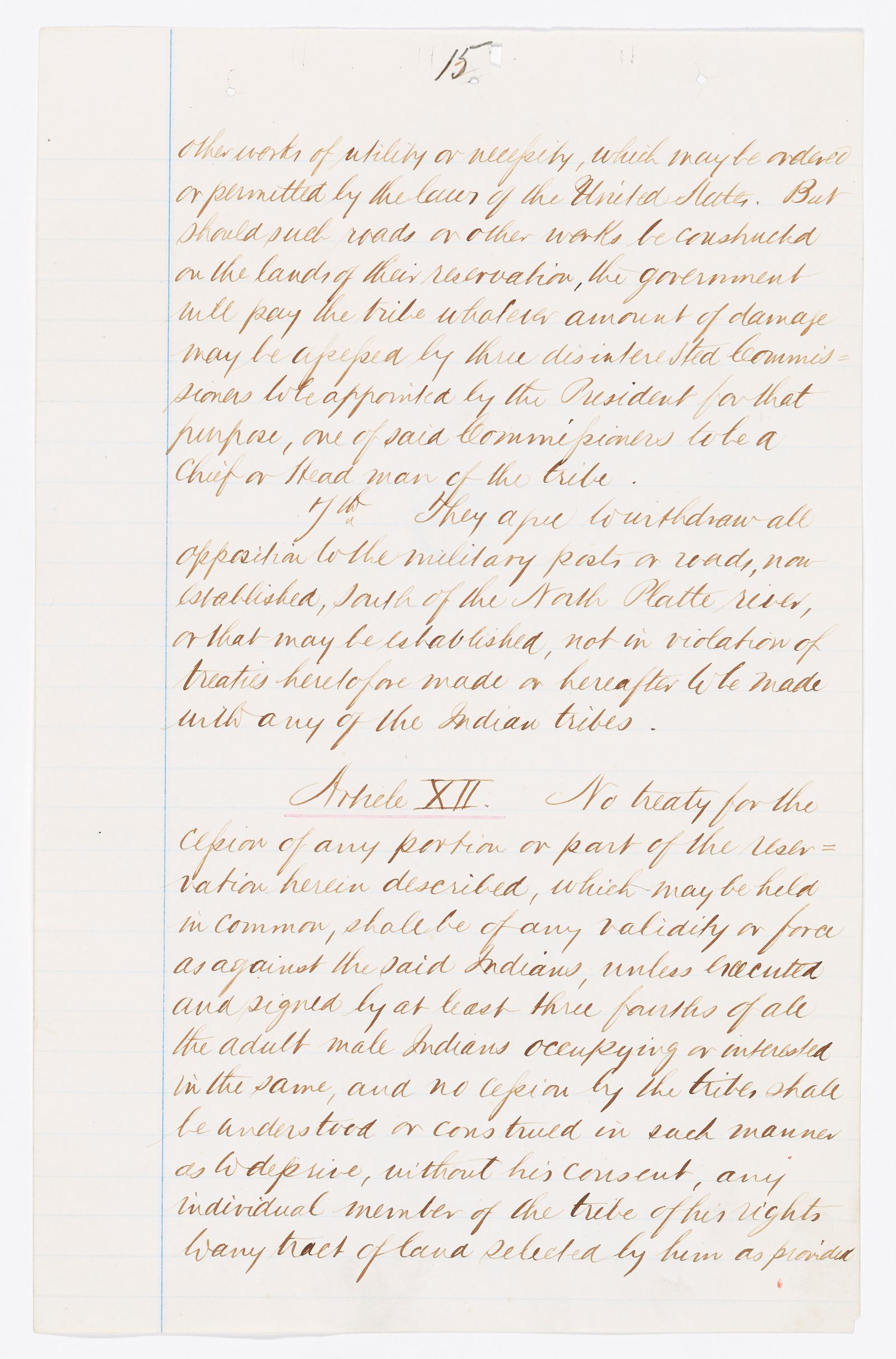
Congress enacted it regardless on February 28, 1877, taking the reservation west of the 103rd meridian and between the forks of the Cheyenne River, and on the Wyoming side the treaty’s unceded territory and the right to hunt there. The treaty’s consent rule was never met, and the few who signed did so after Congress had made future food money depend on the cession. The land was stolen. Summarizing the Court of Claims’ findings, the Supreme Court wrote of “the pattern of duress practiced by the Government on the starving Sioux.” The 1876 War and the Taking of the Hills tells the whole sequence.
What the Court Decided, and Why the Tribes Said No
On June 30, 1980, in United States v. Sioux Nation of Indians, the Supreme Court held, 8 to 1, that in the 1877 Act Congress made a Fifth Amendment taking of tribal property, for which the government owed just compensation with interest: $17.1 million, the land’s 1877 value, plus 5 percent a year since 1877, which came to about $106 million. The Indian Claims Commission had also held the United States liable for gold that trespassing prospectors dug before 1877, worth $450,000 in the ground. Nowhere did the Court call the taking theft or hold the Act illegal or void, and it ordered no land returned. It did quote the Court of Claims, which had written in 1975: “A more ripe and rank case of dishonorable dealings will never, in all probability, be found in our history.”
The tribes have never accepted the money; in their view, taking it would surrender the claim to the land itself. Accepting it would end “the treaty obligations that the federal government has with us,” Theresa Two Bulls, a former Oglala Sioux Tribe president, told PBS NewsHour in 2011. Gerald Clifford, a Lakota who coordinated the Black Hills Steering Committee, gave another reason in 1988: “You cannot sell what is sacred.” A federal court noted in 2011 that all eight participating tribes had voted against any payout, and that any other resolution “must come from Congress.” News reports put the fund at more than $1 billion as of 2010 to 2011.
What Land Back Seeks in the Hills
Land Back’s newest vehicle in the Hills is a draft He Sapa Restoration Act, which would hand federal land there to the Očhéthi Šakówiŋ, the Seven Council Fires. Standing Rock’s tribal council voted its support on November 12, 2024. By June 2026 all nine of South Dakota’s tribes had voted to keep developing legislation to return federal land in the Hills, NDN Collective announced. Backers say it would bar mining and other extraction and leave private land, and claims under the 1868 treaty, untouched. “The Black Hills are not for sale,” Madonna Thunder Hawk, an elder of the Cheyenne River Sioux Tribe, said in June 2026.
Some tribal voices oppose the draft itself. Philimon Two Eagle, a Brulé Lakota who directs the Sicangu Treaty Council, which chose not to back it, warned in 2024 that Congress would rewrite any such bill and that it would probably be “dead on arrival” there; in his view, only a new treaty can change a treaty. At the state level, a South Dakota House committee shelved, 13 to 0, a 2016 resolution backing the return of some national forest land. On whether return would push people out, Lionel Bordeaux, president of Sinte Gleska University, said in 2011: “it’s never been our intention to remove anybody.”
As of June 2026 the legislation was still an early draft, and the 1980 award sat in a federal trust account that no tribe has drawn on.
Connected
- Gold and the Other MineralsPlacer gold in the creeks and lode gold in the rock at Lead.
- The Custer Expedition of 1874The Army march whose gold reports drew miners onto treaty land.
- The Fort Laramie Treaties of 1851 and 1868The reservation the 1868 treaty set apart, and its three-fourths rule.
- The 1876 War and the Taking of the HillsThe war, the food law and the 1877 Act, told in full.
- The 1980 Ruling and Land BackThe award the tribes refuse and the land return proposals since.
- The Black Hills Gold RushThe miners who came in after the expedition.
- Hé Sápa: Why the Hills MatterWhy the tribes say the Hills cannot be sold.
- Land Back in Plain TermsThe court claim, the refused money and the call for land, kept apart.
Further reading
- Testimony of Chairman Ryman LeBeau, Cheyenne River Sioux Tribe, before the U.S. Senate Committee on Indian Affairs, 2023
- History and Culture, Rosebud Sioux Tribe
- Treaty of Fort Laramie (1868), with transcript, National Archives
- United States v. Sioux Nation of Indians, 448 U.S. 371 (1980), full text, Legal Information Institute, Cornell Law School
Sources
- Testimony of Ryman LeBeau, Chairman, Cheyenne River Sioux Tribe, on S. 2088, the Wounded Knee Memorial and Sacred Site Act. U.S. Senate Committee on Indian Affairs, 2023.
- History and Culture. Rosebud Sioux Tribe.
- Black Hills still not for sale, Oglala Sioux Tribe rejects FOIA request to unseal value. Talli Nauman, Buffalo’s Fire, published by ICT, 2025.
- The West: Battle for the Black Hills. Peter Carrels, Reason, 1988.
- For Great Sioux Nation, Black Hills Can’t Be Bought for $1.3 Billion. Mike Fritz and Hari Sreenivasan, PBS NewsHour, 2011.
- Why the Sioux Are Refusing $1.3 Billion. PBS NewsHour, 2011.
- Native leaders draft bill to regain some of sacred Black Hills. Amelia Schafer, ICT, with the Rapid City Journal, 2024.
- All Nine South Dakota Tribes Pass Resolutions Supporting Developing Legislation to Return Federal Lands. NDN Collective, 2026.
- ‘Black Hills are not for sale’: South Dakota tribes unite behind federal land return proposal. Tamara Chibe, KOTA, 2026.
- Treaty of Fort Laramie (1868), transcript. National Archives, Milestone Documents.
- United States v. Sioux Nation of Indians, 448 U.S. 371. Supreme Court of the United States, 1980 (Legal Information Institute, Cornell Law School).
- United States v. Sioux Nation of Indians, 448 U.S. 371, with footnotes. Supreme Court of the United States, 1980 (Public.Resource.Org).
- Different Horse v. Salazar, No. CIV 09-4049. U.S. District Court for the District of South Dakota, 2011 (National Indian Law Library).
- Ulysses S. Grant Launched an Illegal War Against the Plains Indians, Then Lied About It. Smithsonian Magazine.
- South Dakota lawmakers kill bill to support return of land to tribes. Indianz.com, 2016.
Last reviewed: