History
The Black Hills Gold Rush
The six covered wagons that left Sioux City on October 6, 1874, bore a false destination in paint: “O’NEILL’S COLONY,” a Nebraska settlement soldiers had no reason to block. The wagons were really headed for the Black Hills, which the 1868 treaty closed to outsiders. Their passengers, the Gordon Party, opened the Black Hills gold rush of 1874 to 1877, when thousands of miners crossed onto that treaty land, worked its creeks with pans, rockers and sluices, and outlasted the Army’s attempts to keep them out.
The Gordon Party Winters at French Creek
Twenty-eight people set out, among them one woman, Annie Tallent, and her 10-year-old son. On December 23, 1874, they reached French Creek near present-day Custer, where prospectors with the Army’s Custer Expedition had reported gold that summer. They built a stockade about 80 feet on a side and spent the winter sinking pits in the gravel. The gold was real but scant: the officer sent to remove them saw a few miners holding “small quantities of beautiful floss gold.”
That officer, Capt. John Mix, rode out of Fort Laramie with a cavalry company in March 1875 and found the stockade in early April. The party marched out with his troops, on April 10 by his account. Food, not force, probably decided it: the party was running short, the historian Watson Parker noted.
Whose Land Were the Miners On?
The Rosebud Sioux Tribe’s history puts the rush in a sentence: the United States did not honor the treaty that ended Red Cloud’s War, and “gold prospectors and miners flooded the region in the 1870s.” In 2023 Ryman LeBeau, chairman of the Cheyenne River Sioux Tribe, told a Senate committee that under the 1868 treaty the Great Sioux Nation had reserved all of western South Dakota, the Black Hills included, as its “permanent home,” and that when President Grant sent a commission in 1875 to buy the Hills, the Nation refused, as was its treaty right.
The treaty bears that out. Article II set the Great Sioux Reservation, which took in the Black Hills, Hé Sápa, apart for the tribes’ “absolute and undisturbed use and occupation” and barred outsiders from passing over, settling on or living in it. The Gordon Party and every miner who followed them before 1877 entered in violation of it.
Article 12 made any cession invalid without the signatures of three-fourths of the adult men. The 1877 Act took the Hills anyway, ratifying an 1876 agreement that, the Supreme Court found in 1980, only 10 percent of the adult men had signed. The land was stolen. How it was taken is told on The 1876 War and the Taking of the Hills.
Why Couldn’t the Army Keep Miners Out?
The Army had orders to remove miners; the trouble came after arrests. Lt. Col. Richard Dodge, who led the Army escort for the geologist Walter P. Jenney’s 1875 survey of the Hills, wrote that more than a hundred men had been caught and sent out, and that civil authorities freed every one at once.
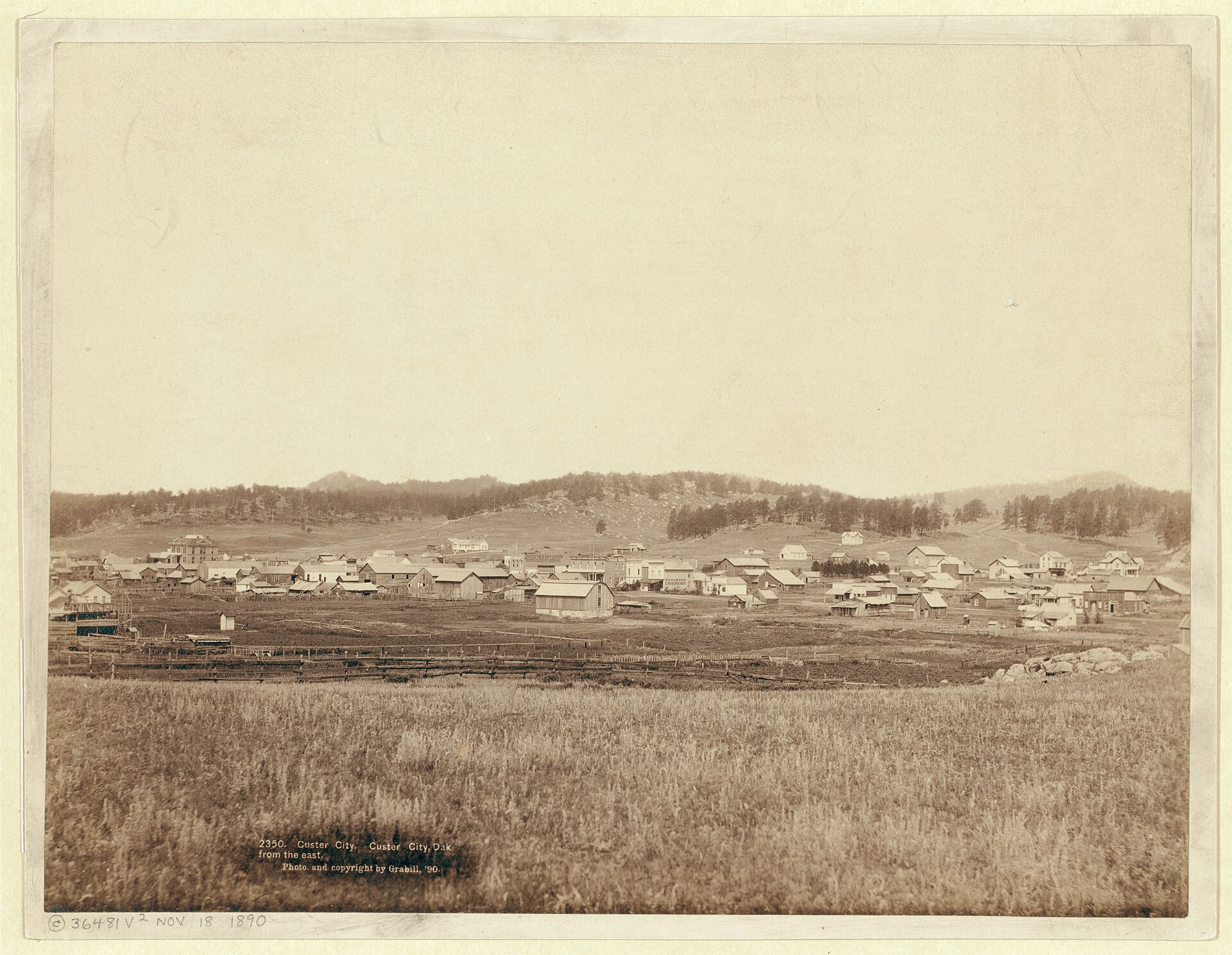
By July 20, 1875, Dodge wrote, at least 600 men had slipped past the guards. Gen. George Crook then ordered the miners out by proclamation, asking them to go on their own after first holding a miners’ meeting on August 10. They met at Custer City, laid out that same day, and divided its lots before they left. By sunrise on August 11 the valley was empty, Dodge wrote.
Many came back, and some had never left. That fall Capt. Edwin Pollock set up a post called Camp Collins at Custer. His troops rounded up dozens of miners and took them under guard to Fort Laramie, yet none was punished there, Parker found, and desertion thinned Pollock’s own ranks.
Then the government gave up. On November 9, 1875, Lt. Gen. Philip Sheridan wrote to General Terry that President Ulysses S. Grant had decided the Army would stop resisting the miners’ occupation of the Black Hills, convinced that resistance only sharpened their desire. The orders were to be enforced “quietly,” and a second Sheridan letter, to General Sherman, said the decision was to stay confidential, as the Supreme Court recounted in 1980.
Who Came, and How Many?
Before the 1880 census there are only estimates. In January 1876 they ran from about 800 men at work in the Hills to 4,000 in and around them, and one early 1876 figure of 6,000 to 10,000 came from someone Parker judged “probably an optimist.” By Parker’s reckoning, some 7,000 men came and went during 1876, and the most in the Hills at any one time was about 5,000. The 1880 census found about 16,500 people in Lawrence, Pennington and Custer counties.
Parker went through the roster of the Society of Black Hills Pioneers, men who arrived before 1877. About two in five were born outside the United States, and about as many in New York, Pennsylvania, Ohio, Illinois or Kentucky. Many had worked earlier rushes in California, Nevada, Colorado and Montana; most of the miners Jenney met on Castle Creek were Montana men. Chinese miners and merchants came as well, and Deadwood gained a Chinatown.
Pans, Rockers and Sluices
In the first rush years nearly all mining was placer mining, a 1974 USGS review found: washing loose gold, freed from its rock by weathering, out of gravel. The geology is on Gold and the Other Minerals.
Three tools did the washing. In a pan, a miner swirled gravel with water until the light material spilled over the edge and the heavy gold stayed behind. A rocker was a small box sluice, rocked from side to side, that a miner could carry from claim to claim. A sluice was a line of wooden troughs; gravel and water ran through it, and cross-pieces called riffles stirred the flow so the gold could drop out.
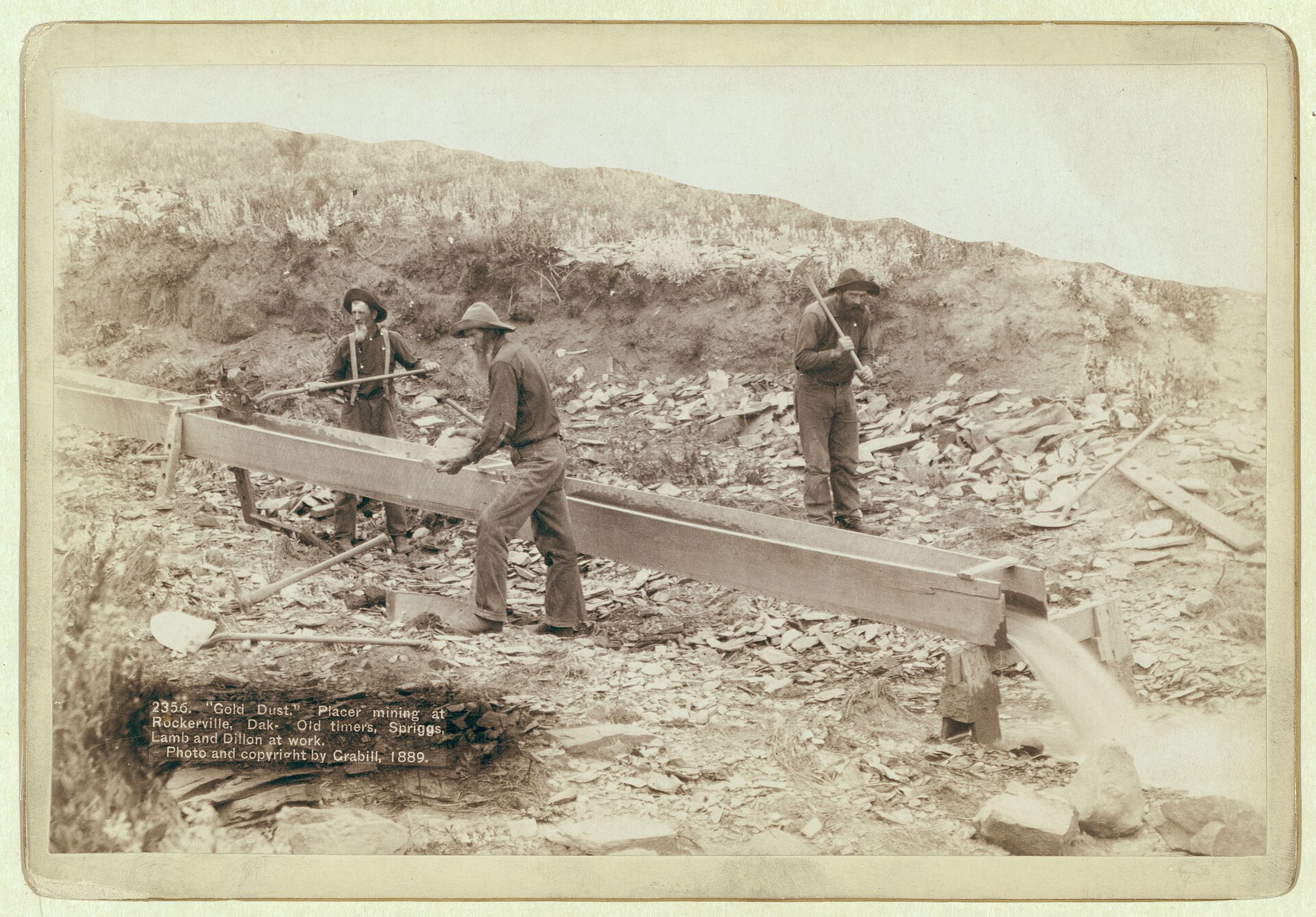
Sluices needed water in quantity. When Jenney reached French Creek in June 1875, the miners there had built small dams and were digging ditches so they could start sluicing. A few weeks later, miners above the Gordon stockade told him that three men shoveling into one small sluice had washed out nearly $27 in gold in a day.
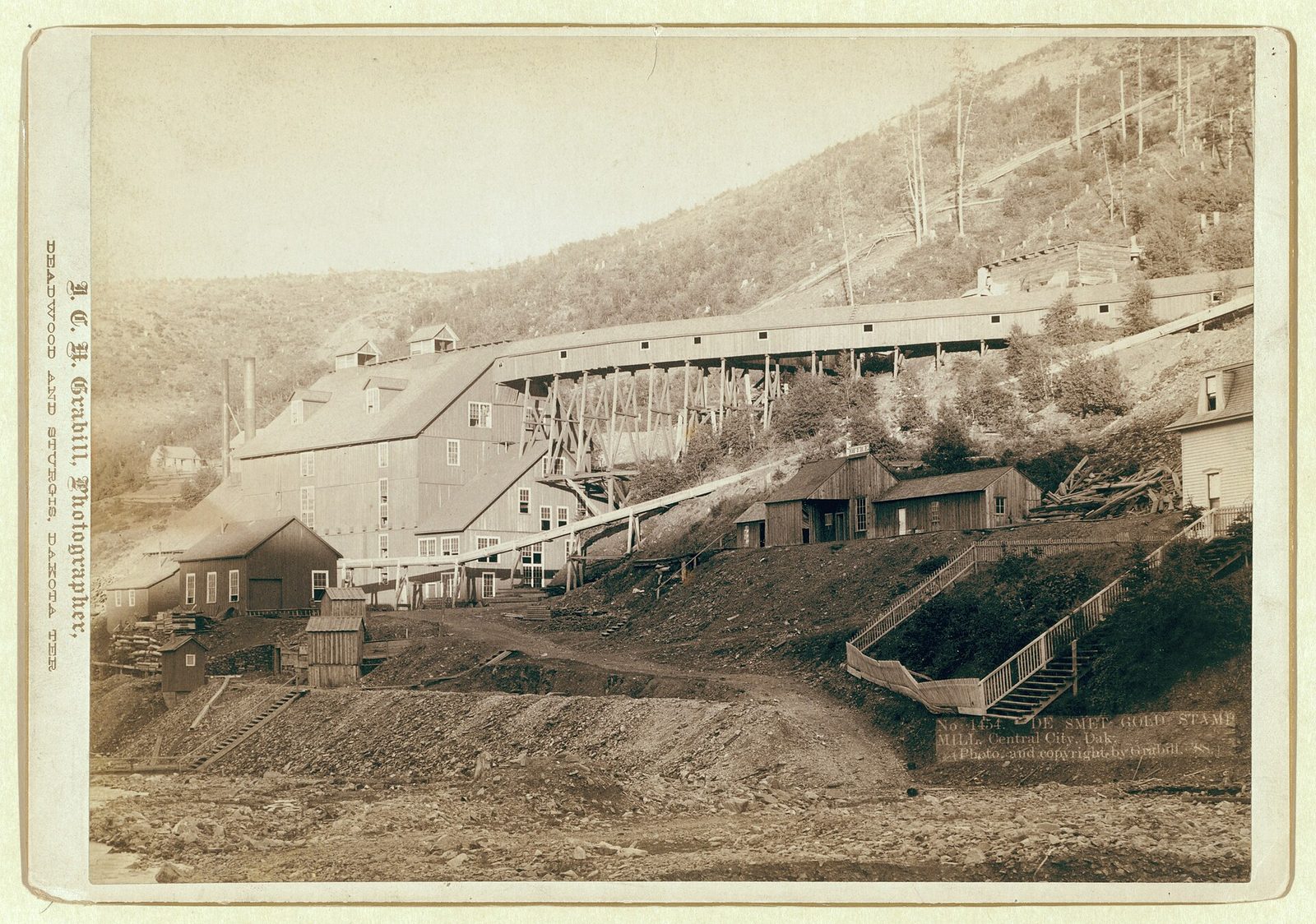
From Custer to Deadwood Gulch
In mid-January 1876 Custer held about a thousand people, by the accounts Parker collected, and Hill City, 14 miles north, a little under half that.
Gold was found in Deadwood Gulch in the fall of 1875. A state historical marker counts 50 miners in the gulch by January 1, 1876, and the USGS review ranks the gulch’s area far ahead of all other placer ground.
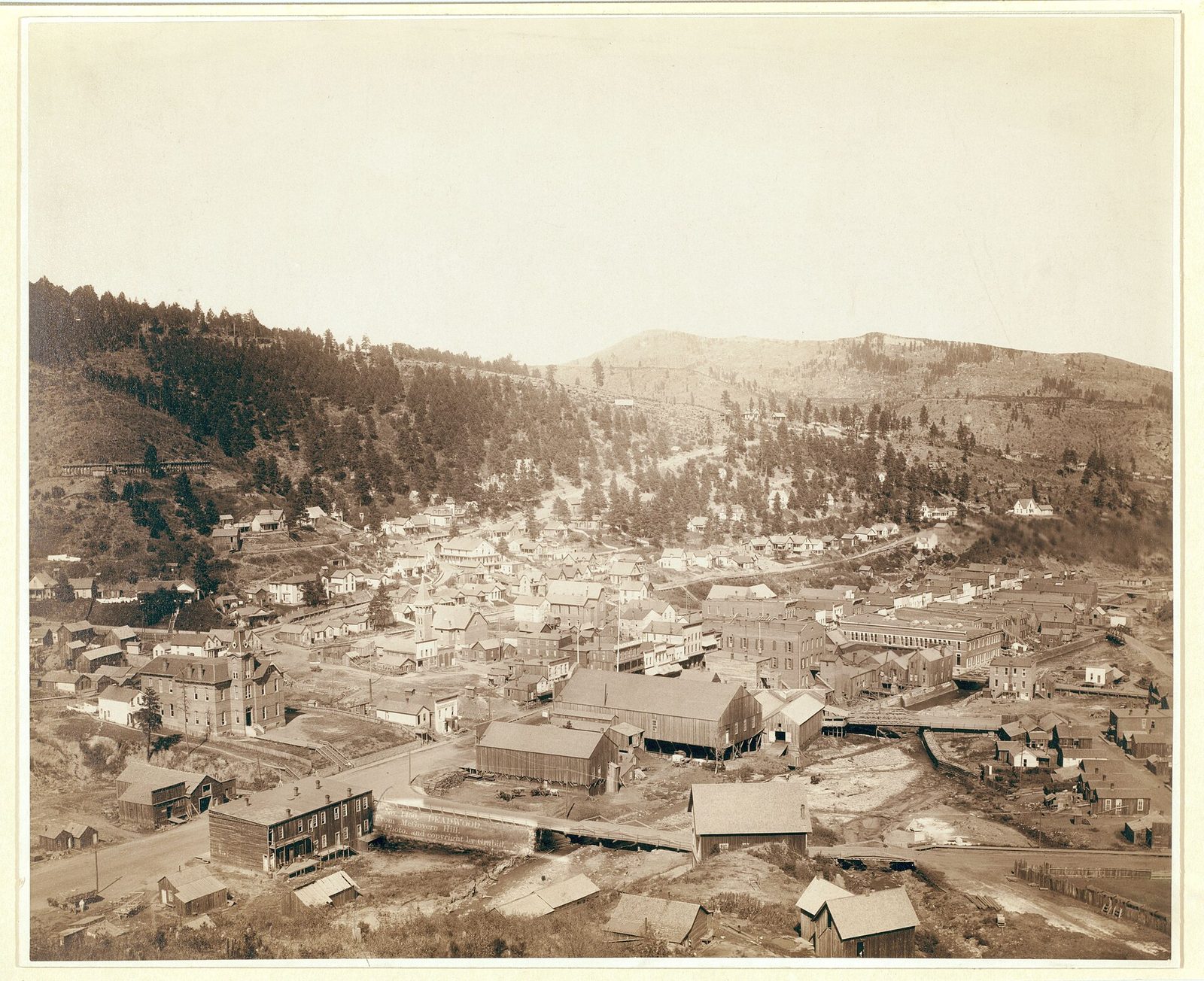
In spring the miners went north. Hill City, platted in February, had 250 houses that month and 50 by mid-April, as miners left for Deadwood, some also fearing attack during the 1876 war. By summer one visitor counted fewer than 25 people in Custer; by fall it was filling up again. Deadwood’s story is on Deadwood’s Wild Years, 1876 to 1879.
Rockerville’s dry gravel, found in December 1876, was worked with rockers or hauled to Spring Creek until a 17-mile flume brought water in 1880. How much gold came out is uncertain; the 1974 USGS review found Parker’s estimate of more than half a million dollars unsourced and probably too high. The flume lost money. Rochford belongs to the next stage, a hardrock camp on gold ledges that had more than a thousand people by the end of 1878, Parker writes. Hardrock mining, with its costly mills, took over when the northern gravels gave out late in the 1870s.
Stories the Record Doesn’t Support
The Thoen Stone, a slab found near Spearfish in 1887, is carved with a message saying seven men came to the Hills in 1833 and got gold in 1834, and that all but the writer were killed. Writing in 1965, Parker said years of study had not proved the party existed, and that the finder, Louis Thoen, was a stonemason, the most likely carver. Black Hills Gold jewelry has its own origin legend, told on Black Hills Gold: The Jewelry and Its Legend.
A 1955 marker in Hill City calls Annie Tallent the first woman to enter the Hills, though the Hills had been home to Lakota women, and to women of other tribes, long before 1874. A 2023 Forest Service assessment says Custer reached 10,000 people by the spring of 1875. The town was not laid out until that August, and in January 1876 it held about a thousand.
Nor did the rush make most miners rich. Parker put the Hills’ 1876 gold output at about $1.5 million (a later School of Mines figure: $1.2 million). Spread across the 7,000 who came that year, that would be about $200 each, but it was never spread evenly: experienced Montana and western prospectors, roughly one miner in twelve, tended to end up with the best ground. Newcomers, Parker concluded, usually left the Hills broke.
Connected
- The 1876 War and the Taking of the HillsHow the Hills the miners entered were taken from the tribes.
- Gold and the Other MineralsPlacer gold and lode gold, and why the gold lay where it did.
- Deadwood’s Wild Years, 1876 to 1879The town that grew from the richest placer gulch.
- Custer, South DakotaThe rush town laid out on French Creek in August 1875.
- Hill City, South DakotaA placer camp of 1876 that emptied and came back.
- Rochford, South DakotaA hardrock gold camp that boomed in 1878.
- Rockerville, South DakotaDry diggings, rockers and a 17-mile flume.
- Black Hills Gold: The Jewelry and Its LegendThe jewelry called Black Hills Gold, and the legend told about it.
Further reading
- History and Culture, Rosebud Sioux Tribe
- Testimony of Ryman LeBeau, Chairman, Cheyenne River Sioux Tribe, U.S. Senate Committee on Indian Affairs
- The Black Hills Gold Rush, 1874–1879 (Watson Parker), University of Oklahoma
- Gordon Stockade (The Wi-Iyohi), South Dakota State Historical Society
Sources
- History and Culture. Rosebud Sioux Tribe.
- Testimony of Ryman LeBeau, Chairman, Cheyenne River Sioux Tribe, on S. 2088, the Wounded Knee Memorial and Sacred Site Act. U.S. Senate Committee on Indian Affairs, 2023.
- Treaty of Fort Laramie (1868), transcript. National Archives.
- United States v. Sioux Nation of Indians, 448 U.S. 371. Supreme Court of the United States, 1980 (Legal Information Institute, Cornell Law School).
- Gordon Stockade (The Wi-Iyohi 15, no. 11). South Dakota State Historical Society, 1962.
- The Report of Captain John Mix of a Scout to the Black Hills, March–April 1875 (Watson Parker, editor). South Dakota History 7, no. 4, South Dakota State Historical Society, 1977.
- Exploring the Black Hills, 1855–1875: Reports of the Government Expeditions; The Scientists’ Search for Gold, 1875: Walter P. Jenney and Henry Newton (James D. McLaird and Lesta V. Turchen). South Dakota History 4, no. 4, South Dakota State Historical Society, 1974.
- The Black Hills Gold Rush, 1874–1879 (Watson Parker, doctoral dissertation). University of Oklahoma, 1965.
- Deadwood Historic District, National Historic Landmark nomination. National Park Service, 1976, amended 1989.
- Gold in the Black Hills, South Dakota, and How New Deposits Might Be Found (Circular 699, James J. Norton). U.S. Geological Survey, 1974.
- Population of States and Counties of the United States: 1790 to 1990. U.S. Census Bureau, 1996.
- What Is Placer Gold Mining? National Park Service, Yukon-Charley Rivers National Preserve, 2015.
- South Dakota State Historical Society Markers (markers 39, 67, 392 and 470). South Dakota State Historical Society, revised 2020.
- Revised Forest Assessment: Cultural Resources. USDA Forest Service, Black Hills National Forest, 2023.
Last reviewed: