History
The Homestake Mine and Sanford Lab
Under an agreement signed on March 18, 1892, the people of Lead, South Dakota, owned their houses but not the ground under them. Title stayed with the Homestake Mining Company, which wanted a free hand with the ore beneath the streets; a household or business held only a company permit and could be ordered off with 90 days' notice. The Homestake Mine grew from a claim staked on April 9, 1876, into workings more than 8,000 feet deep that produced nearly 40 million ounces of gold before the last ore came out on December 14, 2001. Its story runs from George Hearst's purchase through the company town, a lockout and the Open Cut, to the physics laboratory that moved into its tunnels, the Sanford Underground Research Facility (SURF).
Who Found the Homestake?
Four prospectors found it. On April 9, 1876, Moses and Fred Manuel, Hank Harney and Alex Engh marked out a claim where gold-bearing rock broke the surface near present-day Lead, and called it the Homestake. The claim lay on land the 1868 Fort Laramie Treaty had set apart for the tribes, a history told on The 1876 War and the Taking of the Hills.
The ore was free-milling, meaning the quartz gave up its gold fairly easily when crushed and treated with mercury. The rock that held it, a band of ancient iron-rich rock geologists call the Homestake Formation, is described on Gold and the Other Minerals.
In 1877 the finders sold out to a group headed by George Hearst, with his fellow Californians James B. Haggin and Lloyd Tevis. That November the owners incorporated the Homestake Mining Company.
The man who ran the mine for 29 years was Thomas J. Grier, a Canadian-born former telegrapher who became superintendent on July 9, 1885. Five years into his tenure, the Homestake had about 1,500 men on the payroll, and its 650 stamps, machines that pounded ore to crush it, could work through as much as 700 tons in a working day. Grier kept buying up the claims around it, and by 1901 the company held the whole mountain.
Around 1900 the company relied on outsiders for little: it logged and sawed its own lumber, ran a railroad, and generated its own electricity. Its 1899 timber contract with the government, Case No. 1, was the first regulated federal timber sale; The National Forest and the CCC has the details. The company built hydroelectric plants, including two in Spearfish Canyon finished in 1910 and 1918, and by 1925 its own plants supplied all the electricity it used; the canyon plants are part of Spearfish Creek: Power, Rails and the 1933 Flood.
Lead Under the Company
By the mid-1880s Lead depended on one mine, and the Homestake reached into almost every corner of town life. Wages were handed out at the company store, the Hearst Mercantile or Brick Store (opened in 1879), where a miner could take goods and settle up, interest-free, on payday. A company hospital went up in 1889. In December 1894 Grier opened a free library in rented rooms on the top floor of the miners' union hall, presented to the town as a Christmas gift from Phoebe Apperson Hearst, who had inherited George Hearst's estate when he died in 1891. Phoebe Hearst funded a free kindergarten, begun by Lead's Woman's Club in 1900 and dedicated in spring 1901. At the end of 1906 Grier granted miners an eight-hour day without cutting the daily wage of $3.50.
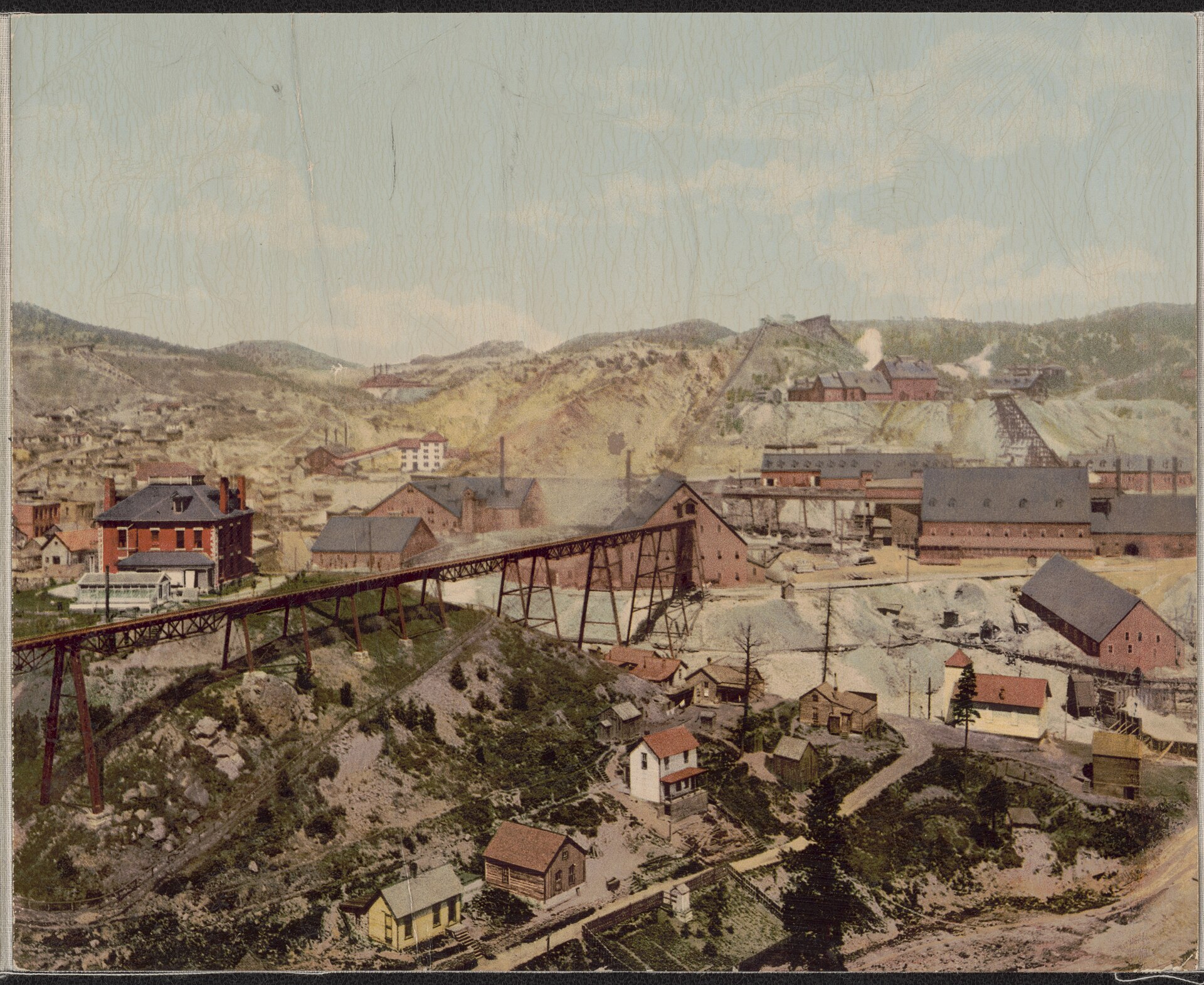
The work drew immigrants. A 1974 National Register nomination for the Lead Historic District names England, Scotland, Ireland, Italy, the Balkans and Scandinavia as the homelands of the people who made up the mine's main work force and the town's permanent residents. By 1900, the nomination says, Lead was the second-largest city in South Dakota.
The Lockout of 1909 and 1910
In late 1909 Grier locked the Homestake's miners out rather than let the union make it a closed shop, one that hires only union members. The Lead City Miners' Union, formed in 1877, had helped found the Western Federation of Miners in 1893 as its Local No. 2. In 1909 the federation set out to sign up every Homestake miner and warned of a walkout if all had not joined by November 25.
Grier announced that the company would hire only nonunion men, and in late November, before the deadline, he shut the mine. The company brought in Pinkerton detectives to back its guards. To get their jobs back, workers had to sign a card stating, "I am not a member of any labor union." The mine reopened with nonunion crews in January 1910 and was back at full production on March 3. Within a few years the local had lost its charter, and no union was voted in at the Homestake again until 1966, when, by SDPB's account, the United Steelworkers of America won by a narrow margin.
Grier then widened the benefits. Workers no longer paid $1.10 a month toward the company hospital, and they and their families were treated free. He also started an employee aid fund on August 1, 1910, to pay for accidents, illness and deaths, and added a yearly bonus of 7 percent of wages.
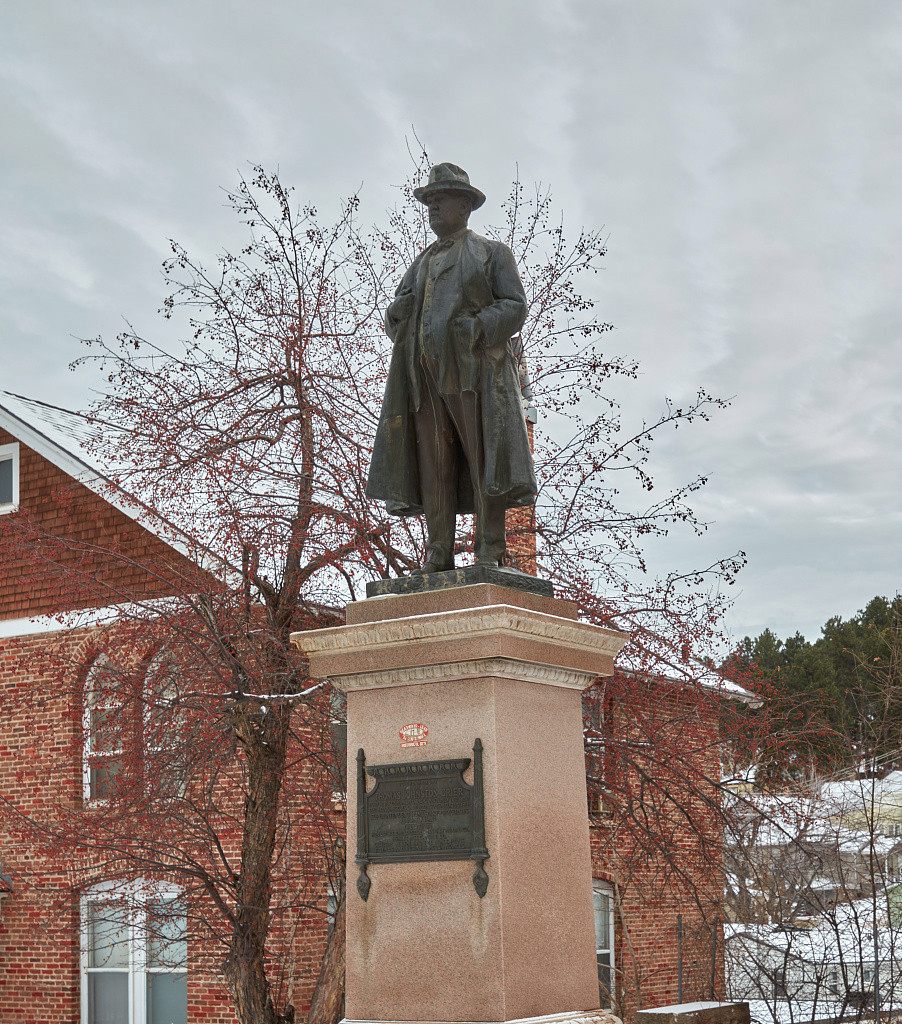
The largest gift was the Homestake Opera House and Recreation Building, which Grier planned with Phoebe Hearst and which opened on August 31, 1914. It held a theater, the library, a heated swimming pool and a bowling alley, and everything but the theater was free to Lead residents. In 1984 a fire burned out the theater.
That same August, a congressional inquiry into working conditions held hearings in Lead. One member, Austin B. Garretson, president of the railway conductors' union, called Grier's rule "a despotism, benevolent though it may be." Grier died in Los Angeles on September 22, 1914, three weeks after the Opera House opened.
What Is the Open Cut?
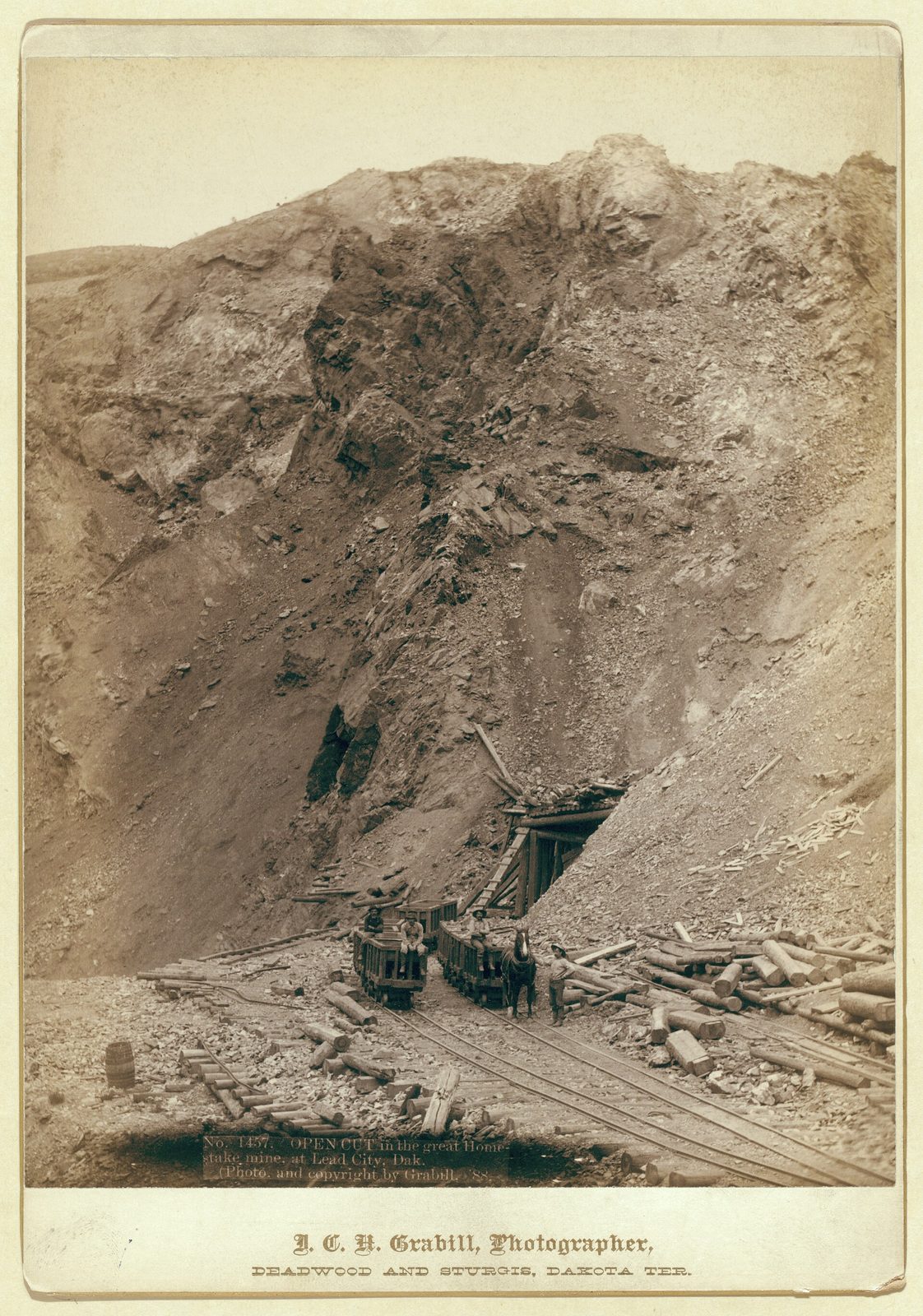
The Open Cut is the great pit at the top of the Homestake, on the spot where the gold strike of 1876 was made. Surface mining stopped in 1941, started again in 1983, and ended for good in September 1998. Since then, published depths have run from about 1,000 feet, in an architectural history of the site, to 1,250 feet, the figure given by the Sanford Lab Homestake Visitor Center on its rim.
Early miners did not backfill the stopes, the chambers left where ore was taken out, and parts of the town began to sink. Settling near the Open Cut was noticed as early as 1895, and in 1911 the Grier Mansion and part of Gold Street began to cave in. Buildings at the foot of the Open Cut had to move; in 1920 Christ Episcopal Church was moved brick by brick a short way west.
On September 11, 2000, the company announced it would close the mine, citing low gold prices, high costs and ore poorer than expected. The last ore was mined on December 14, 2001, on the 1400 level, almost straight below the Open Cut. That same day, Homestake's merger with Barrick Gold Corporation was completed. The mill ran the last ore on January 18, 2002, and shut down for good on February 13.
From Gold Mine to Physics Lab
In 1965 Raymond Davis Jr., of Brookhaven National Laboratory, built a detector on the 4,850-foot level: a 100,000-gallon tank of perchloroethylene, a dry-cleaning fluid, set up to catch neutrinos from the sun. It caught only about a third as many as theory predicted. The experiment ran for nearly three decades, and in 2002 Davis shared half of the Nobel Prize in Physics with Masatoshi Koshiba; Riccardo Giacconi won the other half for separate work. That thread is followed on From a Gold Mine to a Nobel Prize.
The mine's pumps were shut off in June 2003, and water began filling the lower levels. In 2004 the South Dakota Legislature formed the South Dakota Science and Technology Authority to weigh turning the empty mine into a laboratory. In 2006 Barrick donated the mine, its surface buildings and its inventory to the state, and T. Denny Sanford gave $70 million toward the conversion.
Crews went back underground in 2007, the year the National Science Foundation chose Homestake for a proposed national underground laboratory. The National Science Board declined in December 2010 to pay for more design work, and from 2011 the U.S. Department of Energy backed the research there.
SURF is run by the South Dakota Science and Technology Authority. A laboratory complex on the 4,850-foot level, the Davis Campus, was ready in 2012, and experiments at SURF have searched for dark matter and for a very rare form of radioactive decay. The international Deep Underground Neutrino Experiment, hosted by Fermilab, roughly 800 miles away near Chicago, needed caverns about 4,850 feet down. When their excavation was finished in 2024, about 800,000 tons of rock had been hauled to the surface and dumped into the Open Cut, where the Homestake was first claimed in 1876.
Connected
- Lead, South DakotaThe town the Homestake built, over the Open Cut.
- Gold and the Other MineralsThe Homestake Formation and why so much gold gathered at Lead.
- From a Gold Mine to a Nobel PrizeHow a tank of dry-cleaning fluid on the 4,850-foot level led to a Nobel Prize.
- Spearfish Creek: Power, Rails and the 1933 FloodThe canyon plants that made the mine's electricity.
- The 1876 War and the Taking of the HillsHow the treaty land under the claim was taken from the tribes.
- The Black Hills Gold RushThe rush that brought the Homestake's finders into the Hills.
- The National Forest and the CCCTimber Case No. 1 and the forest that fed the mine its timbers.
- What the Old Mines Left BehindWhat the cleanups cost, who paid, and what reclamation worked.
Sources
- Homestake Mining Company Maps and Blueprints Collection, finding aid. Homestake Adams Research and Cultural Center (Deadwood History), undated.
- A Brief History of Black Hills Gold Mining (L. Michael Kaas). Mining History Association, 2018.
- Treaty of Fort Laramie (1868). National Archives, Milestone Documents, undated.
- An Iron Hand in a Velvet Glove: Thomas J. Grier's Management of the Homestake Mine, 1885–1914 (Susan L. Richards and Rex C. Myers). South Dakota History 38, no. 2, South Dakota State Historical Society, 2008.
- Philanthropy as Cultural Outreach: Phoebe Hearst and Music in Lead, South Dakota (Leta E. Miller). South Dakota History 47, no. 3, South Dakota State Historical Society, 2017.
- Lead Miners' Union Collection, finding aid. Homestake Adams Research and Cultural Center (Deadwood History), undated.
- History of the Homestake Mining Company Lockout (Brian Gevik). SDPB, 2018.
- Hydroelectric and Kirk Power Plant Operation Records, finding aid. Homestake Adams Research and Cultural Center (Deadwood History), undated.
- Lead Historic District, National Register of Historic Places nomination and amendments. National Park Service, 1974, with later amendments.
- Lead's Historic Homestake Opera House Turns 100 (Amy Varland). SDPB, 2014.
- History of the Historic Homestake Opera House (Brian Gevik). SDPB, 2015.
- Sanford Underground Research Facility (Michelle L. Dennis). SAH Archipedia, Society of Architectural Historians and University of Virginia Press, undated.
- City of Lead (including the Sanford Lab Homestake Visitor Center's listing). Black Hills Mining Museum, undated.
- Summary of the Mining Industry in South Dakota, 2001. South Dakota Department of Environment and Natural Resources, 2002.
- South Dakota 2002 Mineral Summary (E. H. Holm, T. Cline Jr. and M. R. Nelson). South Dakota Department of Environment and Natural Resources, 2003.
- Homestake Strikes Gold Again. Lawrence Berkeley National Laboratory, 2007.
- The Sanford Underground Research Facility at Homestake (J. Heise). arXiv 1401.0861, 2014.
- Our Story. Sanford Underground Research Facility, undated.
- Davis Experiment. Sanford Underground Research Facility, undated.
- The Nobel Prize in Physics 2002: Press Release. Royal Swedish Academy of Sciences (Nobel Prize Outreach), 2002.
- Excavation of Colossal Caverns for Fermilab's DUNE Experiment Completed. Brookhaven National Laboratory, 2024.
Last reviewed: