Connections
From a Gold Mine to a Nobel Prize
In the open air in Lead, South Dakota, as anywhere on the earth's surface, a cosmic ray or two crosses a person's hand every second, according to the Sanford Underground Research Facility (SURF). On the 4,850-foot level of the old Homestake Mine beneath the town, the laboratory says, the same hand might go more than three months without one. That difference is why a gold mine became a good place to catch particles from the sun. The chain runs from a folded layer of ancient rock, through 125 years of mining that chased it downward, to a tank of dry-cleaning fluid, a Nobel Prize, and the physics laboratory in the old tunnels.
Why Did the Gold Lie So Deep?
The gold lay deep because the rock that held it slants down into the earth. Almost all of the Homestake's ore came from one unit, the Homestake Formation, an ancient layer of iron-rich rock described on Gold and the Other Minerals. The Geological Survey's James J. Norton, writing in 1974, traced the gold's concentration to places where a second set of folds had buckled the first and opened up the rock.
Those folds are tilted. A 2010 field-trip guide from the South Dakota School of Mines and Technology, by M.P. Terry and C.J. Paterson, describes the formation wrinkled into smaller folds, which the mine called ledges, and says the gold worth mining sat mostly in the downward folds, the synclines. The folds of the Main Ledge dive toward the southeast at an angle of 35 degrees, and followed along that slant they go on for more than 3 miles (5,000 meters), reaching about 7,500 feet (2,300 meters) underground. To stay with ore laid out like that, a mine has to keep going down.
The Homestake followed it for 125 years. On April 9, 1876, Moses and Fred Manuel, Hank Harney and Alex Engh staked a quartz outcrop near present-day Lead, the start of the Homestake. It was staked on land the 1868 Fort Laramie Treaty had set apart for the tribes, which the 1877 Act took without the consent the treaty required (see The 1876 War and the Taking of the Hills). Miners first chased the veins underground with hand tools, SDPB recounts, and the shafts kept going deeper until the workings reached more than 8,000 feet. When the last ore came up, on December 14, 2001, the mine had produced nearly 40 million ounces of gold. The Homestake Mine and Sanford Lab tells that history in full.
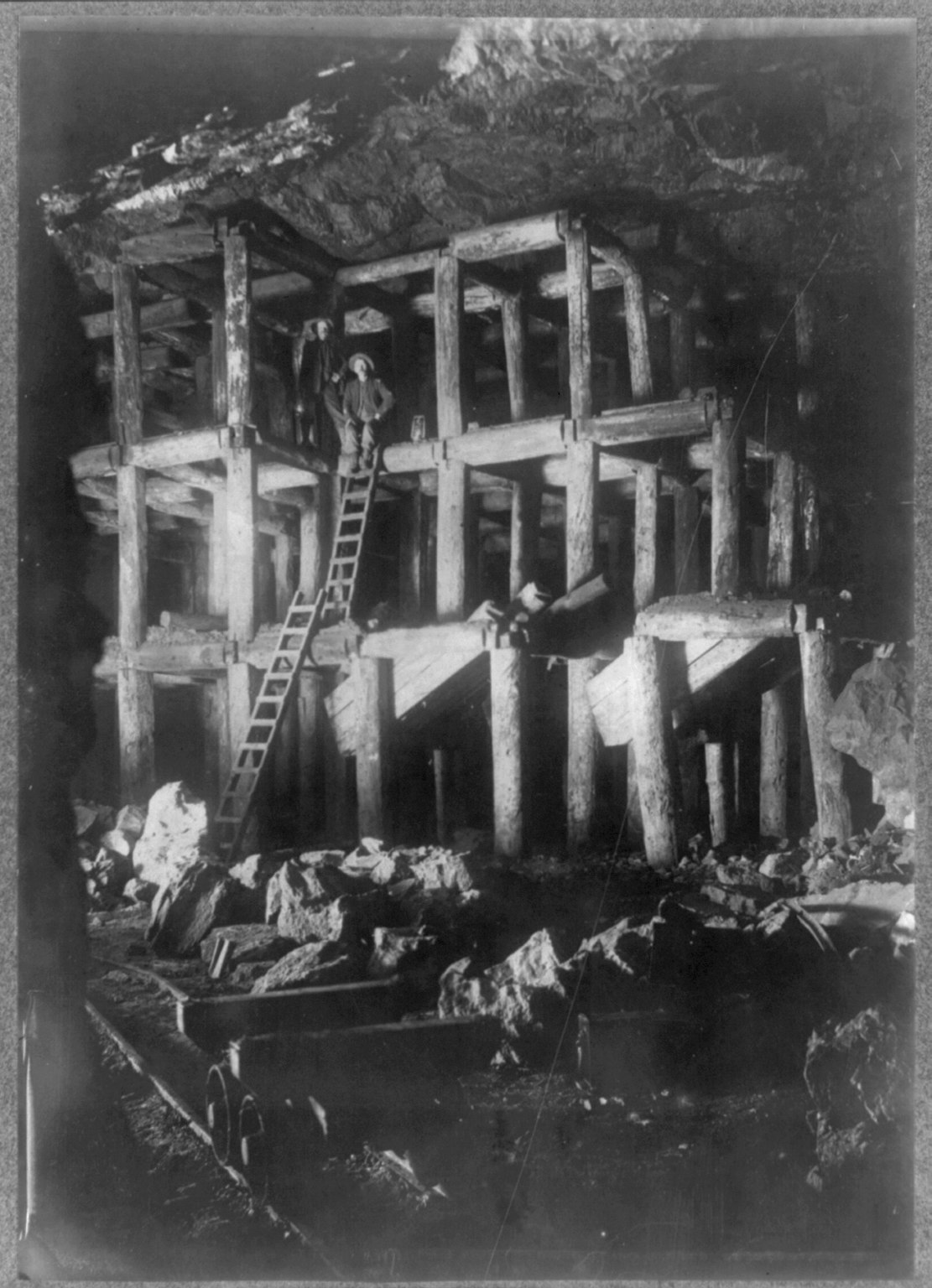
Lead, the Homestake's company town, grew up partly over the workings. By the mid-1890s, SDPB's Brian Gevik wrote in 2016, the mined-out ground under it was already moving buildings.
A Mile of Rock as a Shield
What drew physicists was the rock over the deep levels, not the gold. Cosmic radiation from space reaches the ground all the time, and in a sensitive detector it is noise that can bury a faint signal. Rock soaks it up. SURF rates its shielding against muons, one kind of particle in the cosmic-ray shower: the rock above its 4,850-foot level shields against them about as well as 4,300 meters, or some 14,000 feet, of water would. At that depth the cosmic background falls to one ten-millionth of its level at the surface, the laboratory says. Lawrence Berkeley National Laboratory wrote in 2007 of experiments that need thousands of feet of rock between them and cosmic rays.
Neutrinos from the sun are the exception. They "go through matter like it isn't there," as SURF's history of the Davis experiment puts it, so the same rock that screens out the noise lets the signal through. Brookhaven National Laboratory, where Raymond Davis Jr. worked, says cosmic rays were the reason his chlorine went so far underground.
The Homestake Mining Company also did the digging: it cut the cavern on the 4,850-foot level for Davis, SURF's history says. The link between the gold and the physics is the hole itself. The ore pulled the mine down, and the depth brought the physicists.
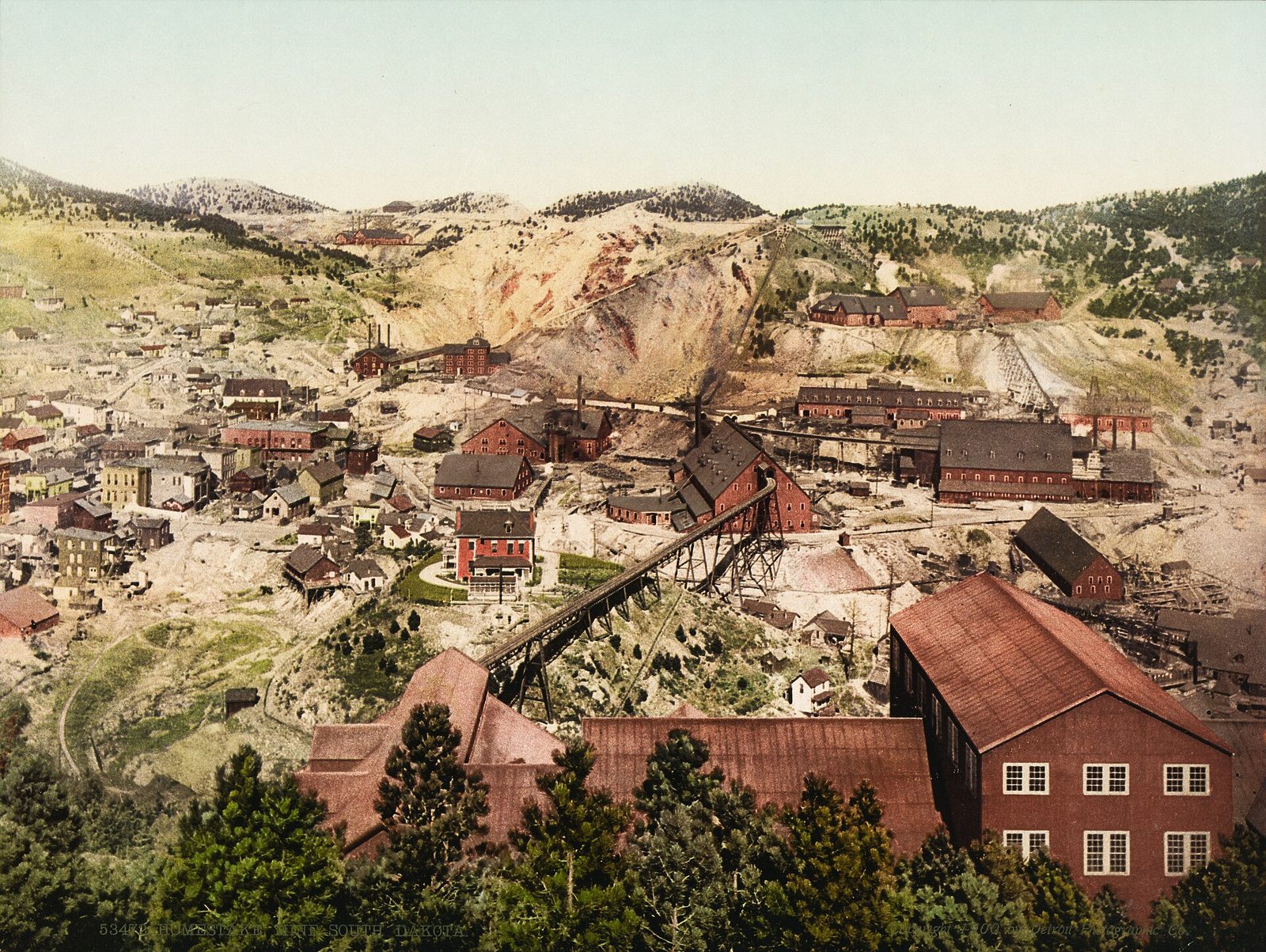
The Tank on the 4,850-Foot Level
The detector Davis installed there in 1965, for Brookhaven National Laboratory, was a tank holding 100,000 gallons of perchloroethylene, a chlorine-rich dry-cleaning fluid. Now and then a neutrino from the sun would turn an atom of chlorine into radioactive argon-37, and Davis worked out ways to pull those few argon atoms back out of the tank and measure them.
John Bahcall, who was doing postdoctoral work at Caltech, had worked out how many neutrinos the tank should catch. It caught about a third as many. The shortfall, which came to be called the solar neutrino problem, held through nearly three decades of the experiment. The Nobel Prize's summary of Davis's lecture counts 2,200 solar neutrinos captured over 25 years, and it says Bruno Pontecorvo's idea of neutrino oscillation finally accounted for the gap. Neutrinos switch among three types, SURF's history explains, and Davis's tank could catch only one of them.
The 2002 Nobel Prize in Physics went half to Davis and Masatoshi Koshiba of Japan together, cited "for pioneering contributions to astrophysics, in particular for the detection of cosmic neutrinos," and half to Riccardo Giacconi for his work on cosmic X-ray sources.
What Fills the Old Mine Now?
The old mine is now SURF, a physics laboratory that the South Dakota Science and Technology Authority runs on the property Barrick Gold, the Homestake's owner by then, gave the state in 2006.
The LUX dark-matter detector, with about 770 pounds of xenon on the 4,850-foot level, led the world in sensitivity in October 2013, by SURF's account, and was decommissioned in 2016. LUX-ZEPLIN (LZ), managed by Berkeley Lab, began running in 2021 with 10 metric tons of liquid xenon, about 22,000 pounds.
Fermilab, near Chicago, hosts the Deep Underground Neutrino Experiment (DUNE) and plans to send a beam of neutrinos about 800 miles to detectors at SURF. The caverns for those far detectors were dug from 2019 to 2024, and the rock taken out of them, about 800,000 tons, went into the Open Cut. On May 7, 2026, SURF, Fermilab and CERN marked the first of 10 million pounds of steel going underground. CERN is supplying the steel and two cryostats, vessels that will each hold 17,000 metric tons of liquid argon. As of that May the detectors were still to be built, and Fermilab's stated priority was a first beam to DUNE by 2031.
LZ, meanwhile, has recorded one event its researchers are hard pressed to explain. In a report the U.S. Department of Energy posted on September 1, 2026, the team, working from data taken between March 2023 and April 2024, put the chance that known backgrounds could account for it at about 0.5 percent, or 2.6 sigma. That falls short of the 5 sigma that physicists treat as the mark of a discovery, and LZ's spokesperson, Rick Gaitskell of Brown University, said the team was not claiming to have seen dark matter. As of that report LZ was still gathering data, under nearly a mile of rock, as Davis's tank had been.
Connected
- Gold and the Other MineralsThe Homestake Formation, the layer whose gold drew the mine down.
- The Homestake Mine and Sanford LabThe mine from the 1876 claim to its closing, and the lab that followed.
- Lead, South DakotaThe company town built over the workings.
- The 1876 War and the Taking of the HillsHow the treaty land under the claim was taken from the tribes.
Sources
- Gold in the Black Hills, South Dakota, and How New Deposits Might Be Found (Circular 699, James J. Norton). U.S. Geological Survey, 1974.
- Geologic Field Trips in the Black Hills Region, South Dakota (Bulletin 21), Field Trip 1 road log, by M.P. Terry and C.J. Paterson. South Dakota School of Mines and Technology, 2010.
- Homestake Mine Announces That It Would Cease Gold Mining Operations (SD History). SDPB, 2023.
- Summary of the Mining Industry in South Dakota, 2001. South Dakota Department of Environment and Natural Resources, 2002.
- Treaty of Fort Laramie (1868). National Archives, Milestone Documents.
- The Sinking Town of Lead, South Dakota (Brian Gevik). SDPB, 2016.
- Going Deep for Science. Sanford Underground Research Facility, undated.
- Homestake Strikes Gold Again. Lawrence Berkeley National Laboratory, 2007.
- The Sanford Underground Research Facility at Homestake (J. Heise). arXiv 1401.0861, 2014.
- Davis Experiment. Sanford Underground Research Facility, undated.
- The Detection of Cosmic Neutrinos (Nobel Prize in Physics). Brookhaven National Laboratory, undated.
- Raymond Davis Jr.: Nobel Lecture, A Half-Century with Solar Neutrinos. Nobel Prize Outreach, lecture of 2002.
- Nobel Prize in Physics 2002 (summary page). Nobel Prize Outreach, 2002.
- Our Story. Sanford Underground Research Facility, undated.
- LZ Sees Surprising Result in Search for Dark Matter. U.S. Department of Energy, Office of Science, 2026.
- SURF, Fermilab, CERN Mark Major Milestone for World-Leading DUNE Experiment. Sanford Underground Research Facility, 2026.
- Officials Hail ‘Major Milestone’ for US Deep Underground Neutrino Experiment (Michael Banks). Physics World, 2026.
Last reviewed: