Connections
The Return of the Bison
Before dark one day in October 2022, 100 bison hauled from a corral at Badlands National Park were coming off the trucks on the Rosebud Reservation, and 200 more, for the Cheyenne River Sioux Tribe, were to be loaded at the park the next day, the Associated Press reported. By the park’s count, about 655 young bison went that fall to the Cheyenne River Sioux Tribe, the Rosebud Sioux Tribe, the Oglala Sioux Tribe and the Oneida in Wisconsin, in work coordinated with the Oglala Sioux Tribe and the InterTribal Buffalo Council. Herds kept in the parks around the Black Hills grow past what their grass can feed, and part of that surplus now goes to tribes rebuilding their own herds. The thread runs from the park herds’ beginnings to the tribes’ council and to what tribal governments and members say the return means.
The Herds the Hills Kept
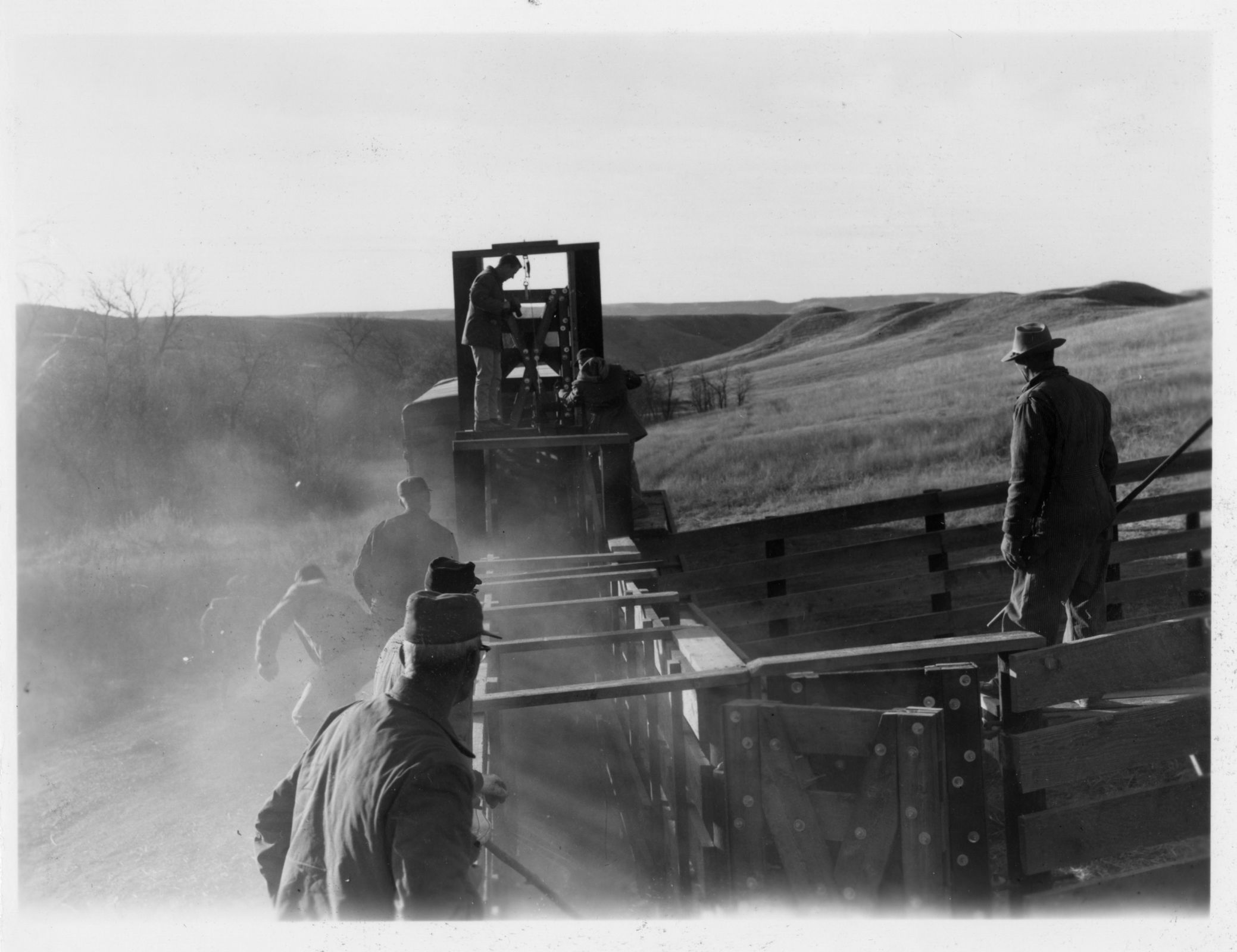
After the plains herds were all but wiped out by the mid-1880s, a story told on Bison, each park herd around the Hills was stocked from outside: Wind Cave National Park’s with 14 bison shipped from New York in 1913 and six from Yellowstone in 1916, Custer State Park’s with the 36 it bought from Scotty Philip’s herd in 1914, and Badlands’ by truck from Theodore Roosevelt National Park in North Dakota in 1963. In the Oglala account told by Wilmer Mesteth, the first bison were people who went up early against the Creator’s order, before the rest emerged through Wind Cave; Limestone, Caves and the Emergence Story follows where that account and the cave meet.
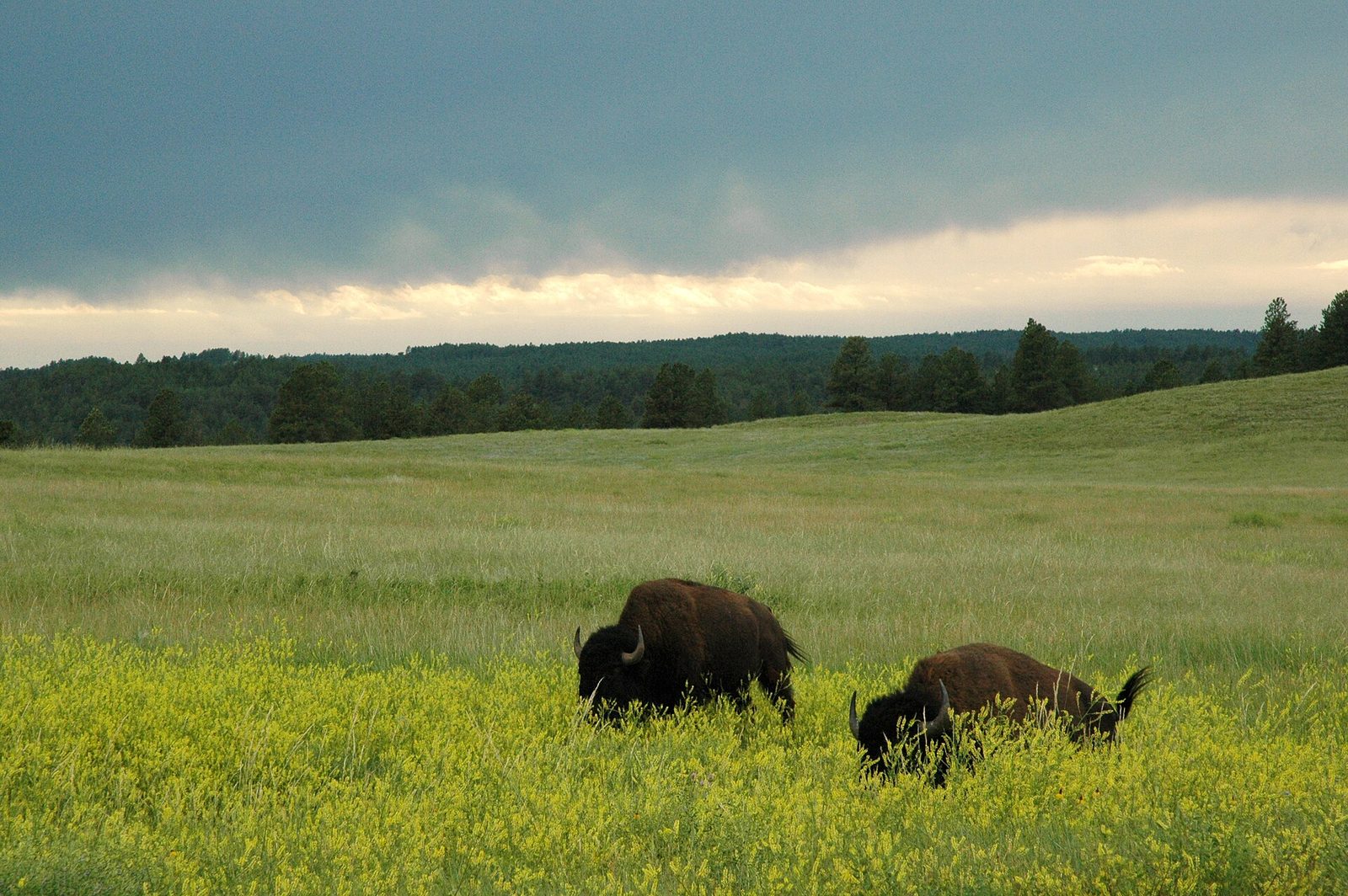
Custer State Park counted about 1,300 bison at its roundup on September 25, 2026, and with drought planned to sell about 600; the roundup, the sale and the ranch trade are on Bison Herds, Bison Ranching and the Buffalo Roundup. Bison have also moved toward that park from a reservation: in 1951, the park’s own history records, it bought 60 from a Pine Ridge Reservation herd.
How the Tribes Organized in 1991
The tribes’ network dates from 1991. That year about 10 tribes holding some 1,500 bison among them formed the council, according to its testimony to Congress on the Indian Buffalo Management Act. Its first name was the InterTribal Bison Cooperative, and it still went by that name in 2006, when Wind Cave National Park described it as a Rapid City nonprofit with 57 member tribes. Also in 1991, the Cheyenne River Sioux Tribe chartered a corporation, owned by the tribe, to run the tribal herd. That herd started with fewer than 100 animals and had topped 1,000 by 1996, Harvard’s Honoring Nations program reported in 1999.
Congress took note on May 9, 2016, in the National Bison Legacy Act, the law that made the North American bison the national mammal. Its findings counted more than 60 tribes in the council and a combined herd kept by tribal members on more than 1,000,000 acres of tribal land, and they found that bison “were integrally linked with the economic and spiritual lives of many Indian tribes.” Testifying before the Senate Committee on Indian Affairs on June 12, 2024, Ervin Carlson of the Blackfeet Nation, the council’s president, put its membership at 83 tribes in 22 states; by the council’s own testimony to a House subcommittee in March 2026, it had grown to 90.
In 2020 testimony for a House appropriations subcommittee, Carlson described “a long-standing spiritual and cultural connection with buffalo.” The same testimony shows the practical side: eight member tribes were serving tribal-raised bison in school lunches, and the council was paying to move surplus animals out of Badlands, Theodore Roosevelt and Wind Cave national parks with no funding for the job.
Where Do the Parks’ Surplus Bison Go?
Some go to tribes, mostly from the national parks. When Wind Cave culled 133 bison in October 2006, most went to tribes at Crow Creek in South Dakota, Fort Peck in Montana and the Ho-Chunk in Wisconsin, with the Cooperative arranging the moves. Of the 127 the park removed in 2019, 93 went to Nature Conservancy preserves, and the council placed 34 with the Prairie Island Mdewakanton, the Flandreau Santee Sioux Tribe and the Red Lake Band of Chippewa Indians. Badlands and Theodore Roosevelt National Park supplied the first 100 animals for a range of nearly 28,000 acres on the Rosebud Reservation in October 2020, a project that REDCO, the economic development corporation of the Rosebud Sioux Tribe, led with the World Wildlife Fund.
Custer State Park’s surplus goes to the sale ring; the park held its first live auction in February 1966. In October 2026 a Game, Fish and Parks spokesman listed private producers, processors and other state parks among the buyers, Cowboy State Daily reported; he named no tribes. In June 2026 one bull took a different road. After he was involved in a visitor’s death in the park, the Rosebud Sioux Tribe’s Game, Fish and Parks Department announced that it would take him, choosing relocation over euthanasia, KOTA reported; the tribe would keep him for the rest of his life, somewhere secure and closed to the public. The state agency said removing the bull put public safety first and thanked the tribe. The tribe’s statement, dated June 10, said the bull had acted on his wild nature and spoke of “our cultural obligation to protect our relative” alongside the need to keep the public safe, Cowboy State Daily reported.
Wildlife, Livestock or Relative
Behind those two roads lies a question of what a bison is. In October 2022, Troy Heinert, the council’s director, watched the Rosebud-bound bison at Badlands. “Buffalo, they walk in two worlds,” he told the Associated Press. Heinert, who lives on the Rosebud Reservation and was then a state senator, meant that bison are handled both as a commercial animal and as wildlife, and that tribes have long counted them as wildlife, even relatives. At a harvest on the Rosebud range, the same report said, the tribal elder Duane Hollow Horn Bear told the people gathered that the bison before them was a relative, one that had given up its life to sustain them and the way they live. In 2020 Wizipan Little Elk, REDCO’s chief executive, called the tie between tribal communities and bison sacred, part of “a shared story of strength, resilience and economic revitalization.”
Not every claim about these herds is a count. The Park Service’s 2020 release said the Rosebud range would in time carry 1,500 bison, more than any other herd a tribe manages in the country; that was a forecast. Two years later the AP put the range at about 1,000 bison, a size the Cheyenne River herd had passed by 1996. In October 2026 SDPB still called the Rosebud herd “the largest Native-owned bison herd in the world,” with no number. Over two decades the Interior Department had sent more than 20,000 bison to tribes and tribal organizations, the AP reported in 2022, usually when its own herds needed thinning.
In the fall of 2026 a nonprofit, not a tribe, started another herd in the Badlands. On October 6, Thunder Valley Community Development Corporation, based on the Pine Ridge Reservation, turned 50 bison out on a range unit of nearly 40,000 acres, former cattle range that it leases from the Oglala Sioux Tribe, KOTA reported. Brandon Big Eagle, Thunder Valley’s Lakota Land Systems director, told KOTA that bison were “the first of our people to emerge from Wind Cave in our creation stories.” SDPB reported on October 19 that the 50 came from the Rosebud range, the herd Badlands bison had helped start in 2020.
Connected
- BisonThe animal, how close it came to dying out, and the small herds that carried it through.
- Bison Herds, Bison Ranching and the Buffalo RoundupThe Custer State Park herd, its fall roundup and auction, and ranch bison.
- Custer State ParkThe park whose herd began in 1914 with 36 bison from Scotty Philip’s herd.
- Limestone, Caves and the Emergence StoryWhere the Oglala account of the first bison herd meets Wind Cave.
- Wind Cave National ParkA park whose surplus bison have gone to tribes since at least 2006.
- Badlands National ParkThe park that sent about 655 bison to tribes in 2022.
Sources
- News release on bison distributed to tribes (November 7, 2022). Badlands National Park, National Park Service, 2022.
- Bison spread as Native American tribes reclaim stewardship. Associated Press, as published by KSTP, 2022.
- Bison Transfer to Establish Wolakota Buffalo Range Marks Interior Commitment to Bison Conservation (news release, October 30, 2020). National Park Service, 2020.
- Wildlife Management. National Park Service, Wind Cave National Park, 2026.
- The Lakota Emergence Story, as told by Wilmer Mesteth and retold by Sina Bear Eagle. National Park Service, Wind Cave National Park, 2024.
- Bison being loaded onto a truck (photograph record, November 1963). National Park Service, Theodore Roosevelt National Park, via the Theodore Roosevelt Digital Library, Dickinson State University.
- Park Conducts Annual Bison Roundup (news release, October 17, 2006). Wind Cave National Park, National Park Service, 2006.
- News release on the 2019 bison roundup (October 25, 2019). Wind Cave National Park, National Park Service, 2019.
- Testimony of Ervin Carlson, President, InterTribal Buffalo Council (American Indian and Alaska Native Public Witness Hearings). House Appropriations Subcommittee on Interior, Environment, and Related Agencies, 2020.
- InterTribal Buffalo Council Testimony on H.R. 5153, the Indian Buffalo Management Act, by Ervin Carlson. House Committee on Natural Resources (Democratic members’ site), undated.
- Testimony of Ervin Carlson, President, InterTribal Buffalo Council (legislative hearing on S. 2908, the Indian Buffalo Management Act, and other bills, June 12, 2024). U.S. Senate Committee on Indian Affairs, 2024.
- National Bison Legacy Act, Public Law 114-152 (May 9, 2016). Office of the Law Revision Counsel, U.S. House of Representatives.
- Honoring Nations 1999 Honoree: Pte Hca Ka, Inc., Cheyenne River Sioux Tribe. Harvard Project on American Indian Economic Development, Harvard University (hosted by the Native Nations Institute, University of Arizona), 1999.
- Custer State Park History. South Dakota Game, Fish and Parks, 2026.
- Buffalo Roundup. South Dakota Game, Fish and Parks, 2026.
- Drought Forcing Custer State Park To Auction Off At Least 600 South Dakota Bison, by Kate Meadows. Cowboy State Daily, 2026.
- Rosebud Sioux Tribe to relocate bison involved in fatal Custer State Park incident, by Tamara Chibe. KOTA, 2026.
- Bison Escapes Death Sentence After Killing Woman In Custer State Park, by Kate Meadows. Cowboy State Daily, 2026.
- Lakota nonprofit returning bison to 40,000 acres in Badlands National Park to restore native prairie, by Tamara Chibe (KOTA). Dakota News Now, 2026.
- 50 bison released onto nearly 40,000 acres in Badlands in Lakota-led restoration effort, by Karli West. KOTA, 2026.
- Nonprofit celebrates historic milestone in bison restoration project, by Delainey LaHood-Burns. SDPB, 2026.
- Testimony of Ervin Carlson, President, InterTribal Buffalo Council, to the Subcommittee on Interior, Environment and Related Agencies. U.S. House Committee on Appropriations, March 18, 2026.
Last reviewed: