Connections
Rock, Bear and Rope: Devils Tower
On July 31, 1932, Short Bull, a Lakota man from west of Oglala, South Dakota, told of a warrior who fasted beside a great rock and saw from a giant bear's tracks that he had come to the bear's lodge. In his account, as it was written down through an interpreter, "the cracks in the big rock were made by the big bear's claws." To a geologist, the same grooves are seams between columns that split apart as molten rock cooled. At Devils Tower, in northeast Wyoming, one thread runs from that rock and the tribes' bear accounts to the first national monument, a century of climbers' ropes and the voluntary June closure.
What Is the Bear Story of Devils Tower?
There is no single bear story. The National Park Service publishes five accounts, one each from an Arapaho, a Cheyenne, a Crow, a Kiowa and a Lakota teller, and they differ in who flees, who climbs and what becomes of them.
The earliest dated one, from 1897, came from I-See-Many-Camp-Fire-Places, a Kiowa soldier at Fort Sill, Oklahoma. Seven girls fleeing bears were carried up on a rising rock into the sky, where they became the Pleiades, while the bears scraped its sides and broke their claws. In the account Sherman Sage, an Arapaho, gave on August 19, 1932, a sister who has become a bear slips and scratches the rock. Dick Stone, who took down Short Bull's account, also recorded a Crow telling from Ride-The-White-Hip-Horse, in which the rock grows to save two girls and the claw marks remain, and a Cheyenne one from Young-Bird, in which the rock rises under praying men who kill a giant bear. Of the five, only the Cheyenne account leaves no bear's marks on the stone.
The story shifts with its teller. In a Kiowa version that the Smithsonian's National Museum of the American Indian published in December 2025, as its narrator heard it in childhood, the seven sisters become the Big Dipper instead.
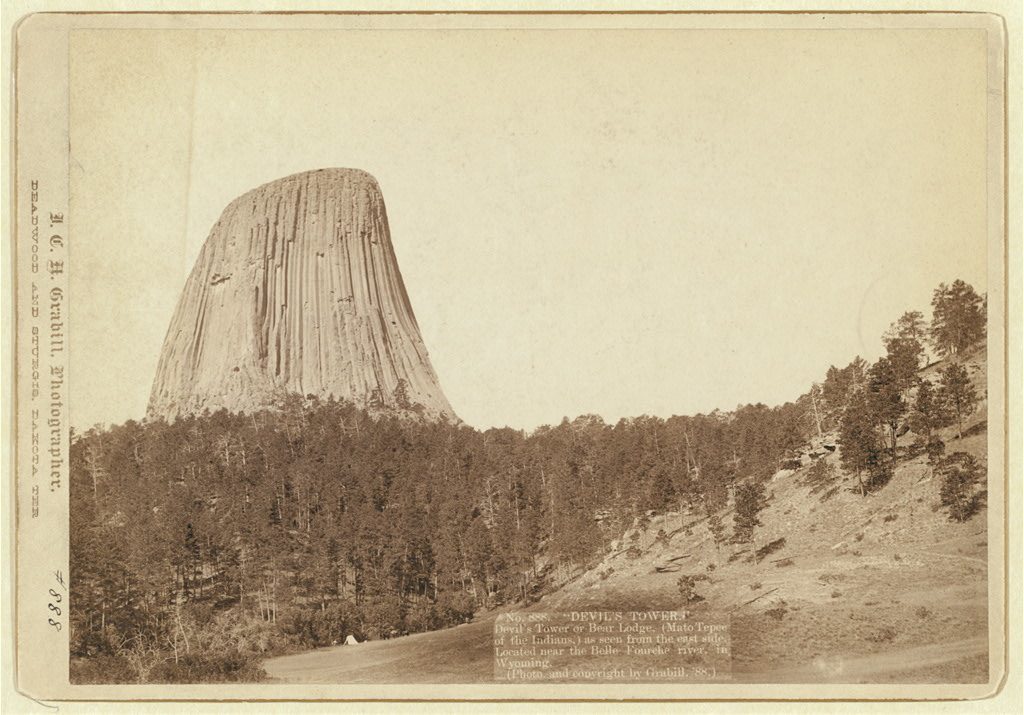
The names follow the bear: Bear's Tipi in the Arapaho account, Bear's House in the Crow, and Bear Lodge as the English for the Lakota and Cheyenne names. The Cheyenne name is Náhkȯheome, Chief Dull Knife College's Cheyenne dictionary records. Oral and tribal history "connects us to this sacred place and sacred ceremonies," the Northern Cheyenne Tribe's president, Jace Killsback, told ICT in April 2017.
From Columns of Rock to a Scientific Monument
By the Park Service's account, the Tower is phonolite porphyry, magma that pushed up into sedimentary rock about 50 million years ago and, cooling out of sight, cracked into columns; erosion later stripped away the softer layers around it. Geologists still argue over how it formed, as Devils Tower, Bear Butte and the Igneous Rocks of the Hills explains.
The English name came through the Army. Lt. Col. Richard Dodge's journal of 1875 gave the tribes' name for the shaft as "The Bad God's Tower." A guide may have mistaken Bear Lodge for it, the Park Service suggests, though others see a deliberate renaming, and the agency says "the truth is lost to history." The 2017 ICT report's flat statement that an interpreter erred goes beyond that record.
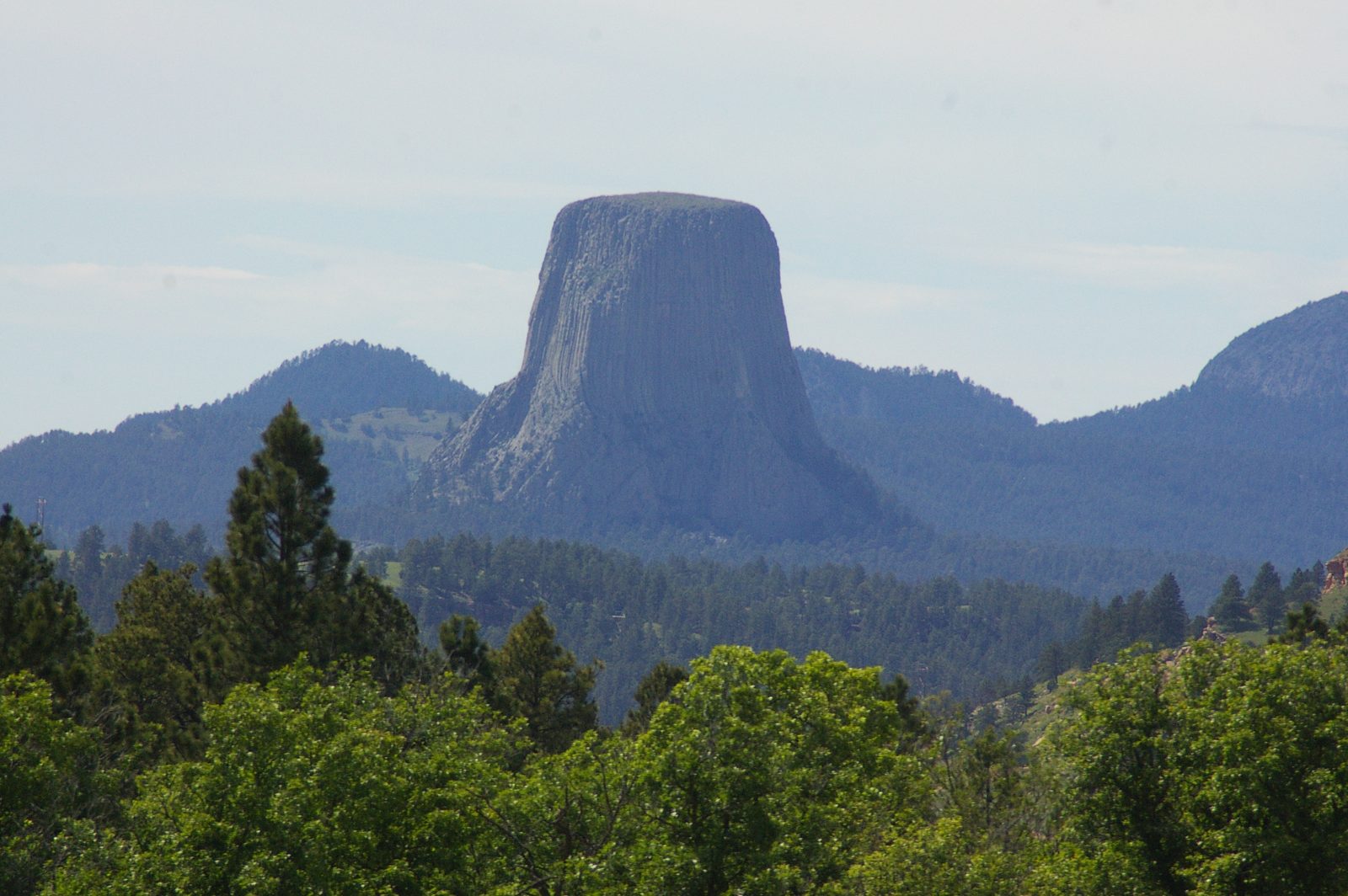
President Theodore Roosevelt used the new Antiquities Act on September 24, 1906, to proclaim the first national monument, Devils Tower. Proclamation 658 names the rock as its reason, calling the Tower "such an extraordinary example of the effect of erosion in the higher mountains as to be a natural wonder and an object of historic and great scientific interest." It mentions no tribe and no bear. Ronald F. Lee's history for the Park Service calls the result "essentially a scientific monument." The Tower lay in what the 1868 treaty called "unceded Indian Territory," and the 1876 agreement, made law by the 1877 Act, took that territory and the tribes' hunting rights there (see The 1876 War and the Taking of the Hills).
Ladders, Ropes and 6,505 Climbers
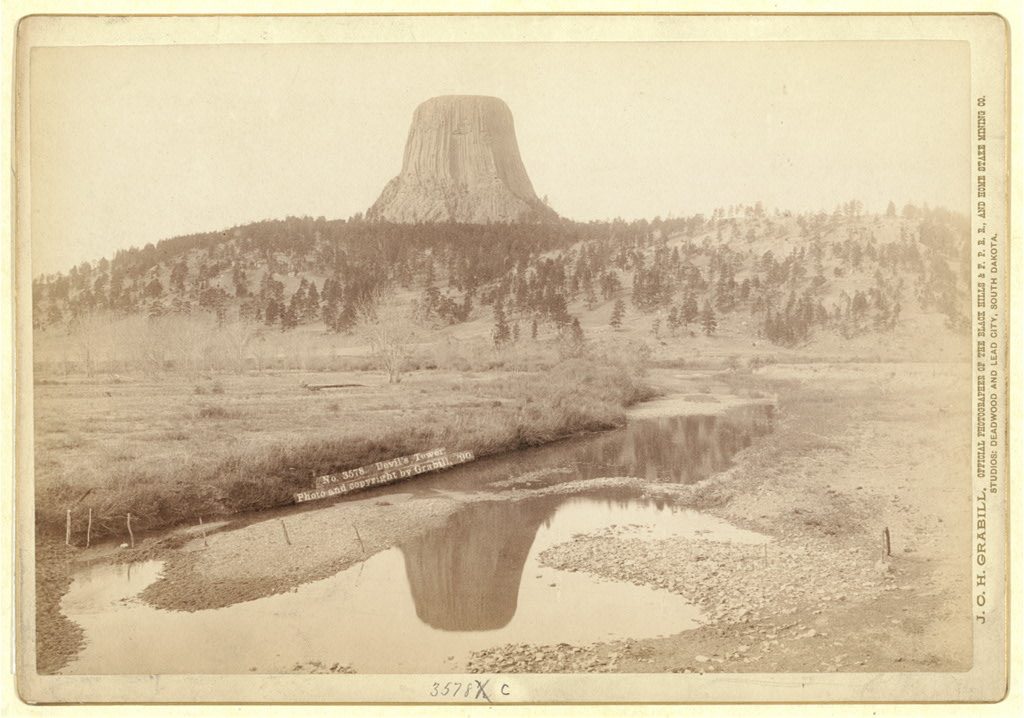
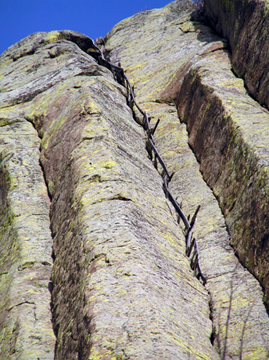
Climbers reached the top of the 867-foot Tower before the monument existed. In 1893 Willard Ripley, who ranched in the Belle Fourche valley just north of the Tower, and William Rogers, another local rancher, built a ladder of wooden pegs and boards about 350 feet up a crack. On the Fourth of July Rogers climbed it, flag in hand, before a crowd the Park Service puts at about 800.
In 1937 Fritz Wiessner led Lawrence Coveney and William House in the first free climb (climbing today is on Devils Tower National Monument). In October 1941 a parachutist, George Hopkins, was stranded on the summit for six days, supplied from planes, until Jack Durrance, whose 1938 route is now the Tower's most popular, led a party of eight up to bring him down.
Then the numbers grew: 312 climbers reached the summit in 1973, and 6,505 climbed in 1992, the busiest year in the records of the Park Service's 1995 climbing plan. Tribal nations objected. A 1993 resolution of the Dakota, Lakota and Nakota Nations, which the plan quoted, opposed letting federal managers allow "further destruction to these Sacred Sites," Devils Tower among them.
Why Do Climbers Stay Off the Tower in June?
June brings many of the tribes' ceremonies to the Tower, though not all of them, the Park Service says, and as a mark of respect the agency asks climbers to keep off the rock that month; most do. Its Climbing Management Plan, released in February 1995 and updated in 2006, asks that nobody climb the Tower or scramble on the rocks inside the Tower Trail loop. The agency relies on climbers' restraint, not enforcement.
Not everyone complies. "We see them climbing up there," Waylon Black Crow Sr., who chaperones young Lakota runners from Pine Ridge on a yearly route past the Tower, said in a June 2017 Wyoming Public Radio report. By the station's figures, June climbers fell from more than 1,200 in 1994 to 167 once the closure began, then rose to 373 in 2016. Up to 85 percent of climbers skip June, the Park Service said in May 2014, and as of April 2026 it calls the closure very successful. The plan also outlasted a 1996 lawsuit by climbers and a commercial guide, which the Cheyenne River Sioux Tribe entered on the plan's side; the courts left the closure in place in 1998 and 1999, as Sacred Sites tells in full.
The June notices carry the bear back into the federal record. The Park Service's releases of May 2023 and June 2024 named the rock first by its Lakota name and as Bear Lodge, with Devils Tower in parentheses.
On September 24, 2025, 119 years to the day after the proclamation, Kiowa tribal members marked the opening of the monument's 120th anniversary with a Seven Sisters Celebration arranged by Amanda Hill, director of the Kiowa Tribal Historic Preservation Office, the museum's December 2025 article says. Such joint efforts, Hill said there, give the tribe what it needs for "sustainable tribal engagement within our ancestral lands." Micah Robedeaux sang, and six Kiowa women danced with Hill at the foot of the rock that, in the Kiowa accounts, a bear once clawed.
Connected
- Devils Tower, Bear Butte and the Igneous Rocks of the HillsHow the Tower's magma hardened into columns, and the theories still argued.
- Sacred Sites: Bear Butte, Devils Tower and Wind CaveWhat the Tower means to the tribes, and the full story of the June closure.
- Devils Tower National MonumentVisiting the Tower today: its names, trails and climbing rules.
- Hulett, WyomingThe Belle Fourche valley town 9 miles north, near where the 1893 ladder climbers ranched.
- The 1876 War and the Taking of the HillsHow the unceded territory around the Tower was taken in 1876 and 1877.
Further reading
- In Support of the Name Bear Lodge National Monument (Currently "Devils Tower"), Resolution SD-15-001, National Congress of American Indians (an organization of tribal governments, on the name, 2015)
- Devils Tower: Name Is "Offensive, Disrespectful, Repugnant" to Tribes, ICT (Northern Cheyenne, Northern Arapaho and Oglala Lakota leaders on the Tower and its name, 2017)
- The Kiowa Return to Tso ai, a Sacred Place With a Meaning Far Removed From Its Role in 'Close Encounters of the Third Kind', Smithsonian National Museum of the American Indian (the Seven Sisters Celebration and a Kiowa telling of the story, 2025)
- First Stories, National Park Service (the bear accounts of Arapaho, Cheyenne, Crow, Kiowa and Lakota tellers, as the Park Service publishes them)
Sources
- First Stories. National Park Service, Devils Tower National Monument, 2025.
- The Kiowa Return to Tso ai, a Sacred Place With a Meaning Far Removed From Its Role in 'Close Encounters of the Third Kind'. Smithsonian National Museum of the American Indian, 2025.
- Devils Tower: Name Is "Offensive, Disrespectful, Repugnant" to Tribes, by Jack McNeel. ICT, 2017.
- Devils Tower: Proposals to Change the Name. National Park Service, Devils Tower National Monument, 2025.
- Frequently Asked Questions. National Park Service, Devils Tower National Monument, 2026.
- Proclamation 658, Devils Tower National Monument, Wyoming, by Theodore Roosevelt, September 24, 1906. The American Presidency Project, University of California, Santa Barbara.
- The Proclamation of National Monuments Under the Antiquities Act, 1906-1970, by Ronald F. Lee. National Park Service, 2023.
- Rogers & Ripley Stake Ladder. National Park Service, Devils Tower National Monument, 2025.
- First Climbers. National Park Service, Devils Tower National Monument, 2025.
- Parachutist George Hopkins. National Park Service, Devils Tower National Monument, 2025.
- Final Climbing Management Plan/Finding of No Significant Impact. National Park Service, Devils Tower National Monument, 1995.
- Climbing Information. National Park Service, Devils Tower National Monument, 2026.
- Voluntary Climbing Closure During June (news release). National Park Service, Devils Tower National Monument, 2014.
- Voluntary Climbing Closure at Devils Tower (news release). National Park Service, Devils Tower National Monument, 2017.
- Voluntary Climbing Closure in June (news release). National Park Service, Devils Tower National Monument, 2023.
- Voluntary Climbing Closure in June (news release). National Park Service, Devils Tower National Monument, 2024.
- Climbers Ignore Native Americans' Request At Devils Tower, by Maggie Mullen. Wyoming Public Media, 2017.
- Bear Lodge v. Babbitt: Brief for the Federal Respondents in Opposition. Office of the Solicitor General, U.S. Department of Justice, 2000.
- Bear Lodge Multiple Use Association v. Babbitt, 2 F. Supp. 2d 1448. U.S. District Court for the District of Wyoming, 1998 (via Leagle).
Last reviewed: