The Outdoors
Devils Tower National Monument
On September 24, 2025, the anniversary of the day in 1906 when Theodore Roosevelt made Devils Tower the first national monument, Kiowa dancers and a singer came for a Seven Sisters Celebration organized by Amanda Hill of the Kiowa Tribal Historic Preservation Office. Many of the tribe's participants had never been there, she said in a Smithsonian article published that December, "but now they know this place." Devils Tower National Monument, on the Wyoming side of the Hills, is sacred to many tribes and a park with five trails and hundreds of climbing routes; its names, trails, climbing, June closure, rock and history follow.
What Do the Tribes Call Devils Tower?
Many tribes know the Tower as Bear Lodge, and their leaders have long asked that the federal name be changed, because the word Devils offends them. "We have actual and significant cultural, historical and spiritual ties to the Bear Lodge," Jace Killsback, president of the Northern Cheyenne Tribe, told ICT in 2017. In the same report, Northern Arapaho chairman Roy Brown backed any naming that respects the Tower's spiritual meaning, and Trina Lionhill, the Oglala Lakota historic preservation officer, said the Great Plains Tribal Chairman's Association tribes had agreed on Bear Lodge.
A proposal made for a Lakota spiritual leader reached the U.S. Board on Geographic Names on November 20, 2014, asking that the Tower be renamed Bear Lodge, the Park Service says, and the Oglala Sioux Tribe's president followed on December 1 with a letter to the Secretary of the Interior seeking the same for the monument. The leader was Arvol Looking Horse, and the proposal told the board, "It is never too late to correct a mistake." That year the National Congress of American Indians, an organization of tribal governments, asked for the name Bear Lodge National Monument; its resolution called the 1906 name "based on faulty translation."
The National Park Service counts more than 20 tribes that hold the Tower sacred. Lakota, Cheyenne, Arapaho and Crow names it records include Bear Lodge and Bear's Tipi. The Cheyenne name, Náhkȯheome, also means Bear Lodge, Chief Dull Knife College's Cheyenne dictionary shows. Many tribal accounts tie the rock to a bear, a thread followed on Rock, Bear and Rope: Devils Tower.
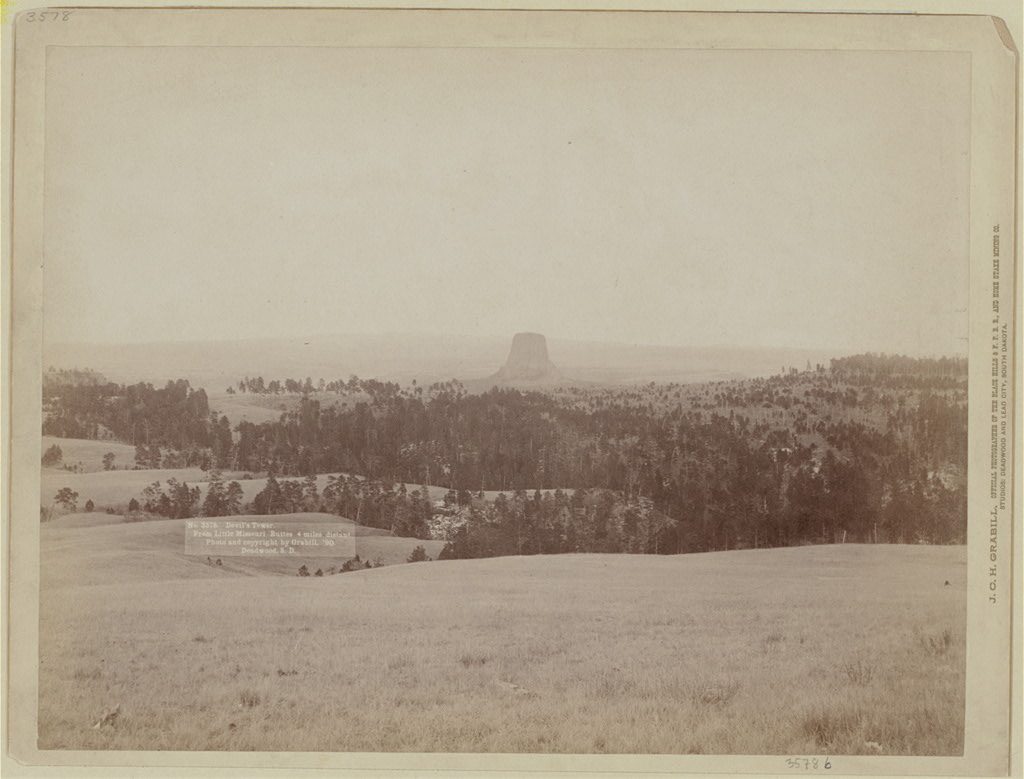
The English name, the Park Service says, goes back to an Army officer, Lt. Col. Richard Dodge, who wrote in 1875 that the tribes called the shaft the Bad God's Tower; whether Bear Lodge was mistranslated or deliberately replaced, the agency adds, is lost to history. In 2024 the Interior Department's Advisory Committee on Reconciliation in Place Names urged the Secretary to rename the Tower Bear Lodge; the department ended the committee in February 2025. Bills to keep the name Devils Tower have come before several Congresses, the latest in January 2025, still in committee in November 2026. As of April 2025, the Park Service said, neither the federal nor the Wyoming naming board was taking comment on the 2014 proposal.
Tied to trees beside the trails are prayer offerings, colored cloths and small bundles, which the Park Service counts as the most frequent ritual there. Visitors are asked not to touch or disturb them; Sacred Sites says more about them.
Five Trails Below the Columns
The Tower sits 9 miles south of Hulett, Wyoming, and its five trails all connect. The Tower Trail, which the Park Service calls the park's most popular hike, is a paved loop around the base with close views of the boulder field, the slope of broken columns at the Tower's foot.
- Distance
- 1.3-mile loop; 1.8 miles round trip with the approach from the parking lot
- Elevation gain
- No figure from NPS; a steep start, then stretches of moderate up and down
- Difficulty
- Generally easy, by NPS; the first section is steep (a grade of 20 percent or more), and the loop doesn't meet ADA standards
- Trailhead
- At the upper parking area, opposite the visitor center
- Season
- Open all year but not maintained in winter, when packed snow and ice are common; NPS suggests spring and fall
The Red Beds Trail, a 2.8-mile loop that NPS rates moderately strenuous, takes two to three hours. It drops toward the Belle Fourche River valley and climbs back to the visitor center on a narrow, rocky path with stone steps and some steep drop-offs, passing the red rock of the Spearfish Formation, the oldest rock exposed in the park, NPS says. Joyner Ridge, a quieter 1.5-mile loop on the north boundary, starts from a dirt road off the main park road; its eastern side drops steeply into a draw and climbs back.
Valley View and South Side, 0.6 mile each, start at the amphitheater and cross the prairie dog town. Valley View stays nearly level, with views of the river; South Side turns steep past the park road and joins the Red Beds Trail. From the picnic area, the walk up to the visitor center covers 1.5 miles and gains 440 feet, and NPS rates it moderate to strenuous.
Black-tailed prairie dogs (Cynomys ludovicianus) live in the town near the river, and you can watch them from the car. The Park Service asks visitors not to approach or feed them: they can bite, and they can carry plague. See Prairie Dogs and Black-Footed Ferrets.
Can You Climb Devils Tower?
Yes, under the National Park Service's 1995 Climbing Management Plan, updated in 2006. Cracks by the hundreds run up between the columns, and the longest reaches nearly 400 feet, the Park Service says. The monument's 2024 brochure counts more than 220 routes climbed and about 5,000 climbers a year. Anyone climbing, or scrambling above the boulder field, must first register at the kiosk at the head of the Tower Trail. The plan allows replacing old bolts but bars new ones and power drills.
For the tribes, June is a month of ceremony at the Tower. People of the nations tied to the Tower by ancestry return then to fast and pray, and to hold Sun Dances, sweats and vision quests, the Smithsonian's National Museum of the American Indian wrote in 2025. Waylon Black Crow Sr., a chaperone for Lakota young people from Pine Ridge whose yearly run around the Hills stops at the Tower, told Wyoming Public Radio in 2017 that it is painful when climbers ignore the June closure at a sacred site, and that he and others can do little but watch.
The Park Service's answer, set out in the 1995 plan, is a voluntary closure. All through June it asks that no one climb the Tower or scramble within the Tower Trail loop, since many tribal ceremonies, though not all, take place that month; others happen there year-round. Most climbers comply, the agency said in 2017, and the Access Fund, a climbers' nonprofit, backs the closure. Climbers and a commercial guide sued over the plan in 1996, with the Cheyenne River Sioux Tribe joining to defend it, and the voluntary closure survived; that case, and June climbing since, are told on Sacred Sites.
Columns of Phonolite, About 50 Million Years Old
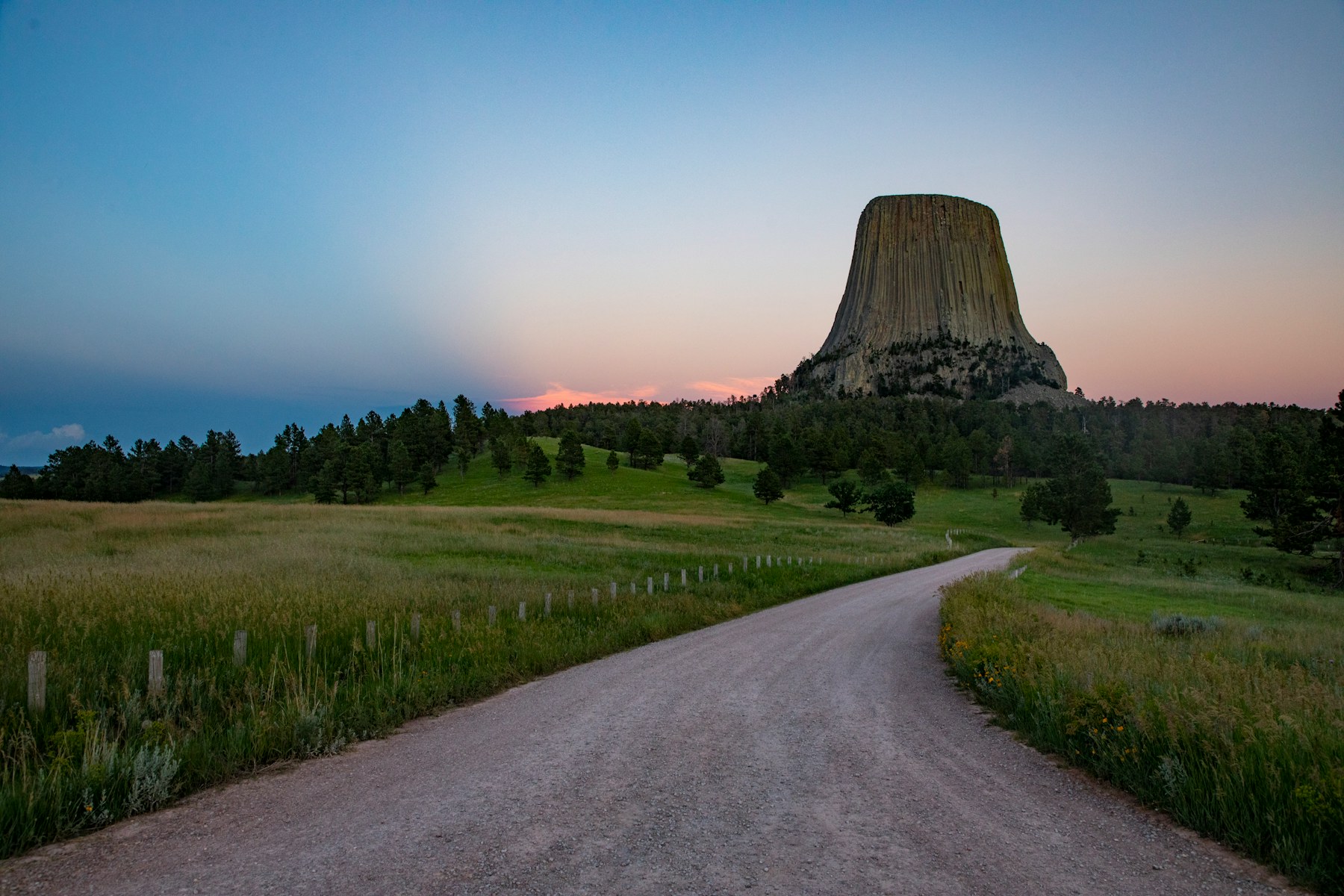
Devils Tower is phonolite porphyry, an igneous rock close to granite in makeup but without quartz, about 50 million years old by the Park Service's dating. It is an intrusion: molten rock that forced its way into the sedimentary layers around it and hardened underground. Cracks that opened as the cooling rock shrank divide it into columns, and erosion, mostly by the Belle Fourche River, stripped the softer layers away. By the agency's measure the Tower stands 867 feet from base to summit and 1,267 feet above the river, with its top 5,112 feet above sea level. Its exact origin is still argued (see the igneous rocks of the Hills). The red beds along the river are the same layer that rings the Hills as the Red Valley.
A Forest Reserve, a Stake Ladder and a Stranded Parachutist
Protection began with a temporary forest reserve on February 19, 1892. On September 24, 1906, President Theodore Roosevelt proclaimed Devils Tower the first national monument under the Antiquities Act.
In 1893 two local ranchers, William Rogers and Willard Ripley, built a ladder of wooden stakes up the first 350 feet; Ripley reached the top soon after they finished it in late June, and Rogers climbed before a crowd on July 4. Fritz Wiessner led the first free climb in 1937. In October 1941 a stunt parachutist, George Hopkins, landed on the summit, planning to descend a rope dropped from a plane, but it snagged in brush 50 feet below him. He spent six days on top, supplied from the air, until Jack Durrance, a Dartmouth student who had pioneered a route up the Tower in 1938, led a party up and brought him down on October 6.
What remains of the 1893 ladder can be seen without binoculars: its upper part, which the Park Service restored in 1972 (its pages give 140 and 200 feet). The lower section is gone.
Connected
- Sacred Sites: Bear Butte, Devils Tower and Wind CaveWhat the Tower means to the tribes, and the full story of the June closure.
- Rock, Bear and Rope: Devils TowerThe rock, the bear story, the first monument and the closure as one thread.
- Devils Tower, Bear Butte and the Igneous Rocks of the HillsHow the Tower's columns formed, and the theories still argued.
- Hulett, WyomingThe town in the Belle Fourche valley 9 miles north of the Tower.
- The Wyoming Side of the HillsThe region around the Tower, from Sundance to Newcastle.
- Prairie Dogs and Black-Footed FerretsThe animals of the town below the Tower.
- The Red ValleyThe red beds of the Spearfish Formation, seen along the Red Beds Trail.
Further reading
- In Support of the Name Bear Lodge National Monument (Currently "Devils Tower"), Resolution SD-15-001, National Congress of American Indians (an organization of tribal governments, 2015)
- Devils Tower: Name Is "Offensive, Disrespectful, Repugnant" to Tribes, ICT (Northern Cheyenne, Northern Arapaho, Oglala Lakota and Cheyenne River leaders on the name, 2017)
- The Kiowa Return to Tso ai, a Sacred Place With a Meaning Far Removed From Its Role in 'Close Encounters of the Third Kind', Smithsonian National Museum of the American Indian (the Kiowa Seven Sisters Celebration at the Tower, 2025)
Sources
- The Kiowa Return to Tso ai, a Sacred Place With a Meaning Far Removed From Its Role in 'Close Encounters of the Third Kind'. Smithsonian National Museum of the American Indian, 2025.
- Devils Tower: Name Is "Offensive, Disrespectful, Repugnant" to Tribes, by Jack McNeel. ICT, 2017.
- In Support of the Name Bear Lodge National Monument (Currently "Devils Tower"), Resolution SD-15-001. National Congress of American Indians, 2015.
- Comment sought on potential change to name of Devils Tower. Indianz (Ho-Chunk, Inc.), 2015.
- Cheyenne Dictionary, English to Cheyenne, letter B. Chief Dull Knife College.
- Cheyenne Dictionary, English to Cheyenne, letter D. Chief Dull Knife College.
- Recommendation letter to the Secretary of the Interior. Advisory Committee on Reconciliation in Place Names, 2024.
- Reconciliation in Place Names Committee. National Park Service, 2025.
- S. 31, a bill to designate the mountain at the Devils Tower National Monument, Wyoming, as Devils Tower. U.S. Senate, 119th Congress, 2025.
- Bill status: S. 31, 119th Congress. U.S. Government Publishing Office, 2026.
- Devils Tower: Proposals to Change the Name. National Park Service, Devils Tower National Monument, 2025.
- A Place of Reverence for Native Americans. National Park Service, Devils Tower National Monument, 2025.
- Hiking Trails. National Park Service, Devils Tower National Monument.
- Walk the Tower Trail Loop. National Park Service, 2020.
- Hike the Red Beds Loop Trail. National Park Service, 2020.
- Prairie Dog Town. National Park Service, Devils Tower National Monument.
- Devils Tower National Monument (park brochure). National Park Service, 2024 (via npshistory.com).
- Climbing Information. National Park Service, Devils Tower National Monument.
- Final Climbing Management Plan/Finding of No Significant Impact. National Park Service, Devils Tower National Monument, 1995.
- Climbing Management Plan Update. National Park Service, Devils Tower National Monument, 2006.
- Voluntary Climbing Closure at Devils Tower (news release). National Park Service, 2017.
- Climbers Ignore Native Americans' Request At Devils Tower, by Maggie Mullen. Wyoming Public Media, 2017.
- Bear Lodge Multiple Use Association v. Babbitt, 175 F.3d 814. U.S. Court of Appeals, Tenth Circuit, 1999.
- Bear Lodge v. Babbitt: Brief for the Federal Respondents in Opposition. Office of the Solicitor General, U.S. Department of Justice, 2000.
- Frequently Asked Questions. National Park Service, Devils Tower National Monument.
- The Proclamation of National Monuments Under the Antiquities Act, 1906-1970, by Ronald F. Lee. National Park Service, 2023.
- First Climbers. National Park Service, Devils Tower National Monument.
- Parachutist George Hopkins. National Park Service, Devils Tower National Monument.
- A Stuntman's Jump: Parachutist Stranded for Days on Devils Tower, by Abby Dotterer. WyoHistory.org, Wyoming State Historical Society, 2019.
- Domestic Geographic Name Change: proposal to rename Devils Tower as Bear Lodge, prepared for Arvol Looking Horse. U.S. Board on Geographic Names form, 2014; posted by Indianz (Ho-Chunk, Inc.), 2018.
Last reviewed: