Wildlife and Plants
Prairie Dogs and Black-Footed Ferrets
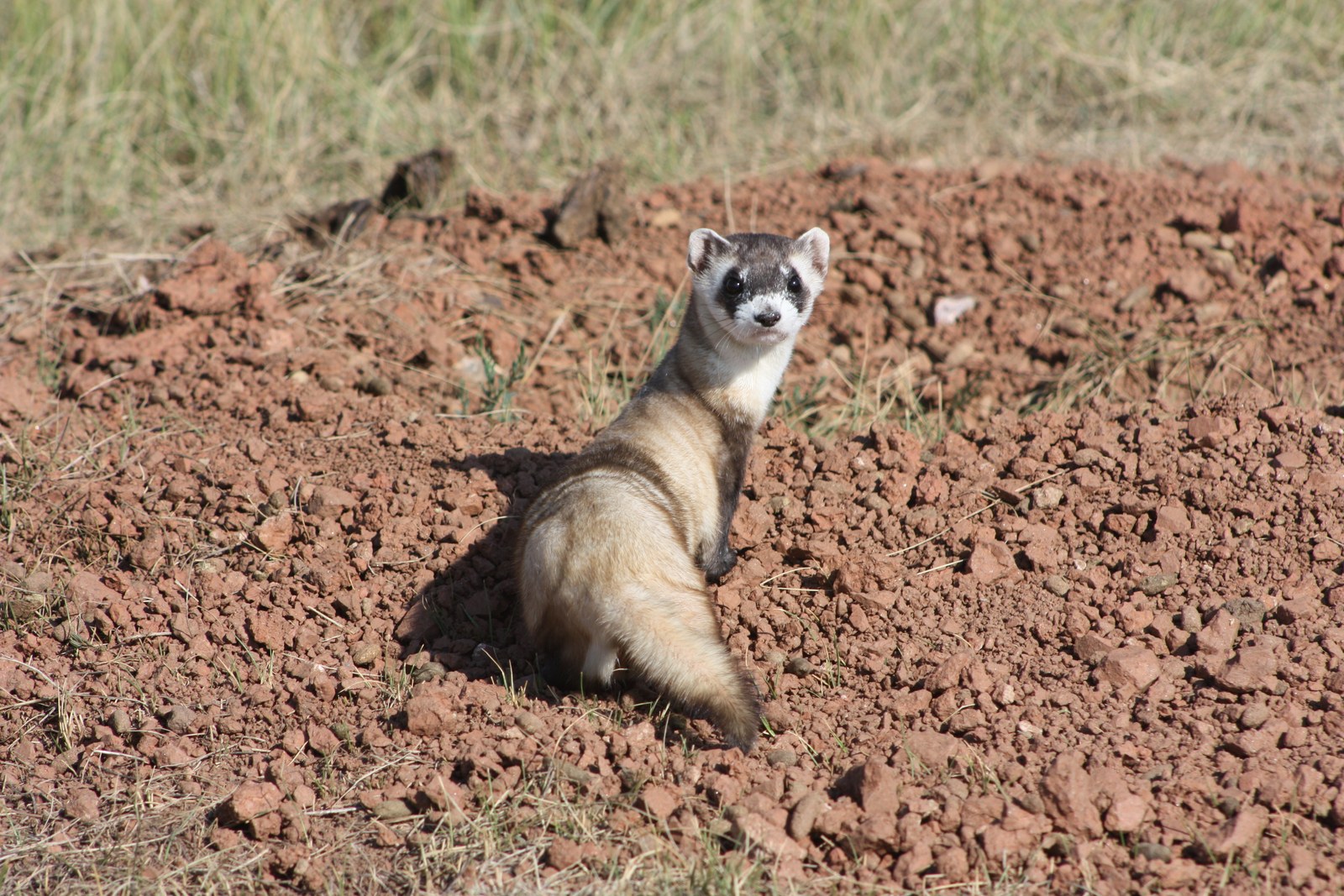
An average family of black-footed ferrets (Mustela nigripes) needs at least 250 prairie dogs a year, by the National Park Service's estimate, and it sleeps and raises its kits in prairie dog burrows. Around the Black Hills, both species live on the grasslands of Badlands National Park, the Buffalo Gap National Grassland and Wind Cave National Park. Their story here covers how a town works, the ferret's near extinction and return, the plague that kills both, and the dispute over prairie dogs on grazing land.
Inside a Prairie Dog Town
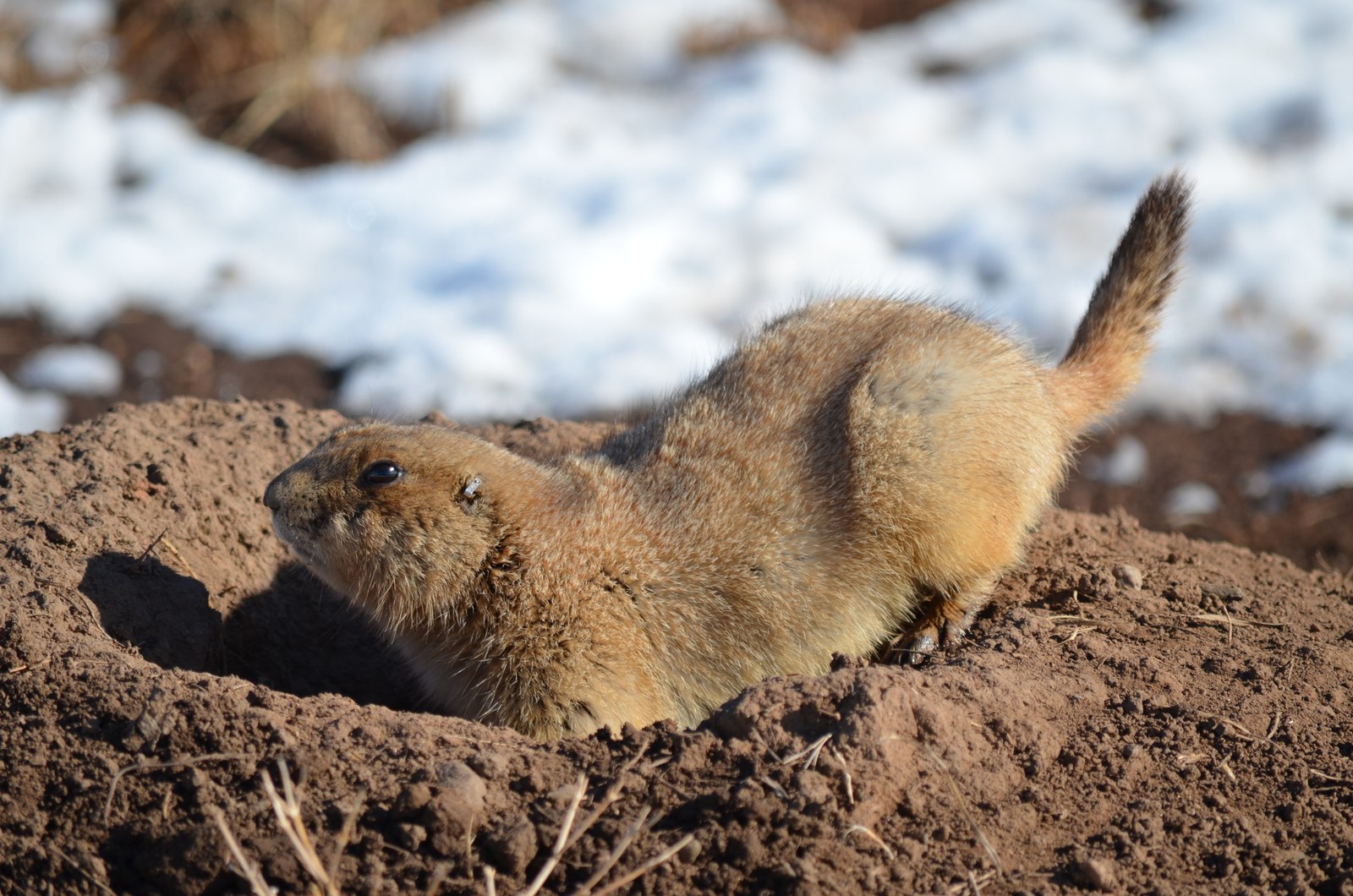
The black-tailed prairie dog (Cynomys ludovicianus) is a light-brown, short-legged burrower 12 to 16 inches long and 1 to 3 pounds in weight, with a black tip on its tail. It lives in colonies called towns, with about 30 to 50 burrow openings to the acre. Each opening sits in a cone of dirt 1 to 3 feet wide that keeps rain out and serves as a lookout, above a tunnel 3 to 6 feet deep. A town is split among family groups called coteries, most often a lone adult male with three or four adult females and their young from the past year.
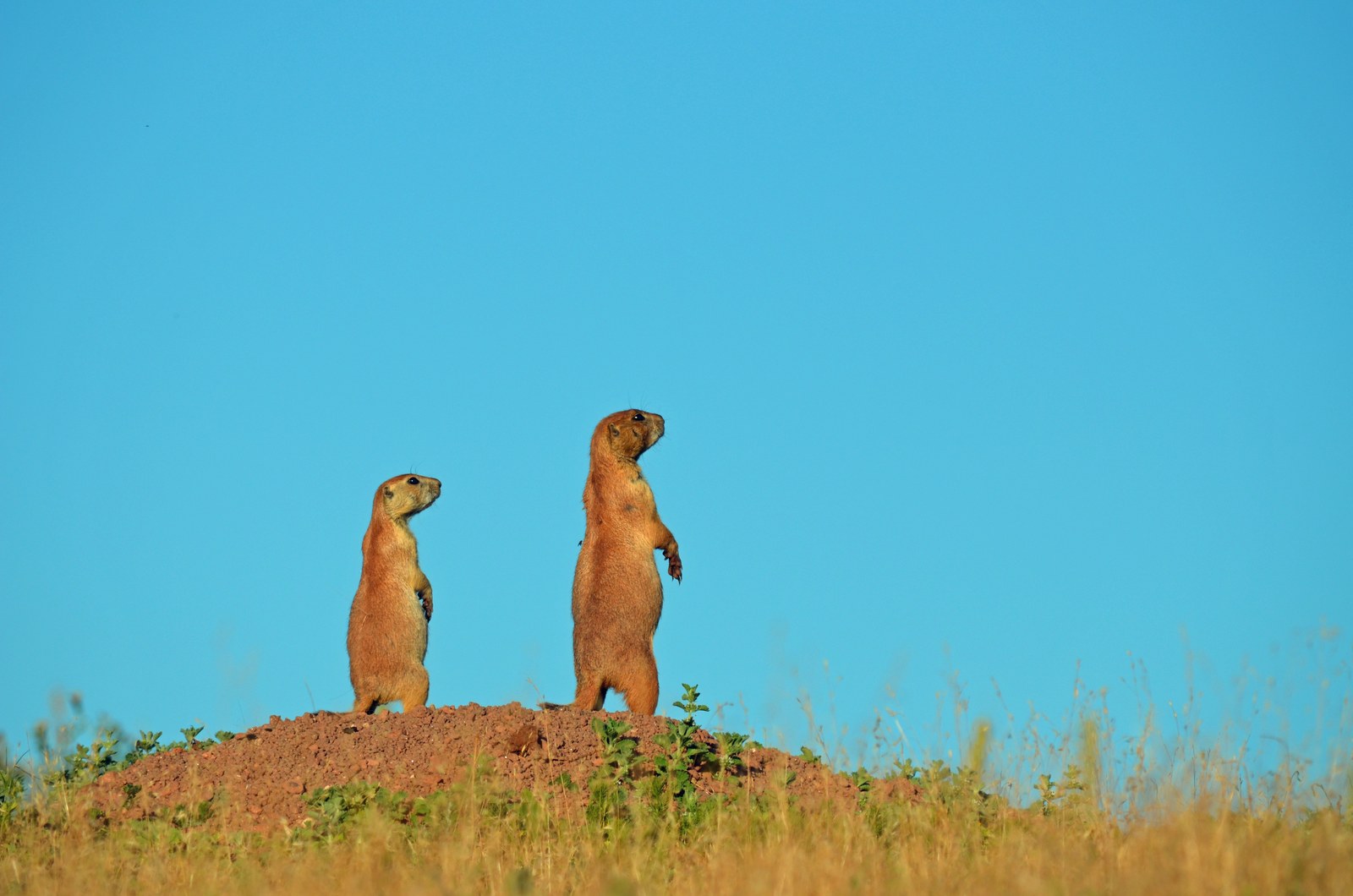
A call the Park Service names the "jump-yip" is the all-clear, given once a threat is gone. The warning before it is a quick string of nasal yips that brings nearby prairie dogs up on their hind legs to look. Prairie dogs also bite off plants they don't eat, probably so predators can't approach under cover.
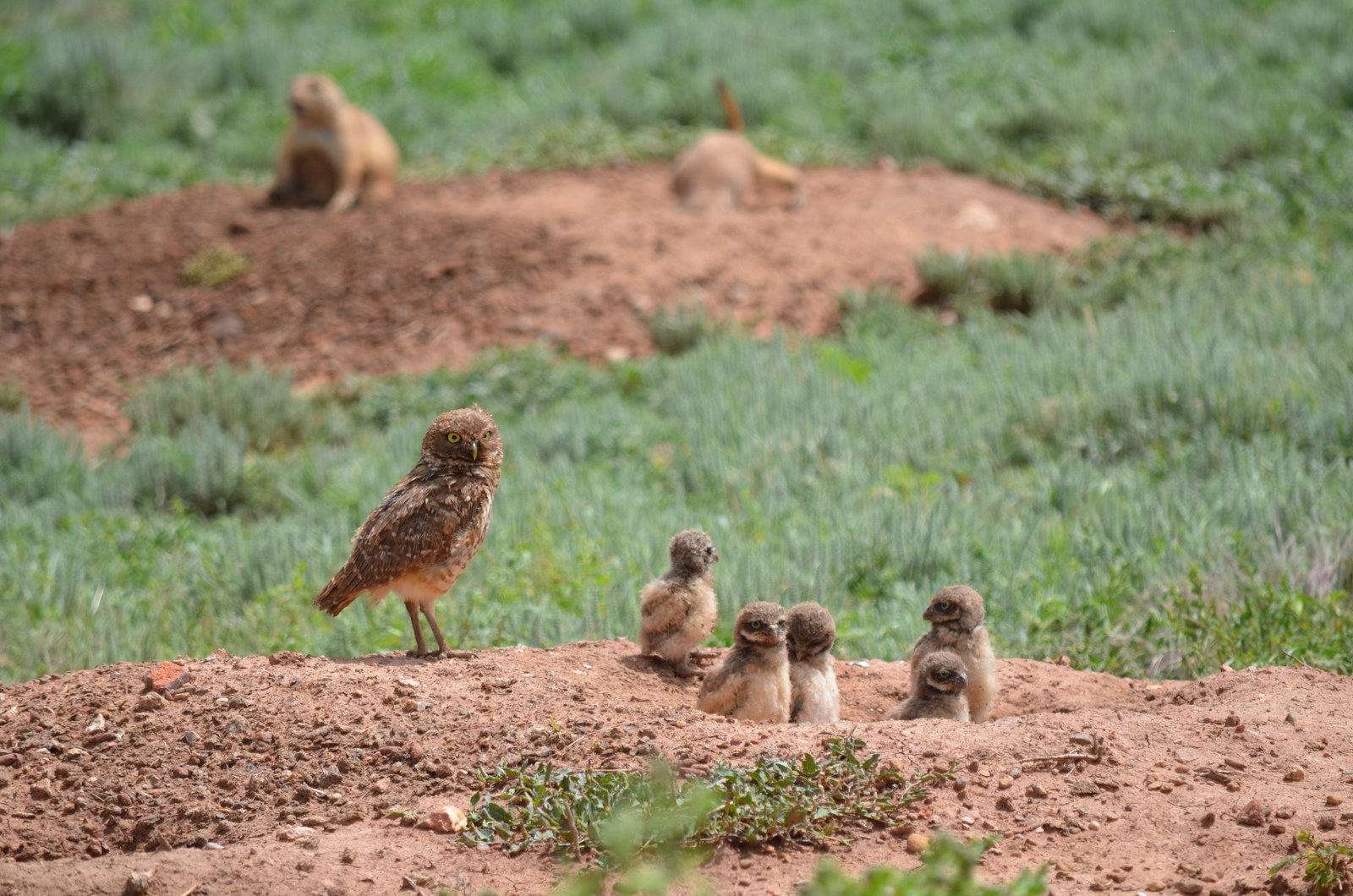
Many other animals use the towns. Burrowing owls (Athene cunicularia) nest and roost in burrows that prairie dogs dug, and rattlesnakes, rabbits and small rodents move into empty ones. Eagles, hawks and foxes are among the animals that hunt prairie dogs, and the clipped grass grows back more nutritious, which benefits the large wild grazers.
A Ferret Given Up for Extinct
The black-footed ferret hunts at night, lives alone except when mating and raising young, and may sleep up to 21 hours a day. About 90 percent of its diet is prairie dog, and a single ferret gets through one roughly every third day. Poisoning prairie dogs as farming spread was one cause of the ferret's fall, the Park Service says. By some estimates, black-tailed prairie dogs once ranged over at least 100 million acres across 11 states; the Fish and Wildlife Service later put the figure at 1.8 million acres in 10, the Associated Press reported in 2005.
The ferret went on the endangered species list in 1967. South Dakota held the last wild ferrets anyone knew of, in Mellette County, until they disappeared by 1974, and after the last captive one died in 1980, the species was thought to be extinct. Then, on September 26, 1981, near Meeteetse, Wyoming, John and Lucille Hogg's ranch dog, Shep, killed a ferret and brought it home. The find led biologists to a colony of more than 120. Plague and canine distemper struck the colony in 1985, and from 1985 to 1987 all that were left, 18 animals, were taken into captivity. They became the breeding stock for the program the Fish and Wildlife Service runs from its National Black-footed Ferret Conservation Center in northern Colorado.
Back on the Badlands and at Wind Cave
The first ferrets went back to the wild in 1991, in Shirley Basin, Wyoming. On June 14, 1994, the Park Service signed a decision to return them to Badlands National Park and the Buffalo Gap National Grassland near Wall, starting in the park. That fall, 36 ferrets went out into the Conata Basin–Badlands prairie dog complex. Releases in the Conata Basin, part of the Buffalo Gap grassland, added 147 more from 1996 through 1999. The last captive-born ferrets were added there in 1999, Travis Livieri, executive director of Prairie Wildlife Research, told South Dakota Public Broadcasting (SDPB) in July 2026, and the population has bred on its own since.
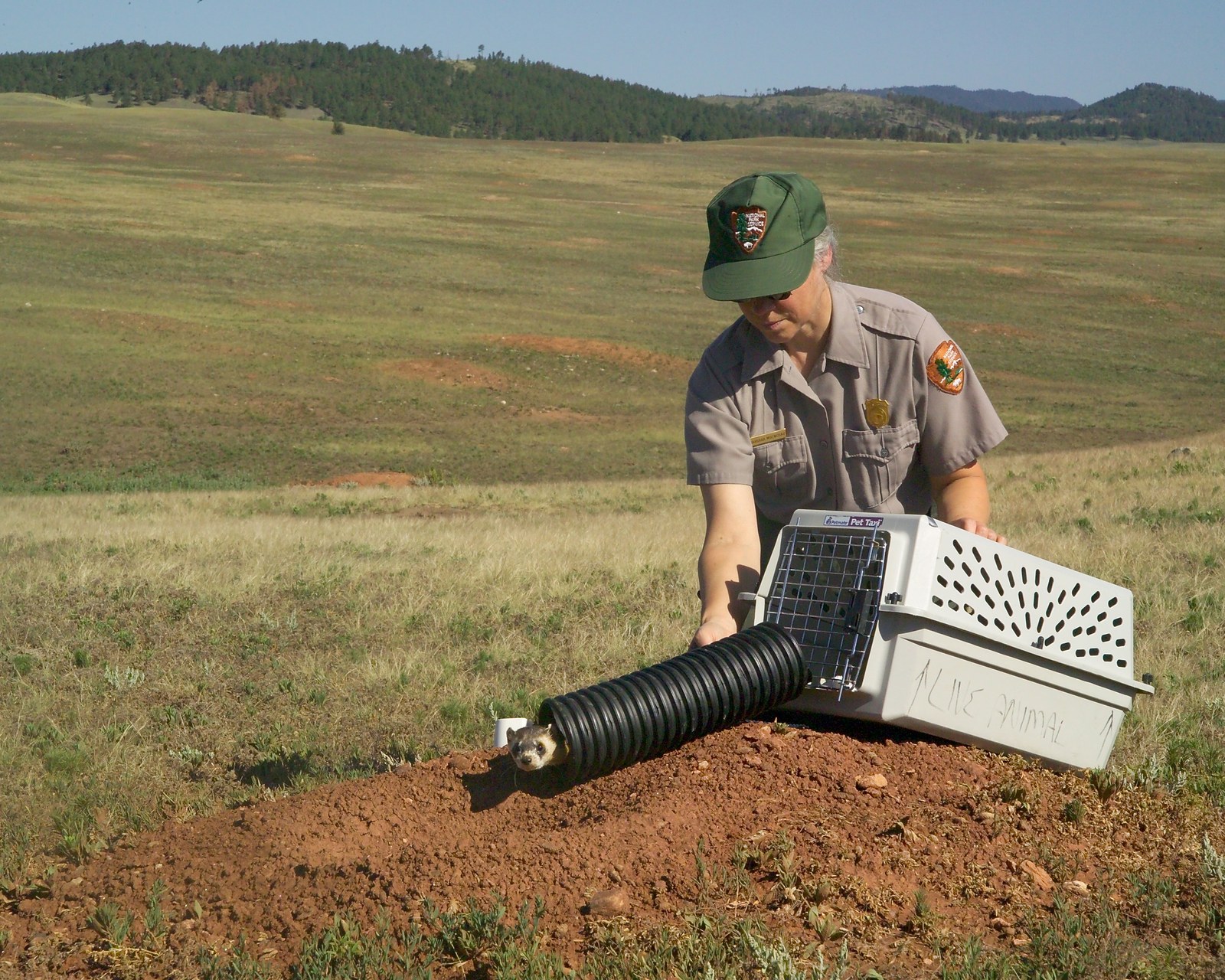
Wind Cave National Park followed on July 4, 2007, when seven ferrets trapped in the Conata Basin were released there. No ferret had been seen in the park in 30 years, acting superintendent Rick Mossman said. In 2024 the Park Service put the park's capacity at 40 to 60 ferrets, depending on prairie dog density, and releases there continue. The Cheyenne River Sioux Tribe had kept ferrets for three years by 2004, ICT reported, and the Rosebud Sioux Tribe was planning a release.
Why Plague Hits Both Animals
Sylvatic plague, caused by the bacterium Yersinia pestis, reached North America by accident in the early 1900s, according to the U.S. Geological Survey, and most of the continent's mammals have little or no immunity to it. Fleas spread it. An outbreak can kill 90 percent or more of a colony's prairie dogs. Ferrets can catch it from flea bites or infected prey, and lose their food supply at the same time.
Plague was found in the Conata Basin in 2008. The USGS reported that the outbreak killed about 100 ferrets, roughly a third of those in the basin, and close to two-thirds of its prairie dogs. Livieri told SDPB that the ferret count fell from 355 in 2007 to about 50 in 2013. Crews dusted burrows with insecticide to kill fleas and trapped some wild ferrets to give them two shots of a vaccine the Army had developed for people.
Dusting has limits. Burrows in parts of the Conata Basin, the Buffalo Gap grassland and Badlands National Park were dusted with the insecticide deltamethrin every year starting in 2005, and a 2018 study in the Journal of Wildlife Diseases found it had stopped working in two colonies treated for more than eight years: fleas were back within a month. The authors urged rotating insecticides and adding vaccines. One for prairie dogs, given in bait, was developed by the USGS National Wildlife Health Center and the University of Wisconsin–Madison. In field trials in seven western states from 2013 to 2015, published in EcoHealth in 2017, it protected prairie dogs only in part. Survival was better on vaccine plots where plague struck, but prairie dogs there still died of it.
Ranchers, Conservation Groups and the 2005 Law
Prairie dogs compete with cattle for forage. About 250 prairie dogs eat as much as one 1,000-pound cow, the Park Service figures, though it says the cost is hard to measure and turns on rainfall, range condition, prairie dog density and whether livestock are present.
In September 2004, eight conservation and animal-welfare groups sued over a federal and state plan to poison and shoot prairie dogs in the Conata Basin. In the groups' announcement, Jonathan Proctor of the Predator Conservation Alliance called the deal "a breach of the public trust." In February 2005, ranchers around Interior blamed the federal government. It had not poisoned prairie dogs in more than four years, the Associated Press reported, while it weighed protecting them under the Endangered Species Act. Jerry Heinrichs, who had sold his 150 cows the year before, told the AP, "The worst enemy we've got right now is our own government." In the same story, Proctor blamed the bare ground on overgrazing in a drought that had brought some areas only 2 inches of rain in two growing seasons.
Gov. Mike Rounds signed Senate Bill 216 on March 4, 2005. The veterinary news site dvm360 reported in April that he had made prairie dogs a "statewide pest," but the law's text was narrower than that. As passed, it counted prairie dogs as a "pest" only when four conditions all held: plague had been reported in a colony east of the Rocky Mountains; Game, Fish and Parks found more than 145,000 acres of them statewide, tribal lands included; they were moving onto land against the owner's wishes; and the neighbor kept no maintained 1-mile buffer or other agreed border, with a written complaint filed with the state Department of Agriculture.
Game, Fish and Parks guidance also offers control of colonies on private land that spread from neighboring public land, if they cover at least 10 acres and lie within a mile of the public boundary; private land next to tribal land or a city or town doesn't qualify.
How Many Ferrets Live There Now?
Fewer than 100 ferrets lived in the Conata Basin and the Badlands as of July 2026, according to Livieri. Plague returned in 2024, a year when 250 were counted, and drought in 2025 pushed the number below 100, he told SDPB on July 10. In an October 2026 WyoFile story the Associated Press carried, he said the count fell from 250 to 70 between 2024 and 2025. Four days before the July interview, an SDPB preview of Wall's 30-year celebration, citing the Forest Service, had put almost 300 ferrets in Badlands National Park alone, nearly half the species' wild population. The park is part of the Conata Basin–Badlands complex, so both figures can't be current, and the preview gave no year for its count. "We still can't make it rain," Livieri said in July.
Connected
- Badlands National ParkThe park where the first reintroduced ferrets in South Dakota went free in 1994.
- Wind Cave National ParkThe prairie above the cave, where ferrets returned in 2007.
- The Badlands and WallThe Buffalo Gap grassland, the Conata Basin and the towns around them.
- Wall, South DakotaThe town that celebrated 30 years of ferret releases in July 2026.
- The Southern HillsThe pine and prairie country around Wind Cave.
- Birds and WildflowersMore of the birds that share the grasslands.
Sources
- Black-footed Ferret: Rebounding in the Badlands. National Park Service, Badlands National Park, 2020.
- Black-tailed Prairie Dogs. National Park Service, Scotts Bluff National Monument, 2021.
- Burrowing owl, Badlands National Park, 2014. National Park Service, NPGallery, 2014.
- National Black-footed Ferret Conservation Center. U.S. Fish and Wildlife Service.
- Black-Footed Ferrets: Top Milestones for a Species Once Presumed Extinct. Smithsonian's National Zoo and Conservation Biology Institute, 2021.
- Scientists celebrate a milestone for the critically endangered black-footed ferret, by Lori Walsh. South Dakota Public Broadcasting, 2026.
- Ranchers Blame Government for Prairie Dog Damage (Associated Press). Environmental News Network, 2005.
- Record of Decision, Final Environmental Impact Statement, Black-Footed Ferret Reintroduction, Conata Basin/Badlands, South Dakota. National Park Service, Federal Register 59, no. 118, 1994.
- Badlands (South Dakota): Black-Footed Ferret Reintroduction. National Park Service Morning Report, December 16, 1994; copy held by the NPS History Collection.
- Black-footed Ferrets Return to Wind Cave National Park. National Park Service, Wind Cave National Park, 2007.
- Masked Bandits: Black-footed Ferrets in Wind Cave. National Park Service, Wind Cave National Park, 2024.
- Protecting Black-Footed Ferrets and Prairie Dogs Against Sylvatic Plague. U.S. Geological Survey, National Wildlife Health Center, Fact Sheet 2008–3087, revised 2011.
- Resistance to deltamethrin in prairie dog (Cynomys ludovicianus) fleas in the field and in the laboratory, by David A. Eads and others. Journal of Wildlife Diseases, 2018.
- Sylvatic plague vaccine partially protects prairie dogs (Cynomys spp.) in field trials, by Tonie E. Rocke and others. EcoHealth, 2017.
- Broad Coalition Acts to Save a National Treasure in South Dakota. Center for Biological Diversity (press release for eight plaintiff groups), 2004.
- Chapter 212 (SB 216): Prairie dogs considered pests under certain conditions. South Dakota Session Laws, South Dakota Legislature, 2005.
- South Dakota governor declares prairie dogs pests. dvm360, 2005.
- Prairie Dog Control: Best Management Practices. South Dakota Game, Fish and Parks.
- Forest Service, community of Wall celebrating black-footed ferret reintroduction. South Dakota Public Broadcasting, 2026.
- No black-footed ferrets found in Meeteetse, 40 years after a rescue saved the species. WyoFile, distributed by the Associated Press; Spectrum News NY1, 2026.
- Ferrets finding a home at Rosebud, by Matt Ross. ICT, 2004.
Last reviewed: