Wildlife and Plants
Wild Turkeys in the Black Hills
After a snowstorm in the Black Hills, bare ground shows first on the south-facing slopes, where the sun melts the snow fastest. Merriam’s turkeys (Meleagris gallopavo merriami) favor those slopes, state biologists say, scratching through the pine needles for ponderosa pine seed, the food they prefer in winter. The birds are newcomers, first released here in 1948. This page covers how turkeys came to the Hills, how the flock spread, where visitors see them, and how they get through winter.
Did Wild Turkeys Always Live in the Black Hills?
Wildlife agencies on both sides of the state line treat the Black Hills turkeys as introduced. Every wild turkey population in South Dakota comes from released birds, says the South Dakota Department of Game, Fish and Parks (GFP). Eastern wild turkeys once lived in the woodlands of the state’s southeast, their range reaching northwest only as far as the mouth of the Cheyenne River, and market hunting and the clearing of woodland had likely wiped them out by 1920.
The Wyoming Game and Fish Department says the wild turkey was not historically found in Wyoming, probably because natural food could not be counted on in winter. Merriam’s turkey comes from farther south. The Forest Service’s Fire Effects Information System gives its original range as Texas, Arizona, New Mexico, Oklahoma and Colorado, and Wyoming’s biologists say it evolved in pinyon pine, juniper and mountain foothill country.
Eight Birds West of Spearfish
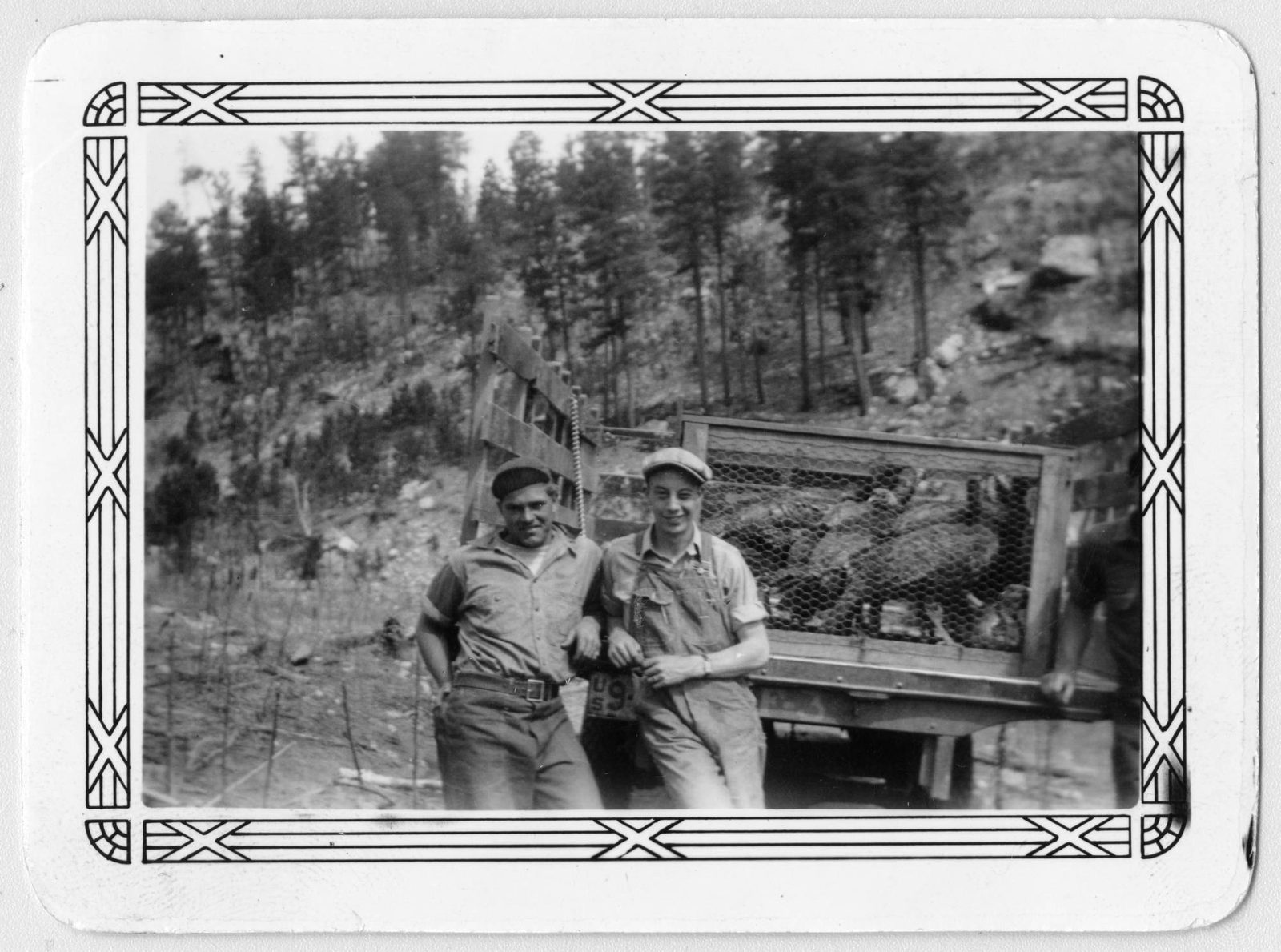
The first successful release came in 1948, when two gobblers and six hens, wild-trapped Merriam’s turkeys from New Mexico, were let go west of Spearfish in Lawrence County, GFP’s 2017 turkey plan says. More wild-trapped birds followed from Colorado in 1950 and New Mexico in 1951, released near Custer and Hot Springs in the southern Hills. The plan adds that 49 more were later stocked in Custer State Park.
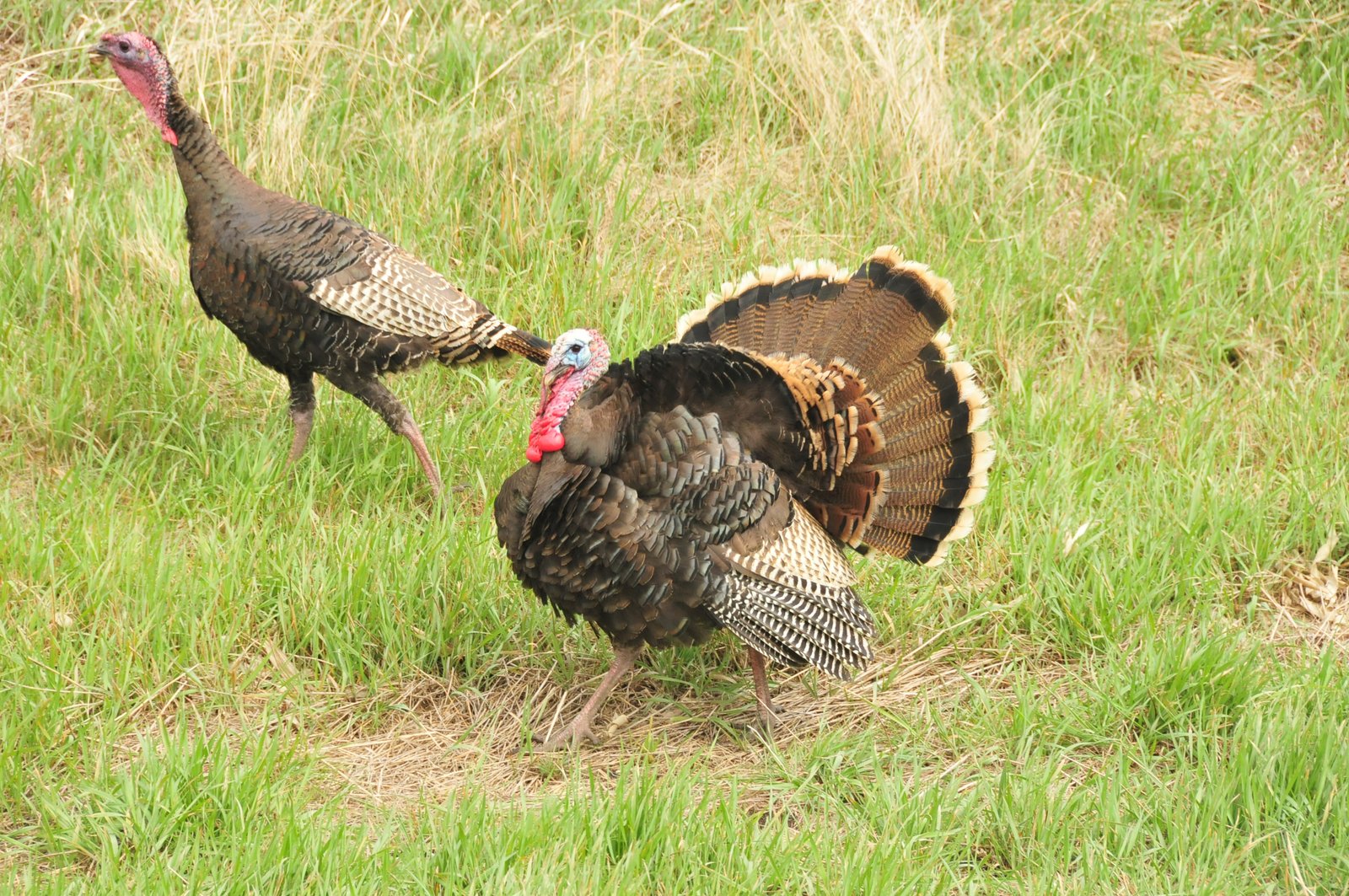
By the fall of 1952 an estimated 1,000 wild turkeys lived in the Black Hills, and from 1953, the plan says, that flock supplied birds for releases along the Missouri River and its western tributaries. South Dakota’s first turkey season opened in the Hills in the fall of 1954, when 750 licensed hunters took about 135 birds. Wyoming released turkeys in its part of the Hills in the 1950s. By 1993 the researchers Mark Rumble and Stanley Anderson could write that the turkeys occupied the entire Black Hills.
Where Do Visitors See Wild Turkeys?
Custer State Park manages its turkeys partly to be seen. GFP’s plan names the aims there as the best possible public view of the birds and a small, high-quality hunt for residents, and in 2015 the park set a 200-yard no-hunting buffer along public roads to protect that viewing. The park’s rules forbid feeding or bothering its animals, GFP says.
At Wind Cave National Park, flocks of turkeys may turn up in the grassland, the Park Service says. The bird list for Devils Tower National Monument marks the wild turkey as introduced, common and breeding there. Jewel Cave National Monument gained its turkeys from a fire. Before the Jasper Fire of 2000, dense forest covered the monument and meadows were scarce, so turkeys came only rarely; once the burn opened ground to feed in, the Park Service says, they stayed as uncommon residents.
Pine Seed, Ranch Grain and Deep Snow
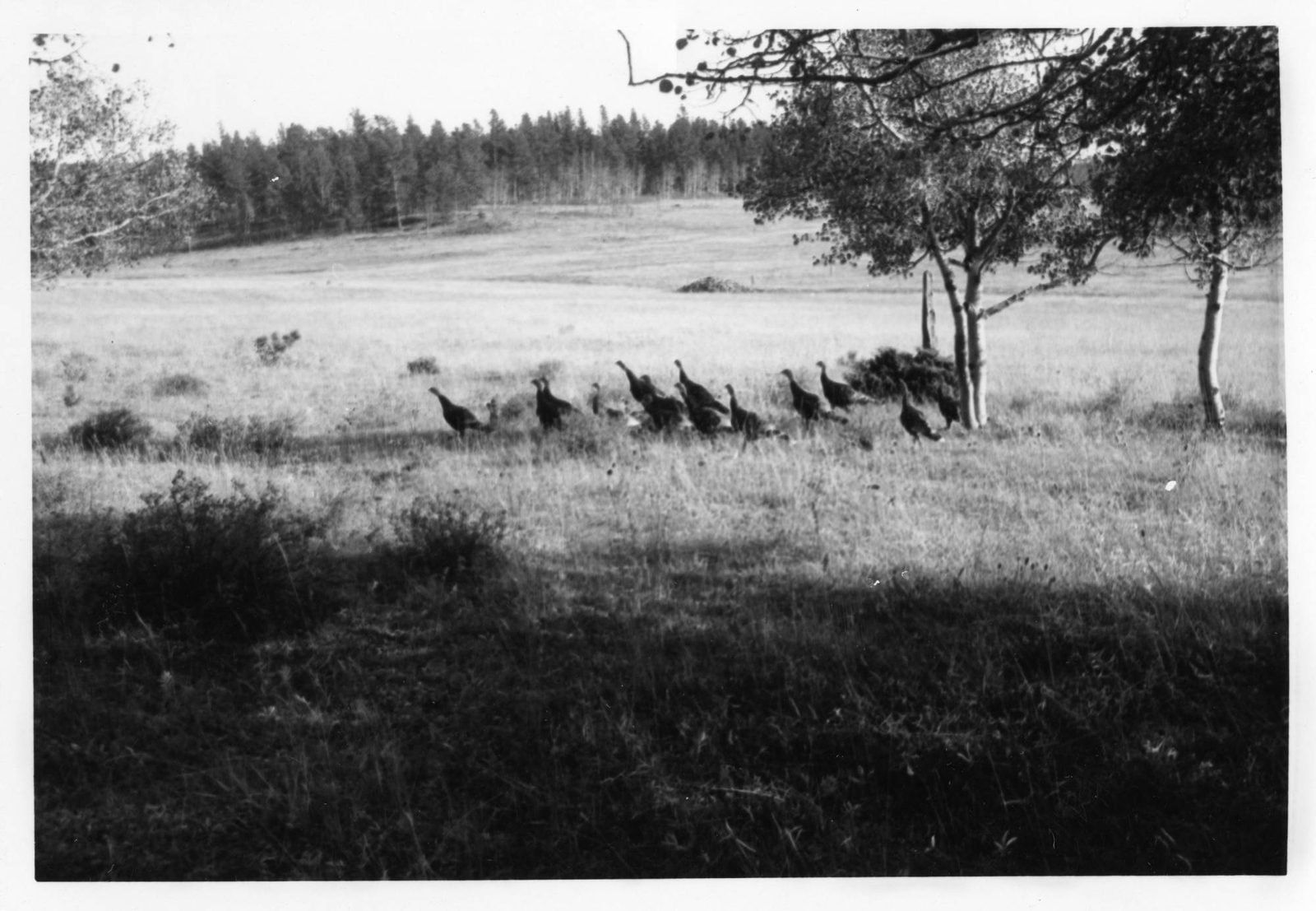
In winter, turkeys eat pine seed when the ponderosas have it. Rumble and Anderson studied the birds from 1986 to 1989 and found that the adults ate 78 kinds of food, but in winter they preferred ponderosa pine seed and chose the places where it was most plentiful. Ponderosa pine in the Hills sets good seed in most years and a heavy crop every two to five years, GFP’s plan says. In drought, when the pines bore less, the turkeys’ winter diet turned mostly to kinnikinnick fruit and the leaves and seeds of low plants.
Chad Lehman, Rumble and Lester Flake radio-tracked 86 hens in the southern Hills through the winters of 2001 to 2004. In the forest the hens fed under larger pines with fairly clear ground beneath. They also chose farmsteads, and the pine seed supply seemed to decide between forest and farm more than cold or snow depth did.
Black Hills turkeys roost in larger ponderosa pines with open branch spacing, and they usually pick a different roost site each night unless a steady food supply such as a ranch is close by, GFP’s plan says. In much of Wyoming, the state’s manual says, turkeys spend the winter near ranch buildings, fed by landowners or picking up grain spilled where cattle are fed. Not every rancher welcomes them: an objective of GFP’s 2021 to 2030 turkey plan is to work with landowners on turkey damage to stored livestock feed.
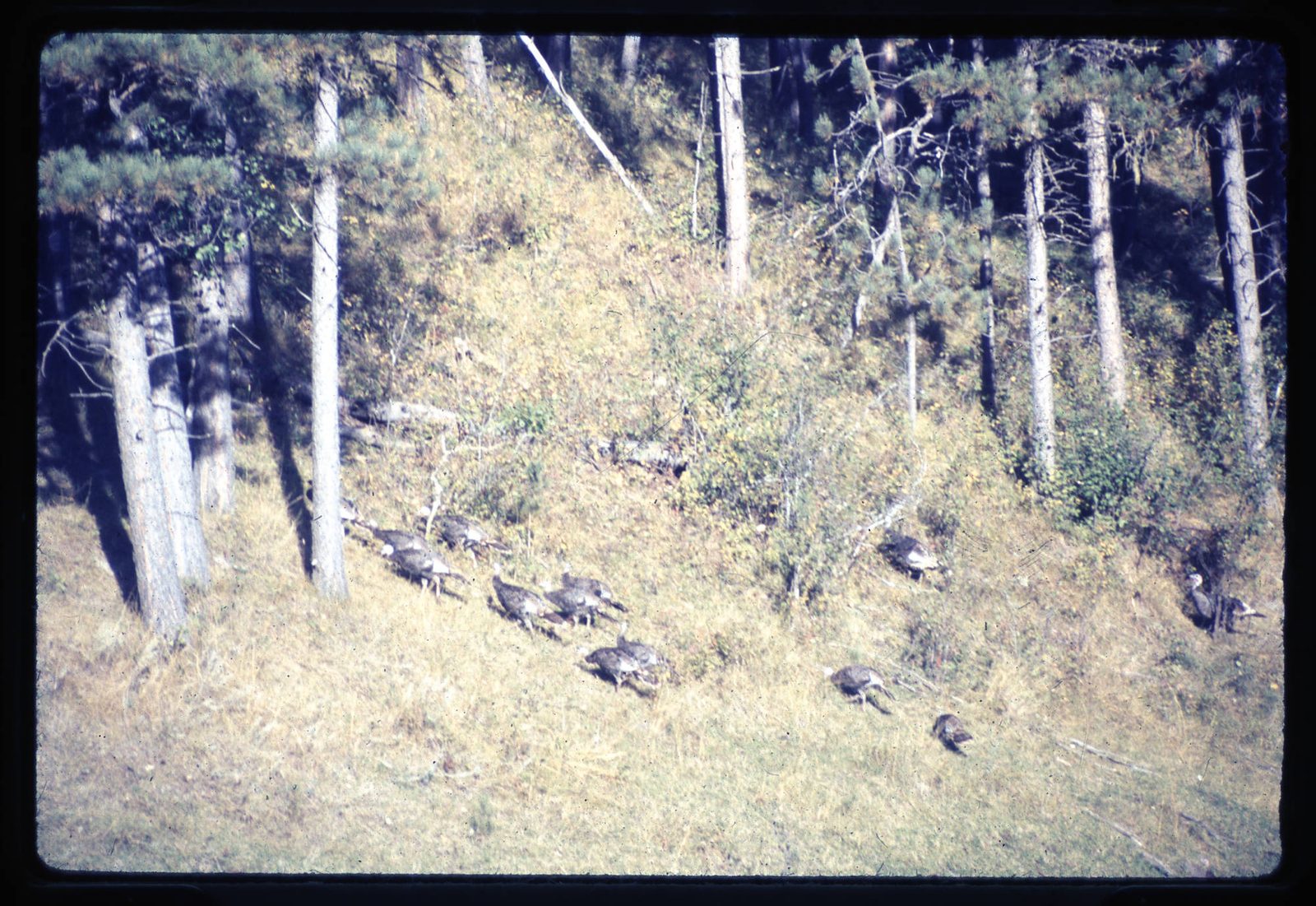
Deep snow that lasts is the danger. In the southern Hills, three yearlings and an adult starved after snow more than about 8 inches deep covered their food for roughly two weeks; the dead birds had lost 40 to 41 percent of their weight, the 2017 plan reports. Pine beetle epidemics can also shrink the best winter range, it adds, and thinning young stands can shorten the wait for that range to grow back.
Nests, Poults and Predators
Hens nest on the ground. A 1993 Black Hills study, cited in Wyoming’s manual, found most hens starting nests in the last week and a half of April or the first week of May, with clutches averaging nine eggs. Common juniper and fallen wood hide many first nests, and snowberry often hides a second attempt, GFP says.
The first weeks are the hardest. In the southern Hills, Lehman and colleagues followed 841 poults raised by 57 radio-marked hens and found that 33 percent lived to four weeks old, with 54 percent of the deaths in the first seven days. Survival fell with rain and with cold, wet spells, and several poults under three days old apparently died of hypothermia, their 2008 study reported. Insects and other small arthropods made up more than 60 percent of what poults ate in Rumble and Anderson’s study, grasshoppers and beetles above all.
Coyotes have been the main predator of nesting hens in South Dakota studies, GFP says. A 2022 study in the northern Hills listed coyotes, mountain lions, bobcats, raccoons, skunks, red foxes, golden eagles, great horned owls, American crows and northern goshawks as possible predators of turkeys or their nests.
Hard Winters and a Northern Decline
Hens in the northern Black Hills were dying faster than they were replaced, that 2022 study in the Journal of Wildlife Management found, and harsh winters and springs appeared to be part of the reason. Its authors, led by GFP biologist Lehman, took up the question after harvest and survey data pointed to fewer birds there. With hen survival and nesting measured from 2016 to 2018, their model gave a yearly growth rate of 0.74: at those rates the hens would decline by about a quarter each year.
Northern hens survived less well than those in the central and southern Hills, mainly because of losses in winter and spring, which the authors tied to the north’s wetter, snowier weather. Snowfall there averaged 264 centimeters, about 104 inches, a year from 2008 to 2018. Adult hens averaged about 9.7 pounds, against 10.4 in the southern Hills, and some starved in winter and even while nesting. The authors recommended no hunting of hens in any open season.
For the Black Hills as a whole, GFP uses the spring harvest as a stand-in for the size of the flock. A two-year average of 1,400 birds or fewer counts as low and 1,900 or more as high. For 2022 the figure was 1,670, in the moderate range, the agency’s 2021 to 2030 plan reports.
Connected
- Custer State ParkWhere 49 turkeys were stocked after the first releases, and where hunting is barred near the roads so visitors can see them.
- The Southern HillsWhere Colorado and New Mexico turkeys were released near Custer and Hot Springs in 1950 and 1951.
- The Ponderosa Forest, Fire and the Pine BeetleThe pine whose seed carries turkeys through winter, and the beetle and fire that reshape it.
- Birds and WildflowersOther birds of the Hills’ spruce, burns and streams, and the wildflowers of the same country.
- Jewel Cave National MonumentWhere turkeys settled after the Jasper Fire opened meadows.
- Mountain Lions in the Black HillsA predator that takes turkeys now and then, though deer are most of what it eats.
- Spearfish, South DakotaThe town nearest the first release of turkeys in the Hills, in 1948.
Sources
- South Dakota Wild Turkey Management Plan, 2016–2020 (Wildlife Division Report 2017-01, January 2017). South Dakota Department of Game, Fish and Parks, 2017.
- Summary: South Dakota Wild Turkey Management Plan, 2021–2030 (Wildlife Division Report 2021-01S, September 2022). South Dakota Department of Game, Fish and Parks, 2022.
- Wild Turkey (chapter 17, draft for the revised Bio-Techniques Manual), by Greg Anderson. Wyoming Game and Fish Department, 2015.
- Meleagris gallopavo, wild turkey, by S. A. Snyder. Fire Effects Information System, USDA Forest Service, Rocky Mountain Research Station, 1992.
- Macrohabitat Associations of Merriam’s Turkeys in the Black Hills, South Dakota, by Mark A. Rumble and Stanley H. Anderson. Northwest Science 67(4), 1993 (via USDA Forest Service Treesearch).
- Feeding Ecology of Merriam’s Turkeys (Meleagris gallopavo merriami) in the Black Hills, South Dakota, by Mark A. Rumble and Stanley H. Anderson. American Midland Naturalist 136(1), 1996 (via USDA Forest Service Treesearch).
- Winter Habitat Selection Patterns of Merriam’s Turkeys in the Southern Black Hills, South Dakota, by Chad P. Lehman, Mark A. Rumble and Lester D. Flake. Western North American Naturalist 67(2), 2007.
- Merriam’s Turkey Poult Survival in the Black Hills, South Dakota, by Chad P. Lehman, Lester D. Flake, Mark A. Rumble and Daniel J. Thompson. Intermountain Journal of Sciences 14(4), 2008 (via USDA Forest Service Treesearch).
- Factors Influencing Rate of Decline in a Merriam’s Wild Turkey Population, by Chadwick P. Lehman, Michael J. Yarnall, Andrea R. Litt, Christopher T. Rota and Jay J. Rotella. Journal of Wildlife Management, 2022 (doi:10.1002/jwmg.22240).
- Turkey (Jewel Cave National Monument). National Park Service, 2015.
- Wind Cave Birds. National Park Service, Wind Cave National Park, 2024.
- Birds (Devils Tower National Monument, bird checklist). National Park Service, 2025.
- Custer State Park. South Dakota Department of Game, Fish and Parks, undated (viewed 2026).
Last reviewed: