Wildlife and Plants
Birds and Wildflowers
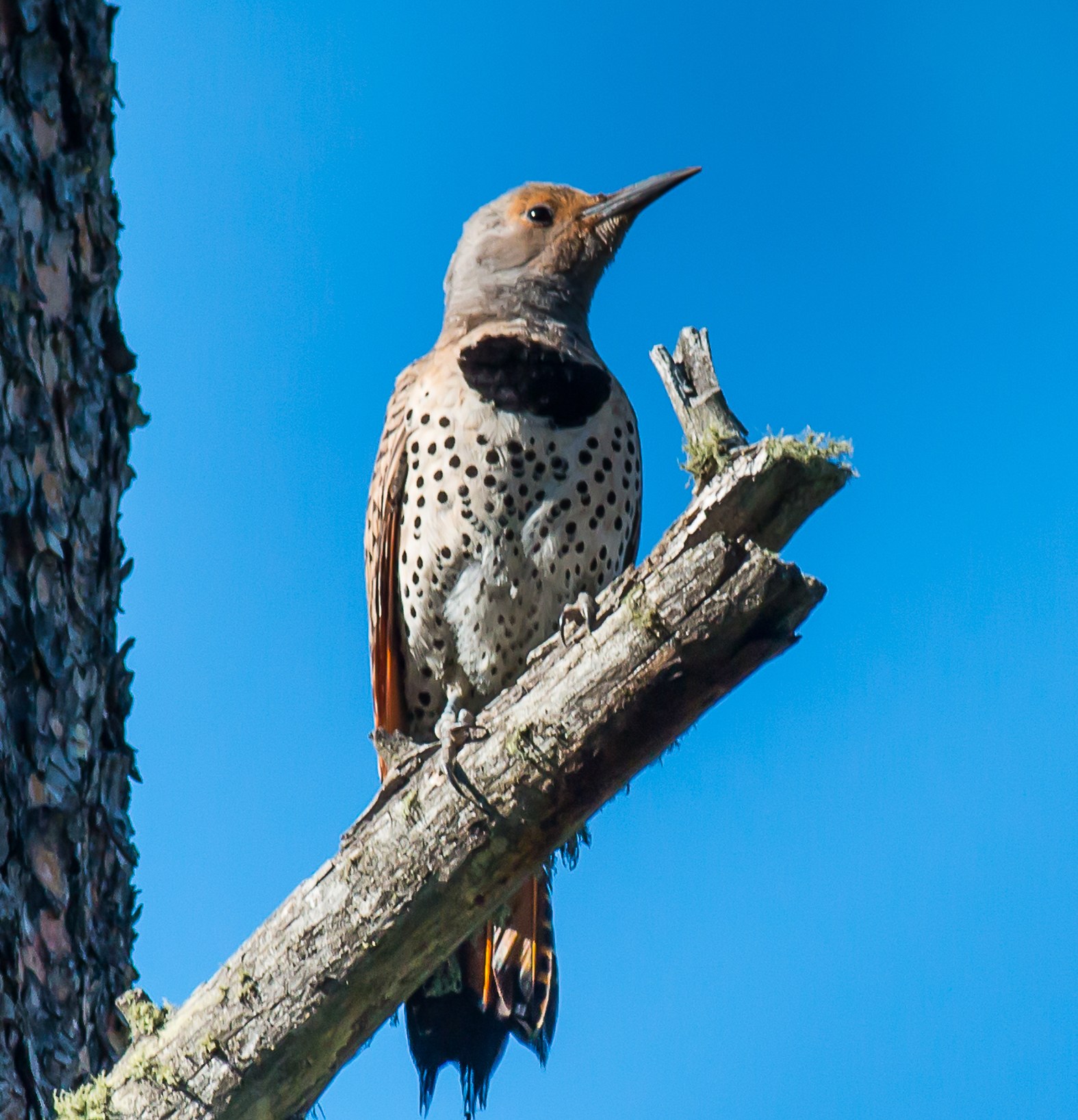
At Wind Cave National Park, a male northern flicker (Colaptes auratus) usually carries what the National Park Service calls "the black mustache stripe of an eastern bird," along with a western bird's red or orange feathers. Eastern yellow-shafted and western red-shafted flickers interbreed across a long hybrid zone on the Great Plains, and Wind Cave's birds show the mix. Across the Black Hills, birds and plants of the north, east, west and south overlap, many near the edge of their range. Some keep to the cool northern spruce, others to the ponderosa pine, the prairie edge or fast mountain streams, and two have drawn official attention, the American dipper a state threatened listing and the black-backed woodpecker a federal listing petition.
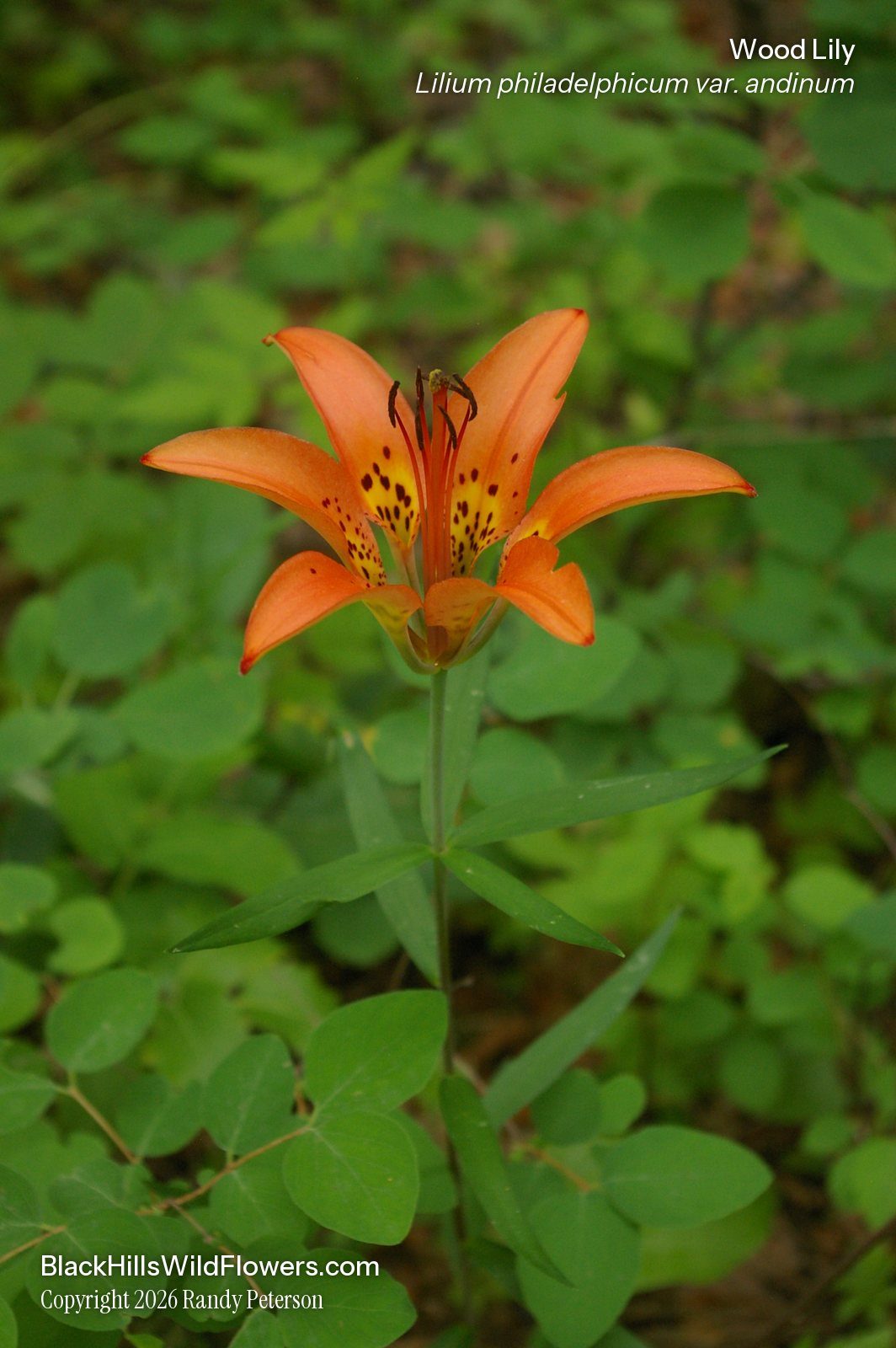
The Black Hills National Forest says the Hills are often seen as an "ecological crossroads." More than 1,500 plant species grow here, in communities that draw on the Rocky Mountains, the Great Plains, the boreal forest of the north and the deciduous forest of the east.
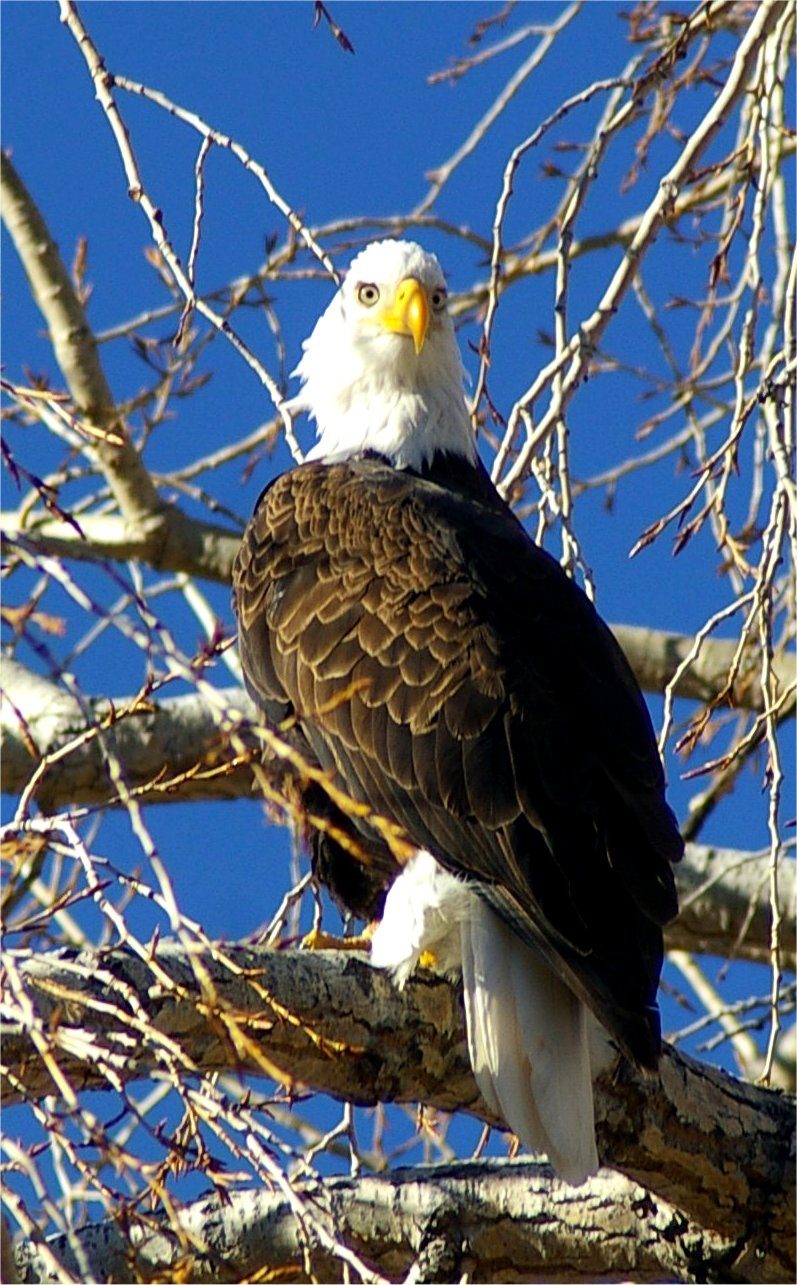
Birds mix the same way. Because the Hills sit near the center of the United States, the Park Service explains, Wind Cave, in the Southern Hills, has both eastern and western birds. Golden eagles (Aquila chrysaetos) and black-billed magpies (Pica hudsonia) may be new to someone from the East Coast, while for a West Coast visitor the red-headed woodpecker (Melanerpes erythrocephalus) may be the unfamiliar one. Even the park's prairie is mixed, part eastern tallgrass and part western shortgrass.
Out on the plains, as of 2020 the Park Service had documented 206 bird species at Badlands National Park, 67 of them known nesters, and it describes the park as lying "at an avian crossroads" for eastern and western birds. Golden eagles nest on the park's cliffs, and rock wrens (Salpinctes obsoletus) live among its steep, eroded walls.
Spruce, Birch and Northern Holdouts
Compared with the rest of the range, the northern Black Hills are cooler and much wetter, a 2003 Forest Service conservation assessment notes. Pockets of northern forest hang on there in draws and on slopes that face north, where white spruce (Picea glauca), called Black Hills spruce here, grows with paper birch (Betula papyrifera) and beaked hazelnut (Corylus cornuta), in what the assessment calls relic boreal hardwood forest. These stands lie apart from the spruce of the Rocky Mountains and the Canadian border country.
The large round-leaved orchid (Platanthera orbiculata) grows thinly through Canada's boreal forest and the northern states, most widely in the East, with scattered pockets from the Appalachians to the Pacific Northwest. Its Black Hills population is disjunct, meaning separated from that main range, and the assessment calls it "unique in its isolation from the species' primary range." NatureServe ranked it imperiled in South Dakota in 2001. The first Black Hills record came from Spearfish Canyon, a plant collected there in 1929. Other plants the assessment counts as disjunct northern species grow with it, among them wild sarsaparilla (Aralia nudicaulis) and Canada mayflower (Maianthemum canadense).
Some birds are just as tied to the spruce. In 2002 the Rocky Mountain Bird Observatory surveyed birds across the national forest and found that in the Black Hills the three-toed woodpecker, now called the American three-toed woodpecker (Picoides dorsalis), keeps largely to white spruce.
Woodpeckers of the Pine and the Burn
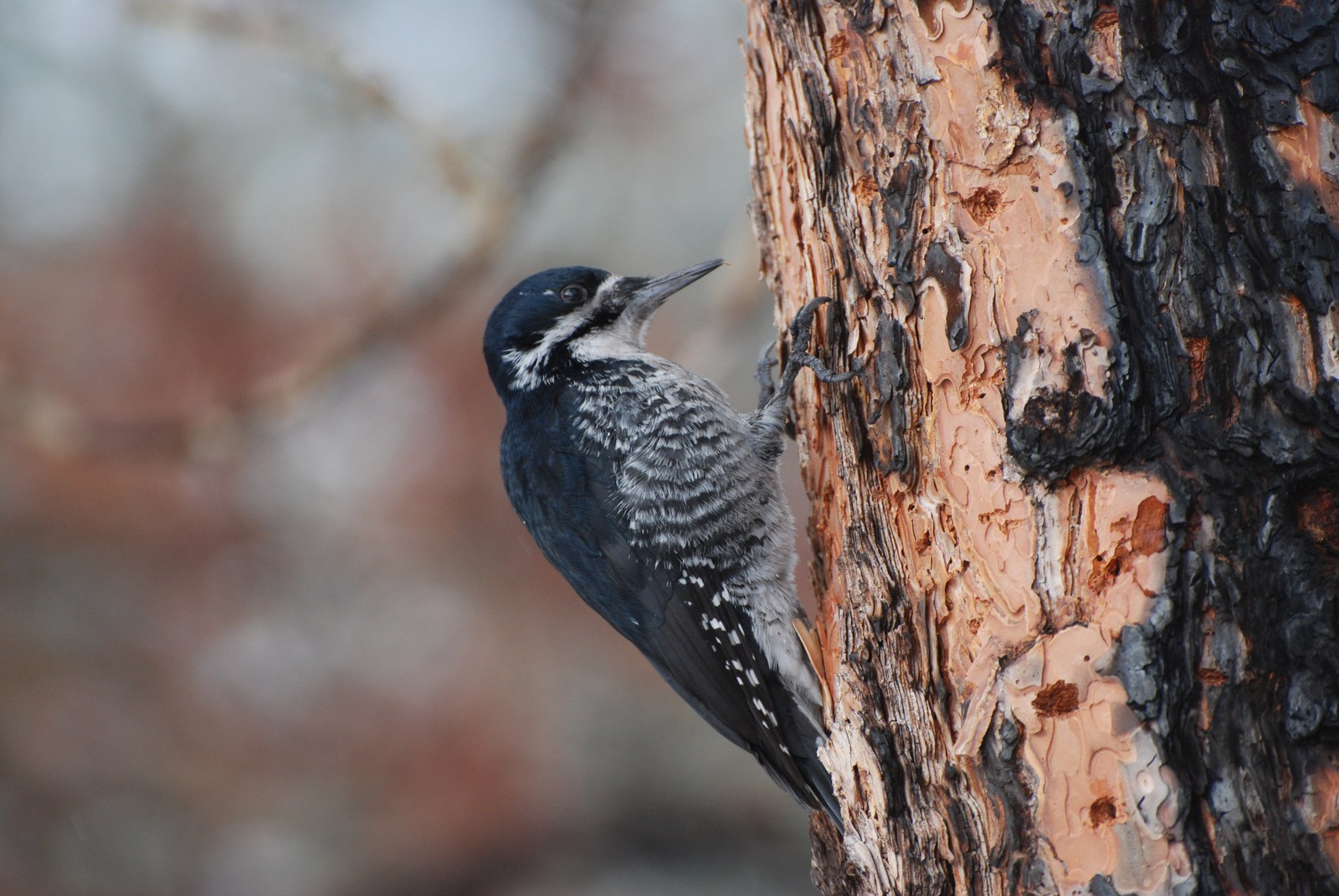
The ponderosa pine (Pinus ponderosa) forest, whose fires and beetle epidemics are told on The Ponderosa Forest, Fire and the Pine Beetle, has birds of its own. Among the owls, tanagers and woodpeckers the Park Service lists in the pine at Wind Cave is the black-backed woodpecker (Picoides arcticus), a mostly Canadian bird whose Black Hills members form a small population cut off from the rest.
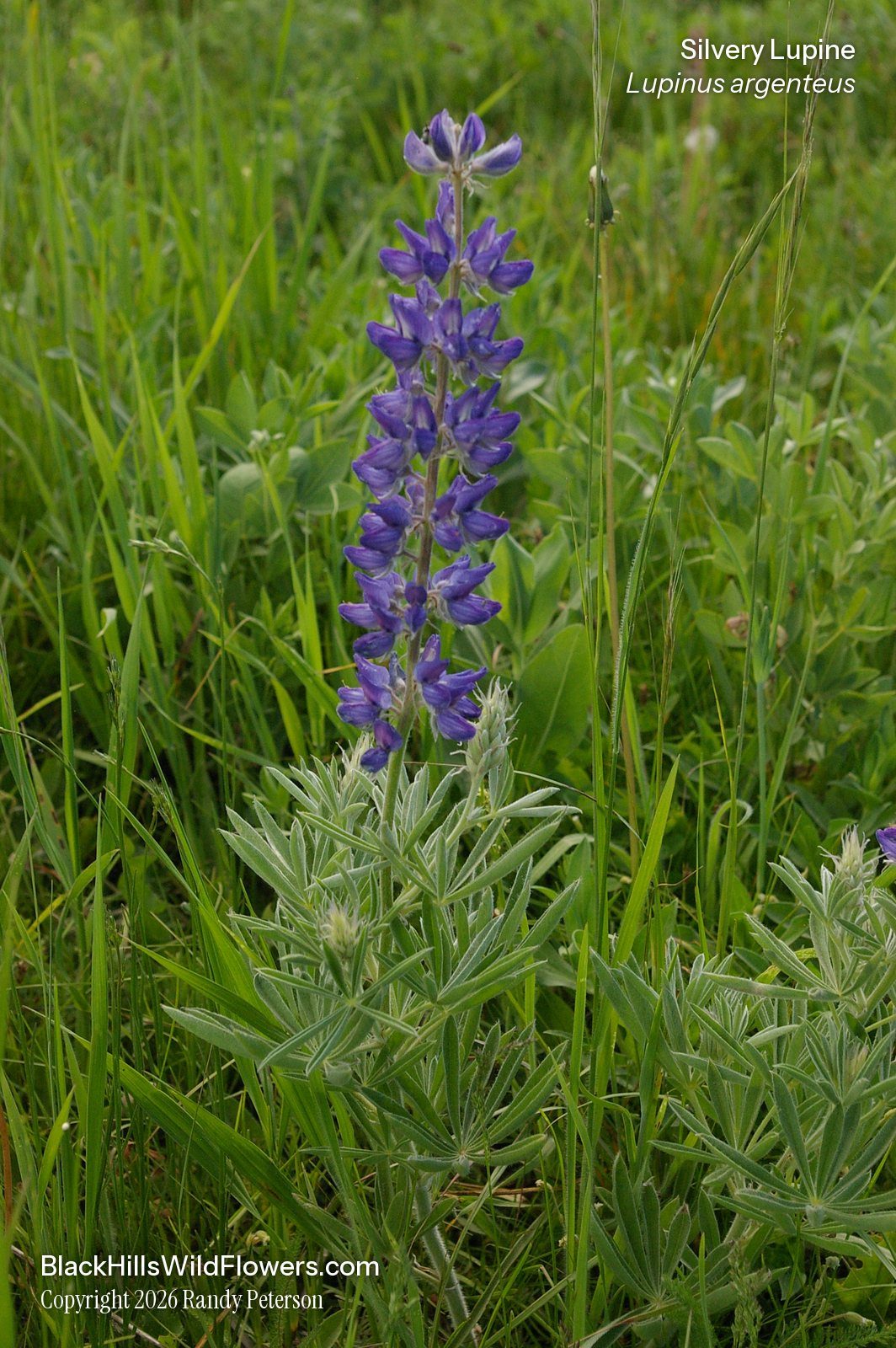
Fire and beetles feed the black-backed woodpecker. It eats mainly the larvae of wood-boring and bark beetles, which become available after severe fires and other big disturbances, the U.S. Fish and Wildlife Service says, and it prefers to forage on burned trees. Across its range it keeps to standing dead timber and appears most abundant where fire has recently killed trees or beetles have killed many. In the Black Hills, the 2002 surveys found black-backed woodpeckers, red-headed woodpeckers and northern flickers more densely in burned forest than anywhere else the surveyors counted.
Virginia's warbler (Leiothlypis virginiae) reaches the northeastern edge of its range in the Black Hills, South Dakota Game, Fish and Parks notes. The 2002 surveys found it only in pine-juniper shrubland.
When Do Pasque Flowers Bloom?
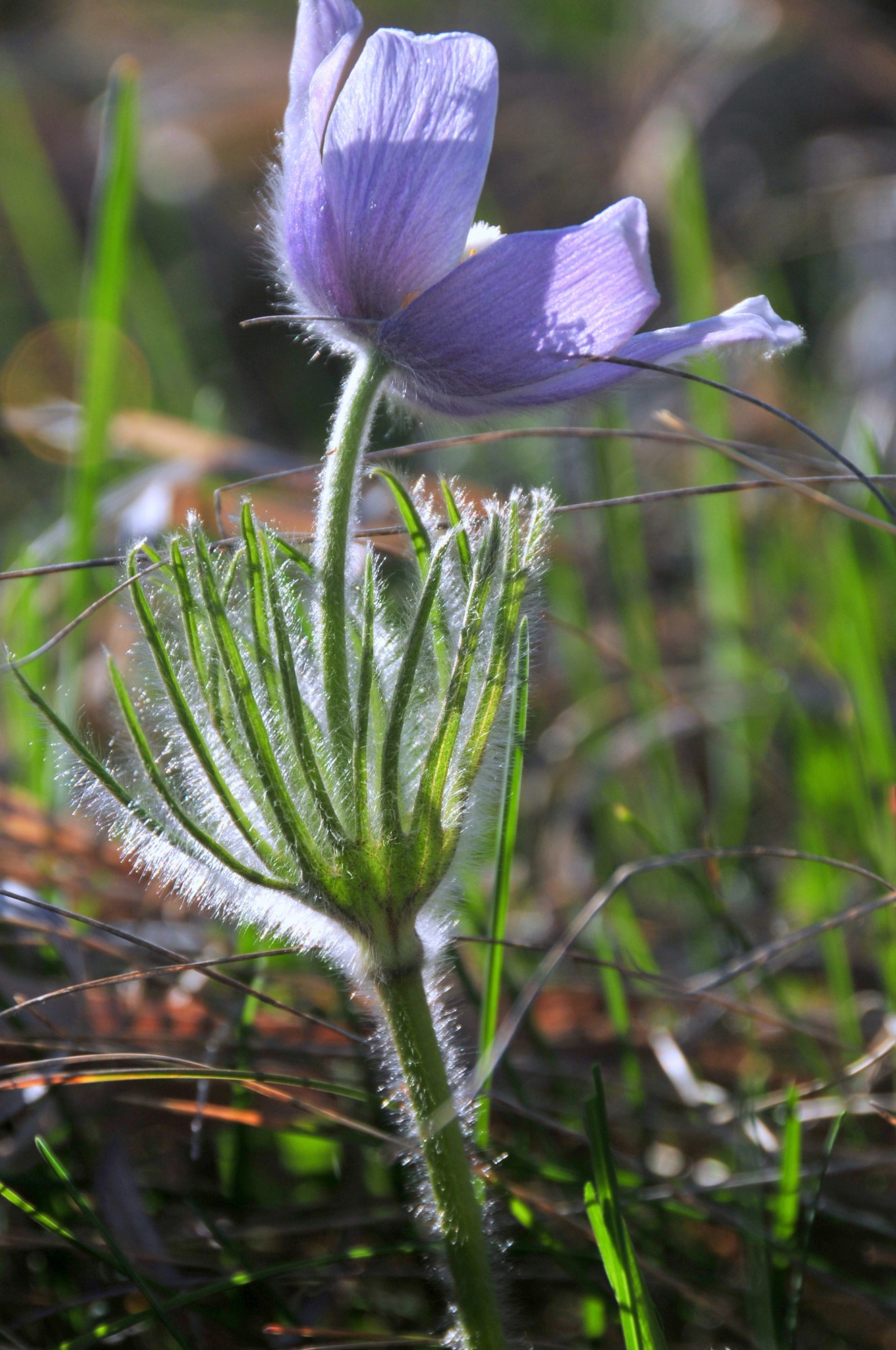
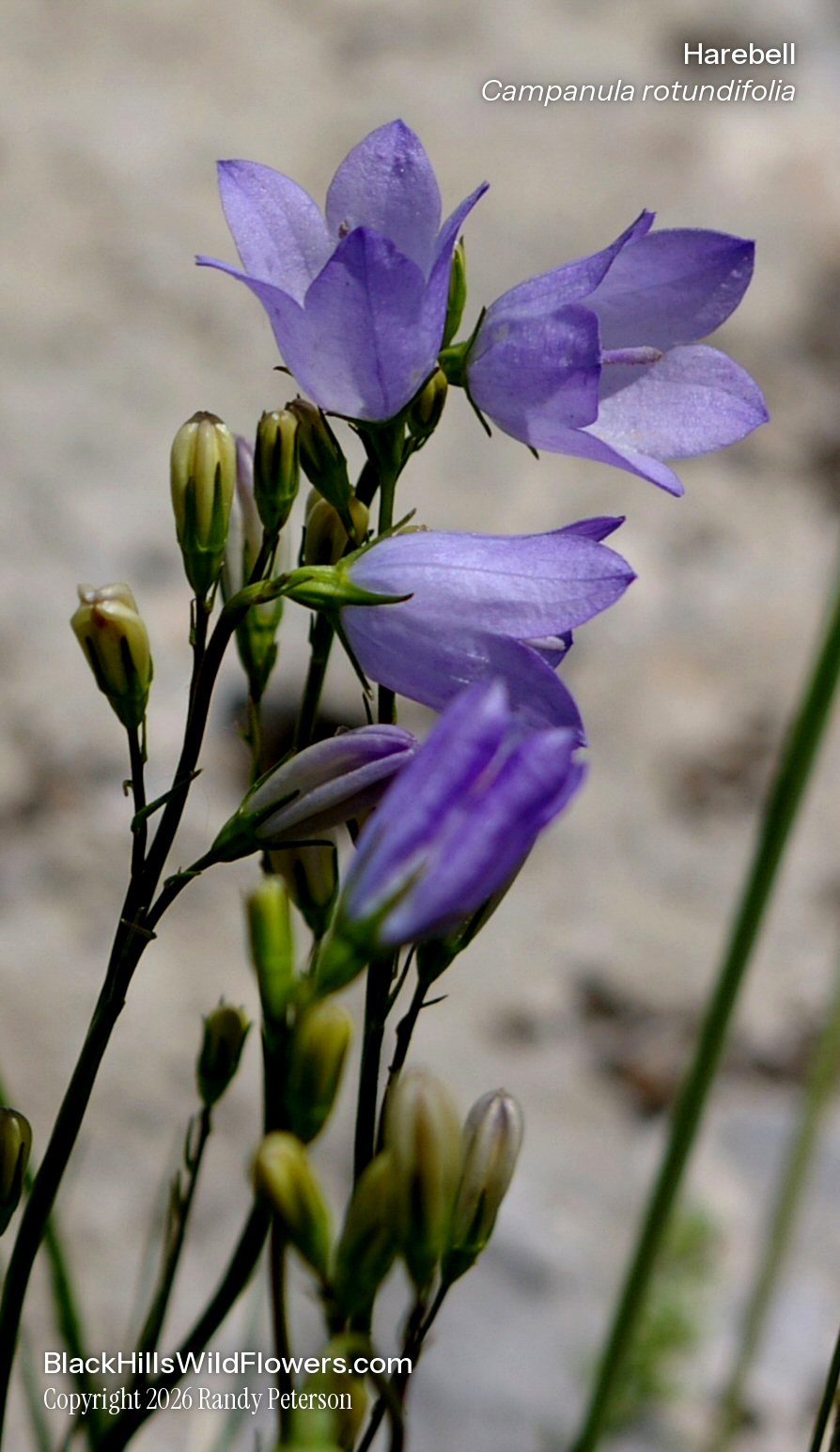
Pasque flowers bloom from March to May, according to both Jewel Cave National Monument and SDSU Extension. The pasque flower (Pulsatilla patens, also classed as Anemone patens, the name the Park Service uses) became South Dakota's floral emblem, with the motto "I Lead," under a 1903 state law. The state code still calls it by an older scientific name, Pulsatilla hirsutissima. A knot of yellow stamens sits at the center of the flower, ringed by five to seven sepals that pass for petals, most often white, SDSU Extension says, but sometimes tinted lavender or blue-violet. A coat of silky hair on the stem holds in warmth during the cold of early spring, the monument notes.
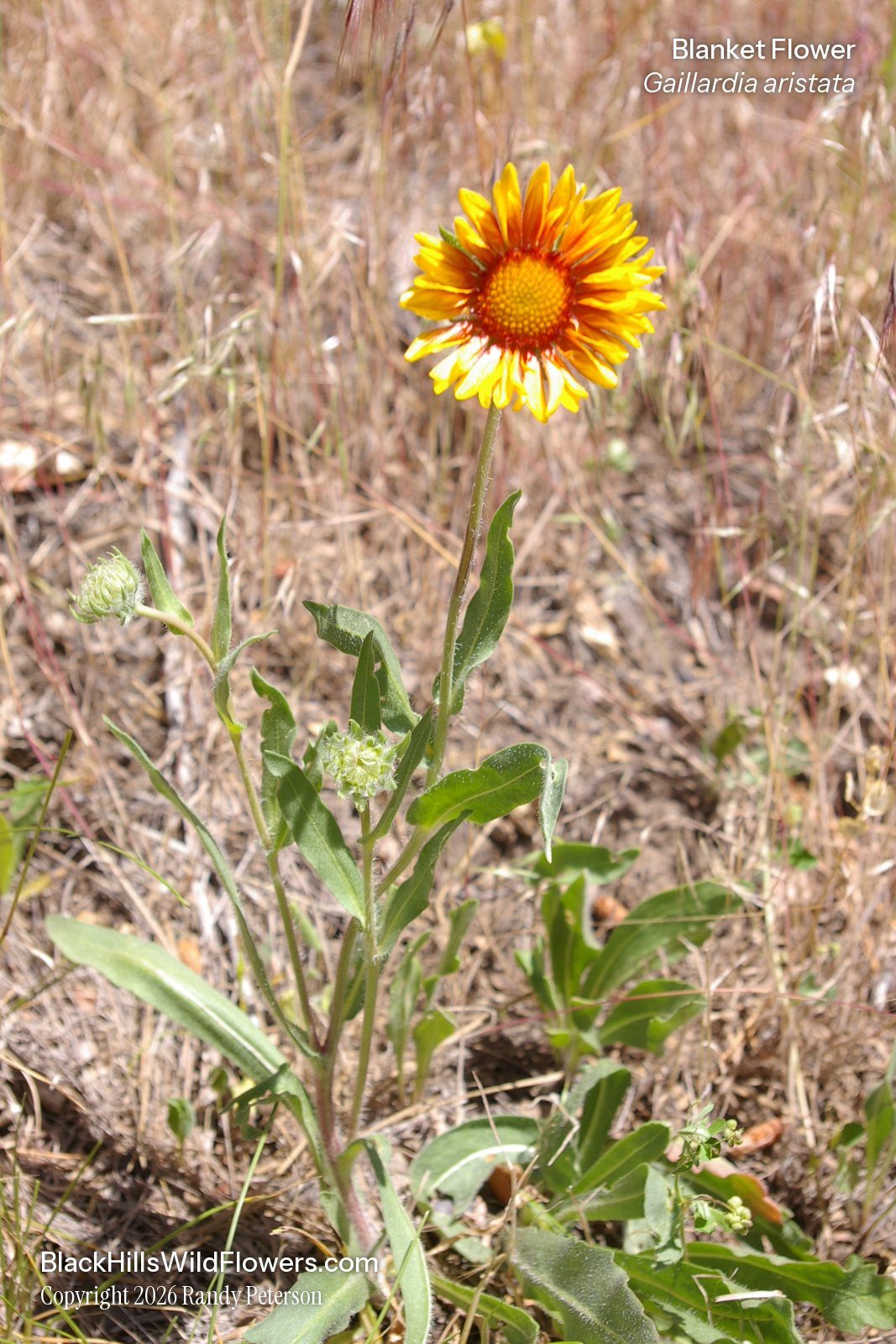
Of the 19 wildflowers Jewel Cave profiles, Rocky Mountain iris (Iris missouriensis) blooms in May and June, purple coneflower (Echinacea angustifolia) in June and July, and Gunnison's mariposa lily (Calochortus gunnisonii), with three white petals, from June into August.
Dippers on the Mountain Streams
The American dipper (Cinclus mexicanus), a songbird that feeds in the water, needs creeks that flow all year, fast and clear, over cobble or gravel. Its food is mostly the insects and other small animals of the stream bottom, big caddisflies and stoneflies above all, with an occasional small fish, trout included. It nests on a ledge above the water, under a bridge or on a boulder, waterfall or creekside cliff.
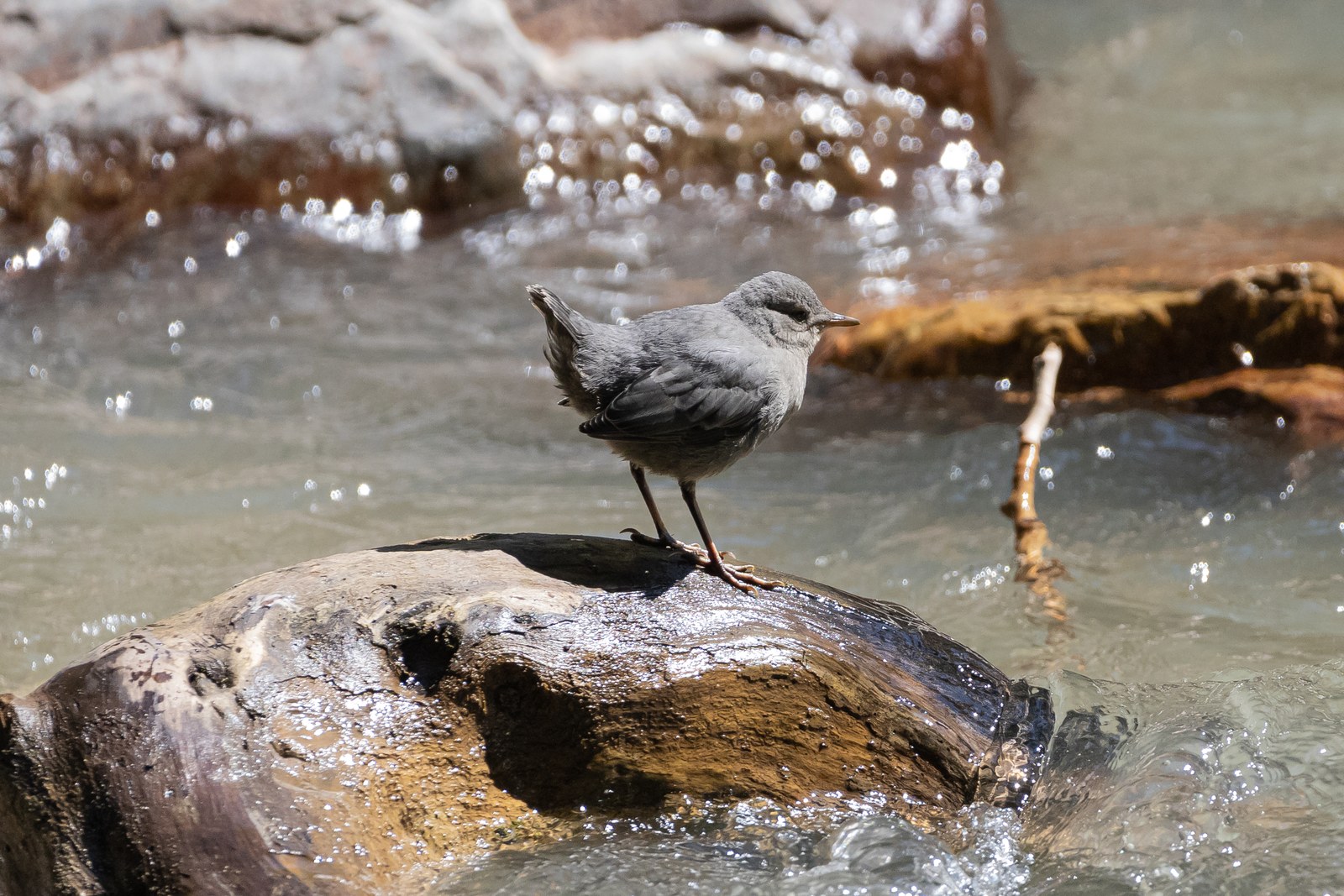
The Black Hills birds mark the species' eastern limit, more than 120 miles from the nearest other dippers, and Game, Fish and Parks describes them as genetically distinct from western birds. In 2017 and 2018, surveyors from Bird Conservancy of the Rockies searched about 99 miles of stream spread over eight watersheds. They found active nests at 35 sites the first year and 36 the second. All but 10 of the 45 sites used in either year were in the Spearfish Creek system, Little Spearfish and Iron creeks among them. Whitewood Creek had nine, and Rapid Creek one pair, at Thunderhead Falls.
A Petition, Two Dams and Nest Boxes
On May 2, 2012, four conservation groups, among them the John Muir Project of the Earth Island Institute and the Center for Biological Diversity, petitioned the Fish and Wildlife Service to list the Black Hills black-backed woodpeckers, and a second population in Oregon and California, as threatened or endangered subspecies or, failing that, as distinct population segments, populations the law can list separately. They named salvage logging after fires and other disturbances, active fire suppression and forest thinning as threats. In April 2013 the Service found that listing "may be warranted" and said it would carry out a full status review. On October 5, 2017, it found listing "not warranted at this time." The Black Hills birds are not a subspecies, the Service concluded, and no taxonomic authority recognizes one. Nor are they a distinct population segment: their habitat is not unusual for the species, their genes carry nothing absent from the main boreal population, and losing them would leave no significant gap in its range. With nothing the law could list, the Service never weighed the threats.
Every larger stream in the Black Hills once had dippers, according to Game, Fish and Parks; dams, pollution, silt and shrinking flows have since taken most of that range. Dippers were recorded on French Creek in the 1920s; after a dam formed Stockade Lake upstream in the 1930s, the records stop. The department judges Pactola Dam, with the erratic, lower flows it brought, the likely reason dippers are all but gone from Rapid Creek.
South Dakota has listed the dipper as threatened since 1996, because its range was shrinking and its population was cut off. Starting in 1997, the department fixed nest boxes beneath Spearfish Creek bridges, then added boxes on Whitewood and Rapid creeks. Nesting on Spearfish Creek rose sharply after the boxes went up, the Bird Conservancy reported in 2019, and the population appears stable: 57 to 66 breeding adults were counted in 2004 to 2009, and at least 70 were estimated in 2017 and 2018. Nest success, though, was lower than in most dipper populations elsewhere, and lowest in nest boxes; the report still urged keeping the boxes up. The state's standard for delisting calls for steady or rising numbers of breeders in three or more watersheds. The 2017 and 2018 surveys confirmed breeding in two, Spearfish and Whitewood.
Connected
- Spearfish CanyonWhere the round-leaved orchid was first reported in the Hills, and the creek that holds most of the dippers.
- The Southern HillsWind Cave's mixed prairie and pine, where eastern and western birds overlap.
- Badlands National ParkCliffs and mixed-grass prairie with 206 documented bird species.
- The Ponderosa Forest, Fire and the Pine BeetleThe fires and beetle kills that black-backed woodpeckers depend on.
- Prairie Dogs and Black-Footed FerretsThe prairie dog towns where golden eagles hunt and burrowing owls nest.
- The Northern HillsThe cooler, wetter end of the range, with Spearfish and Whitewood creeks.
- Jewel Cave National MonumentThe monument whose wildflower list runs from pasque flowers to goldenrod.
Field guide
The companion guide Black Hills Wildflowers is a photo guide to the wildflowers, trees, shrubs, grasses and mushrooms of the Black Hills, arranged by flower color.
Sources
- Black Hills Native Plants. USDA Forest Service, Black Hills National Forest, 2025.
- Wind Cave Birds. National Park Service, Wind Cave National Park, 2024.
- Revisiting a Classic Hybrid Zone: Rapid Movement of the Northern Flicker Hybrid Zone in Contemporary Times (preprint), by S. M. Aguillon and V. G. Rohwer. bioRxiv, 2021 (published in Evolution, 2022).
- Digest: Recent Movement of a Flicker Hybrid Zone, by Jente Ottenburghs. Evolution, 2022.
- Conservation Assessment for the Large Roundleaved Orchid in the Black Hills National Forest, South Dakota and Wyoming, by J. Hope Hornbeck, Carolyn Hull Sieg, Deanna J. Reyher and Darcie J. Bacon. USDA Forest Service, Black Hills National Forest, 2003.
- Monitoring the Birds of the Black Hills: Year 2, Final Report, by Arvind Panjabi. Rocky Mountain Bird Observatory, for the Black Hills National Forest, 2003.
- SGCN List for 2025 South Dakota Wildlife Action Plan Revision. South Dakota Game, Fish and Parks, 2024.
- Two Black-backed Woodpecker Populations to be Considered for Federal Protection. U.S. Fish and Wildlife Service, 2013.
- 12-Month Findings on Petitions To List 25 Species as Endangered or Threatened Species (Federal Register 82: 46618). U.S. Fish and Wildlife Service, 2017.
- 12-Month Findings on Petitions To List 25 Species as Endangered or Threatened Species (summary). U.S. Fish and Wildlife Service, 2017.
- Wildflowers. National Park Service, Jewel Cave National Monument, 2025.
- Native Plants to Know: Eastern Pasqueflower (Pulsatilla patens), by Lora Perkins, Robin Buterbaugh and Allison Dollen. SDSU Extension, South Dakota State University, 2026.
- South Dakota Codified Laws, Chapter 1-6: State Emblems (1-6-10, state floral emblem; 1-6-11, state tree). South Dakota Legislature.
- March 2013: South Dakota's State Flower. South Dakota State Historical Society Foundation, 2013.
- Badlands Birds. National Park Service, Badlands National Park, 2020.
- Identification and Monitoring of American Dipper Populations and Inhabited Areas in South Dakota: Final Report, by Nancy E. Drilling. Bird Conservancy of the Rockies, for South Dakota Game, Fish and Parks, 2019.
- State T&E Species Status Reviews. South Dakota Game, Fish and Parks, 2018.
Last reviewed: