Wildlife and Plants
The Ponderosa Forest, Fire and the Pine Beetle
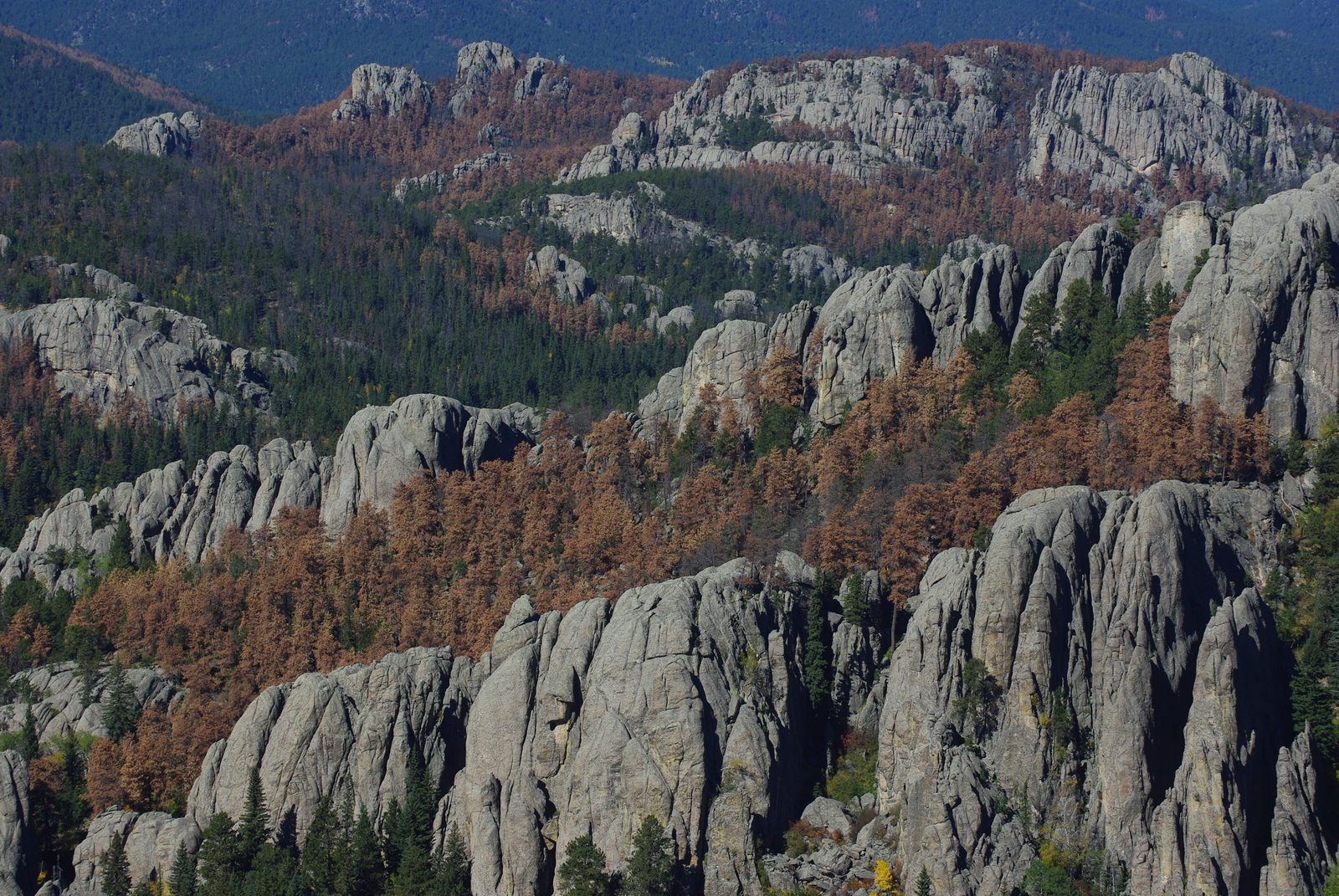
In the Black Hills, mountain pine beetles (Dendroctonus ponderosae) usually leave the tree they grew up in during the last days of July. The female goes first, through a hole less than a tenth of an inch wide, and emergence peaks around August 15. Most years the beetles settle in a few weak pines. From about 1996 to 2016 they killed about 8.6 million ponderosa pines (Pinus ponderosa). The ponderosa forest of the Black Hills has been shaped by that beetle, by fire, and by people's efforts to manage both.
Why Ponderosa Pine Covers the Hills
Ponderosa pine dominates nearly 1.5 million acres of the Black Hills region, a 2021 Forest Service report says, and growing-season rain is a large part of the reason. The trees are the Rocky Mountain variety, Pinus ponderosa var. scopulorum, with long needles mostly in bundles of two or three. Rising from the plains, the Hills wring extra rain from passing storms, most of it from March into August: about 29 inches a year near Lead and Deadwood, though only about 16 near Hot Springs, Wayne Shepperd and Michael Battaglia wrote in a 2002 Forest Service report.
Those growing-season showers, more than anything else in the climate, are what let the pine grow and reseed so freely here, Shepperd and Battaglia wrote, and big seed crops come every two to five years. Foresters plan their cutting around that habit, as Logging the Ponderosa explains.
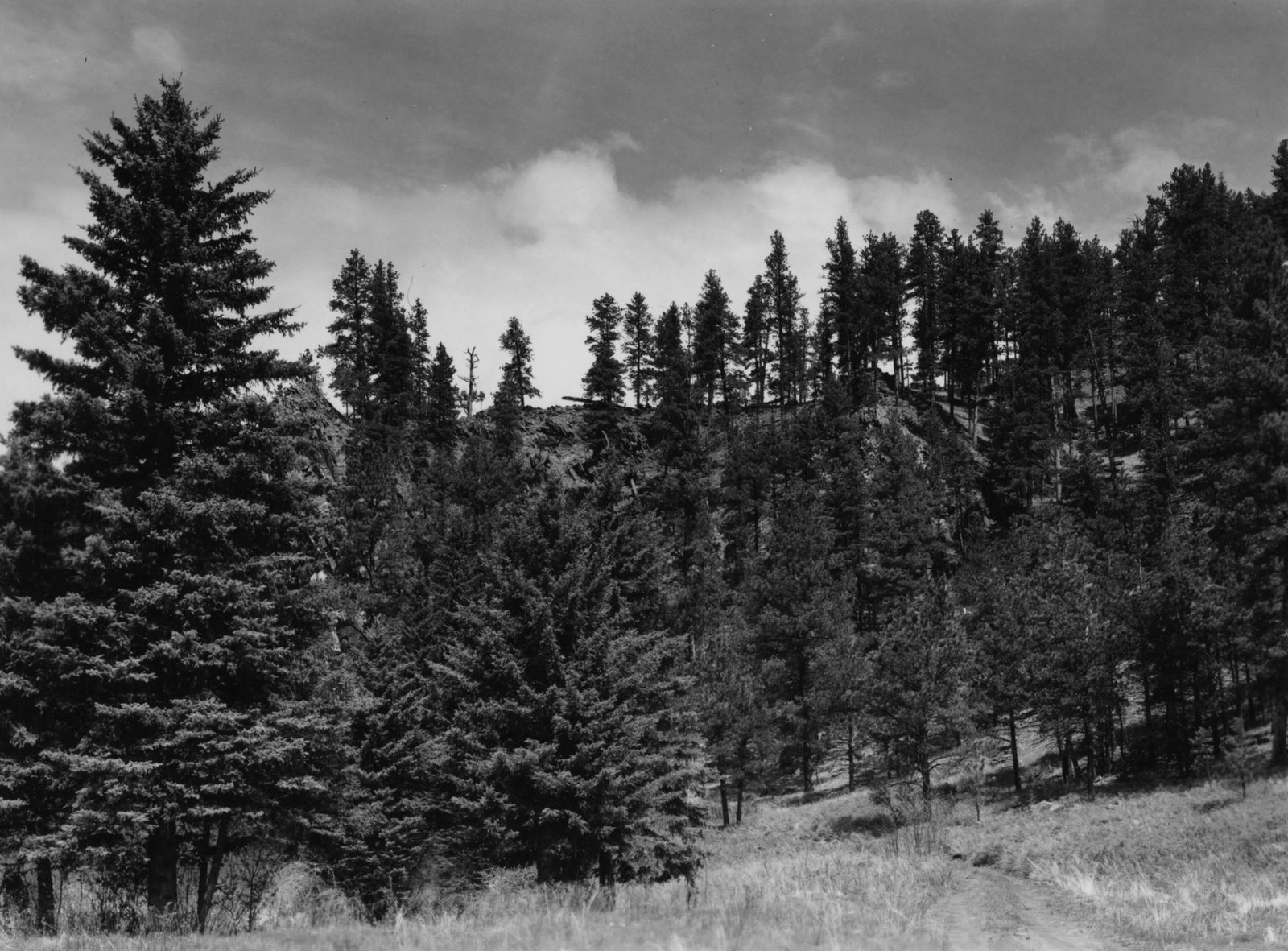
Ponderosa has company. White spruce (Picea glauca), called Black Hills spruce here and South Dakota's state tree since 1947, holds the coolest, wettest high ground. Quaking aspen (Populus tremuloides) and paper birch (Betula papyrifera) grow among the spruce, and bur oak (Quercus macrocarpa) grows along the northern edge of the Hills. The Needles Highway in Custer State Park, one of the roads on Scenic Drives, winds among ponderosa pine and Black Hills spruce, with birch and aspen around its meadows, South Dakota Game, Fish and Parks says.
How Often Did Fire Burn the Hills?
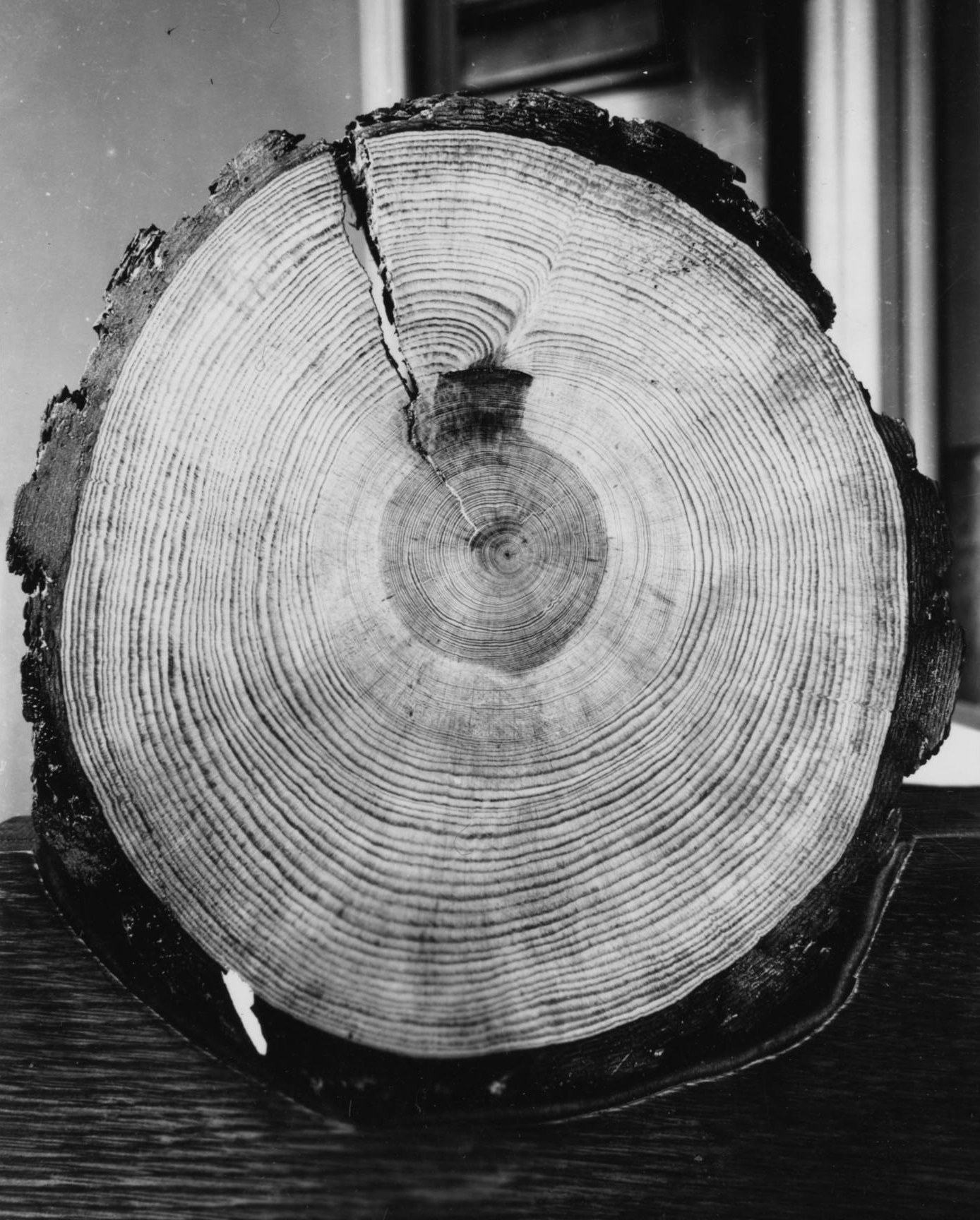
Tree-ring studies date old fires by the scars left on trees that survived them. As the 2021 Forest Service report sums them up, a patch of Black Hills pine burned on average once every 10 to 31 years before settlement, more often at low elevations than high. In studies published in 1996 and 1999, P. M. Brown and C. H. Sieg found that fire returned about twice as often to the grassy southeastern edge near Wind Cave as to the interior forest around Jewel Cave, where most fires burned in July and August, the peak months for lightning fires on the northern plains. Low-intensity fires of that kind, Shepperd and Battaglia wrote in 2002, burned off small seedlings and the lowest limbs of large pines.
How often and how severely fire burned across the Hills is still argued. Writing in Conservation Biology in 1997, D. J. Shinneman and W. L. Baker proposed that frequent light fires may have kept forests open in the warmer, drier south, while rare catastrophes, stand-killing fires among them, may have shaped the cooler, wetter center and north. They found evidence of several such fires between 1730 and 1852, matched them to early explorers' reports of dense old forest in the same places, and faulted proposed national forest plans that rested only on the frequent-light-fire view.
Brown's 2003 dissertation at Colorado State University read the fire scars differently. Surface fires had burned nearly everywhere, he found, and an even-aged stand doesn't prove a crown fire, since wet years can start a wave of seedlings and drought or beetles can open a stand. He allowed that patchy crown kills and other disturbances helped open stands, and that fire behaved more variably in the Hills than in other ponderosa forests, but concluded that the tree rings largely bear out the standard view: frequent surface fires kept most stands open. In 2005 the Black Hills National Forest, weighing both views and a study of how the Jasper Fire burned, wrote that the old regime "might be best described as a mixed severity fire regime."
Fire Suppression and the Jasper Fire
Fires nearly stopped soon after settlers arrived in the 1870s, Brown found. By the early 1900s, as settlement and gold mining spread, fires were being put out to save towns and timber. Suppression, logging and grazing left the forest crowded with small trees, short on big ones and with fewer open stands, the 2021 report says. Since 2000 the fires have grown larger and more severe. Of the 547,449 acres that burned in the Black Hills region from 1960 through 2019, about three-quarters burned from 2000 on, by the 2021 report's figures.
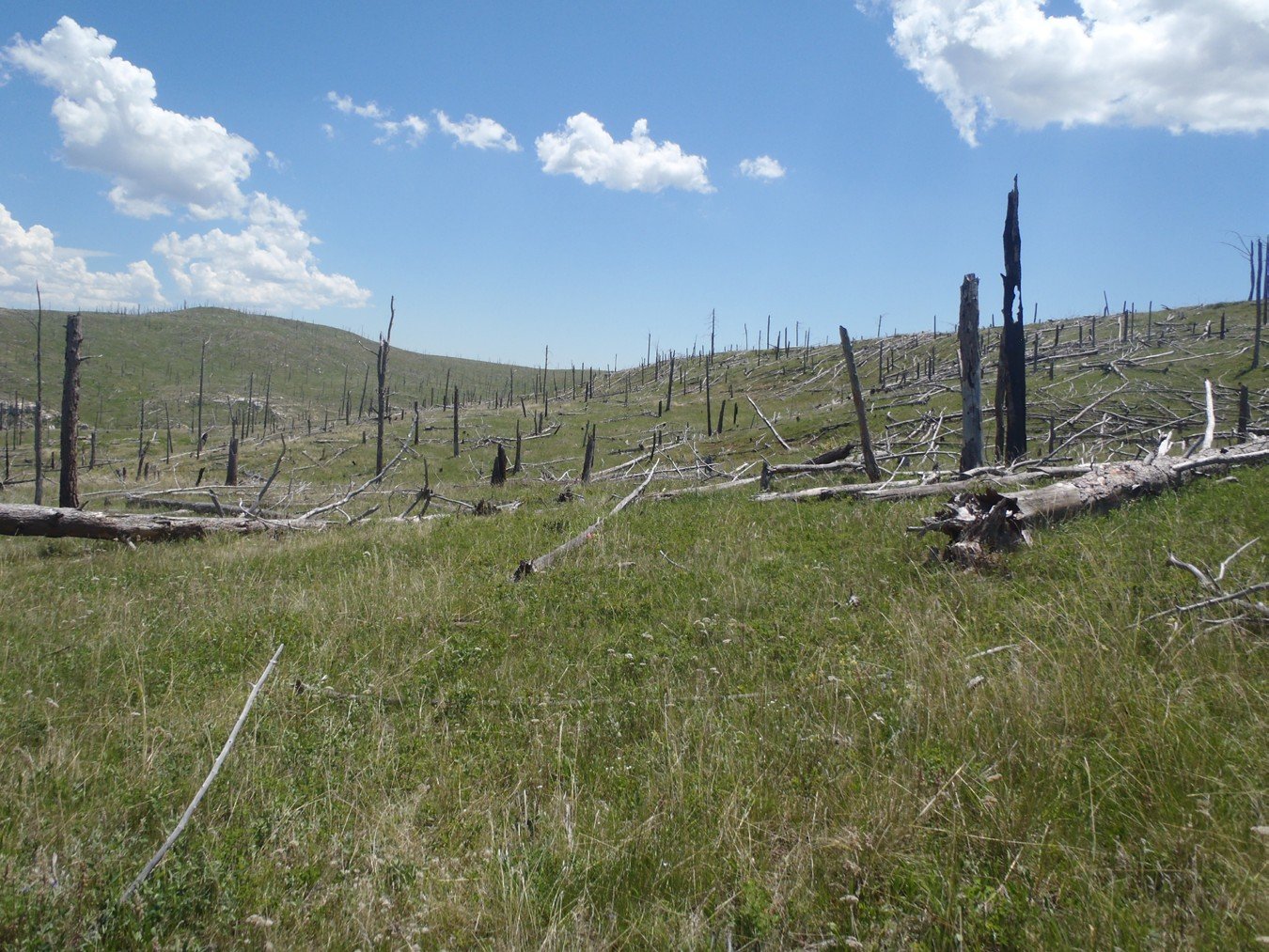
The largest was the Jasper Fire, set by an arsonist on August 24, 2000, just west of Jewel Cave. It burned 83,508 acres, taking in about 90 percent of Jewel Cave National Monument, and as of 2024 no larger wildfire had been recorded in the Black Hills. Heat, dry air and heavy fuel on the forest floor fed it. By the Park Service's reckoning, flames moved through roughly seven football fields of forest each minute, on average, during its first day. Twenty years on, Forest Service scientists reported, large patches that burned most severely still had few or no young pines; grasses, low plants, snags and fallen logs had taken over.
How a Beetle Kills a Pine
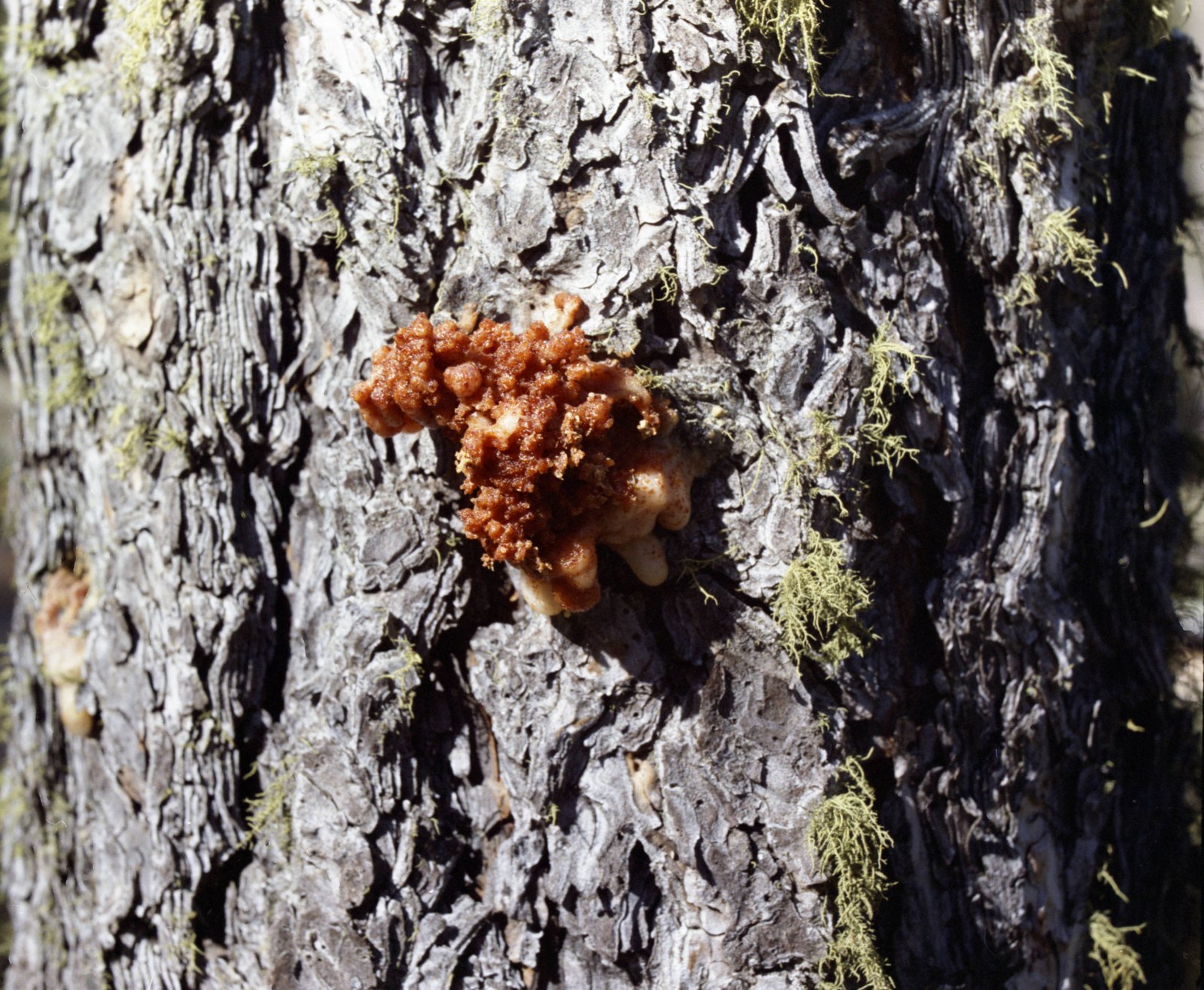
Mountain pine beetles kill a pine by attacking it in great numbers and carrying in a blue-staining fungus that cuts off water to its crown. The beetle, also known as the Black Hills beetle, is native here; it spends its one-year life under bark, leaving only for its summer flight. Research on lodgepole pine, which the same beetle attacks in similar ways, shows how the attack is coordinated: a female finds a tree by the scent of its resin, bores in and gives off a chemical signal that, mixed with the tree's own, draws in a crowd. The pine fights back with pitch, leaving pitch tubes on the trunk. A killed pine usually stays green until the next spring, then fades through yellow and red to brown.
Beetles favor pines about 8 to 12 inches across in crowded stands, where competition weakens each tree. Away from big epidemics, beetle and disease kills are not always a loss, the Forest Service's 2023 assessment notes: where the canopy opens, young trees and undergrowth fill in and wildlife gains habitat. The assessment counts epidemics about every 20 years: in the early 1900s, the 1940s and the 1960s through the 1980s, before the most recent, from about 1996 to 2016. Civilian Conservation Corps crews once worked against bark beetles in Custer State Park; their camps and the 1897 forest reserve are on The National Forest and the CCC.
Did Thinning Slow the Epidemic?
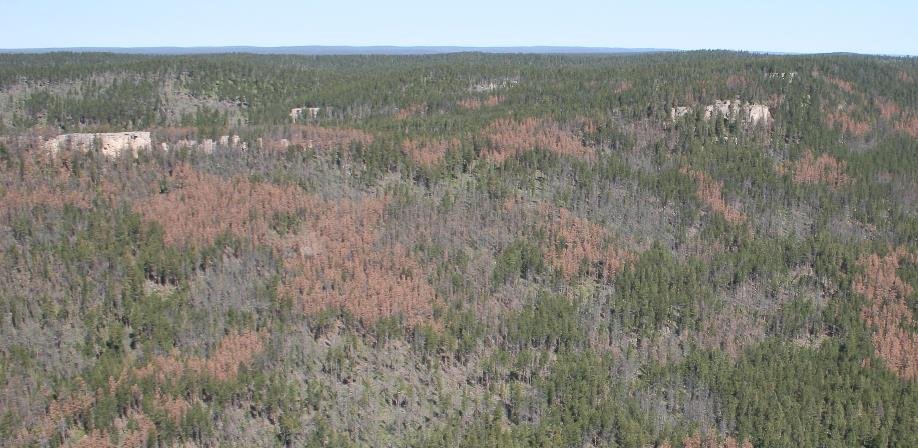
Thinned stands lose fewer trees to beetles, Forest Service research shows, but whether the cutting during the last epidemic was the right amount, in the right places, is disputed. That epidemic started as scattered patches in the central Hills in the late 1990s and by 2012 reached across the central and northern Hills and the Bear Lodge Mountains, the assessment says.
A 2017 study led by J. F. Negrón, in the journal Forest Science, compared 21 pairs of thinned and unthinned stands in the Black Hills. Beetles killed more than a third of the pine in the unthinned stands, by tree count and by basal area, and less than 4 percent in the thinned ones; the authors concluded that lowering stand density across a large area can reduce beetle losses. In 2021 timber industry representatives argued that fires and beetle outbreaks would worsen if harvests were cut sharply, the Associated Press reported.
Others point to what the cutting cost. In 2021, three Forest Service scientists concluded that the forest's live sawtimber had shrunk under the beetles and the cutting of green trees combined. Blaine Cook, who spent more than 20 years as a Forest Service forest management scientist in the Black Hills before retiring in 2019, told the AP in September 2021 that his monitoring in the 2010s had shown the stepped-up logging after the outbreak outrunning the forest's growth. In 2010, Brian Brademeyer of Friends of the Norbeck dismissed the idea that beetle-killed trees were more fire-prone than green ones as "self-serving, logging institution building," NPR reported. Harvest levels, that 2021 report and the mills are on Logging the Ponderosa.
The young pines have come back thick. The 2023 assessment calls stands of 5,000 to 10,000 seedlings and saplings an acre common, and warns that without management, those thickets and the beetles' snags could let a fire on the ground climb into the treetops.
Connected
- Logging the PonderosaTimber sales, the mills and the fight over how much the forest can sell after the beetles.
- The National Forest and the CCCThe 1897 forest reserve and the CCC crews who thinned pine and fought beetles and fires.
- Scenic Drives: Needles Highway, Iron Mountain Road and MoreRoads through pine and spruce forest, the Needles Highway among them.
- Jewel Cave National MonumentThe monument the Jasper Fire burned across in 2000.
- The Southern HillsPine and prairie country around Wind Cave, Jewel Cave and the Jasper Fire burn.
- Custer State ParkHome of the Needles Highway and of the CCC camp credited with its beetle work.
Sources
- Ecology, Silviculture, and Management of Black Hills Ponderosa Pine (RMRS-GTR-97), by Wayne D. Shepperd and Michael A. Battaglia. USDA Forest Service, Rocky Mountain Research Station, 2002.
- A Scenario-Based Assessment to Inform Sustainable Ponderosa Pine Timber Harvest on the Black Hills National Forest (RMRS-GTR-422), by Russell T. Graham, Mike A. Battaglia and Theresa B. Jain. USDA Forest Service, Rocky Mountain Research Station, 2021.
- Revised Forest Assessment: Insects, Disease, and Invasive Species. USDA Forest Service, Black Hills National Forest, 2023.
- Final Environmental Impact Statement, Phase II Amendment: Natural Disturbance Processes, Fire (section 3-7.1). USDA Forest Service, Black Hills National Forest, 2005.
- Fire, Climate, and Forest Structure in Ponderosa Pine Forests of the Black Hills, by P. M. Brown. Dissertation, Colorado State University, 2003; its chapters II and III were published as Brown and Sieg 1996 and 1999 (posted by the USDA Forest Service, Rocky Mountain Research Station).
- Nonequilibrium Dynamics between Catastrophic Disturbances and Old-Growth Forests in Ponderosa Pine Landscapes of the Black Hills, by D. J. Shinneman and W. L. Baker. Conservation Biology 11(6), 1997 (record and abstract in the Aspen Bibliography, Utah State University).
- Large-scale thinning, ponderosa pine, and mountain pine beetle in the Black Hills, USA, by J. F. Negrón, K. K. Allen, A. Ambourn, B. Cook and K. Marchand. Forest Science, 2017 (record and abstract in Treesearch, USDA Forest Service).
- Mountain Pine Beetle (Forest Insect and Disease Leaflet 2), by Ken Gibson, Sandy Kegley and Barbara Bentz. USDA Forest Service, 2009 (record and abstract in Treesearch).
- The Jasper Fire. National Park Service, Jewel Cave National Monument, 2024.
- Remembering the Jasper Fire. National Park Service, Jewel Cave National Monument, 2025.
- Climate change, logging collide — and a forest shrinks, by Matthew Brown. Associated Press, published by The Spokesman-Review, 2021.
- Forest Near Mount Rushmore Suffers Beetle Attack, by Charles Michael Ray. NPR, All Things Considered, 2010.
- South Dakota State Historical Society Markers (marker 516, Civilian Conservation Corps – French Creek). South Dakota State Historical Society, revised 2020.
- Scenic drives through Custer State Park. South Dakota Game, Fish and Parks, undated.
- South Dakota Codified Laws 1-6-11: State tree. South Dakota Legislature (law of 1947).
- Pinus ponderosa var. scopulorum. Flora of North America, Volume 2, undated web edition.
Last reviewed: