Ranching, Farming and Work
Logging the Ponderosa
In the 1890s, federal lawyers wanted a timber trial moved to Sioux Falls, across the state, arguing that too many Black Hills residents had cut timber illegally themselves for the government to get a fair trial in the Hills. The case stayed in Deadwood. Filed in 1894, it charged the Homestake Mining Company with illegally cutting 6,828,160 trees on public land and sought $688,804; Judge John Carland decided the case in 1898 and set the damages at $75,000. No one used more of the region's timber than Homestake did in those years. Logging the ponderosa pine of the Black Hills has gone on for 150 years, from gold-rush sawmills and mine timbers, through more than a century of federal timber sales, to a smaller industry that now disputes how much timber the Black Hills National Forest can sell.
Gold Mines Ran on Pine
Every gold camp needed wood. Heavy timbers kept the tunnels from caving in, cordwood was the fuel, and boards went into every building. The first sawmills, a few small ones, arrived with the 1876 rush to cut rough lumber for mines and new towns, historian Richmond Clow writes. The rush took place on land the 1868 Fort Laramie Treaty had set apart for the tribes; how the Hills were taken from them in 1877 is told on The 1876 War and the Taking of the Hills.
The Free Timber Act of 1878 let western residents cut trees on public mineral land for mining, building, farming and household use, under Interior Department rules that spared trees less than 8 inches across. Clow found those rules largely unenforced. Homestake started its own narrow-gauge railroad in 1881 to haul logs to Lead from camps scattered across the northern Hills, where the trees cost it nothing. The forester Henry S. Graves found that within 8 miles of Deadwood almost all the timber had been cut.
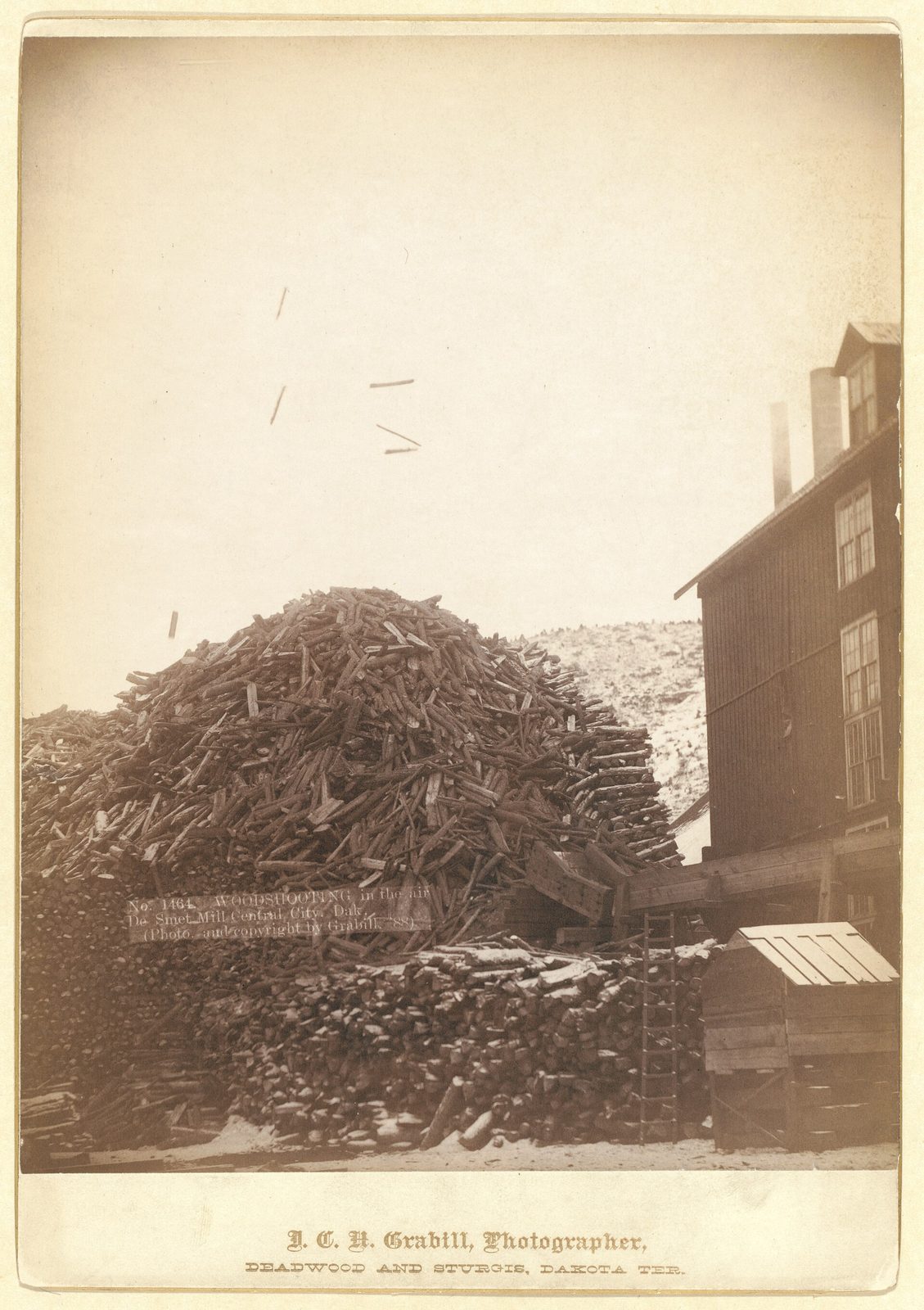
Waste on that scale helped bring the forest reserve of 1897 and Case No. 1, the first regulated federal timber sale, sold to Homestake in 1899.
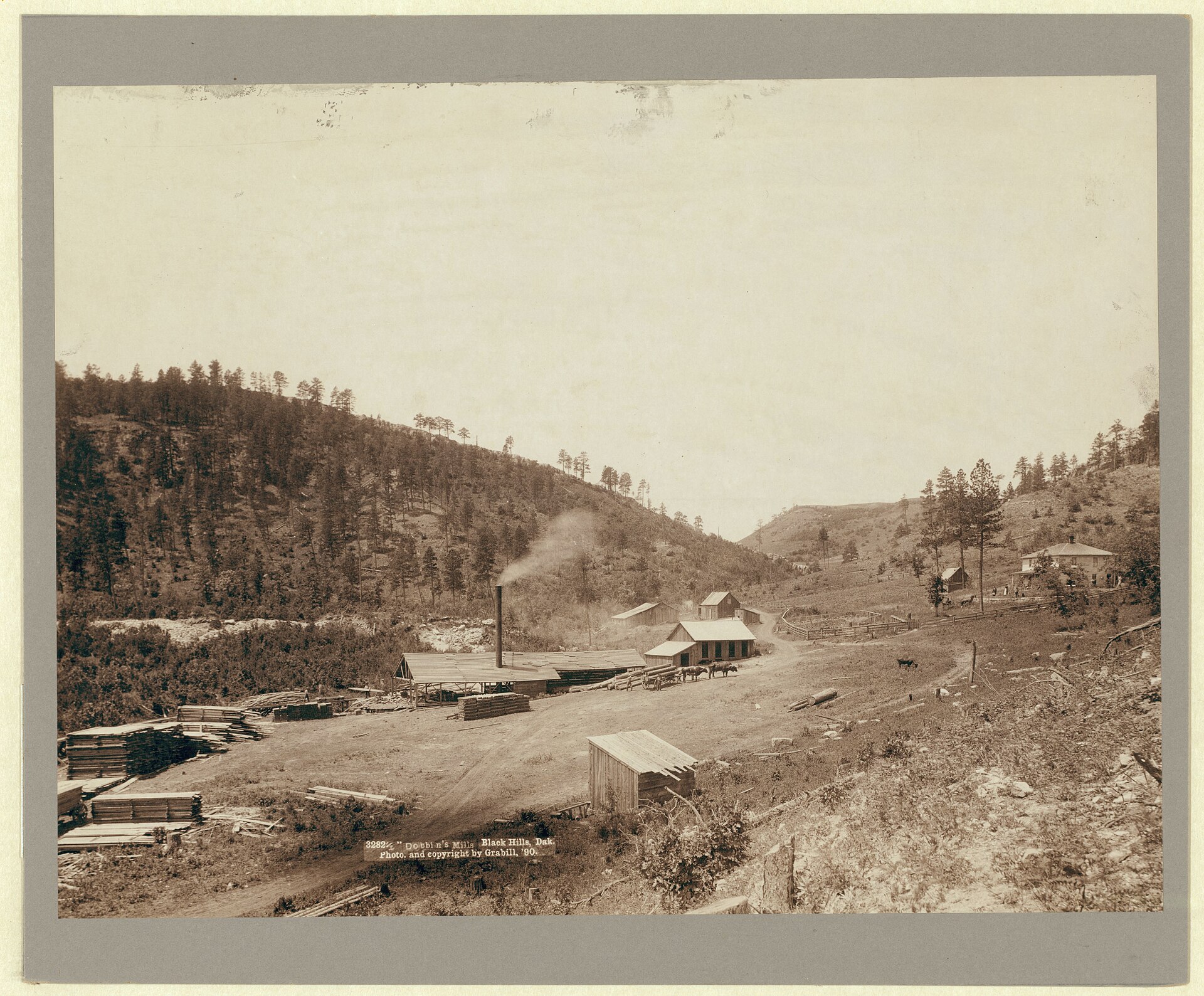
Why Is There Still a Forest?
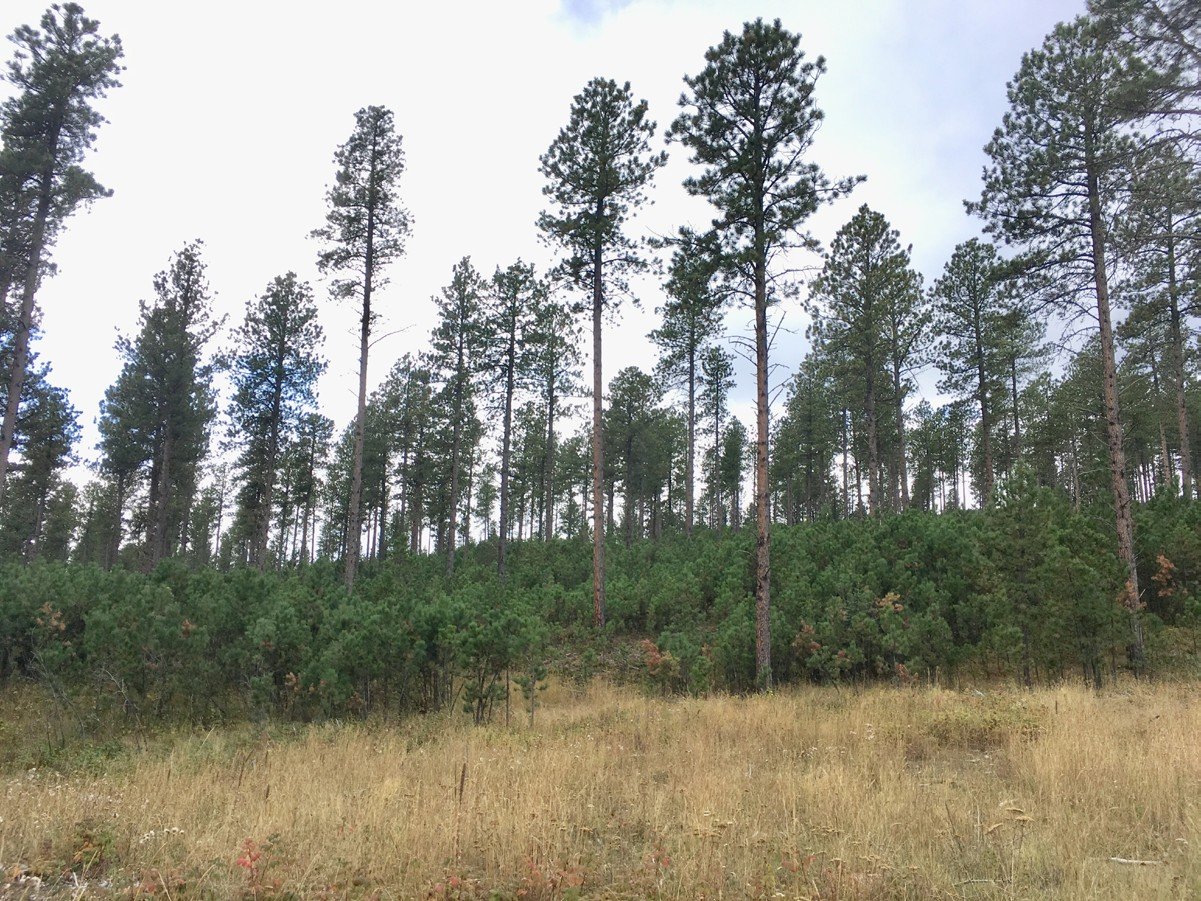
Ponderosa pine in the Black Hills reseeds itself unusually well. The trees bear some seed nearly every year and heavy crops every two to five years, according to a 2002 Forest Service report by Wayne Shepperd and Michael Battaglia, and the heavy seed falls close to the parent tree, about 1 to 1.5 tree heights away. It germinates best above 50°F with more than an inch of rain a month, which the Hills' showers from March into August usually provide. The Colorado Front Range and the Southwest seldom get warm weather and rain at the same time, and seedlings there take hold only once in a while. Seedlings can come up thousands to the acre.
Foresters use that habit. In the method most used in the Hills, the two-cut shelterwood, the first cut leaves an even canopy of the largest, soundest trees to seed the ground. Logging scrapes up the bare mineral soil pine seed favors, new seedlings usually come up within five to 10 years, and most of the old trees come out once the young ones are established.
Fewer fires helped too. Before settlement, fire returned to a given stand every 10 to 31 years on average, depending on elevation. In the early 1900s fires grew rarer, as crews put them out and logging and grazing spread, and the forest filled in; photographs of the Castle Creek valley taken in 1874 and 2000 show the change. From the 1960s through the 1990s, federal inventories found the trees adding more wood each year than loggers took, and at the turn of the century the standing volume of live ponderosa pine was the highest on record.
From Case No. 1 to the Beetle Years
A 2004 market study for the Forest Service, prepared with data help from the industry's trade group, put the timber cut from the national forest since Case No. 1 at about 5 billion board feet, all of it sawn by companies in South Dakota and Wyoming. One of them, Neiman Enterprises, says its first mill opened in 1936 at Upton, Wyoming; the family company is based in Hulett. The forest's current plan, dating from 1997 with a 2006 amendment, sets an allowable sale quantity of 181,000 CCF of sawtimber a year. A CCF is 100 cubic feet of wood. From 1997 through 2011, sales averaged 154,543 CCF a year.
The mountain pine beetle epidemic of about 1996 to 2016 killed roughly 8.6 million ponderosa pines, by the Forest Service's count. The timber program answered with more cutting, since thinning makes dense stands less inviting to beetles. Sales peaked at about 253,000 CCF in 2008, South Dakota Searchlight reported, and averaged 193,107 CCF a year from 2012 through 2017, when about 188,000 acres of ponderosa sawtimber were logged across all ownerships. Yet most of that logging was next to infested stands, not in them, Forest Service scientists later found, so beetles and saws both took live trees and the standing sawtimber shrank.
How Much Timber Can the Forest Sell?
A February 2021 report by three Forest Service scientists counted 5,995,428 CCF of live ponderosa sawtimber on the forest's suitable timberland as of 2019 and found the 181,000 CCF ceiling unsustainable. Of the harvest levels they modeled, 72,400 and 90,500 CCF a year looked sustainable for several decades, on two conditions: that less than 1.04 percent of the standing volume die each year, and that all suitable timberland be open to logging. The Black Hills Forest Resource Association, the industry's trade group, challenged the report under the Data Quality Act in late 2021. After a federal review panel found its key terms confusing, the authors added an addendum in December 2022. The report stood; the addendum calls it "not a decision document" and puts the drop in live volume per acre from 1999 to 2019 at about 20 percent.
In March 2021 Neiman announced it was closing its sawmill in Hill City after 53 years, a loss of 120 jobs. The company said it got about 80 percent of its logs from the Forest Service, and Jim Neiman blamed "purely a lack of timber available for purchase." On April 11, 2024, Neiman announced about 50 layoffs at Spearfish Forest Products in Spearfish, its last South Dakota mill, which SDPB had called the largest sawmill in the Black Hills. In 2023 the forest sold just under 100,000 CCF, a 20-year low, and Baker Timber Products of Rapid City bought the most, ahead of Neiman, the Searchlight found.
In a statement issued with the layoffs, the association's executive director, Ben Wudtke, said "we have more timber now than in the 70s and 80s," when, he said, the forest sold twice as much. The Forest Service's 2021 report notes that the 1962 and 1984 inventories are hard to compare with later ones. Forest Supervisor Shawn Cochran told the Searchlight days later that "the forest is very much in a changed condition," with plenty of volume in trees 9 inches and smaller but a sharp decline in bigger ones, and that mills were closing across the West.
On August 22, 2024, eight tribal governments, among them the Oglala Sioux Tribe, signed a memorandum of understanding with the Forest Service on forestry planning and stewardship, which provides for bringing their planning values into the forest plan revision. Ryman LeBeau, chairman of the Cheyenne River Sioux Tribe, said that month that it gives the tribes "a unique opportunity in decisions that affect the health of the forest."
A March 2025 executive order from President Donald Trump told agencies to cut permitting delays, sell more timber and set yearly targets, which the association welcomed. Dave Mertz, a former Forest Service employee and a member of the Norbeck Society, a conservation group that has sought less logging for years, told KOTA that month that sawtimber at the levels the industry wanted, "those trees that are nine inches and above," was no longer there, and blamed beetles, wildfire and overcutting. Sales rose in 2025 to about 8.4 million cubic feet, or 84,000 CCF, after falling from 2021 through 2024, the Searchlight reported.
A New Forest Plan, Still Being Written
The 181,000 CCF ceiling belongs to the current plan, which the Forest Service began revising in fall 2021. The agency's timeline, last updated in March 2025, called for a draft plan and environmental impact statement in fall 2026 and a final decision in 2027. In May 2025 the revision's leader, Lou Conroy, told the forest's advisory board his team was still identifying land suitable for timber production and doing all it could before publishing a notice of intent, which starts a two-year clock. The forest had expected to publish it in July 2025; as of late October 2026 the Federal Register carried none. Until a new plan takes effect, the old ceiling stays on the books, more than twice what the forest sold in 2025.
Connected
- The National Forest and the CCCThe 1897 reserve and Case No. 1, where the federal timber program began.
- The Ponderosa Forest, Fire and the Pine BeetleThe tree, its fires and the beetle epidemic that cut the timber supply.
- The Homestake Mine and Sanford LabThe mine that was the Hills' largest timber user.
- Hill City, South DakotaWhere Neiman's sawmill closed in 2021 after 53 years.
- Spearfish, South DakotaHome of Spearfish Forest Products, which cut about 50 jobs in 2024.
- Hulett, WyomingBase of Neiman Enterprises, the family sawmill company.
- Stagecoaches and RailroadsThe narrow-gauge lines that hauled timber to the mines.
Sources
- Timber Users, Timber Savers: Homestake Mining Company and the First Regulated Timber Harvest, by Richmond L. Clow. Forest History Today, Forest History Society, 1998.
- On the Narrow Gauge and Beyond: The Homestake and Northern Black Hills (book excerpt on Case No. 1), by David A. Wolff. South Dakota Historical Society Press; excerpt published by South Dakota Searchlight, 2026.
- United States v. Sioux Nation of Indians, 448 U.S. 371. Supreme Court of the United States, 1980 (Legal Information Institute, Cornell Law School).
- An act authorizing the citizens of Colorado, Nevada and the Territories to fell and remove timber on the public domain for mining and domestic purposes (the Free Timber Act), June 3, 1878, ch. 150, 20 Stat. 88. US Statutes at Large (GovInfo), 1878.
- Ecology, Silviculture, and Management of Black Hills Ponderosa Pine (RMRS-GTR-97), by Wayne D. Shepperd and Michael A. Battaglia. USDA Forest Service, Rocky Mountain Research Station, 2002.
- A Scenario-Based Assessment to Inform Sustainable Ponderosa Pine Timber Harvest on the Black Hills National Forest (RMRS-GTR-422, with addendum), by Russell T. Graham, Mike A. Battaglia and Theresa B. Jain. USDA Forest Service, Rocky Mountain Research Station, 2021; addendum 2022.
- Revised Forest Assessment: Insects, Disease, and Invasive Species. USDA Forest Service, Black Hills National Forest, 2023.
- Forest Product Industry Market Study (contents and executive summary), by William Teasley, Bridges Corporation, for the USDA Forest Service, Black Hills National Forest, 2004.
- Neiman Enterprises home page (the company's own account). Neiman Enterprises, undated.
- Sawmill Closure Eliminates 120 Jobs in Hill City, by Seth Tupper. SDPB, 2021.
- Hill City sawmill shuts down, by Gray Hughes. Hill City Prevailer (Southern Hills Publishing), 2021.
- Sawmill owner says logging reductions could shut down largest mill in Black Hills, by Lee Strubinger. SDPB, 2021.
- Review spurs updates to Black Hills sustainable harvest report. South Dakota Searchlight, 2022.
- Spearfish Forest Products Announces Layoffs in Response to Reduced Forest Service Timber Sale Program. Neiman Enterprises, news release, 2024.
- Black Hills sawmill lays off workers and alleges Forest Service is to blame. South Dakota Searchlight, 2024.
- Changed forest and market factors share blame for sawmill troubles, forest supervisor says. South Dakota Searchlight, 2024.
- Eight Oceti Sakowin Leaders Sign Memorandum of Understanding With The USDA, Forest Service Rocky Mountain Region Black Hills National Forest (press release, August 26, 2024). Standing Rock Sioux Tribe, 2024.
- Sioux Nation, Forest Service forge joint stewardship framework for Black Hills, by Talli Nauman. Buffalo's Fire, republished by ICT, 2024.
- Reactions split in Black Hills over Trump timber push, by Blake Troli. KOTA, 2025.
- Black Hills National Forest Advisory Board: Summary of Meeting, May 21, 2025. USDA Forest Service, Black Hills National Forest, 2025.
- Revision of the Land and Resource Management Plan for the Black Hills National Forest (notice of initiating the assessment phase). Forest Service, Federal Register, 2021.
- Schedule of Proposed Actions: Black Hills National Forest, July 2025. USDA Forest Service, 2025.
- Plan Revision Timeline. USDA Forest Service, Black Hills National Forest, 2025.
- Forest Service and state of South Dakota sign agreement to work together on forest management, by Joshua Haiar. South Dakota Searchlight, republished by KOTA, 2026.
- Documents mentioning the Black Hills National Forest (search, 2025 to 2026). Federal Register, National Archives, checked October 2026.
Last reviewed: