Ranching, Farming and Work
The Open Range and the Cattle Drives
In October 1883 the Sturgis Weekly Record reported that Black Hills cattlemen were drafting an appeal to Congress. It put the stock grazing around the Hills at 700,000 to 800,000 head, on the word of “the best authority.” The number served an argument: the range was crowded, and the stockmen wanted the Great Sioux Reservation opened to their herds. The open range around the Hills took shape in the late 1870s on the South Dakota and Wyoming sides alike, and in western South Dakota it lasted into the early 1900s. It ran on trail herds, big outfits, roundups, brands and grass the cattlemen didn’t pay for.
What Made This Grass Worth the Trip?
Part of the answer was grass that cattle could graze all year. A Forest Service plant review counts buffalograss among the most valuable range grasses of the plains: it loses little of its nutrition as it dries, and livestock of every kind eat it in every season. The grass was thin in places, though: in the dry ranch country west of Jewel Cave, a 1990 National Register study found, each cow can need up to 40 acres.
Beef walked in with the Army. Custer’s 1874 report praised the country as grazing land for cattle and sheep, and his expedition, sent into the Hills while they were still reservation land, drove about 500 beef cattle along to feed its men, a state marker at the French Creek camp records. Every miner and tradesman who followed into the Hills was one more customer for fresh meat.
The 1877 Act took the Hills from the tribes, along with their unceded territory and hunting rights to the west, without the consent the 1868 treaty required (how the Hills were taken). The Act of March 2, 1889 then broke up the rest of the Great Sioux Reservation and opened the land between the new reservations to homesteaders.
Trail Herds and the Big Outfits
The Texas Trail brought Texas herds into northeastern Wyoming from the late 1870s. Big outfits were working the Beulah country by 1880, and between them they had laid claim to all the creekside land along Sand and Redwater creeks, Nicole Lebsack writes for WyoHistory, the Wyoming State Historical Society’s online encyclopedia. Not every Texas cowboy went home: some took jobs on the big Crook County ranches, and a few went on to run outfits of their own. Colorado sent herds to the Hills as well as Texas.
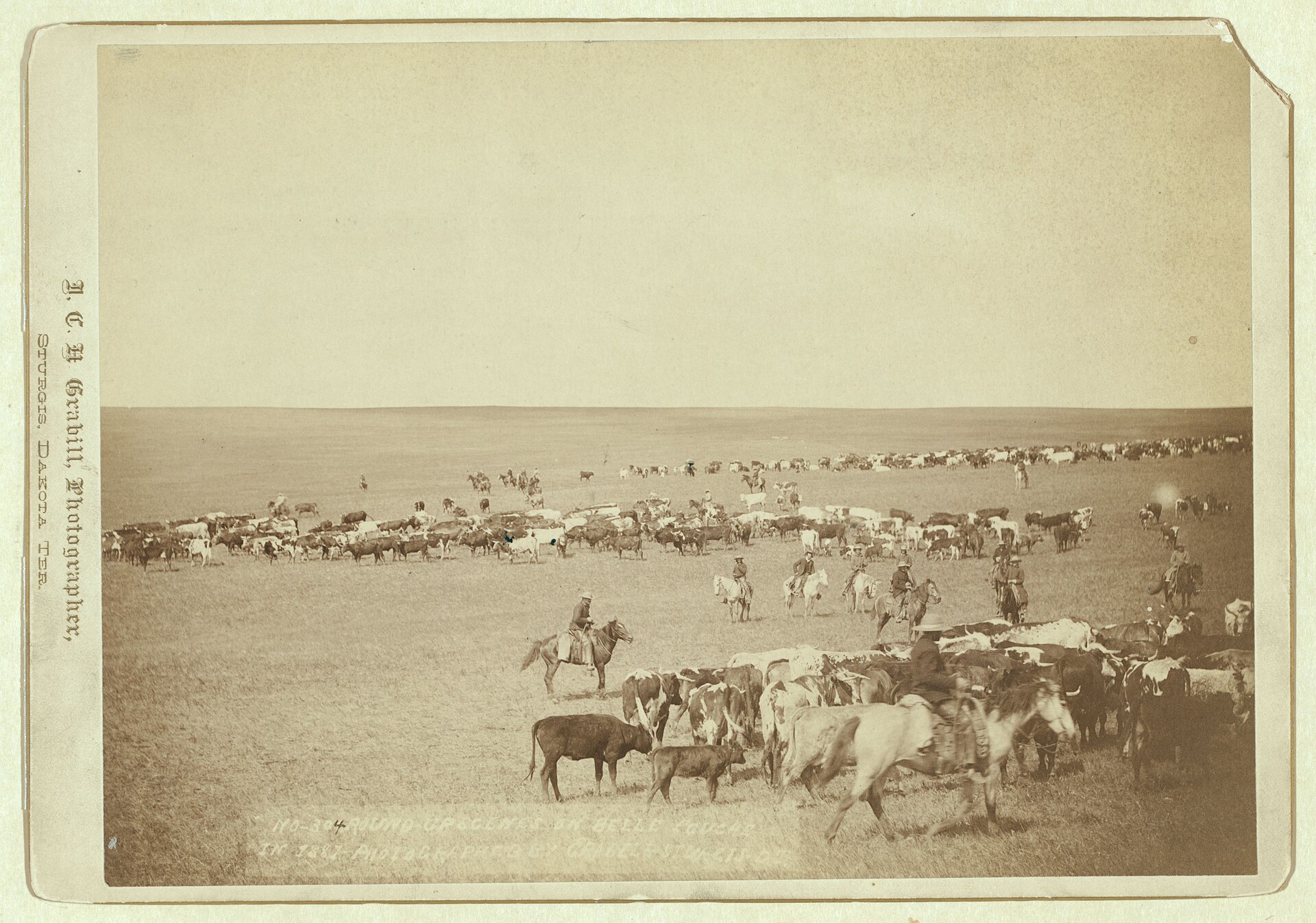
Many big outfits were run from elsewhere. Near Custer, most cattle companies of the late 1800s were outposts of outfits headquartered in Wyoming and Nebraska, the National Register study says; Sturgis and Goodell, a Cheyenne company backed by eastern money, set up a camp near present-day Dewey in 1878. In 1879 the Anglo American Cattle Company put its TOT Ranch headquarters in a former stage station by the Cheyenne River crossing near what is now Edgemont, a 2016 state marker says. In southwestern Custer County, the National Register study adds, owners in the open-range years often lived in town, and few of the early ranches had a house for anyone.
Capital came from farther still. From 1880 to 1900 Wyoming chartered 181 livestock companies carrying $94,095,800 in capital, Samuel Western writes on WyoHistory, and the historian W. Turrentine Jackson estimated that British money in American cattle topped $45 million during the 1880s. Baron Walter von Richthofen’s 1885 book promised profits of 156 percent over five years. Instead, Chicago’s wholesale cattle price fell by half between 1884 and November 1886, when it stood at $3.16 per hundredweight.
Roundups and Brands Kept the Range in Order
A roundup sorted out whose cattle were whose. Unwatched most of the year, the herds were gathered twice: in spring to brand the new calves, in fall to cut out mature cattle for shipping. The Wyoming Stock Growers Association ran the system from the first roundups in 1874, and by 1884 the territory had 31 districts. That year one district’s crews were to start on May 10 at Matthews’ ranch on the Belle Fourche River and work the river and its creeks from the Pumpkin Buttes down to Devils Tower. Historian Michael Cassity, in a 2011 study of Wyoming ranching that WyoHistory adapted in 2026, calls the roundups “complex, carefully planned, and tightly organized operations,” though the rest of the business mostly left cattle to fend for themselves.
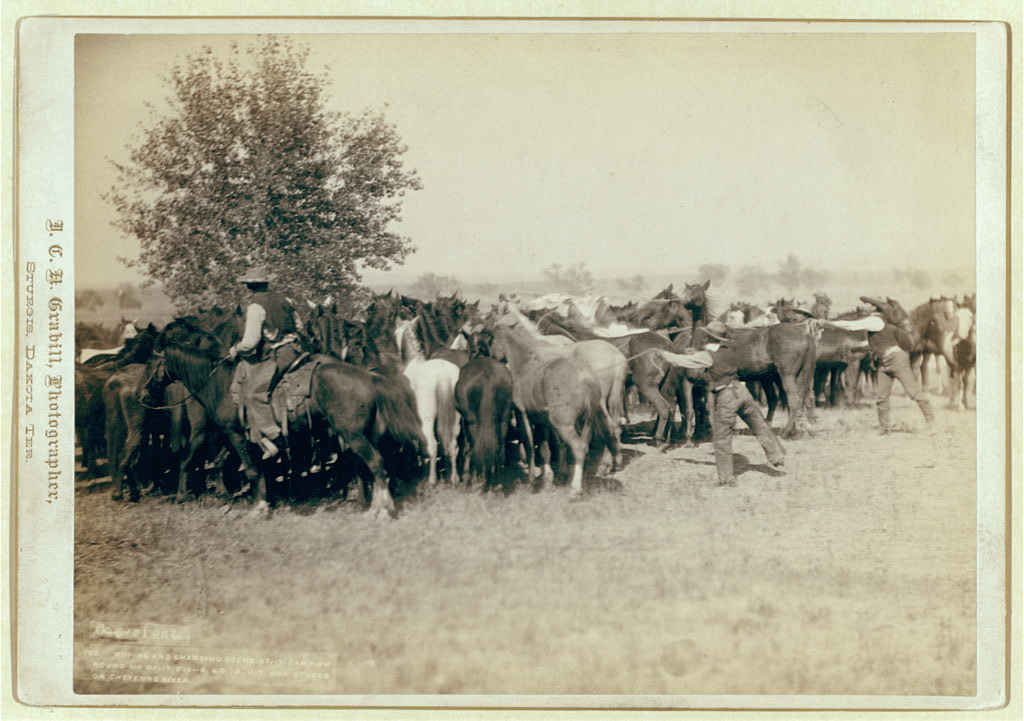
Well east of the Hills, the Missouri River Stockmen’s Association at Fort Pierre named wagon bosses, mapped the ground each wagon would cover and usually set its roundup dates to line up with those of the stockmen’s groups around the Hills. In June 1891, a Pierre paper reported, about 100 riders from the Hills and 50 from Fort Pierre met at the forks of the Bad River.
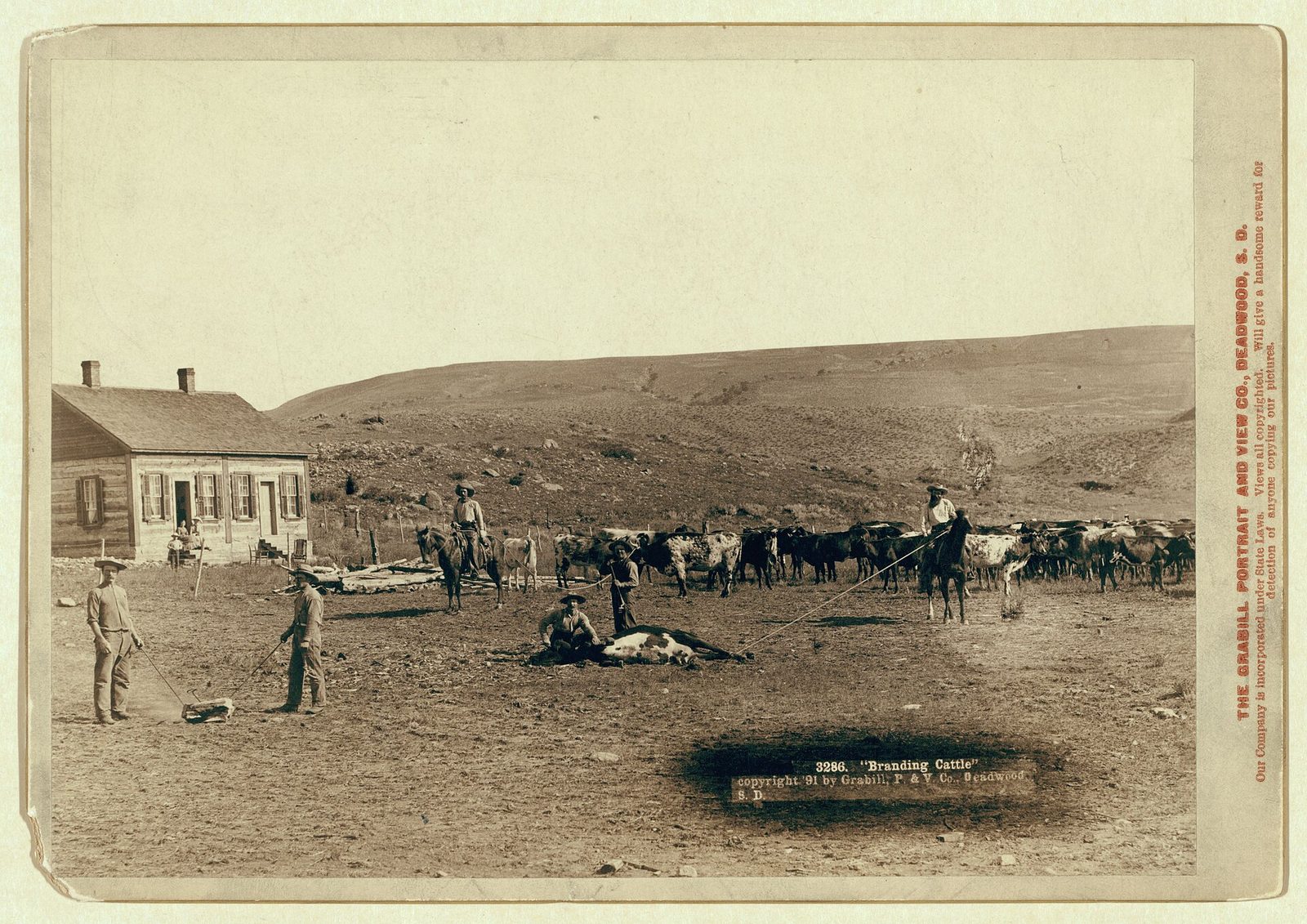
A brand was a title of ownership burned into the hide. In Dakota Territory, a marks and brands law of 1862 let a stockman record a brand with the county register of deeds for 25 cents; the oldest filings the South Dakota State Historical Society reports came from Union County in 1865. The state archives’ index to the 1898–99 state brand book lists 49 owners with Belle Fourche addresses, six under women’s names, and cattle companies based in Wyoming, Nebraska and North Dakota. Wyoming’s livestock board records, brand records among them, sit in the Wyoming State Archives from 1884 on.
Who Rode for the Outfits, and What the Legends Add
Nat Love, a Black cowboy, worked Texas Panhandle and Arizona ranches for about 20 years, and in the 1870s he trailed herds north to the mining towns of the Black Hills and Montana. His 1907 autobiography says the people of Deadwood named him Deadwood Dick on July 4, 1876, after he outdid every challenger at riding, roping and shooting. The Encyclopedia of the Great Plains calls the book “highly exaggerated,” and many scholars think Love took the nickname to make his story more sensational, Documenting the American South notes.
West of Fort Pierre, John Burkholder found, several of the first stockmen were of mixed French Canadian and Lakota ancestry, or were white men with Lakota wives, and those family ties let them graze cattle on reservation land. Freighters without tribal ties or grazing rights commonly hired tribal members to watch their cattle.
A 2017 marker in Whitewood stretches the timeline: it says cattle drives brought longhorns up from the south in the 1860s. The range histories of the Hills give no support for that date. They trace the first herds there to the 1874 expedition and the gold rush that followed.
What the Free Grass Cost
The range itself paid first: it filled up fast. By 1883 it was showing signs of overstocking, and cattlemen made room by turning herds onto reservation grass against the law. Enforcement was weak. When the Cheyenne River agent ordered whites in 1887 to get their cattle off the reservation, the order went nowhere.
The winter of 1886–87 hit the outfits hard. Historian T. A. Larson put Wyoming’s losses at about 15 percent of its herd and Crook County operators’ at roughly 25 percent, Samuel Western writes, though most historians think accounts of that winter’s losses tend to run high.
That winter did not end the open range everywhere. In western South Dakota, on the reservation land opened in 1890, it was just beginning, and it lasted until about 1902, Burkholder found. That year the government began charging $1 a head for cattle grazing tribal land without permission, and President Theodore Roosevelt ordered stockmen’s fences off the public domain. With homesteaders fencing and plowing the country, some big outfits quit and others leased big tracts on the reservations. Small ranchers cut back to fewer, better-bred cattle; Herefords, which the market favored, were a common choice.
Railheads: Moorcroft and Belle Fourche
By its chamber of commerce’s account, Belle Fourche grew where the Fremont, Elkhorn and Missouri Valley track arrived in December 1890, and it is “one of the most important livestock shipping railheads in the West.” That story is followed on Rails, Cattle and Belle Fourche.
Ranchers in Wyoming’s northeast corner once trailed their cattle to market far to the south, at Rock Creek on the Union Pacific, or after 1881 north to Miles City, Montana. The Burlington line through Moorcroft cut that walk short, and Lebsack writes that the town “became the largest cattle-shipping point in the U.S.” in the 1890s. Two state markers put up in 1956 make the same kind of claim for Pierre. Neither source gives the shipping figures that would allow a comparison. Moorcroft stayed a cattle-shipping town until shortly after World War II.
Connected
- The Winter of 1886–87 on the Cattle RangeThe hard winter of 1886–87 and what it did to the herds.
- Rails, Cattle and Belle FourcheHow the railroad made Belle Fourche a cattle-shipping town.
- Belle Fourche, South DakotaThe railhead town on the Belle Fourche River, reached by the railroad in 1890.
- Moorcroft, WyomingThe Burlington’s cattle-shipping stop on the plains west of the Hills.
- Bear Butte and the Plains EdgeThe prairie ring around the Hills where the herds grazed.
- Homesteading the Edges of the HillsThe settlers whose claims and fences closed in on the open range.
- The 1876 War and the Taking of the HillsHow the Hills were taken from the tribes, 1874 to 1877.
Sources
- John H. Burkholder, “Poised to Profit: Fort Pierre and the Development of the Open Range in South Dakota,” South Dakota History 41, no. 3. South Dakota State Historical Society, 2011.
- Ranches of Southwestern Custer County, South Dakota, National Register of Historic Places Multiple Property Documentation Form. National Park Service, 1990.
- Janet L. Howard, Bouteloua dactyloides (buffalograss), Fire Effects Information System. USDA Forest Service, 1995, revised 2018.
- South Dakota State Historical Society Markers (markers 143, 175, 448, 705 and 715). South Dakota State Historical Society, revised 2020.
- Nicole Lebsack, “Crook County, Wyoming”. WyoHistory.org, Wyoming State Historical Society, 2014.
- Samuel Western, “The Wyoming Cattle Boom, 1868–1886”. WyoHistory.org, Wyoming State Historical Society, 2014.
- Michael Cassity, “Roundups on Wyoming’s Open Range”. WyoHistory.org, Wyoming State Historical Society, 2026.
- Cowboys and Ranch Life education kit. South Dakota State Historical Society, 2020.
- South Dakota State Brand Book, 1898–1899, by Address of Owner (index). South Dakota State Historical Society, State Archives.
- Guide to the Wyoming Livestock Board records, 1884–2000. Wyoming State Archives.
- Mark R. Ellis, “Love, Nat (1854–1921),” Encyclopedia of the Great Plains. University of Nebraska–Lincoln.
- Harry Thomas, summary of The Life and Adventures of Nat Love (1907). Documenting the American South, University of North Carolina at Chapel Hill.
- Act of February 28, 1877, ch. 72, 19 Stat. 254. US Government Publishing Office.
- Act of March 2, 1889, ch. 405, 25 Stat. 888. US Government Publishing Office.
- Belle Fourche History (the chamber’s own account). Belle Fourche Chamber of Commerce.
- John C. H. Grabill, “Round-up scenes on Belle Fouche [sic] in 1887”. Library of Congress, Prints and Photographs Division, 1887.
- John C. H. Grabill, “Roping and changing scene at --T Camp on round up of --T. 999 --S. & G., A.U.T. and others on Cheyenne River”. Library of Congress, Prints and Photographs Division, between 1887 and 1892.
Last reviewed: