Connections
The Winter of 1886–87 on the Cattle Range
On April 17, 1887, the Daily Yellowstone Journal in Miles City, Montana, reported that many people believed “the cattle losses have been greatly exaggerated.” A man back from a week of riding the north side ranges, the paper added, said losses there, thought heavier than on any nearby range, would not come to 15 percent. Miles City knew the northern cattle trade well: after 1881, ranchers in Wyoming’s northeast corner could trail their herds there to the railroad (see The Open Range and the Cattle Drives). The quarrel over that winter’s toll has never quite ended, and later tellings made 1886–87 the season that killed the open range. On the Black Hills side, the record shows something smaller and slower: a winter that hit the outfits hard, a range that kept working for years afterward, and a homestead rush that came two decades later for reasons of its own.
Texas herds had been coming up the trail into northeastern Wyoming since the late 1870s. The historian John Burkholder dates the first signs of too many animals on the range around the Hills to 1883. Then the market broke. By November 1886 cattle brought $3.16 per hundredweight wholesale in Chicago, half their 1884 price, Samuel Western writes for WyoHistory, the Wyoming State Historical Society’s online encyclopedia. The weather was turning as well. Western traces a drought north from Texas, where it took hold in the summer of 1884; by 1886 it had reached Montana and eastern Wyoming, and no one there remembered a drier year.
How Many Cattle Did the Winter Kill?
No one knows for certain. The toll was disputed from the start, and the figures run from one 1887 guess of under 15 percent to later estimates of 95 percent in places. In Western’s account the snow arrived early and did not go away. For Wyoming as a whole, the historian T. A. Larson put the loss at about 15 percent of the herd. He put the losses of Crook County operators, in Wyoming’s northeast corner, at roughly 25 percent, the same as in Carbon County. Most historians, Western adds, think accounts of that winter’s losses tend to run high.
One company’s own tally shows how much worse a single herd could fare than its county’s average. The L7, with ranches on the upper North Platte in Carbon County, went into the winter with 6,300 cattle on its books, and its spring roundup in 1887 found 2,851, Herbert O. Brayer wrote in the Annals of Wyoming in 1943. In July a correspondent for the Carbon County Journal wrote that “many men would be happy if they could gather 50 per cent.” Montana’s figures run higher. Losses there reached 60 to 95 percent in places, a Park Service page says, without naming a source, and the Montana Historical Society puts many ranchers’ losses that winter as high as 80 percent.
The Legend and the Record
The best-known picture of the winter was painted in Montana. Louis Kaufman, one of the Helena butchers who owned the ranch where Charles M. Russell worked as a cowboy, wrote to ask how his cattle were doing. The head cowboy, Jesse Phelps, answered, and in with his letter went a watercolor Russell had painted on a shirt-collar box. He called it Waiting for a Chinook, for the warm wind that melts the snow; someone else later added The Last of 5000. Newspapers around the country printed it, and it made Russell’s name, the historical society says.
The season came to be known as the Great Die-Up, a dark pun on the word roundup, in the telling of Smithsonian magazine and the Theodore Roosevelt Presidential Library, and later writers gave it a verdict. A 1987 article in Rangelands, a range-management journal, is titled “Winter of 1886-87: The Death Knell of Open Range.” Memory north of the Hills puts the blow a year later. An undated marker put up by Buffalo and Harding County, in northwestern South Dakota, blames “the terrible winter of 1887-88” for wiping out most of the big herds, and says free grazing ended after it as smaller cattlemen, homesteaders and sheepmen came in.
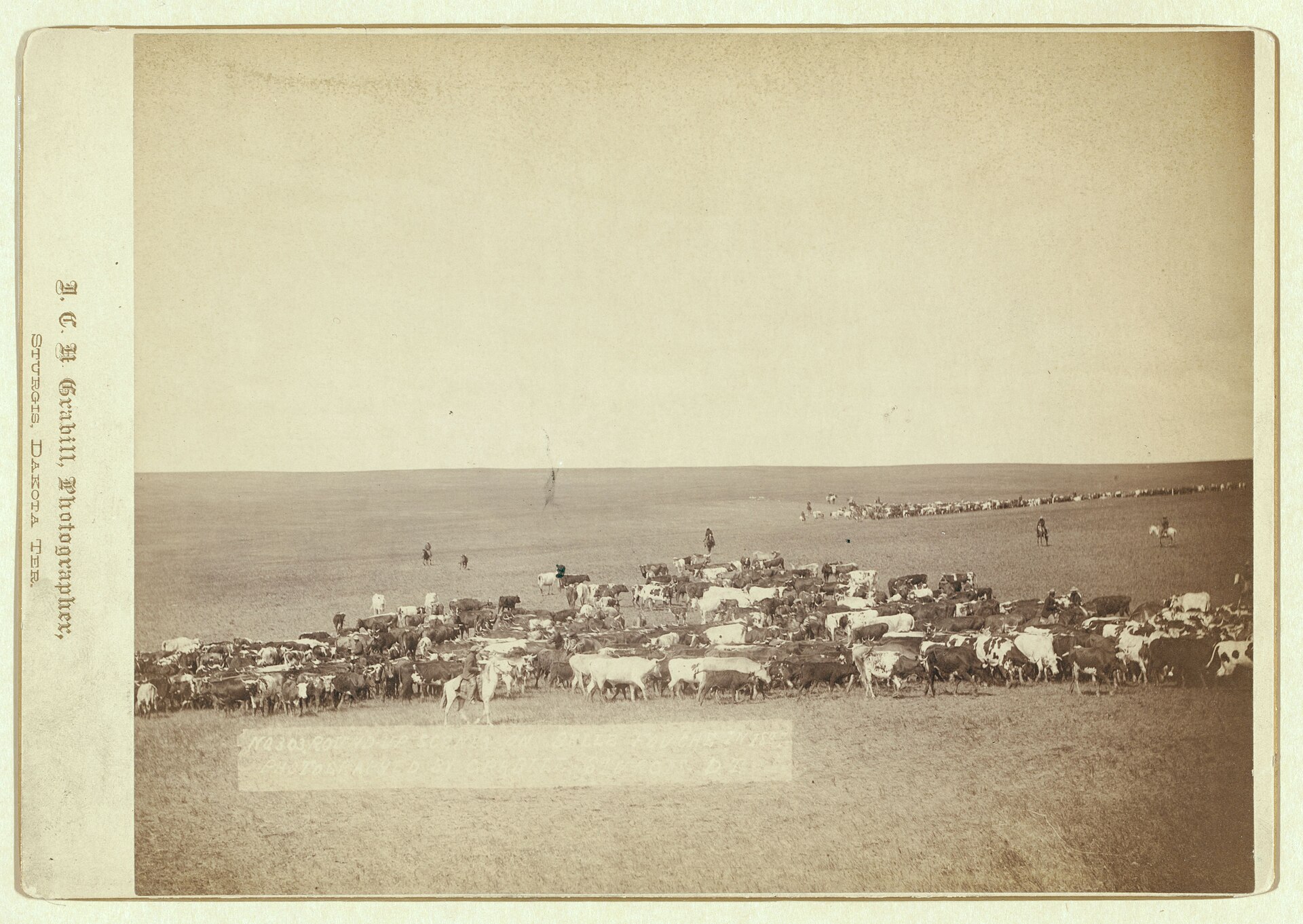
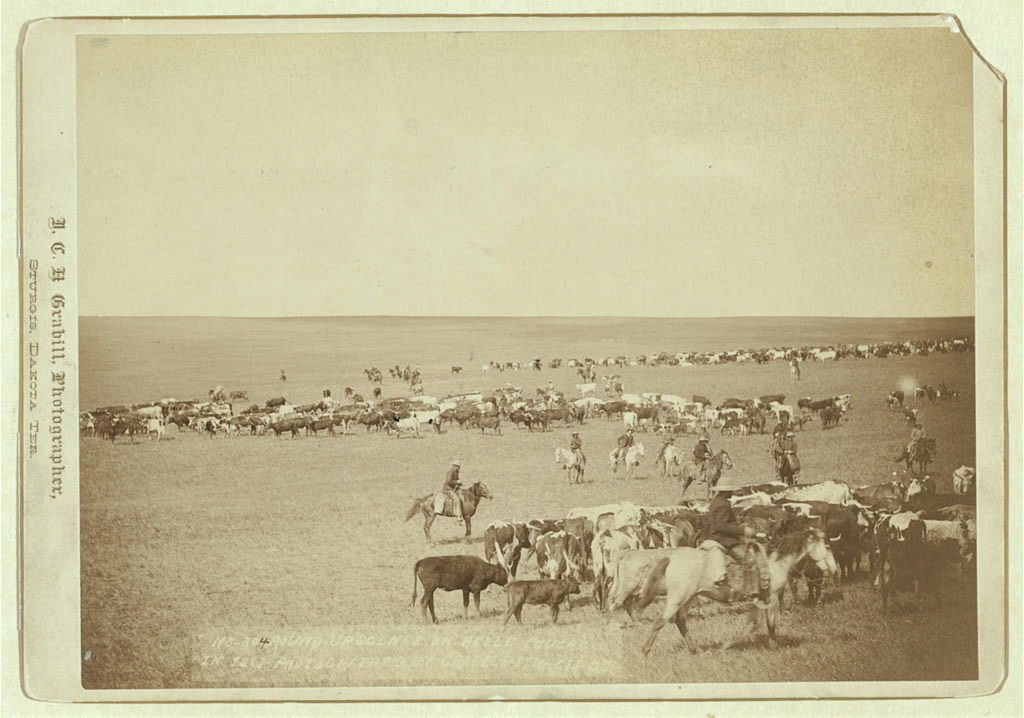
On the Black Hills side, the range outlived the winter. John C. H. Grabill’s camera found a roundup at work on the Belle Fourche in 1887 (see Rails, Cattle and Belle Fourche). The Sturgis and Goodell company, an outfit based in Cheyenne, Wyoming, with a camp near present-day Dewey since 1878, was still at work in southwestern Custer County when the Burlington’s track reached its ranch in 1889, and a permanent stockyard stop went up there, a 1990 National Register study records. Farther east, on reservation land opened in 1890, Burkholder’s history starts the open range that year and ends it about 1902; a 1903 editorial thought that spring’s roundup in eastern Stanley County was probably the last.
Closer readings place the winter inside a longer decline. Western sees the cattlemen’s free range in Wyoming on its way out before the snow fell, pushed by land laws that drew claimants: in 1884 alone, he notes, the people filing land claims outnumbered all those of the 14 years before. At Montana’s Grant-Kohrs Ranch, the Park Service says only that the disaster “foreshadowed” the end of the open-range cattle era.
Hay, Fences and Smaller Herds
Hay is the change the record ties most closely to the winter. After it, the Park Service says, Montana ranchers began feeding their cattle hay all through the cold months. Some tried it in the middle of the crisis. Hoping to save at least some of the L7’s cattle, its manager laid in 100 tons of hay in early February 1887, Brayer writes. The company was then reorganized, sold its Platte ranches and gathered its cattle on the Snake River south of Baggs. For Western, 1868 to 1886 were the Wyoming cattle business’s best years, and it never got back to them. Cattle did not bring $7 a hundredweight again until 1910, and in 1909 the state’s sheep were worth more than its cattle, $32.1 million to $26.2 million.
West of the Missouri in South Dakota, the end of free grass and the turn to smaller herds came later, and the record ties them to other causes. Burkholder links the turn to two federal steps in 1902, a per-head charge for cattle grazed illegally on tribal land and Theodore Roosevelt’s order against cattlemen’s fences on the public domain, and to the homesteaders who came after them (see The Open Range and the Cattle Drives). By then the winter was 15 years gone.
Did the Winter Bring the Homesteaders?
Only in the loosest sense: both belong to the long end of free grass. The homestead rush around the Hills came two decades after the winter and grew from land laws, not from dead cattle. Much of the plains east of the Hills was still reservation land in 1887, a decade after the 1877 Act had taken the Hills from the tribes without the consent the 1868 treaty required (see The 1876 War and the Taking of the Hills).
In western South Dakota, homestead filings ran high in 1907 and 1908, as Homesteading the Edges of the Hills tells. In southwestern Custer County, the 1990 study says, the move from open range to small claims began in the 1880s, as the land boom farther east spread there, and homesteading boomed after 1915, when the 320-acre enlarged homestead law was amended to take in South Dakota, and after the 640-acre stock-raising law of 1916.
For the homesteaders, the hard years came as drought rather than snow: many gave up their claims in the dry years of 1910 and 1911.
Connected
- The Open Range and the Cattle DrivesThe trail herds, outfits and falling prices that set up the winter’s losses.
- Homesteading the Edges of the HillsThe claims filed two decades after the winter, and the droughts that drove so many off.
- Moorcroft, WyomingA Crook County cattle town, in the county where Larson put losses at roughly 25 percent.
- Rails, Cattle and Belle FourcheThe 1887 roundup on the Belle Fourche and the railhead that followed it.
- The 1876 War and the Taking of the HillsHow the Hills and the land around them were taken from the tribes.
Sources
- Daily Yellowstone Journal (Miles City, Montana), April 17, 1887, page 3 (OCR text). Chronicling America, Library of Congress.
- Samuel Western, “The Wyoming Cattle Boom, 1868–1886”. WyoHistory.org, Wyoming State Historical Society, 2014.
- John H. Burkholder, “Poised to Profit: Fort Pierre and the Development of the Open Range in South Dakota,” South Dakota History 41, no. 3. South Dakota State Historical Society, 2011.
- Herbert O. Brayer, “The L7 Ranches,” Annals of Wyoming 15, no. 1 (text). Internet Archive, 1943.
- The Winter of 1886. National Park Service, Grant-Kohrs Ranch National Historic Site, 2021.
- A Family Guide to the Mackay Gallery of Charles M. Russell Art. Montana Historical Society, 2003.
- John E. Mitchell and Richard H. Hart, “Winter of 1886-87: The Death Knell of Open Range,” Rangelands 9, no. 1 (repository record). Society for Range Management, 1987.
- “The 1887 Blizzard That Changed the American Frontier Forever”. Smithsonian Magazine, undated.
- The Devastating Winter of 1886–87. Theodore Roosevelt Presidential Library, undated.
- “Cattle Ranching in Harding County” (marker in Buffalo, South Dakota, erected by Buffalo and Harding County). The Historical Marker Database.
- John C. H. Grabill, “Round-up scenes on Belle Fouche [sic] in 1887”. Library of Congress, Prints and Photographs Division, 1887.
- Ranches of Southwestern Custer County, South Dakota, National Register of Historic Places Multiple Property Documentation Form. National Park Service, 1990.
Last reviewed: