Connections
Fossil Hunters and Tribal Stories
In the first days of the world, as the Oglala storyteller James LaPointe told it in his 1976 book Legends of the Lakota, a great race was run to settle who could eat whom, the race that gives the Red Valley its other name, the Racetrack. It ended with the ground trembling and runners dying where they stood, buried in ash and lava. The huge bones of ancient monsters, LaPointe wrote, “can be found in the badlands to the east and south of the Black Hills.” Lakota people knew those bones long before scientists began coming for them in the 1840s, and who may take one now is a question of land, law and tribal claims.
Water Monsters, Thunder Beings and a Thunder Horse
Lame Deer told another account of the Badlands bones in Winner, South Dakota, in 1969, as the National Park Service at Pipestone National Monument has published it in adapted form. In it a water monster raised a flood in the early world and was turned to stone afterward. “Her bones are in the Badlands now,” Lame Deer said. He had the story, he said, from a Santee grandmother.
Craig Howe, a citizen of the Oglala Sioux Tribe and the founder of the Center for American Indian Research and Native Studies, wrote with Lukas Rieppel, a historian at Brown University, about another strand in the journal Nature in June 2024: the thunder beings, bird-shaped spirits that fought the great monsters of the old world. Lakota people often use that fight, they write, to explain the Badlands’ many fossils.
At the Red Cloud Agency in northwestern Nebraska, the Army scout James H. Cook was shown a petrified tooth 3 inches or more across, which American Horse said had come from a thunder horse. The thunder horse came down in storms to hunt buffalo, and once drove a herd into a camp of people close to starving. The account is Cook’s retelling, known from a Park Service outline for Scotts Bluff that summarizes his manuscript on Red Cloud’s life, and it carries no date.
Long before paleontology was a science, the Park Service says, Oglala Lakota people were already picking up large fossil bones, turtle shells and seashells in the Badlands, and they were the first to grasp that this dry country had once been under water.
Why the Badlands Keep Giving Up Bones
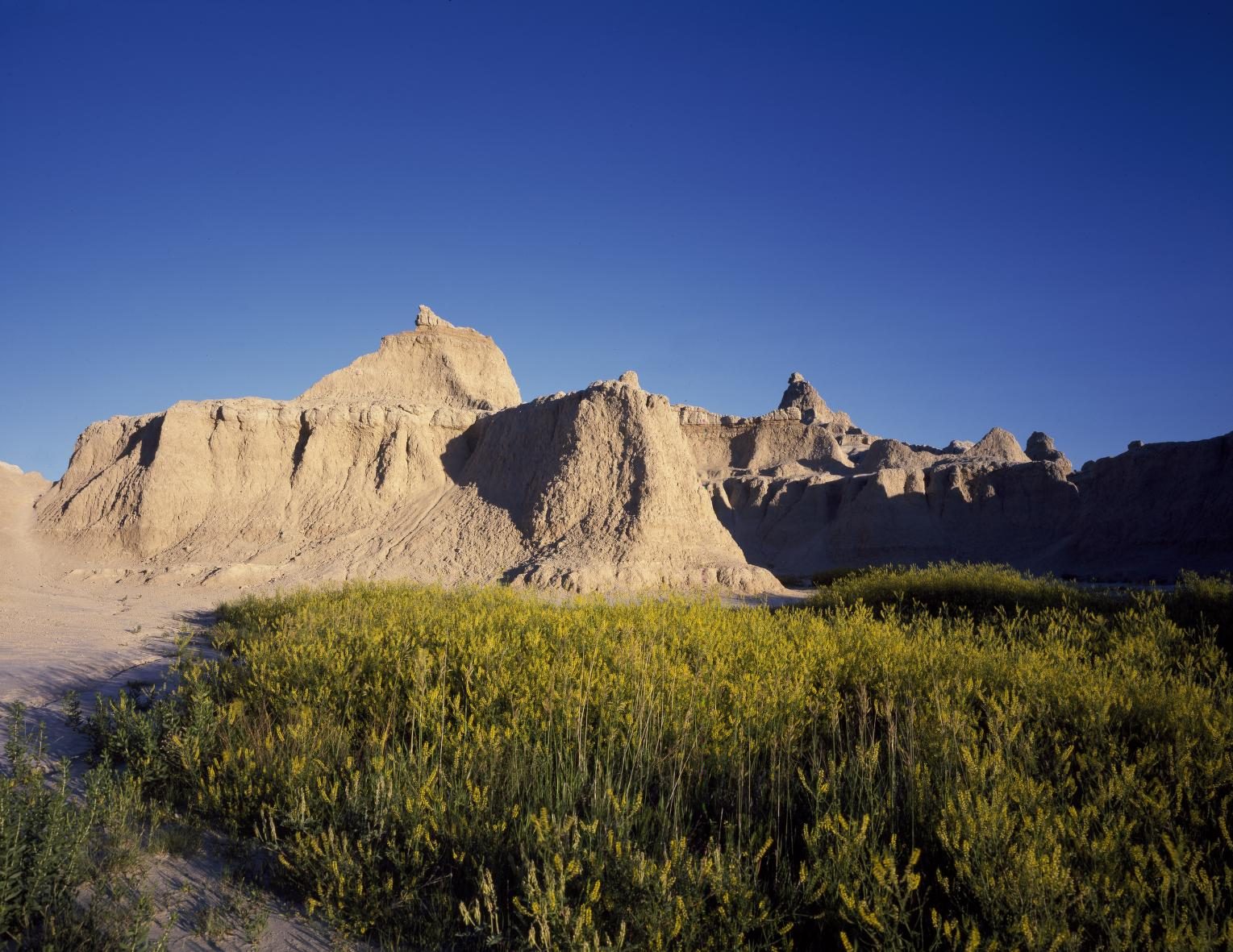
Soft clay, sand and volcanic ash wear back so fast, as How the Badlands Erode explains, that the erosion shaping the buttes of Badlands National Park keeps uncovering fossils. Among the animals on Fossils and the Mammoth Site are the brontotheres, sometimes called thunder beasts, from the Chadron Formation, the lower of the two main layers that hold mammal bones.
Collectors on Reservation Land
Scientists came in the 1840s. By 1847 Hiram Prout, a St. Louis doctor, had described a fragment of a giant animal’s jaw that an American Fur Company agent sent him, and Joseph Leidy of Philadelphia an early camel. Thaddeus Culbertson collected for the Smithsonian in 1850, and F.V. Hayden and F.B. Meek came in 1853. The Yale paleontologist Othniel Charles Marsh brought a party in 1870.
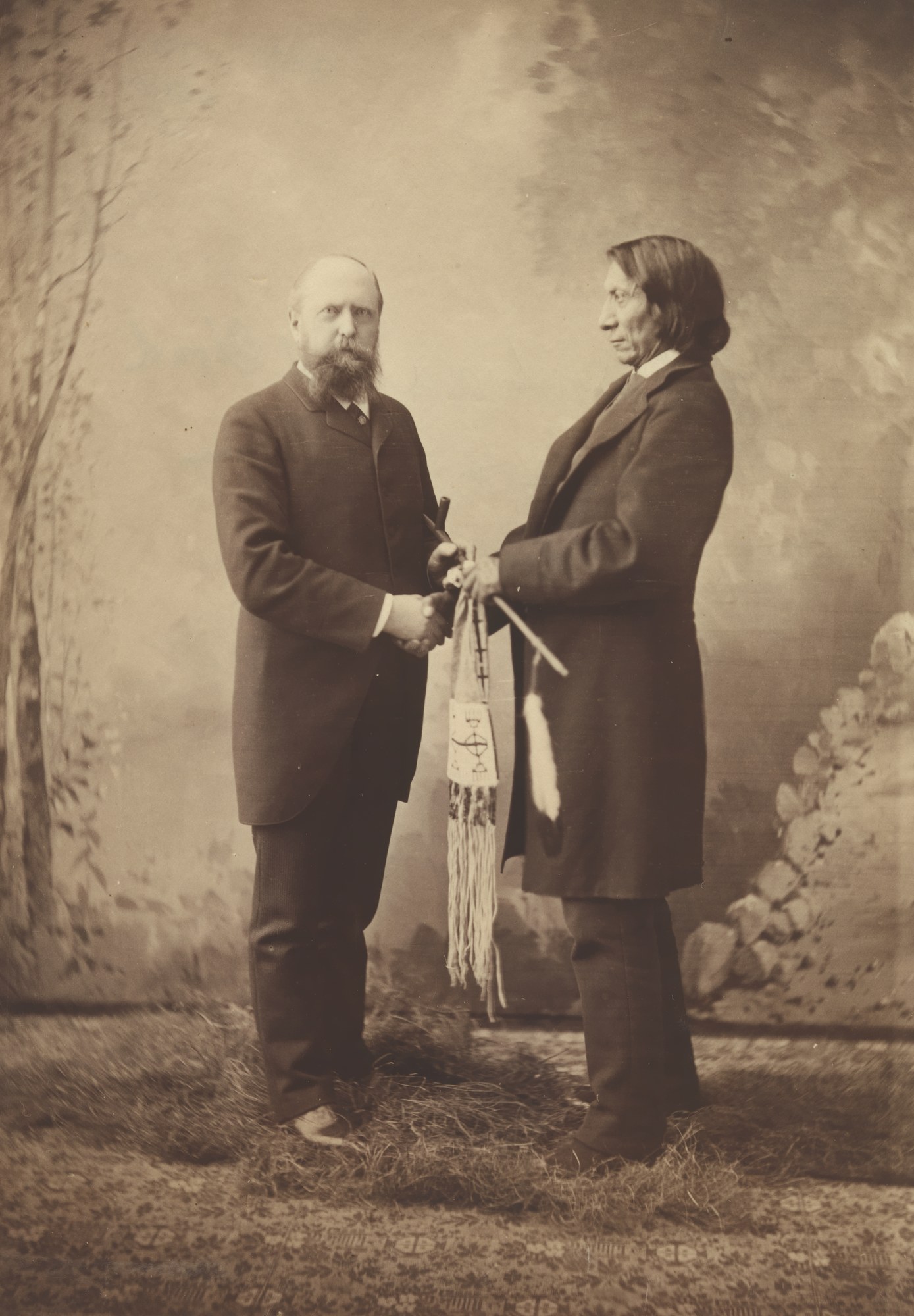
Marsh’s 1874 trip is where the two histories meet. That summer he had sent George Bird Grinnell on the Custer Expedition in his place. At the Red Cloud Agency that fall, Howe and Rieppel write, the Lakota leader White Tail rose to say the bone hunt was a pretext for prospecting and pushing into the Black Hills. Red Cloud, the Oglala leader Maȟpíya Lúta, agreed to the Badlands trip only after long, tense talks, and on two terms: the party would take Lakota guides, and Marsh would tell officials in Washington that the agent was handing out poor supplies and embezzling. Marsh then left at night without the guides, by their account.
A 1968 history of the Badlands says his party, under Army escort, packed its fossils in haste and reached the agency again less than a day ahead of a war party searching the area for the “Big Bone Chief.” That November he shipped about 2 tons of fossils to Yale’s Peabody Museum. The digging was inside the Great Sioux Reservation, the history notes. The Badlands country between the White and Cheyenne Rivers, east of the 103rd meridian, stayed reservation land until the Act of March 2, 1889, cut it away; much of it became public land in 1890, which opened the country around Wall to settlement.
Marsh did report reservation conditions to officials and eastern newspapers, the Smithsonian’s National Portrait Gallery says, and the 1968 history credits him with setting off an investigation of the agency. Howe and Rieppel still say he took countless specimens from Lakota lands without permission. “Lakotans knew what was going on in their treaty lands,” they wrote, as Brown University quoted them in 2024.
A sign at Yale’s Peabody Museum, Howe and Rieppel report, credits Lakota stories of the thunder beings with inspiring the brontotheres’ Greek name, which means thunder beast. A Badlands National Park article says Lakota oral histories inspired Marsh as well. Neither quotes Marsh, and the park article names no source for it.
Who May Take a Fossil Now?
That depends on whose land it is. In Badlands National Park, the Park Service calls taking a fossil illegal and wants anyone who comes across one to leave it where it is and tell park staff. The Big Pig Dig began that way, when visitors spotted bones poking out of the ground beside the Conata Picnic Area and told park staff. Over 15 field seasons the dig produced more than 19,000 fossils, from animals that died about 34 million years ago.
Under the Paleontological Resources Preservation Act of 2009, collecting a fossil from federal land generally takes a permit, and the law backs that rule with fines and prison terms. On the Buffalo Gap National Grassland, the Forest Service prairie that includes the Conata Basin beside the park, visitors may pick up plant and invertebrate fossils from the surface for personal, noncommercial use. Fossils of animals with backbones, tracks included, need a permit, and no fossil from the grassland may be sold.
Tribal land is a separate case. The 2009 law’s definition of federal land leaves out “Indian land,” such as land held in trust for tribes or tribal members. The park’s South Unit, within the Pine Ridge Reservation, is held in trust for the Oglala Sioux Tribe and run by the Park Service under a 1976 agreement with the tribe; as of October 2026, the Park Service describes it as managed with the tribe. Christian Knutson, an Oglala Lakota park ranger at the White River Visitor Center, said in the Smithsonian’s American Indian magazine in 2023 that some people still regard the South Unit as “land lost.”
In a 2015 resolution, the National Congress of American Indians, an intertribal body of tribal governments, declared fossils that matter to tribes “items of cultural patrimony” and called on the Interior Department, the Bureau of Land Management and other agencies, federal and state, to stop granting permits to dig and study fossils on land tied to tribal history and culture. In 2024 Howe and Rieppel asked museums to return fossils taken from the White River Badlands and to build museums with tribal nations on tribal land.
Connected
- Fossils and the Mammoth SiteThe animals of the Badlands beds, from brontotheres to the Big Pig Dig.
- How the Badlands ErodeWhy the soft layers wear back fast enough to keep uncovering bones.
- Badlands National ParkThe park that holds the fossil beds, including the South Unit within the Pine Ridge Reservation.
- The Red ValleyThe Racetrack, the path of the great race in LaPointe’s account.
- The Custer Expedition of 1874The summer expedition Marsh skipped, sending George Bird Grinnell instead.
- Wall, South DakotaThe town whose page dates the Badlands country’s opening as public land to 1890.
Sources
- Why Museums Should Repatriate Fossils, by Craig Howe and Lukas Rieppel. Nature 630, 2024.
- Studying Fossil Extraction on Native Lands and Exploring the Depths of Untold Histories. Brown University, 2024.
- Resolution SD-15-020: To Protect Paleontological Resources on Tribal and Ancestral Tribal Lands. National Congress of American Indians, 2015.
- On Dangerous Ground: Oglala Lakota Land Used as a Bombing Range in World War II Is Still Perilous, by William C. Meadows. American Indian magazine, Smithsonian National Museum of the American Indian, 2023.
- Unktehi and the Flood, as Told by Lame Deer. National Park Service, Pipestone National Monument, 2024.
- Outline of the Geology and Paleontology of Scotts Bluff National Monument and the Adjacent Region: Paleontologic Exploration and Importance. National Park Service, Field Division of Education, undated; copy held by the NPS History Collection.
- Paleontology in the White River Badlands. National Park Service, Badlands National Park, 2020.
- Brontothere: Large Beasts of the Badlands. National Park Service, Badlands National Park, 2020.
- The Big Pig Dig. National Park Service, Badlands National Park, 2020.
- South Unit. National Park Service, Badlands National Park, 2020.
- History of Badlands National Monument and the White River (Big) Badlands of South Dakota: Early Indians and Explorers, by Ray H. Mattison and Robert A. Grom. Badlands Natural History Association, 1968; copy held by the NPS History Collection.
- Othniel Marsh, 1831–1899 (photograph by Frank A. Bowman, 1883). National Portrait Gallery, Smithsonian Institution.
- The Pig Dig: Critical Resource Issues. National Park Service, Badlands National Park, undated; copy held by the NPS History Collection.
- Paleontological Resources Preservation (Public Law 111-11, Title VI, Subtitle D). U.S. Congress, 2009; copy hosted by the USDA Forest Service.
- Collecting Rocks, Meteorites, Artifacts, and Fossils on Nebraska National Forests and Grasslands. USDA Forest Service, Nebraska National Forests and Grasslands, 2011.
Last reviewed: