Landscape and Geology
Fossils and the Mammoth Site
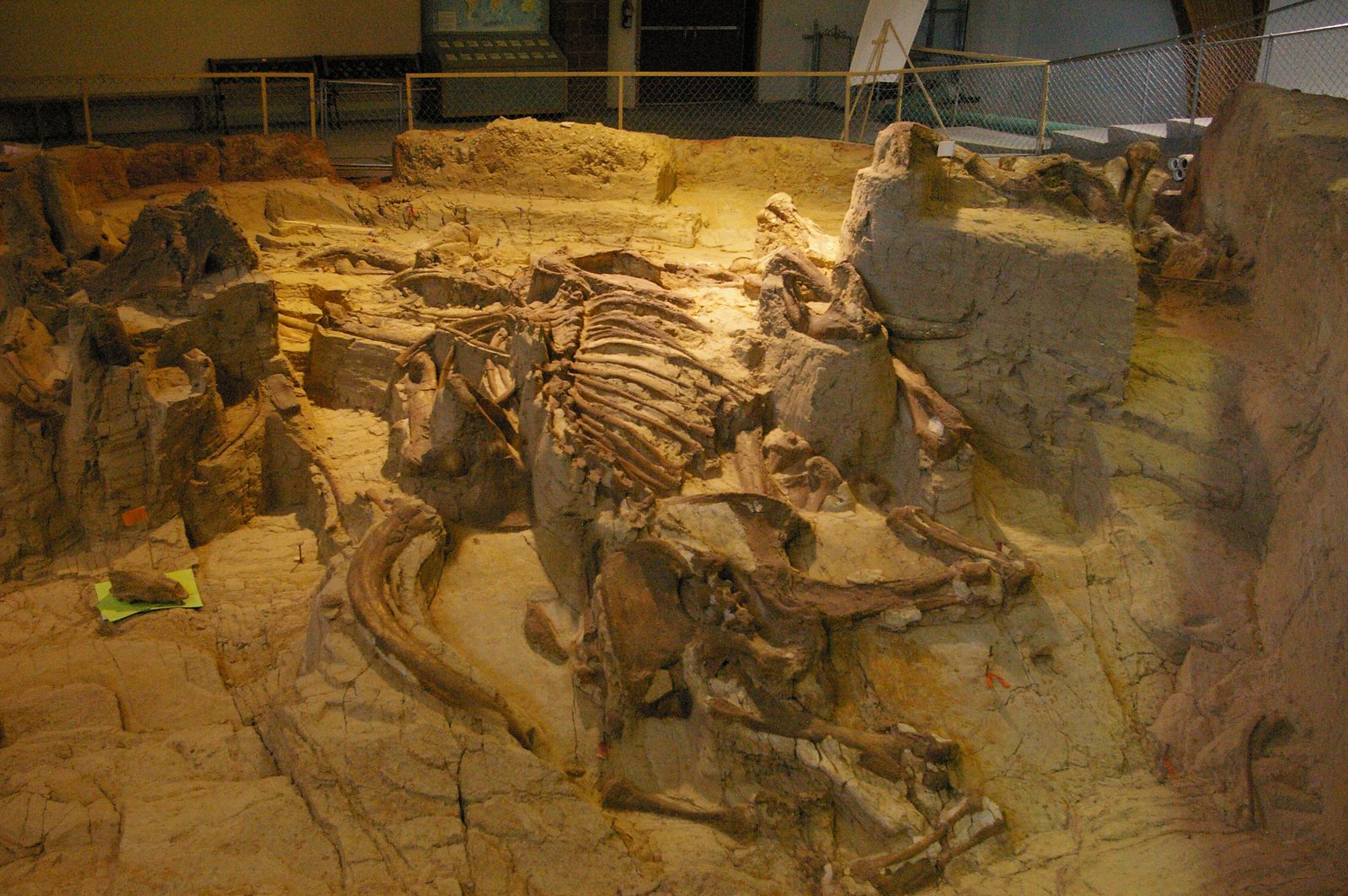
Pieces of backbone and leg bone lay exposed just beyond the Conata Picnic Area in Badlands National Park when two visitors spotted them in 1993 (one Park Service article says 1997). Instead of pocketing them, the pair reported the find to park staff. Scientists and volunteers worked the spot, now called the Big Pig Dig, for 15 field seasons and took out more than 19,000 fossils of animals that died at a watering hole in a drought about 34 million years ago. Fossils turn up in four main settings around the Black Hills: early mammals in the Badlands, sea reptiles in the older shale beneath them, dinosaurs in the sandstone of the Hogback, and Ice Age mammoths in a sinkhole at Hot Springs.
Why Are the Badlands So Full of Fossils?
Badlands National Park holds what the National Park Service calls the world's richest collection of Oligocene vertebrate fossils (animals with backbones, from the epoch that began about 34 million years ago), many of them from the Brule Formation, laid down about 34 to 30 million years ago. The reasons lie in how the rock was made and how fast it is coming apart. The mammal-bearing layers formed on land, across broad floodplains and along rivers, and volcanic ash is mixed into many of them. The Big Pig Dig shows one way bones got buried: in a drought, animals crowded the only nearby water, a stream channel or oxbow pond; weak ones got stuck, scavengers came to feed and died too, and the bones were buried and slowly turned to stone.
Then the burial was undone. The soft layers still wear back about an inch a year on average, by the Park Service's figure, as How the Badlands Erode explains. The park service notes that the same erosion that carves the buttes keeps exposing fossils. Scientific collecting in the White River Badlands, which run from South Dakota into Nebraska and Wyoming, goes back to the 1840s. By the park service's count, 77 of the 84 fossil animal species identified anywhere in North America by the mid-1800s came from these badlands.
The bones were known here long before any scientist arrived: the National Park Service credits the Oglala Lakota with finding big fossil bones, turtle shells and seashells in the Badlands, and says they were the first to work out that the land had once lain under water. Craig Howe, an Oglala Sioux Tribe citizen who founded the Center for American Indian Research and Native Studies, and the Brown University historian Lukas Rieppel wrote in the journal Nature that when the Yale paleontologist Othniel Charles Marsh shipped fossils dug on Lakota land to Connecticut, "most of the Lakotan meanings and stories tied to them were stripped away"; Fossil Hunters and Tribal Stories follows those accounts.
Fossils on federal land are protected by the Paleontological Resources Preservation Act of 2009, which bars collecting them without a permit, apart from small amounts of common invertebrate and plant fossils for personal use on some Forest Service and Bureau of Land Management ground. In Badlands National Park, visitors may not take any fossil; the park asks finders to leave it in place and report it.
Thunder Beasts, Oreodonts and a Horse the Size of a Dog
The mammals come mainly from two layers. The lower one, the Chadron Formation, built up about 37 to 34 million years ago on a hot, wet floodplain that the park service likens to today's Everglades. Ancient alligators lived there, along with brontotheres, sometimes called thunder beasts, the largest mammals found in the Badlands.
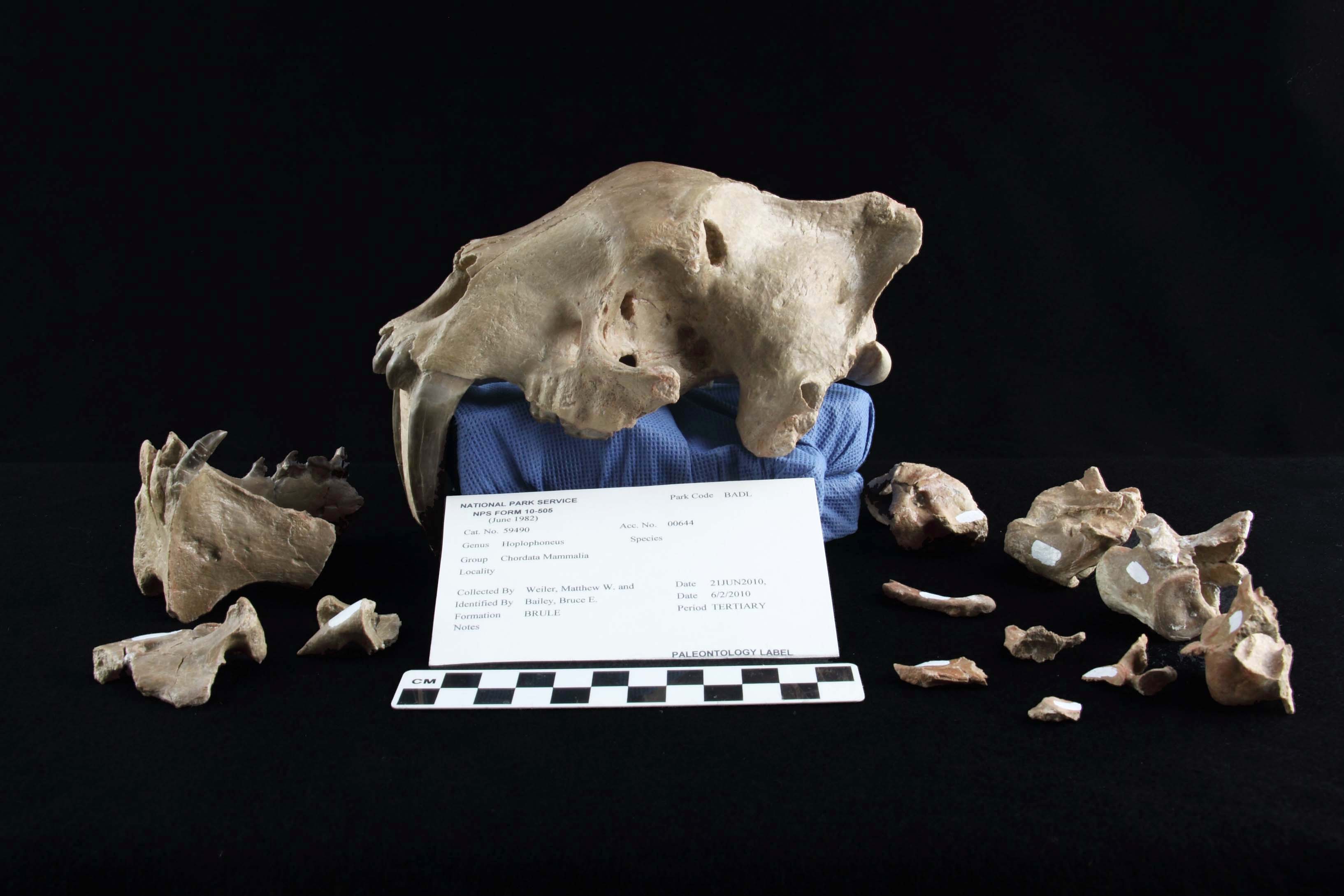
The Brule Formation above it formed after the climate cooled and dried and the floodplain turned to open grassland, crossed by rivers. Oreodonts, plant-eaters that probably grazed in herds, are among its most common fossils. Nimravids, cat-like predators with saber teeth, are among the few hunters. The Big Pig Dig adds more faces. Archaeotherium, the "big pig" itself, was an omnivore and probably a scavenger, more closely related to hippos than to pigs. Subhyracodon was a hornless relative of the rhinoceros. Mesohippus, an early horse, was about the size of a large dog, and Leptomeryx was a hornless deer-like animal about a foot tall.
Small animals are here too, among them insect-eaters such as shrews, hedgehogs and golden moles, and studies of an early camel, Poebrotherium, have helped researchers read the climate of the time. In all, more than 250 species of animals with backbones are known from the park, ranging from rodents to beasts the size of elephants.
Sea Reptiles From the Inland Sea
Below the mammal beds lies something much older: the Pierre Shale, mud laid down on the floor of an inland sea between about 75 and 69 million years ago. That sea, the Western Interior Seaway, split North America in two from the Gulf of Mexico to the Arctic Ocean, and over the Badlands it stood about 1,300 feet deep.
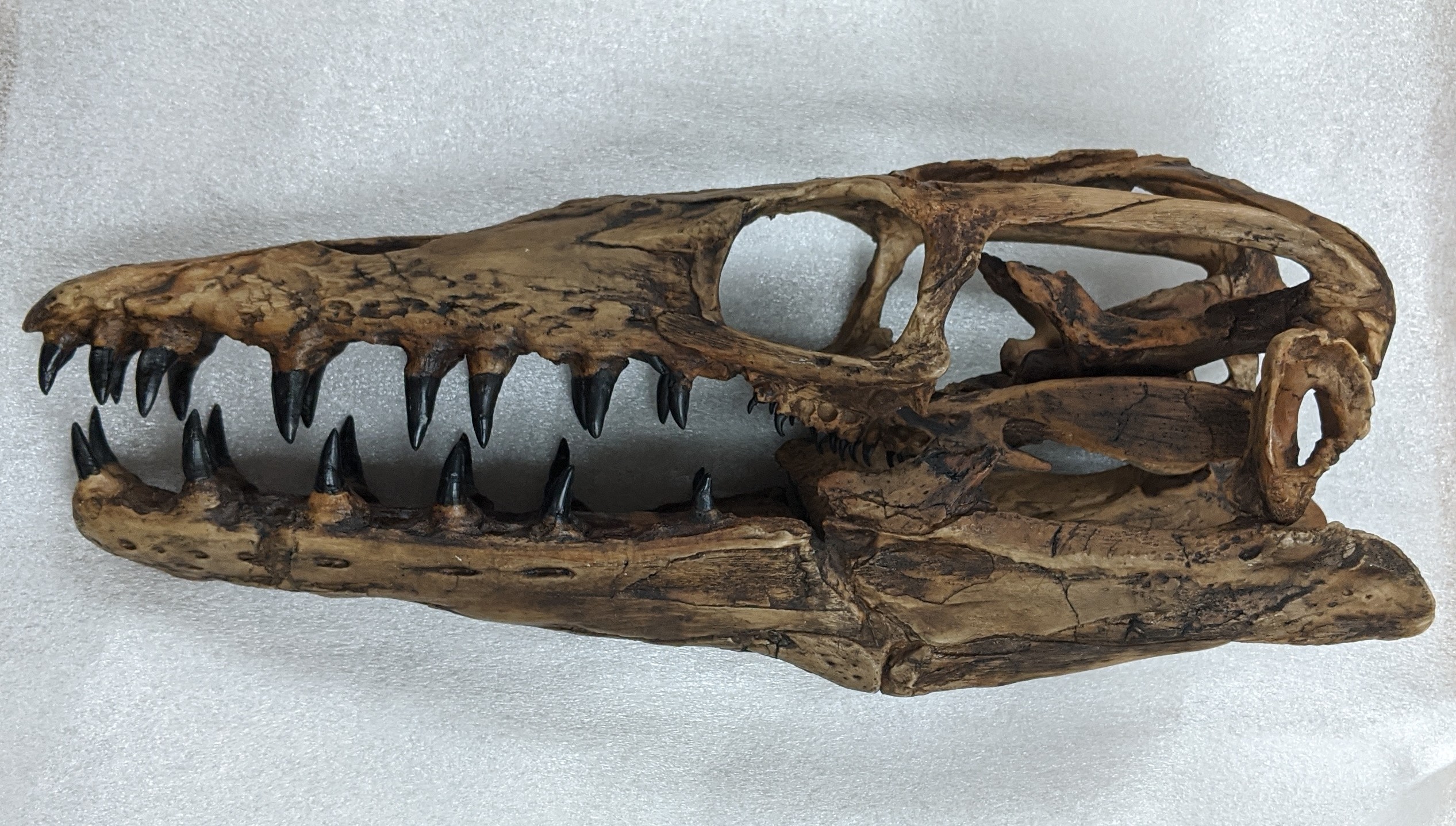
Its top predators were mosasaurs, marine reptiles whose closest living relatives are snakes and monitor lizards. Adults could reach about 50 feet long and ate fish, sharks, squid-like animals and one another. They probably bore live young; one South Dakota skeleton held five unborn young. The park's Pierre Shale also holds ammonites and baculites, shelled relatives of squid and octopus. Dinosaurs still lived on land then, but the park service notes that none are found in the Pierre Shale here.
Between that sea floor and the first mammal beds lies a gap of more than 30 million years. The Yellow Mounds, an old soil that formed on the drained sea floor, mark the break; How the Badlands Erode describes them.
Dinosaurs in the Hogback
Dinosaurs turn up in the rocks of the Hogback, the sandstone ridge of the Inyan Kara Group that forms the outer rim of the Hills (the rings are laid out on How the Black Hills Formed). One layer in that group is a rock formation named for the Lakota: the Lakota Formation, also called the Lakota Sandstone. The geologist N.H. Darton first used the name in 1899, and his 1901 report for the U.S. Geological Survey says it was taken from the Lakota. Its type locality, the reference spot that defines it, was set in 1909 at Lakota Peak, a summit on the Hogback about 4 miles northwest of Hermosa. The formation crops out around the edge of the Hills in both South Dakota and Wyoming.
One of its dinosaurs is Dakotadon lakotaensis, a plant-eater. Louis Rossow and his family dug its partial skull and other bones out of a hillside east of Whitewood, and in November 1975 his son Dale brought the find to scientists' attention. It is held by the Museum of Geology at the South Dakota School of Mines and Technology in Rapid City. Clint Boyd and Darrin Pagnac re-examined it in 2015 and dated it to the Early Cretaceous, more than 120 million years ago. The Lakota Formation has also yielded an armored dinosaur, Hoplitosaurus; Osmakasaurus, from Calico Canyon; and an unidentified sauropod, one of the long-necked giants.
Dinosaur Park is a different thing. The dinosaurs there, on the crest of the Hogback along Skyline Drive in Rapid City, are statues, not fossils: concrete over wire mesh on frames of 2-inch metal pipe, built by the Works Progress Administration and dedicated on May 22, 1936.
The Mammoth Site: Ice Age Bones in a Sinkhole
At the Mammoth Site in Hot Springs, a sinkhole filled with warm spring water trapped more than 60 mammoths found so far, 58 of them Columbian and 3 woolly, by the site’s August 2026 count. Animals that got into it could not climb back out, and their remains built up in the sediment. Luminescence dating published in 2026 puts the bone bed at about 160,000 to 230,000 years old, roughly 200,000 years ago. Shannon Mahan of the U.S. Geological Survey and Jim Mead of the Mammoth Site led the study, and the site's principal investigator, Chris Jass, said the re-dating suggests the site is "over 100,000 years older than we once thought."
The same study found that about 20 feet of bone-bearing sediment built up in the pond at roughly half an inch a year, in thin layers of sandy silt washed in from its margins. If the 75 million years since the oldest Badlands rock was laid down were squeezed into a single day, the time since those mammoths died would fill about the last four minutes.
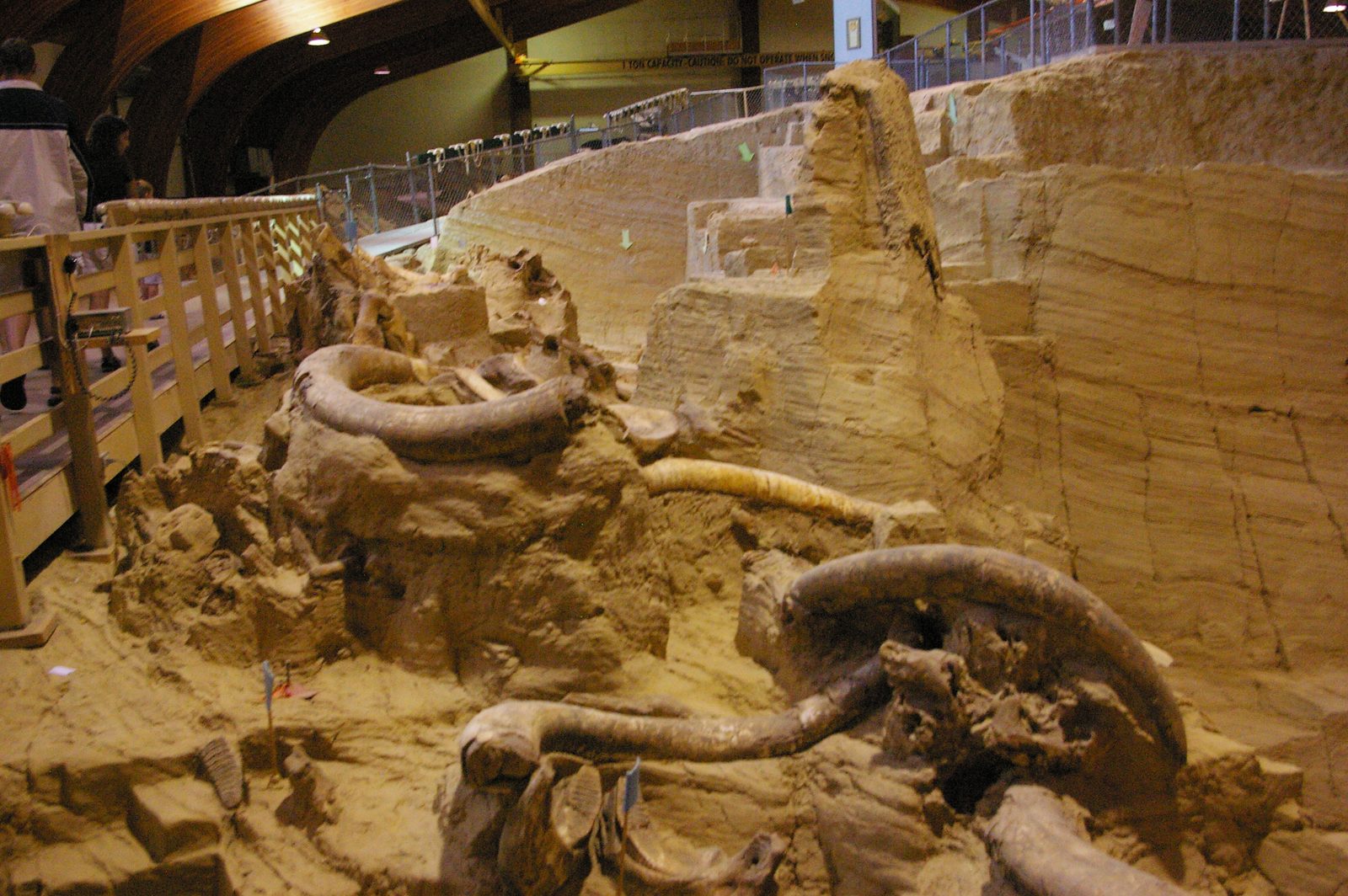
The site was found by accident. According to the Mammoth Site's own history, in June 1974 equipment operator George Hanson, clearing land for houses, cut into a low rise and exposed a mammoth tusk and other bones. His son, Dan Hanson, who had some training in geology and archaeology, phoned Larry Agenbroad of Chadron State College, whose first estimate was at least four to six mammoths. Many of the bones are displayed where they were found, inside a building raised over the sinkhole in Hot Springs.
Connected
- Fossil Hunters and Tribal StoriesThe Lakota accounts of these bones, and the collectors who came for them.
- Badlands National ParkVisiting the park where the mammal fossils and the Pierre Shale are exposed.
- How the Badlands ErodeThe layers and the fast erosion that keep uncovering fossils.
- Hot Springs, South DakotaThe town of the warm springs and the Mammoth Site.
- Rapid City, South DakotaHome of the School of Mines Museum of Geology and the Dinosaur Park statues.
- How the Black Hills FormedThe four rings of rock, including the Hogback that holds the dinosaurs.
Sources
- Paleontology in the White River Badlands. National Park Service, 2020.
- Geologic Formations: How Badlands Buttes Came to Be. National Park Service, 2020.
- NPS Geodiversity Atlas: Badlands National Park, South Dakota. National Park Service, 2024.
- The Big Pig Dig. National Park Service, 2020.
- Big Pig Dig. National Park Service, Badlands National Park, 2020.
- Fossil Lab: How Are Fossils Found? National Park Service, 2020.
- Mosasaur: Apex Predator of the Western Interior Seaway. National Park Service, 2020.
- Geology and Paleontology, Badlands National Park. National Park Service, 2021.
- Paleontological Resources Preservation (Public Law 111-11, Title VI, Subtitle D). U.S. Congress, 2009; copy hosted by the USDA Forest Service.
- Studying Fossil Extraction on Native Lands and Exploring the Depths of Untold Histories. Brown University, 2024.
- Turtle Soup: Craig Howe and Lukas Rieppel, In and Out of Place. Journey Museum and Learning Center, 2026.
- Insight on the Anatomy, Systematic Relationships, and Age of the Early Cretaceous Ankylopollexian Dinosaur Dakotadon lakotaensis. Clint A. Boyd and Darrin C. Pagnac, PeerJ, 2015.
- Geolex: Lakota. U.S. Geological Survey, National Geologic Map Database.
- Geolex: Lakota, References. U.S. Geological Survey, National Geologic Map Database.
- International Chronostratigraphic Chart, version 2024/12. International Commission on Stratigraphy, 2024.
- Dakota Midday: Dakotadon Like Rhino Sized Horse With a Beak. South Dakota Public Broadcasting, 2015.
- Dinosaur Park Dedicated. South Dakota Public Broadcasting, 2023.
- Dinosaur Park. Michelle L. Dennis, SAH Archipedia, Society of Architectural Historians.
- Age Reassignment Using Luminescence Dating for the Mammoth Site, Black Hills, South Dakota, USA. Shannon A. Mahan and others, Quaternary Research, 2026 (U.S. Geological Survey record).
- New Research Re-Dates the Mammoth Site. The Mammoth Site of Hot Springs, 2026.
- About the Mammoth Site: Who We Are and What We Do. The Mammoth Site of Hot Springs.
- History. The Mammoth Site of Hot Springs.
Last reviewed: