Wildlife and Plants
Prairie Rattlesnakes and Other Snakes
At night in Badlands National Park, rattlesnakes lie out on the paved roads to soak up the warmth, the park warns. They are prairie rattlesnakes (Crotalus viridis), the only venomous snakes in South Dakota by the National Park Service’s account, and SDPB reported in 2013 that the species lives in every county west of the Missouri River and in a few spots on the river’s east side. This page covers where it lives around the Black Hills, how to tell it from the bullsnake it is so often taken for, the harmless snakes that share its ground, and what the agencies say about bites.
Where Prairie Rattlesnakes Live
The prairie rattlesnake is a snake of the plains and the lower slopes. On the George S. Mickelson Trail, South Dakota Game, Fish and Parks (GFP) places it on the trail’s southern end and says it is rarely found above 5,000 feet. Along the trail it uses rocky ground, grassland and stream banks.
Wind Cave National Park names two places to expect one: prairie dog towns and rocky areas. Rattlesnakes move into empty prairie dog burrows (see Prairie Dogs and Black-Footed Ferrets), and the park lists prairie dogs among their prey, along with mice and rats. In the Badlands they spend the day hidden, the park there says.
The Park Service rates the species common at Devils Tower National Monument in Wyoming. At Jewel Cave National Monument it is rarely seen, though known to be there. Montana’s state field guide adds that the species lives among ponderosa pines as well as in open, dry country, and is likelier to turn up on south-facing slopes and near rock outcrops.
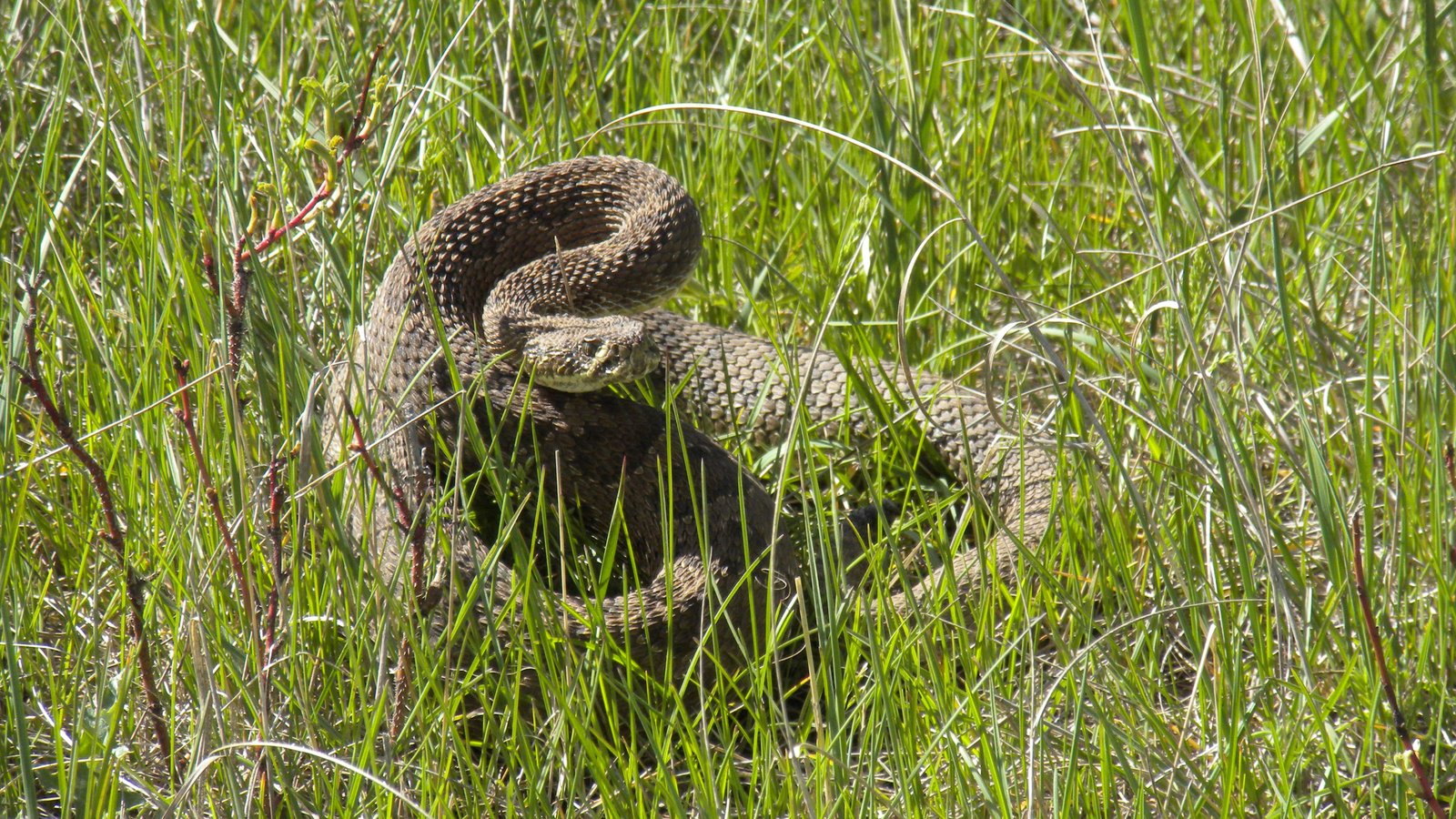
Dens, Long Trips and Young
Prairie rattlesnakes spend the winter together. They den communally, the Montana Field Guide says, citing a study published in 1984 of a Saskatchewan den that held an estimated 150 adults besides the young. In Wyoming they travel long distances out from their home dens and back each year, biologists led by D. Duvall reported in 1990, and their field tests with caged deer mice pointed to finding food as a main reason for the spring trip.
The Montana guide puts the summer range as far as 7 miles from a den. Brian Smith, a biology professor at Black Hills State University in Spearfish, told South Dakota News Watch in 2023 that adults can go up to 10 miles to hunt or find a mate.
The rattlesnake hunts by waiting. It is a pit viper, Devils Tower National Monument explains, named for the pits between its eyes and nostrils that hold heat-sensing organs. It strikes prey that wanders within reach, injects venom, and eats once the animal has died. Its venom is for getting food, not for defense, the monument adds. Jewel Cave National Monument lists rodents, birds, lizards and other snakes as prey, and foxes, coyotes, weasels and most birds of prey as the rattlesnake’s own hunters. Females give birth to 4 to 21 young in late summer, probably every other year, by the Montana guide’s account.
Rattlesnake or Bullsnake?
The bullsnake (Pituophis catenifer) is often mistaken for a rattlesnake, Wind Cave says, and it plays the part. When threatened it may coil, flatten its head and neck and hiss, Devils Tower notes, and Wind Cave adds that it may vibrate its tail in dry leaves to sound like a rattle. It has no venom. GFP’s 2015 checklist of the state’s reptiles calls the species the gopher snake, as Devils Tower also does.
The Park Service gives the marks that tell the two apart. A rattlesnake has a triangular head and pupils shaped like vertical slits; a bullsnake’s head is oval, and its pupils are large and round. Jewel Cave describes its pattern as dark brown spots, each set in a white ring, on a pale gray or light brown body, the rings giving way to bands toward the tail. Devils Tower describes the bullsnake as yellow, its dark brown to black blotches turning to rings near the tail. The plainest difference is the rattle: the prairie rattlesnake is the only rattlesnake on GFP’s checklist.
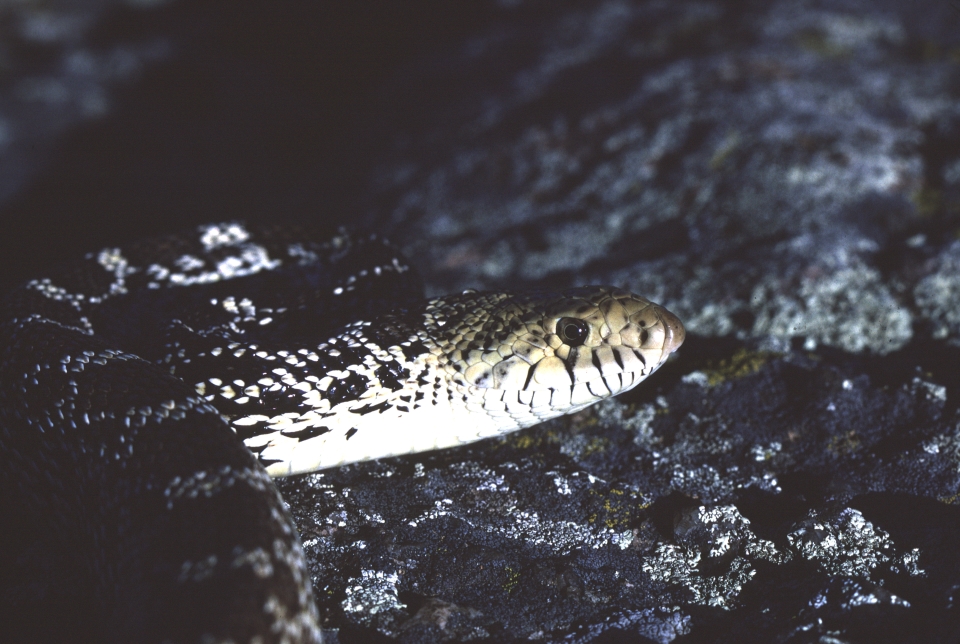
Bullsnakes are the reptile seen most often at Devils Tower, and they sometimes turn up on the Tower itself. They climb trees after eggs and nestlings, and they have been known to prey on rattlesnakes. The parks disagree on size: up to four feet, says Wind Cave, which calls the bullsnake South Dakota’s largest snake, and up to seven feet, says Devils Tower, with longer ones on record.
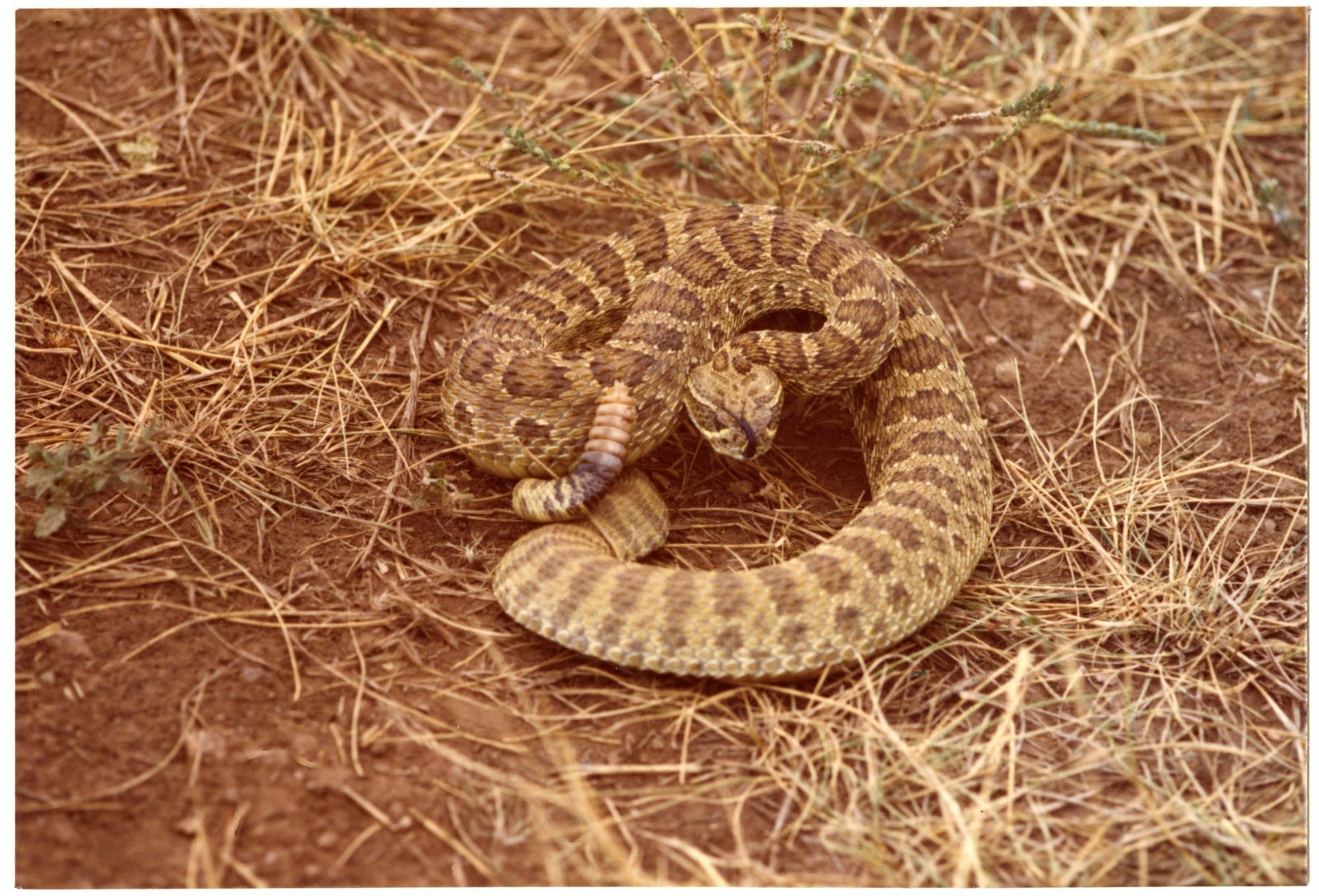
The rattle is a warning, and Devils Tower National Monument renders its message as “I am here, I am scared, and I could be dangerous.” Not every rattlesnake sounds it; some lie still and trust their camouflage. In 2013 SDPB reported that a growing number of Black Hills rattlesnakes seemed to have lost the ability to rattle, on the strength of sightings and theories rather than a study. Smith said then that he saw no reason to rule it out, since snakes can have broken tails and other abnormalities. In 2023 he told News Watch that the snakes always have rattles, even when they don’t use them.
The Harmless Snakes
Of the 16 snake species on GFP’s 2015 checklist, the prairie rattlesnake is the only rattlesnake, and the list gives the Black Hills redbelly snake a line of its own as a subspecies. Devils Tower names five snakes for the monument: the prairie rattlesnake and the bullsnake, both common, and the yellow-bellied racer, the milksnake and the common garter snake. At Wind Cave, yellow-bellied racers are common across the park in summer. Garter snakes and milk snakes, both small, often appear around the visitor center there. Many of these snakes earn their keep: adult snakes help hold down rodent numbers, Devils Tower notes.
What the Agencies Say About Bites
Wind Cave National Park describes prairie rattlesnakes as unaggressive animals that keep out of trouble if people leave them enough space. Bites are rarely fatal, the park adds, but they call for medical care right away. Badlands National Park asks visitors to keep their hands and feet out of spots they can’t see into, such as crevices and overhangs, to back off slowly from a rattle, and to wear closed-toed shoes. Bites often come when people try to kill or harass a snake, experts told News Watch in 2023.
For a bite itself, the National Institute for Occupational Safety and Health (NIOSH), part of the Centers for Disease Control and Prevention, advises emergency care as fast as possible, so antivenom can be started if needed. It also advises staying calm, taking off rings and watches before swelling starts, washing the bite and covering it with a clean, dry dressing, and not driving, since a bite can bring on dizziness or fainting. NIOSH warns against cutting the wound, sucking out venom, tourniquets, ice, alcohol, pain relievers such as aspirin or ibuprofen, and trying to catch the snake.
Across the United States an estimated 7,000 to 8,000 people are bitten by venomous snakes each year, and about five die, NIOSH said in 2024. In South Dakota, a 2013 state Department of Health study found that about 160 people in the state were hospitalized for venomous bites from 2000 through 2011, most in June, July and August and most in counties west of or along the Missouri River, News Watch reported in 2023. Deaths from the bites are rare in South Dakota, Smith told SDPB in 2013. In June 2018 a 70-year-old Illinois man died after a rattlesnake bit his ankle on a golf course at Spearfish, KKRC reported. The Lawrence County medical examiner found that the venom contributed to the death but was not its primary cause, which he listed as cardiac arrhythmia, News Watch later reported.
Connected
- Prairie Dogs and Black-Footed FerretsThe towns whose burrows shelter rattlesnakes and whose prairie dogs feed them.
- Badlands National ParkWhere the park warns of rattlesnakes on warm roads at night.
- Wind Cave National ParkHome to prairie rattlesnakes, bullsnakes, racers, garter snakes and milk snakes.
- The Badlands and WallDry country inside the rattlesnake’s range west of the Missouri.
- The George S. Mickelson TrailRattlesnakes live on its southern end and are rare above 5,000 feet.
- Devils TowerWhere bullsnakes are the reptile seen most often, sometimes on the Tower itself.
- Jewel CaveA monument where the prairie rattlesnake is present but rarely seen.
Sources
- Reptiles and Amphibians (Wind Cave National Park). National Park Service, viewed 2026.
- Reptiles (Devils Tower National Monument). National Park Service, viewed 2026.
- Prairie Rattlesnake (Jewel Cave National Monument). National Park Service, viewed 2026.
- Safety (Badlands National Park). National Park Service, viewed 2026.
- Trail Safety (George S. Mickelson Trail). South Dakota Game, Fish and Parks, 2026.
- Amphibians and Reptiles Checklist. South Dakota Game, Fish and Parks, 2015.
- Prairie Rattlesnake, Crotalus viridis. Montana Field Guide, Montana Natural Heritage Program, viewed 2026.
- Prairie Rattlesnake Vernal Migration: Field Experimental Analyses and Survival Value, by D. Duvall, M. J. Goode, W. K. Hayes, J. K. Leonhardt and D. G. Brown. National Geographic Research 6, no. 4, 1990 (abstract, University of Arizona).
- Venomous Snakes at Work. National Institute for Occupational Safety and Health, Centers for Disease Control and Prevention, 2024 (reviewed 2026).
- Rattlesnake Season Leads to Close Calls, Some Bites and Need for Precautions, by Abbey Stegenga. South Dakota News Watch, 2023.
- Rattlesnake Bite Kills Golfer in Spearfish, by Marc Elliott. KKRC, 2018 (relaying KSFY).
- Rattlesnakes That Can’t Rattle Being Found in the Black Hills, by Gary Ellenbolt. SDPB, 2014 (first aired 2013).
Last reviewed: