The Outdoors
Hiking Black Elk Peak
In 1911 the fire lookout on Black Elk Peak was a wooden crate. The stone tower there now went up more than 25 years later, on a granite summit 7,242 feet high, the highest point in South Dakota. Black Elk Peak (called Harney Peak until 2016) rises in the Black Elk Wilderness of the Black Hills National Forest, and the busiest way up is Trail 9 from Sylvan Lake. The other routes, the wilderness rules, the rock and the tower, and why the mountain carries Black Elk’s name follow in turn.
Trail 9 From Sylvan Lake
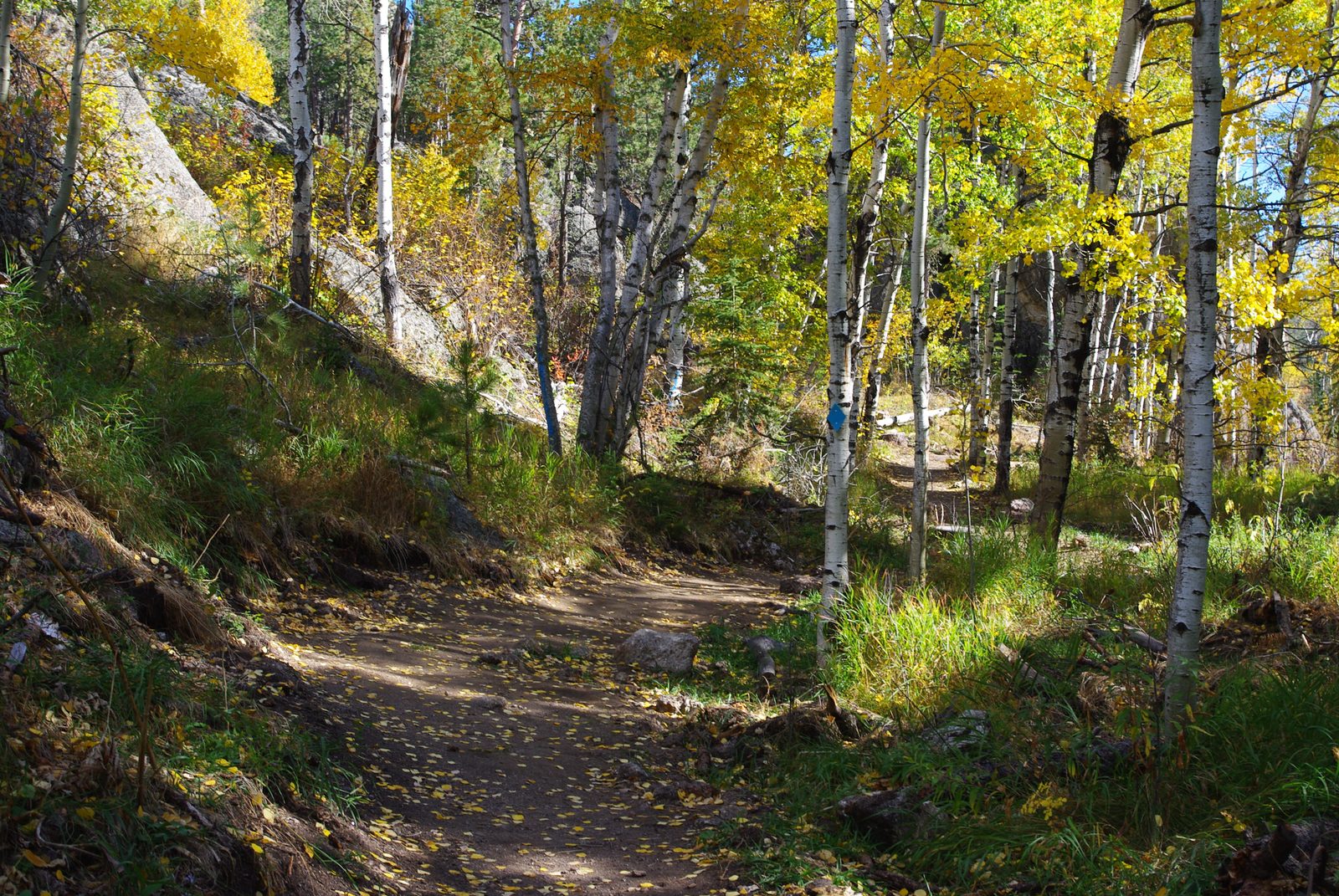
South Dakota Game, Fish and Parks calls Trail 9 the shortest and most traveled way to the top, and the Forest Service ranks it the most heavily used trail in the forest, with about 500 visitors a day at times of peak use. It starts in Custer State Park, just over the footbridge to the swimming beach at Sylvan Lake, and crosses the park boundary into the wilderness.
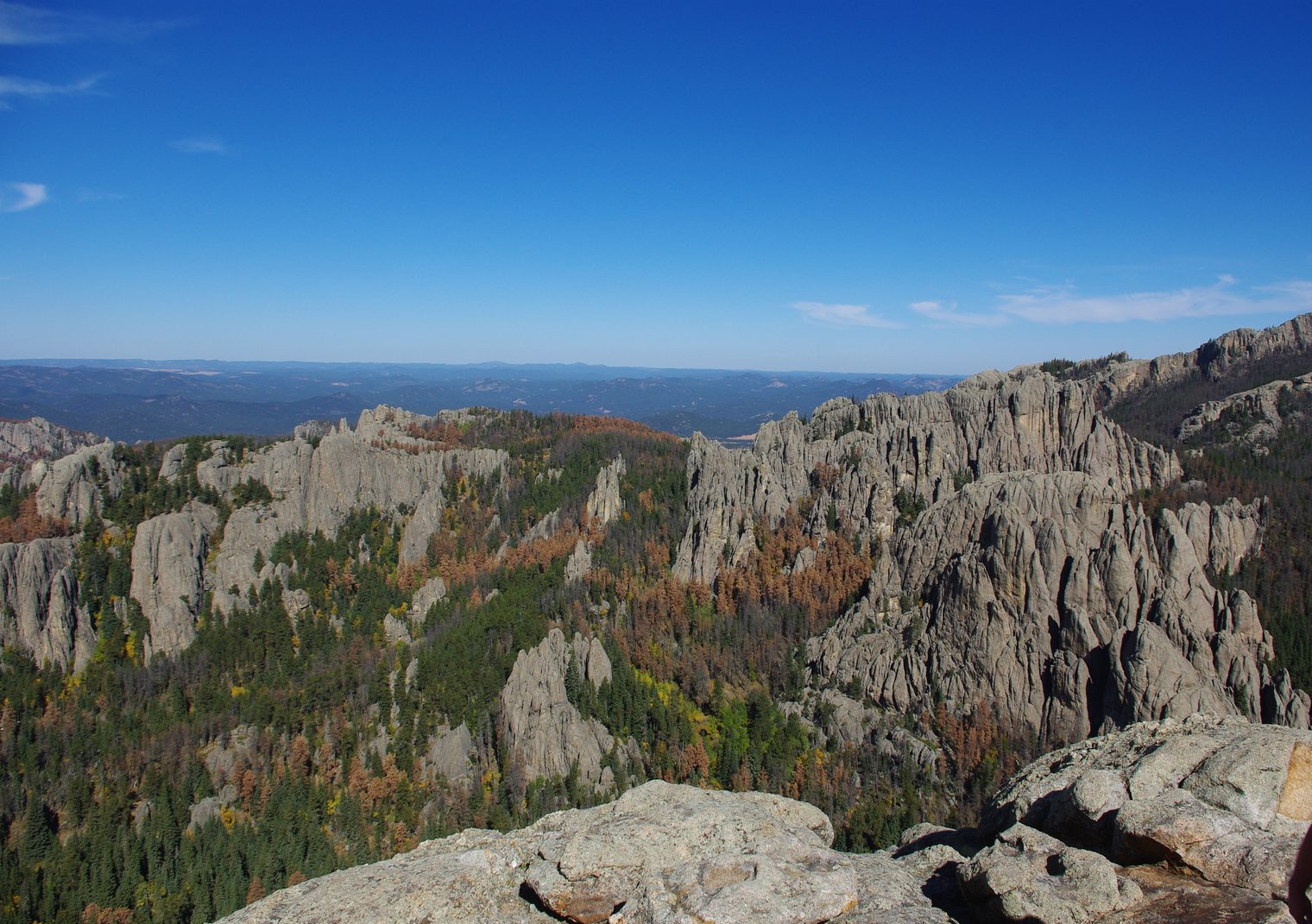
Agency figures for its length differ: 3.5 miles one way in the Forest Service’s trail table, 3.3 in the state park’s 2026 guide and 3.8 in an older Forest Service brochure. The state guide gives it two to four hours, without saying whether that is one way or round trip. The trail is steep, the brochure says, and the Forest Service says the summit looks out over four states: Montana, Nebraska, South Dakota and Wyoming.
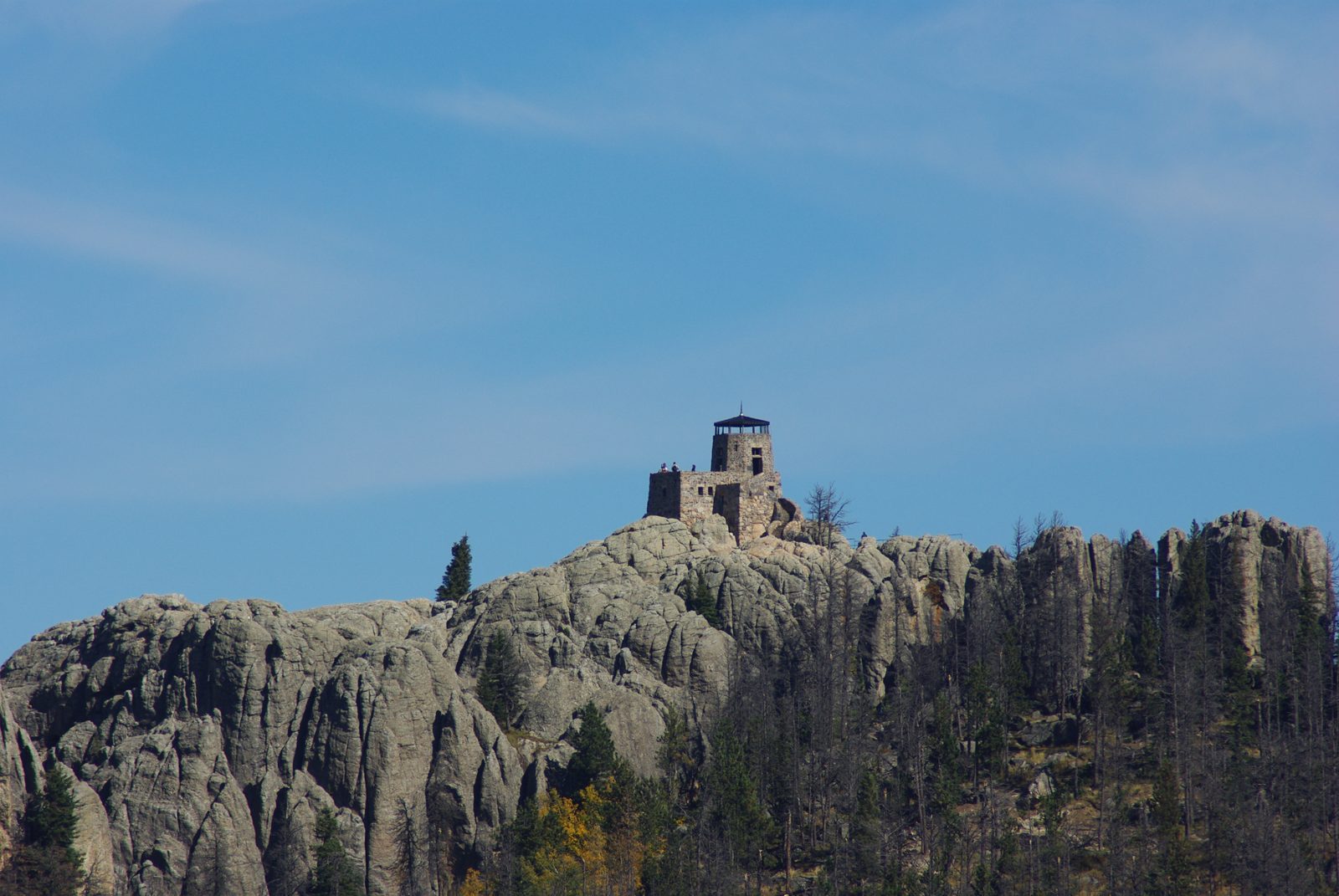
Expect summer thunderstorms with hail, rain and high wind, the state’s guide cautions, and pack extra layers for a summit that is likely to be cool and windy. Nothing along the trail supplies drinking water or a restroom; the guide’s minimum is one quart of water for each hiker.
- Distance
- About 7 miles round trip on Trail 9; 3.3 to 3.8 miles one way, depending on the agency
- Elevation gain
- About 1,100 feet net; the Forest Service’s trail table gives 6,100 to 7,200 feet
- Difficulty
- Moderate (Forest Service); moderate to strenuous (Custer State Park guide)
- Trailhead
- Sylvan Lake day-use area in Custer State Park, north of the Needles Highway (SD 87)
- Season
- Heaviest use May 1 to September 30; summer thunderstorms are common
Other Routes to the Summit
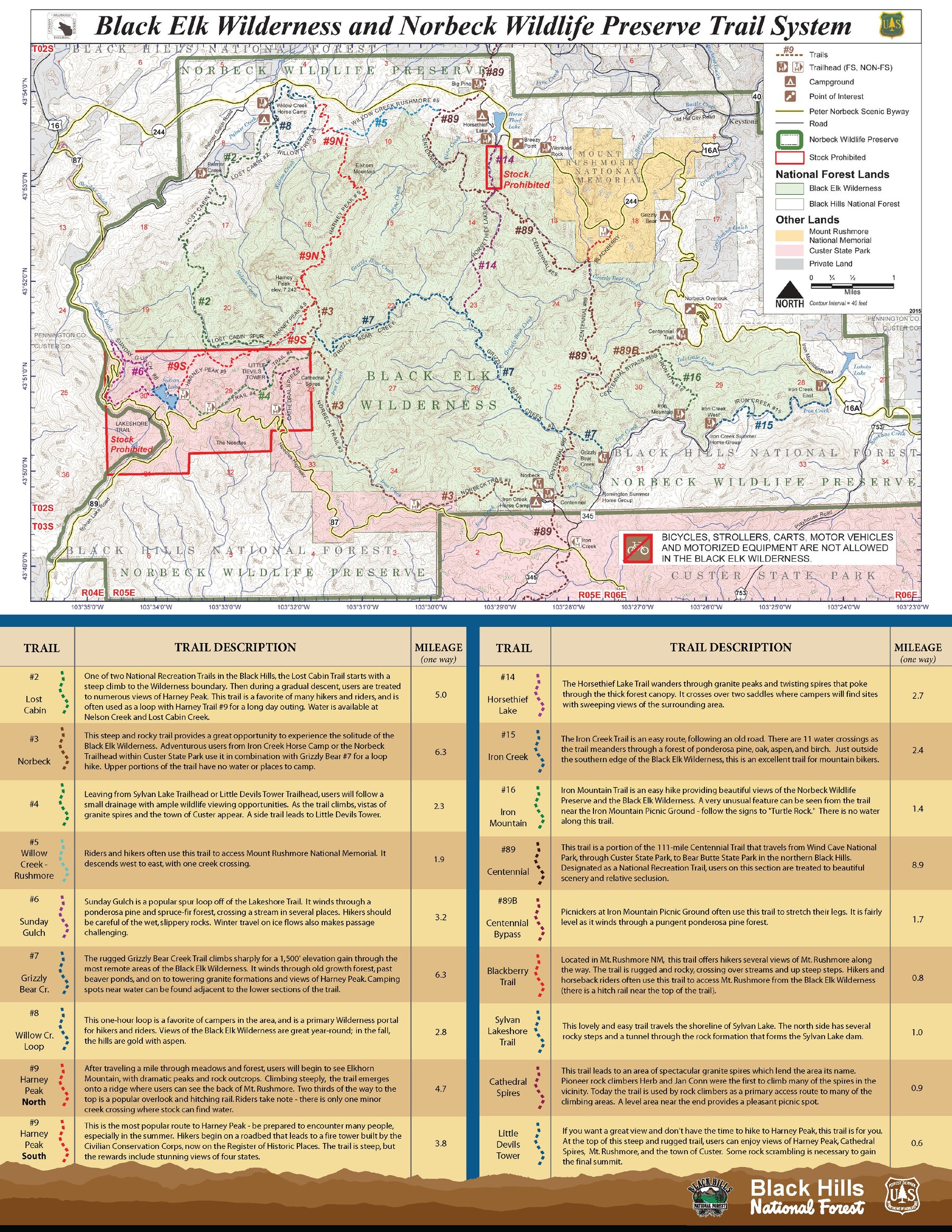
From the same parking area, the state points hikers to a second popular route, which it puts at 3.5 miles one way to the summit and rates moderate to strenuous. It sets out on Trail 4 from the lot’s southeast end and goes by the side trail to Little Devils Tower. Trail 4 then gives way to Norbeck Trail 3, and Trail 3 to Trail 9 for the last climb. The guide warns that the turns at Trails 3, 7 and 9 are hard to spot, above all on the descent.
Trail 9 also has a northern leg, which the Forest Service map shows climbing from the Willow Creek trails near Highway 244, at about 5,100 feet. The agency lists it at 4.4 miles, rates it difficult and opens it to riders. Stock may not use the southern leg’s first stretch, inside Custer State Park. On the way up, the brochure notes, the northern route gives a look at the back of Mount Rushmore.
The Centennial Trail, built for the 1989 centennial, crosses the wilderness east of the peak as Trail 89 on its run of about 111 miles between Wind Cave National Park and Bear Butte. The wilderness holds 38 miles of trail in all, and more than 30,000 people a year hike or ride some part of it, the Forest Service says.
Rules in the Black Elk Wilderness
Congress set the Black Elk Wilderness aside in 1980 and enlarged it in 2002. The only wilderness in the Black Hills National Forest, it sits at the center of the Norbeck Wildlife Preserve and now covers more than 13,534 acres, the Forest Service says. Inside it, the Forest Service prohibits, among other things:
- groups of more than 25 people and livestock combined;
- camping within a quarter mile of the summit or inside the lookout, or within 100 feet of water;
- bicycles, strollers, wagons and carts, game carts included, and any other motorized or mechanized vehicle;
- dogs off leash and out of strict voice control;
- cutting across switchbacks;
- open fires anywhere but designated sites.
Rescue there can be hard and at times impossible, the Forest Service warns, and searches fall to the local sheriff, not the agency.
Mountain goats (Oreamnos americanus), brought to South Dakota rather than native to it, live in the granite around the peak. The state’s goat plan traces them to six from Alberta, penned in Custer State Park in 1924. Two broke out on their first night, the others by 1929, and the goats drifted about 10 miles northwest into this high country. More on them is on Elk, Bighorn Sheep and Mountain Goats.
A Granite Summit and a Stone Tower
The mountain is granite, part of the crystalline core of the Black Hills. The oldest rocks of the core go back about 2.5 billion years, by the U.S. Geological Survey’s count, and the granite of the peak, at about 1.7 billion, is among the youngest. How it formed is told on The Granite Core.
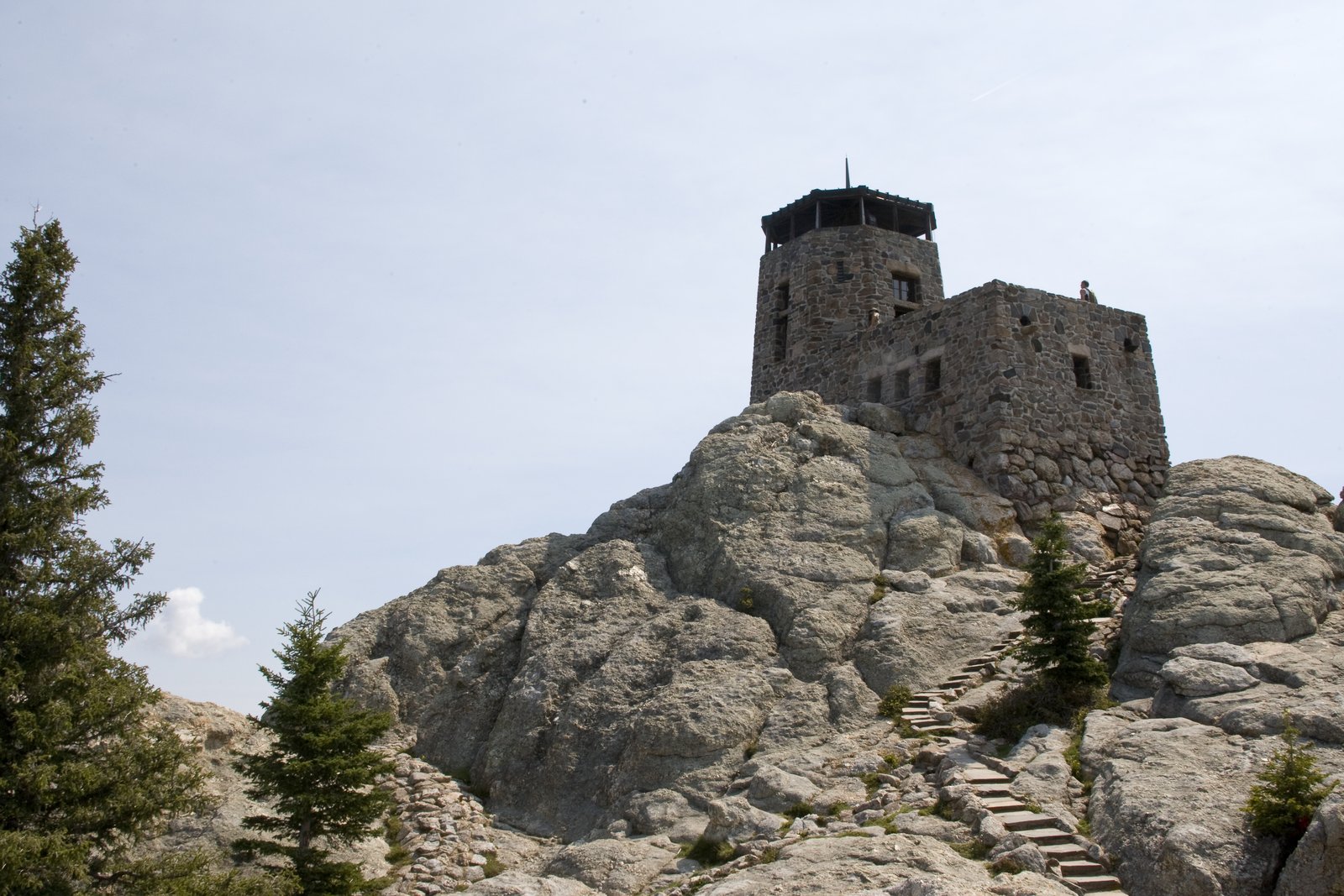
The crate of 1911 gave way in 1920 to a wooden room 12 feet square, enlarged to 16 feet a year later. Civilian Conservation Corps (CCC) men from Camp Doran then built the present stone tower from 1938 to 1940, the Forest Service says. No one has staffed it since 1967, and since 1983 it has been on the National Register of Historic Places; the CCC’s part is told on The National Forest and the CCC.
The Forest Service calls Black Elk Peak “the highest point in the United States east of the Rockies,” and its lookout page stretches that to the Pyrenees in France. A 2026 South Dakota News Watch fact check, noting the Pyrenees wording, rejected a similar claim that the peak tops everything between the Rockies and the Alps. It pointed to Greenland’s Gunnbjørn Fjeld, 12,119 feet, and to Spain’s Mount Teide, in the Canary Islands.
Why Is It Called Black Elk Peak?
The peak was renamed for Black Elk (1863 to 1950), the Oglala Lakota holy man, at the request of Basil Brave Heart, a Lakota elder, who began asking for the change in 2014. Brave Heart objected to the old honoree, Gen. William S. Harney, whose troops killed at least 86 Lakota people, women and children among them, at Blue Water Creek, Nebraska, in 1855. On August 11, 2016, the U.S. Board on Geographic Names voted 12 to 0, with one abstention, for the new name, over objections from South Dakota’s own names board and Gov. Dennis Daugaard. Alex White Plume, an Oglala, told ICT that week that the peak’s true name comes from Oglala origin stories, though Black Elk was “way better than Harney.” At a ceremony at the foot of the mountain that September, Brave Heart spoke of “the presence of a sacred vibration,” and a seventh-generation descendant of Harney joined the circle to say a prayer of thanks.
Lakota accounts tie the mountain to spring ceremonies. Charlotte Black Elk, a Lakota scholar and Black Elk’s great-granddaughter, wrote in 1992 of a yearly round of them across the Hills (see Hé Sápa: Why the Hills Matter); at a mountain that a 2003 study for the National Park Service identifies as this one, people went to “welcome the thunders back for another season of renewal.” In March 2017, at the first spring thunders ceremony there since the renaming, Russell Eagle Bear, historic preservation officer of the Rosebud Sioux Tribe, said the thunders are welcomed back to “fill up the lakes and rivers and creeks in a good way.” The peak, he told SDPB, was the highest point in the Black Hills and the best place to pray to the Great Spirit. A 2026 Forest Service feature shows the tradition continuing: at the spring equinox, tribal members meet at Sylvan Lake for the Welcome Back the Thunders ceremony, and hundreds hike to the summit with prayer offerings.
The Park Service says the name honors the mountain’s part in Black Elk’s vision. The poet John G. Neihardt, who interviewed Black Elk, wrote in June 1931 that in the vision the boy was carried to “the center of the world,” which Neihardt identified as Harney Peak, and that after their interviews Black Elk went up the peak and prayed there. Neihardt’s Black Elk Speaks (1932) is his own telling of Black Elk’s words, and critics have argued that in places his outlook stands in for Black Elk’s, a charge his defenders reject.
The new name stops at the surface. Geologists still call the rock under the lookout the Harney Peak Granite.
Connected
- The Granite Core: Black Elk Peak and the NeedlesThe 1.7-billion-year-old granite of the summit and the spires around it.
- Hé Sápa: Why the Hills MatterThe spring round of ceremonies that brought Lakota people to the peak.
- Custer State ParkHome of Sylvan Lake and the trailheads for Trails 9 and 4.
- The Centennial TrailThe trail, about 111 miles long, that crosses the Black Elk Wilderness east of the peak.
- Elk, Bighorn Sheep and Mountain GoatsThe goats that escaped from the park and settled around the peak.
- The National Forest and the CCCThe crews from Camp Doran who built the stone lookout.
- The Central HillsThe granite country and mining towns around the state’s highest point.
Sources
- Wilderness (Black Elk Wilderness). USDA Forest Service, Black Hills National Forest, 2026.
- Black Elk Wilderness (designating laws, 1980 and 2002). Wilderness Connect, University of Montana, viewed 2026.
- BEW History. USDA Forest Service, Black Hills National Forest, 2026.
- Wilderness Rules and Regulations. USDA Forest Service, Black Hills National Forest, 2025.
- Wilderness Safety. USDA Forest Service, Black Hills National Forest, 2025.
- Non-motorized Trail Brochures (trail table). USDA Forest Service, Black Hills National Forest, 2026.
- Black Elk Wilderness and Norbeck Wildlife Preserve Trail System (map and brochure). USDA Forest Service, Black Hills National Forest, 2023 (map dated 2015).
- Harney Fire Lookout. USDA Forest Service, Black Hills National Forest, 2025.
- Caring for the heart of everything that is (Preston Keres). USDA Forest Service, 2026.
- Trail Mix: A Hiker’s Guide to Custer State Park’s Trails. South Dakota Game, Fish and Parks, 2026.
- Custer State Park Trails: Sylvan Lake, Needles, and Black Elk Wilderness Areas (map). South Dakota Game, Fish and Parks, 2018.
- South Dakota Mountain Goat Action Plan 2024–2028. South Dakota Game, Fish and Parks, 2024.
- Hydrology of the Black Hills Area, South Dakota (Water-Resources Investigations Report 02-4094). U.S. Geological Survey, 2002.
- The Home of the Bison: An Ethnographic and Ethnohistorical Study of Traditional Cultural Affiliations to Wind Cave National Park, Volume 1 (Patricia C. Albers and others). University of Minnesota for the National Park Service, 2003; quoting Charlotte Black Elk (1992) on p. 507.
- Breaking: Black Elk Peak Soars Above The He Sapa, No Longer Harney Peak (David Rooks). ICT, 2016.
- Ceremony Marks Black Elk Peak Renaming (Jim Kent). SDPB, 2016.
- “Welcome Thunders” Ceremony At Black Elk Peak (Jim Kent). SDPB, 2017.
- “In Sacred Motion”: Five Years Ago, a Lakota Elder Beat the Establishment and Renamed Harney Peak (Seth Tupper). SDPB, 2021.
- Highest Peak in South Dakota Renamed for Oglala Lakota Medicine Man. Smithsonian Magazine, 2016.
- Review of The First Sioux War: The Grattan Fight and Blue Water Creek, 1854–1856 (Mark R. Ellis). Great Plains Quarterly 26, no. 3, University of Nebraska–Lincoln, 2006.
- Black Elk. National Park Service, 2025.
- Letter from John G. Neihardt to Julius T. House, June 3, 1931. University of Nebraska–Lincoln (digital edition).
- Review of Interpreting the Legacy: John Neihardt and “Black Elk Speaks” (Dale Stover). Great Plains Quarterly 24, no. 1, University of Nebraska–Lincoln, 2004.
- Fact brief: Is Black Elk Peak the highest point between the Rocky Mountains and the Alps? (Michael Klinski). South Dakota News Watch, 2026.
Last reviewed: