Towns
Keystone, South Dakota
Donald "Nick" Clifford was 15 when he took a job at the Etta Mine, a lithium mine about a mile south of Keystone, and 17 when he started running a jackhammer on Mount Rushmore. The two jobs tell most of his hometown's story. Keystone, home to 240 people in the 2020 census, sits in the granite country of the Central Hills. It grew up on gold and on pegmatite, a granite with giant crystals, and it stood 2 miles from the work while Mount Rushmore was carved, from 1927 to 1941.
Granite, Schist and the Etta Knob
Keystone lies in the crystalline core, the innermost ring of rock on How the Black Hills Formed, where two rocks meet: the Harney Peak Granite, about 1.7 billion years old, whose main body covers some 40 square miles between Custer and Keystone, and the older schist it forced its way into. Much of the granite is pegmatite, rock whose crystals grew far larger than usual, and thousands of smaller pegmatite bodies dot the schist around it (see The Granite Core).
Around Keystone, the larger granite dikes, sheets of granite squeezed into the schist, weather out into walls and pinnacles, a 1925 U.S. Geological Survey report observed. Pegmatite is easy to spot, because its crystals are big enough to pick out one by one; its mica peels apart into thin, shiny leaves.
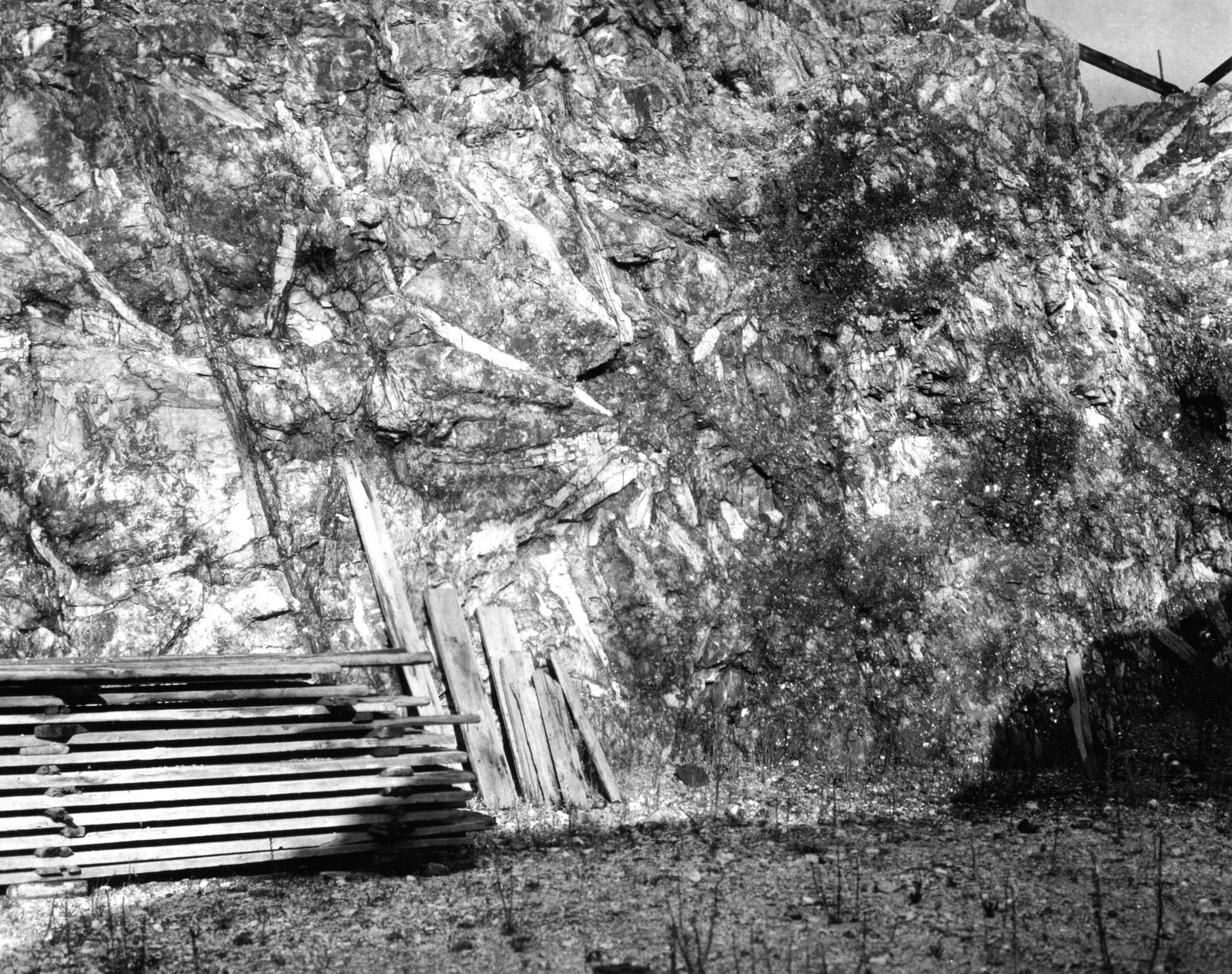
The Etta Mine, about 1 mile south of town, worked one of those pegmatites. Before mining it stood up as a hill, the Etta Knob; underground, the USGS reported in 1964, it is shaped roughly like a teardrop balanced on its point, its long axis diving steeply north. Its first miners seem to have been after sheet mica, soon after 1880. In 1883 the rock proved to hold tin, and the Etta became a mainstay of the Hills' tin venture, a failed enterprise with its headquarters at Hill City. Spodumene, a lithium mineral, followed in 1898, and the 1964 report says the start of that mining is "regarded as the beginning of lithium mining in the United States." The crystals were unusually large; the USGS records one with an exposed length of 47 feet.
Where Did Keystone Get Its Name?
Keystone took its name from the Keystone Mine, located in 1891 by William Franklin, known as Rocky Mountain Frank, and his partners Jacob Reed and Tom Blair, according to a marker the Keystone Area Historical Society put up on First Street in 2005; a 1974 USGS review of Black Hills gold lists the Keystone among the gold mines. The settlement organized the same year, a 1982 National Register nomination notes, but the place was older than its name. It began in 1876, as a placer camp of the Black Hills gold rush, and its first stamp mill opened in 1880, the 1981 National Register nomination for its old company store records.
The Holy Terror followed in 1894. On June 28 that year, Franklin and his adopted daughter, Cora Stone, turned up gold-bearing quartz at the foot of Mount Aetna, the society's markers say. Its ore was "an exceptionally fine grade of gold quartz," in the store nomination's words, and it became Keystone's major mine. The name comes with a story, told on one of the markers: Franklin had let his wife, Jennie, think the mine would carry her name, then filed the claim as the Holy Terror. The marker cites no record for it, and the tale is best taken as town lore.
Sources differ on how big the boom town grew. One society marker says Keystone passed 2,000 people after the gold strike; the Keystone School's National Register nomination counts 1,500 in 1900, with two churches, three hotels and a good many saloons. The two-story frame schoolhouse, which cost $10,000, is on the National Register.
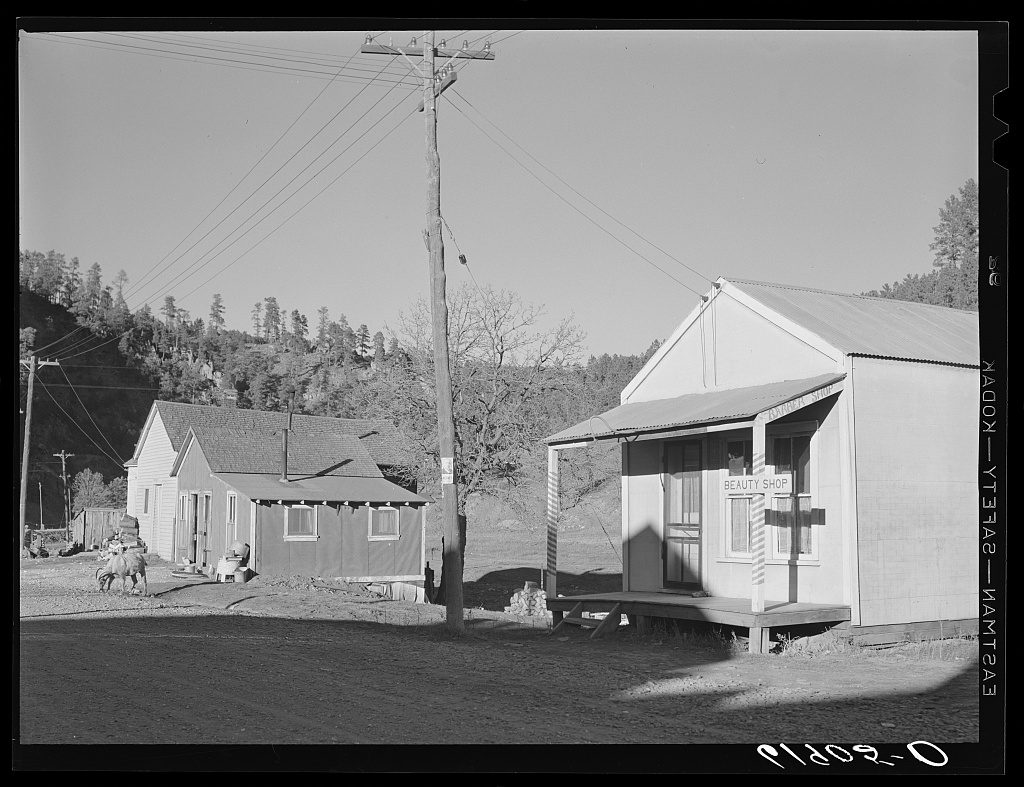
Keystone also became home to Carrie Ingalls, a daughter of Charles Ingalls. She married David N. Swanzey, a widower, on August 1, 1912, and SDPB's 2022 account of her life calls Keystone her adopted home town. She died in 1946 and was buried in the family plot at De Smet.
The Holy Terror did not last as long as the Etta. It shut after a bad fire around 1900, says the 1982 nomination for the log house built for Lewis Byron in Keystone in 1927, while a society marker at the old school dates the closing to 1903. Byron reopened the mine but died in 1940 before it made money, and it closed again. A flood in the early 1970s left few of the town's early houses standing, the same nomination adds.
Mount Rushmore, 2 Miles Away
Mount Rushmore is carved into a granite peak about 2 miles southwest of Keystone, a mountain Lakota people called the Six Grandfathers before the carving, according to the news organization ICT. Christina Rose wrote for ICT in 2013 that the Lakota saw any cutting of the mountain as disrespect. The mountain stands in Hé Sápa, on land the 1868 treaty set apart for the tribes, and the 1877 Act took the Hills without the consent that treaty required (see The 1876 War and the Taking of the Hills). Carving ran from October 4, 1927, to the last drilling on October 31, 1941. Why the presidents were carved, and how tribes and tribal members view them, are told on Mount Rushmore and Crazy Horse Memorial.
When the sculptor Gutzon Borglum arrived, Keystone was a mining and lumber town of roughly 700 to 800, Smithsonian Magazine wrote in 2016. The National Park Service counts almost 400 workers, women as well as men, over the 14 years of carving, and not one was killed. Work stopped in winter, the magazine adds, and the crews looked for other jobs in and around Keystone until it resumed.
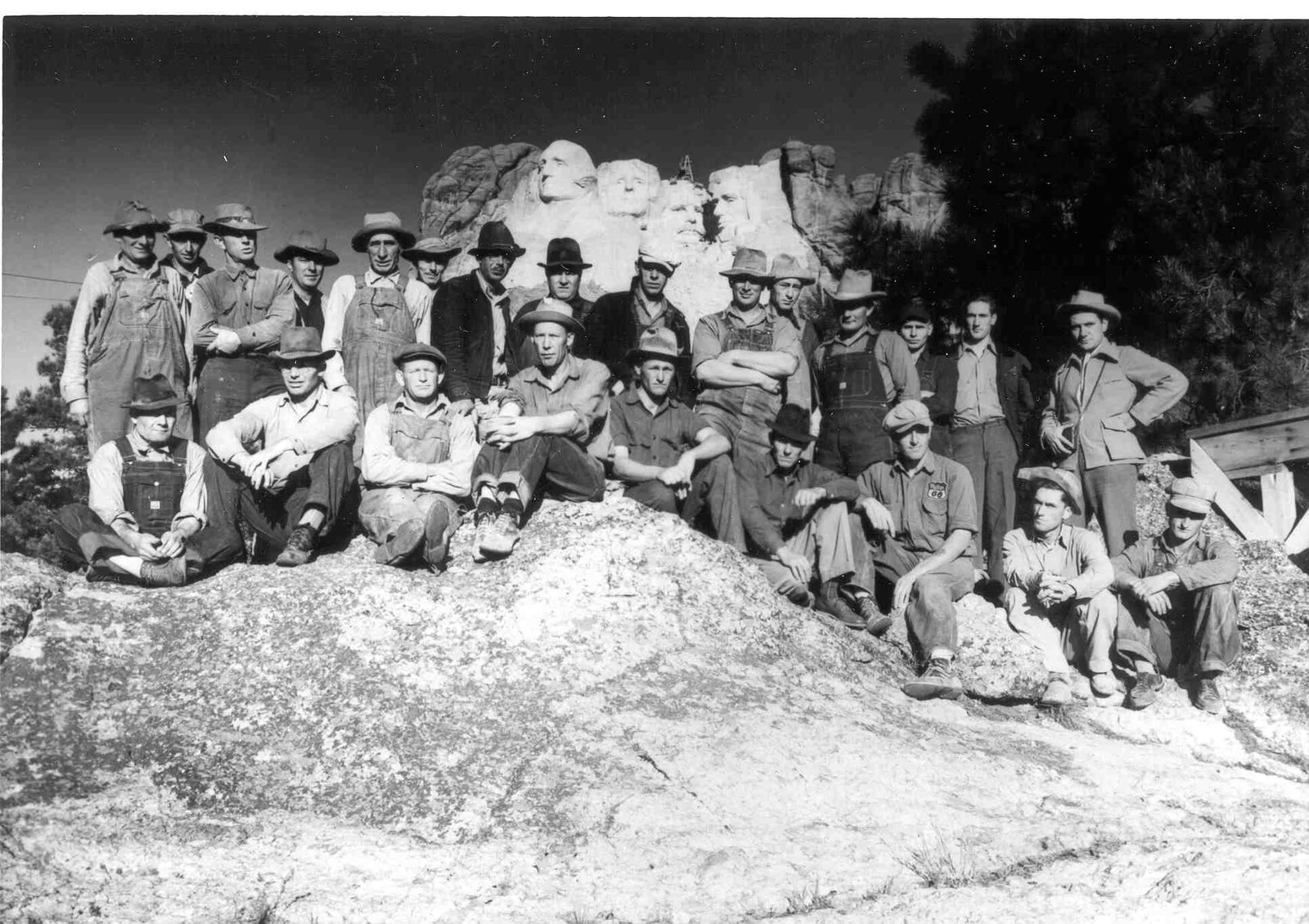
Smithsonian Magazine gives Clifford's birth date as July 5, 1921. He joined the crew in 1938, when only the Lincoln and Roosevelt figures were left to carve, NPR reported, and drilled the Lincoln figure as Lincoln Borglum, the sculptor's son, directed, for 55 cents an hour until 1940. The magazine credits baseball too: Lincoln Borglum, a keen fan, hired ballplayers and fielded an amateur team, the Rushmore Memorial Drillers, on which Clifford pitched and played right field. He moved back to Keystone in the 1970s and died in 2019 at 98, thought to be the last of the carvers still alive.
Flume, Tunnels and Wilderness Nearby
Rockerville, about 6 miles northeast, was a placer camp from December 1876, though its gulch had hardly any water for washing gold. Water came in 1880 by a ditch and wooden flume 17 miles long by most older counts, or 20 by the Forest Service's, and the 1880 census found 321 people there, in the historian Watson Parker's tally.
Iron Mountain Road, part of U.S. Highway 16A, runs 17 miles between Mount Rushmore National Memorial and Custer State Park. Built in the 1930s, it gains and drops height on wooden pigtail bridges, and its three tunnels frame the carving for drivers headed north (see Scenic Drives).
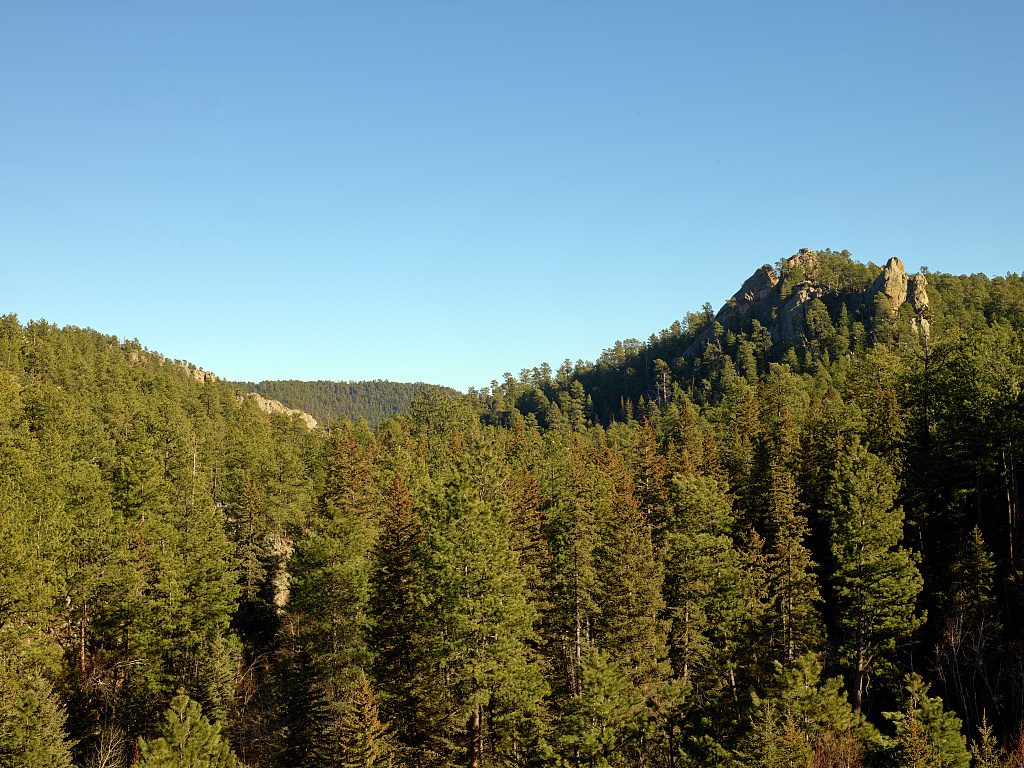
The granite between Keystone and Custer climbs to Black Elk Peak (called Harney Peak until 2016), 7,242 feet, inside the Black Elk Wilderness. Congress designated the wilderness in 1980 and added to it in 2002. It takes in the granite spires of the Harney Range, and the Forest Service puts it at more than 13,534 acres.
Back at the Etta, work ended on April 29, 1960. Its spodumene had been mined since 1898, pausing only when demand fell, and the 1964 report notes that some was still left deeper than the main tunnel. What its giant crystals and the other pegmatite minerals meant, in peacetime and in war, is the thread of Giant Crystals, Wartime Minerals and Keystone.
Connected
- The Central HillsThe region of granite peaks and mining camps that Keystone belongs to.
- The Granite Core: Black Elk Peak and the NeedlesThe 1.7-billion-year-old granite and pegmatites around the town.
- Gold and the Other MineralsThe mica, feldspar, tin and lithium of the pegmatites, and the Hills' gold.
- Giant Crystals, Wartime Minerals and KeystoneThe Etta's spodumene and the minerals wanted in wartime.
- Mount Rushmore and Crazy Horse MemorialThe carving 2 miles from town, and how the tribes view it.
- Rockerville, South DakotaThe dry placer camp and its flume, 6 miles northeast.
- Scenic Drives: Needles Highway, Iron Mountain Road and MoreIron Mountain Road, its pigtail bridges and its tunnels framing the carving.
- Hill City, South DakotaThe 1876 gold camp where the Hills' tin venture kept its headquarters.
Sources
- Geology and Mineral Deposits of Some Pegmatites in the Southern Black Hills, South Dakota (Professional Paper 297-E) (James J. Norton and others). U.S. Geological Survey, 1964.
- Gold in the Black Hills, South Dakota, and How New Deposits Might Be Found (Circular 699) (James J. Norton). U.S. Geological Survey, 1974.
- Central Black Hills Folio, South Dakota (Folio 219) (N. H. Darton and Sidney Paige). U.S. Geological Survey, 1925.
- Geolex: Harney Peak Granite, significant publications (summary of DeWitt and others, Bulletin 1580, 1986). U.S. Geological Survey, National Geologic Map Database.
- NPS Geodiversity Atlas: Mount Rushmore National Memorial, South Dakota. National Park Service.
- Keystone Trading Company Store, National Register of Historic Places nomination (Carolyn Torma, Historical Preservation Center). National Park Service, 1981.
- Keystone School, National Register of Historic Places nomination (Hill City School District, with Carolyn Torma and John Burrows, Historical Preservation Center). National Park Service, undated.
- Byron House ("Serolod"), National Register of Historic Places nomination. National Park Service, 1982.
- William and Jennie Franklin (Keystone Area Historical Society marker 6, 2005). Transcription and photographs on the Historical Marker Database.
- Holy Terror Mine (Keystone Area Historical Society marker 12, 2005). Transcription and photographs on the Historical Marker Database.
- Keystone School (Keystone Area Historical Society marker 18, 2005). Transcription and photographs on the Historical Marker Database.
- Native History: Construction of Mount Rushmore Begins (Christina Rose). ICT, 2013.
- The Workers. National Park Service, Mount Rushmore National Memorial.
- Carving History. National Park Service, Mount Rushmore National Memorial.
- The Last Living Carver of Mount Rushmore Reflects on the Monument at 75. Smithsonian Magazine, 2016.
- Last Living Mount Rushmore Carver Dies at 98 (Vanessa Romo). NPR, 2019.
- Carrie Ingalls' South Dakota Life (Jeanie Kirkpatrick, 1881 Courthouse Museum). SDPB, 2022.
- Scenic Drives (Custer State Park). South Dakota Game, Fish and Parks.
- Wilderness. USDA Forest Service, Black Hills National Forest.
- Black Elk Wilderness (designating laws of 1980 and 2002). Wilderness Connect.
Last reviewed: