Towns
Newcastle, Wyoming
Geologists have a rock named for Newcastle. The Newcastle Sandstone, a layer of light gray sandstone and shale 10 to 100 feet thick around the town, took the town's name in 1920, and since 1962 its type section, the exposure geologists treat as the standard, has lain along U.S. Highway 85 on the town's northern edge. About 15 miles northwest, the same sandstone was the main oil sand at Osage, where a 1920 gusher set off Weston County's oil boom. Newcastle, the county seat, had 3,374 people in the 2020 census. It lies on the southwest edge of the Black Hills, began in 1889 as a railroad town serving the Cambria coal mines, and has lived since on oil, cattle and the railroad.
Where the Sandstone Rim Meets the Prairie
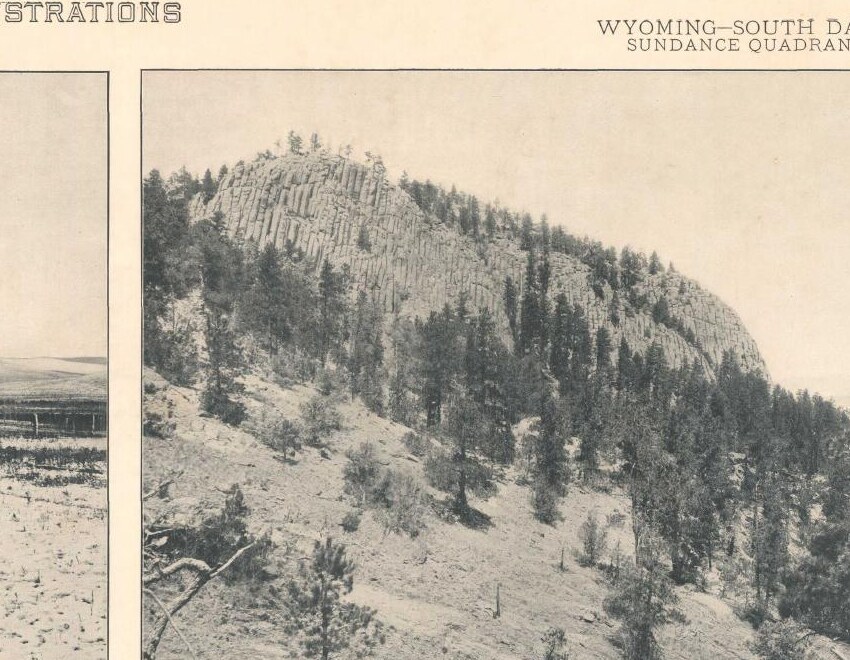
Newcastle sits on the fringe of the Hills, near where the Hogback, the last ring of rock, gives way to the plains (see How the Black Hills Formed). On the Wyoming side that ring widens into a sandstone tableland tilted gently west, and near Newcastle it drops away along a sharp fold called the Black Hills monocline. Mapping the area for a 1963 U.S. Geological Survey report, W.J. Mapel and C.L. Pillmore found the same layers about 3,500 feet higher on the fold's northeast side than on its southwest side. Northeast of town they mapped a plateau cut up by steep-walled canyons, its high ridges capped by the Lakota Formation, the sandstone that held Cambria's coal. To the southwest the land opens into rolling prairie, carved here and there into small badlands.
Away from the fold the layers generally tilt southwest at only 1 to 3 degrees, carrying younger rock, the Newcastle Sandstone among it, under the prairie. That tilt helps explain the oil. In 1922 the Survey geologist A.J. Collier placed the Osage field on the Hills' southwestern flank, where the beds dip away from the range, and found the oil gathered where the dip eases.
Inyan Kara Mountain, between Newcastle and Sundance, reaches 6,368 feet off the main body of the Hills, within the Black Hills National Forest. It is one of the igneous intrusions of the Wyoming side of the Hills, magma that cooled underground and was later uncovered by erosion (see Devils Tower, Bear Butte and the Igneous Rocks of the Hills). A mostly pine-covered ridge wraps around its nearly bare inner peak, a 1971 National Register nomination records. The Lakota writer Delphine Red Shirt wrote in 2015 that the English name is a mistaken spelling of a Lakota one, its "r" an old way of writing a throaty Lakota g.
How Did Newcastle Begin?
Newcastle began in 1889 because of coal. Long before it, the Black Hills figured in Kiowa, Crow, Cheyenne and Lakota stories, WyoHistory, the Wyoming State Historical Society's online encyclopedia, notes. In the 1860s the Cheyenne and Lakota fought to hold northeastern Wyoming, and after the 1876 war the tribes were driven from it onto reservations. Like the rest of the Wyoming side, the town site lay west of the 1868 reservation, in what the treaty called "unceded Indian Territory," and the 1876 agreement, made law by the 1877 Act, took that territory and the tribes' hunting rights (see The 1876 War and the Taking of the Hills).
Coal brought the railroad. In 1887 the Beatrice, Nebraska, contracting firm of Kilpatrick Brothers and Collins sent men to look for coal the Chicago, Burlington and Quincy Railroad's engines could burn, and they found it in a canyon to the north. WyoHistory names the man who found it John Weston; the 1980 National Register nomination for the Cambria Casino calls him Jefferson B. Weston. Weston County, created on March 12, 1890, carries his name, and Newcastle became its seat that April.
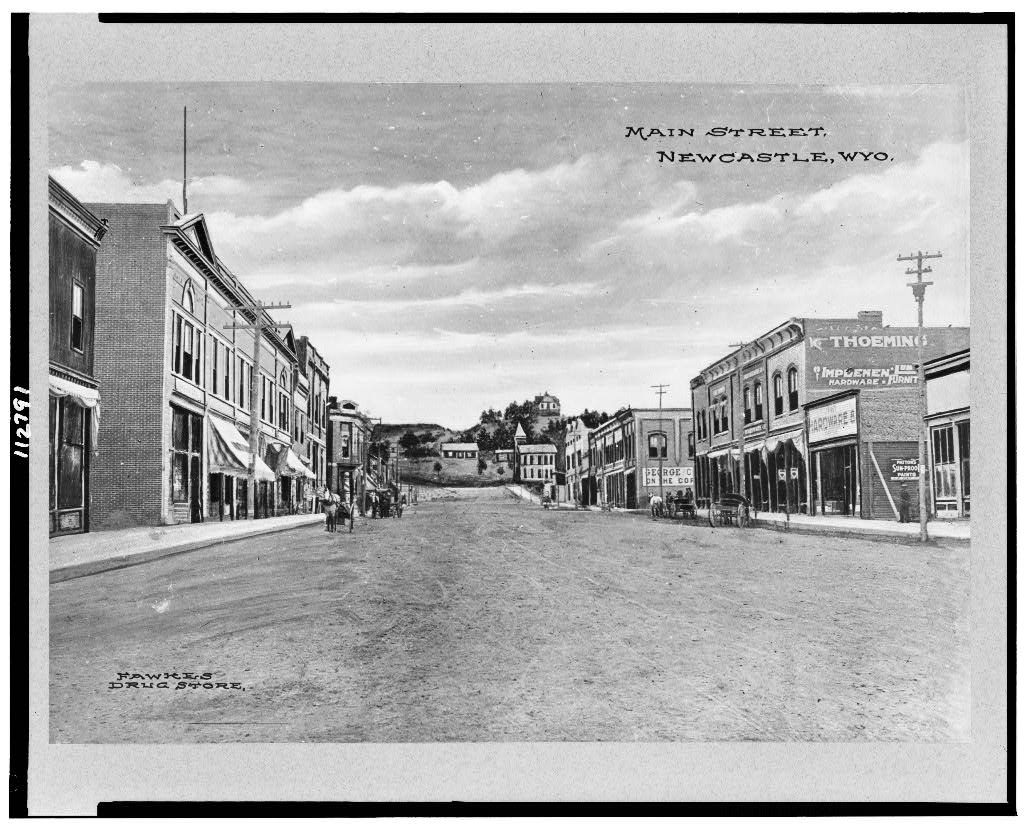
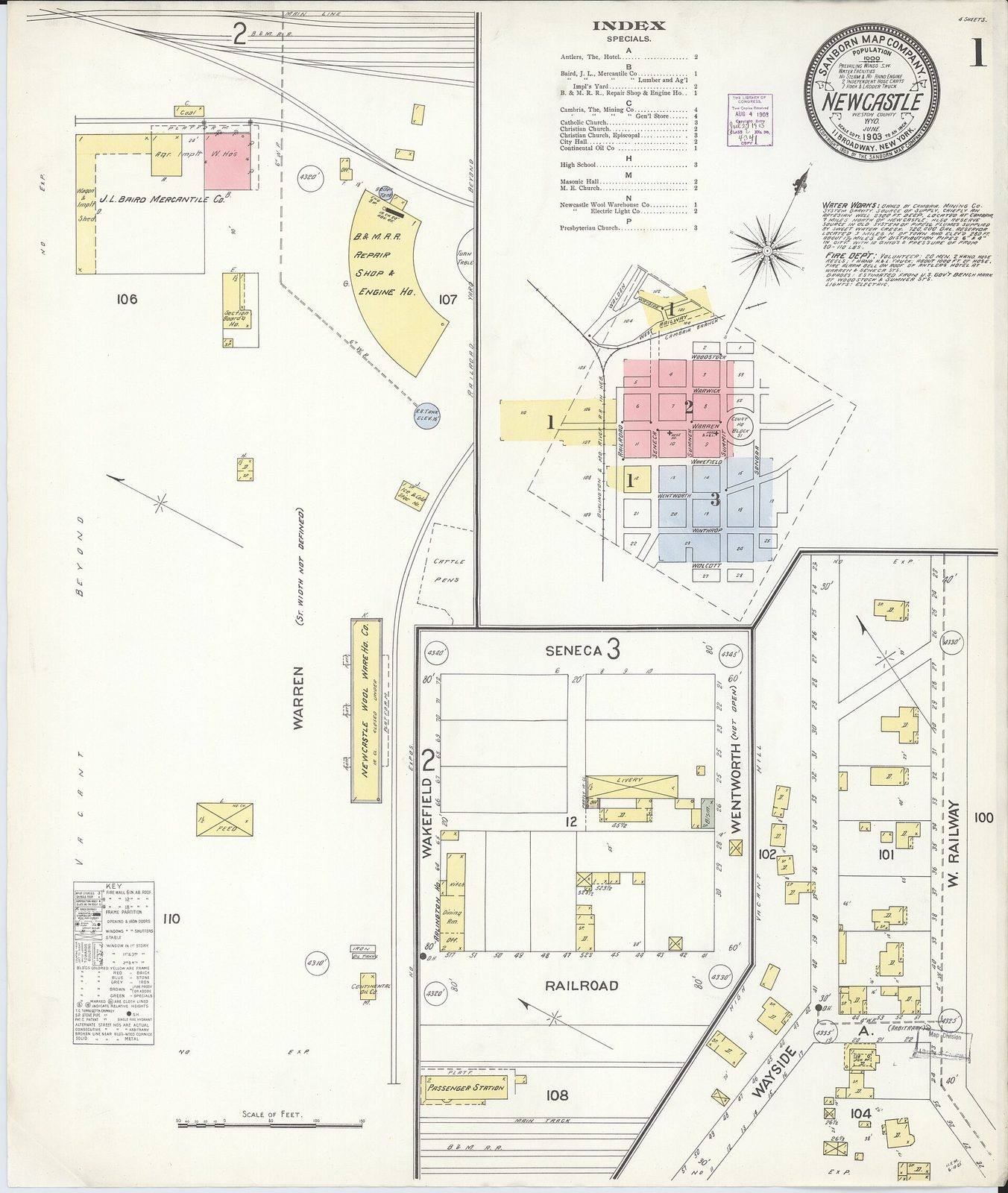
Burlington crews reached Newcastle within about a week of the town's first election, on November 12, 1889, and by December 1 they had finished the 7.8-mile spur north to the mines at Cambria. Cambria's first coal was ready to ship in December 1889, and about 85 percent of its output fed the Burlington's own engines until the mines closed in the late 1920s.
The name came from England. The coal company's superintendent named the town for his hometown, the English coal port of Newcastle upon Tyne, WyoHistory says, and the county's museum district tells the same story. WyoHistory calls him J.H. Hemingway; the Cambria Casino nomination names the mining engineer brought in to install the mines' machinery as Joseph L. Hemingway.
A Mayor in Congress, a Sheriff on Lightning Creek
Frank Mondell, the town's first mayor, came from Iowa in the hard times of the 1880s and went looking for coal where the Burlington meant to build, and WyoHistory credits him and Weston with the find; the Cambria nomination has him helping Hemingway lay out the mine entries and trestles. Elected mayor at 29, Mondell won a seat in Congress in 1894, lost in 1896, won the seat back in 1898 and held it until 1923, his last two terms as House majority leader.
Ray H. Mattison, a National Park Service historian, wrote in the 1950s that Mondell's influence, more than anyone else's, apparently moved Theodore Roosevelt to proclaim Devils Tower the first national monument in 1906. Writing for WyoHistory in 2023, Lucas Fralick called that claim "dubious": Mondell's memoirs and the careful record he kept of his own votes say nothing about the Tower or the Antiquities Act. Roosevelt came through Newcastle in April 1903.
That October the Weston County sheriff, William Miller, rode out of Newcastle with a posse after reports of illegal hunting by Oglala Lakota from the Pine Ridge Reservation. The Oglala held passes from their agent to gather herbs, roots and berries, and they were heading home. On October 31, outside its own county, the posse overtook them on Lightning Creek in Converse County. In Lori Van Pelt's 2018 account for WyoHistory, Hope Clear, an 18-year-old Oglala in the party, heard no warning; the posse said it had shouted warnings and that the Oglala fired first. Five Oglala died, by her count and a 2024 Cowboy State Daily account drawn from the 1903 record, among them 11-year-old Peter White Elk, and so did Miller and his deputy, Louis Falkenberg. After a hearing the case against the Oglala was dropped, and none of the posse faced charges. Mondell, Senator Francis E. Warren and the acting governor took the posse's side.
Oil, Cattle and the Railroad
Collier's report looked back on short-lived oil rushes at Newcastle and at Moorcroft between 1885 and 1900, which turned up only a little heavy oil. The big strike came at Osage: a shallow well found good oil in September 1919, and in March 1920 the field's first deep well blew in as a gusher. WyoHistory puts its flow at 1,500 to 2,500 barrels a day; Collier, writing in 1922, estimated about 200, and the whole field's output early in 1921 at about 550.
A refinery opened on Main Street in 1927 and was still refining oil in 2025, WyoFile reported. In 2014 WyoHistory counted it among the town's main employers and noted its recent spills, leaks and polluted soil, a settled lawsuit, and penalties paid to state and federal regulators. Cattle came first: Texas herds reached the area from 1877 (see The Open Range and the Cattle Drives), and in 2014 most of the county's 1.5 million acres was range, with many Newcastle people working on cattle ranches or running them. Passenger trains quit on August 24, 1969, but the Burlington, now part of BNSF, still kept a headquarters on Main Street in 2014.
The Forest, the Museum and the Stage Road
The Black Hills National Forest's Hell Canyon Ranger District, which manages about 440,000 acres, has offices in Newcastle and in Custer, South Dakota. A marker on U.S. Highway 85 at Four Corners, in Weston County, recalls the 1878 robbery of the Deadwood treasure coach at the nearby Canyon Springs stage station (see Outlaws and the Sundance Kid).
The Anna Miller Museum is run by the Weston County Museum District. It fills a sandstone building put up between 1933 and 1936 to stable the horses of Newcastle's National Guard troop, a cavalry unit since 1914, and to house their keeper. The Guard gave the Weston County Historical Society the use of it for a museum in 1966, and it was listed on the National Register of Historic Places in 1994. In 2018 the museum's director told WyoHistory that its collections held hundreds of documents and photographs about Sheriff Miller and his family. Its exhibits, as WyoHistory lists them, include a one-room schoolhouse, fossils and artifacts from Cambria, the coal camp up the old spur where Newcastle got its start.
Connected
- The Wyoming Side of the HillsThe region around Newcastle, from Inyan Kara to Devils Tower.
- Devils Tower, Bear Butte and the Igneous Rocks of the HillsHow Inyan Kara Mountain, north of town, formed from magma underground.
- Cambria, WyomingThe coal town whose mines brought the railroad to Newcastle in 1889.
- How the Black Hills FormedThe rings of rock, including the sandstone rim Newcastle sits against.
- The 1876 War and the Taking of the HillsHow the unceded territory around Newcastle and its hunting rights were taken.
- Outlaws and the Sundance KidThe 1878 Canyon Springs robbery in Weston County.
- Moorcroft, WyomingThe Burlington town west of the Hills that had its own brief oil boom before 1900.
- Sundance, WyomingThe Crook County seat beyond Inyan Kara Mountain.
Sources
- Newcastle, Wyoming, by Nicole Lebsack. WyoHistory.org, Wyoming State Historical Society, 2014.
- Weston County, Wyoming, by Nicole Lebsack. WyoHistory.org, Wyoming State Historical Society, 2014.
- Frank Mondell: A Congressman for His Times, by Lucas Fralick. WyoHistory.org, Wyoming State Historical Society, 2023.
- Protecting Public Land: Frank Mondell, Theodore Roosevelt and Devils Tower National Monument, by Lucas Fralick. WyoHistory.org, Wyoming State Historical Society, 2023.
- Devils Tower National Monument: A History, by Ray H. Mattison, historian, National Park Service. Devils Tower Natural History Association, 1956, revised 1973 (Project Gutenberg edition).
- Trouble on Lightning Creek: A Stained Page in Wyoming's History, by Lori Van Pelt. WyoHistory.org, Wyoming State Historical Society, 2018.
- Anna Miller Museum. WyoHistory.org, Wyoming State Historical Society.
- Wyoming Army National Guard Cavalry Stable (Anna Miller Museum). Wyoming State Historic Preservation Office, National Register listings.
- Geologic Unit: Newcastle. National Geologic Map Database, Geolex, U.S. Geological Survey.
- Geology of the Newcastle Area, Weston County, Wyoming (Bulletin 1141-N), by W.J. Mapel and C.L. Pillmore. U.S. Geological Survey, 1963.
- The Osage Oil Field, Weston County, Wyoming (Bulletin 736-D), by A.J. Collier. U.S. Geological Survey, 1922.
- Newcastle oil refinery restarts operations after it ‘went boom’ in February, by Dustin Bleizeffer and Tennessee Watson. WyoFile, 2025.
- National Register of Historic Places Inventory-Nomination Form: Inyan Kara Mountain, by Mark Junge. Wyoming Recreation Commission for the National Park Service, 1971.
- National Register of Historic Places Inventory-Nomination Form: Cambria Casino (Flying V Guest Ranch), by Mark G. Junge and Gregory D. Kendrick. Wyoming State Historic Preservation Office for the National Park Service, 1980.
- Restoring Our Sacred Peak to Its Original Name, by Delphine Red Shirt. Native Sun News, as reprinted by Indianz, 2015.
- Treaty of Fort Laramie (1868), transcript. National Archives.
- Hell Canyon Ranger District, Newcastle office. USDA Forest Service, Black Hills National Forest.
- Explore Newcastle. Weston County Museum District, 2026.
- Museums District Board. Weston County, Wyoming.
- Wyoming History: Boy, 11, Sheriff Among 7 Killed in 1903 Fight at Lightning Creek, by Dale Killingbeck. Cowboy State Daily, 2024.
Last reviewed: