Ghost Towns
Cambria, Wyoming
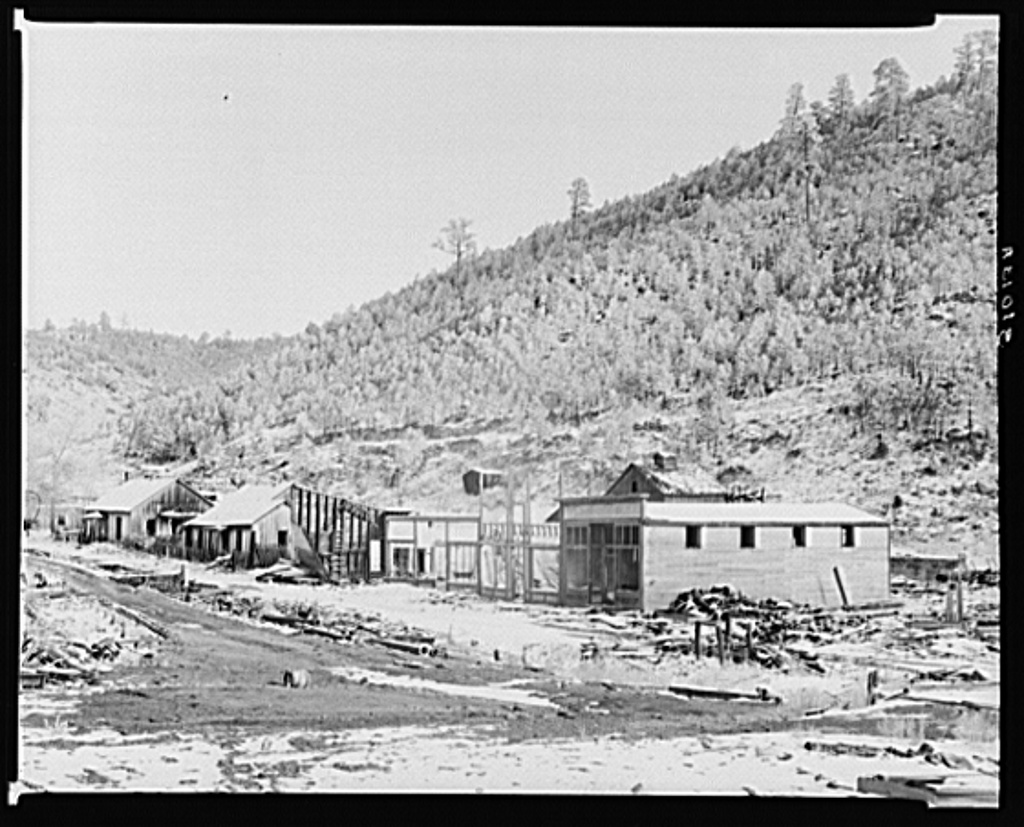
In November 1937 Russell Lee, a photographer for the federal Farm Security Administration, made a set of pictures in a canyon north of Newcastle, Wyoming: abandoned houses, a row of cottages, an old hotel, a snowy main street. The caption cards filed with them call the place a ghost mining town. It was Cambria, a company coal town whose mines fed the Burlington railroad's locomotives from 1889 until the late 1920s. One coal bed made the town, and when that coal ran short, the town emptied.
Why Was There Coal in This Canyon?
Cambria existed because of a coal seam thick enough to mine, something the Black Hills rarely offer. The coal lies in the Lakota Formation, one of the hard sandstones that build the Hogback, the outermost ring of rock around the Black Hills (see How the Black Hills Formed). On the Wyoming side the rim spreads into a broad tableland that slopes gently down toward the plains. The Lakota's only minable coal bed lies near its base and, around most of the rim, amounts to little more than thin streaks in dark shale. Near Cambria it thickened to 3 to 10 feet of hard bituminous coal, good enough for locomotives, across about 12 square miles. Nowhere else in the Hills, a 1912 U.S. Geological Survey report said, had it proved workable beyond a few acres.
Canyons cut into that tableland gave miners a way in from the side. Lying nearly level some 200 to 300 feet down, the coal shows in the canyon walls 50 or 60 feet above the creek beds. Miners drove their entries in from those outcrops, and the 1912 report found the workings free of both water and gas.
A Company Town Built for the Burlington
In the late 1880s the Burlington, building northwest from Nebraska toward Montana, needed locomotive fuel along the way. In 1887 Kilpatrick Brothers and Collins, railroad contractors from Beatrice, Nebraska, sent a party to find coal. Newcastle grew where the canyon opened out, as near as the railroad's surveys showed the main line could come, and a 7.8-mile spur ran up to the mines.
Coal began moving in December 1889. WyoHistory, the Wyoming State Historical Society's online encyclopedia, has the branch finished by December 1; the 1980 National Register nomination for the Cambria Casino has the first load ready on December 4; and the 1912 Survey report counts 2,700 tons shipped that month. About 85 percent of the output went to the Burlington to burn in its own engines, both the report and the nomination say. From 1891 until the early 1900s, beehive ovens turned much of the fine slack coal into coke for Black Hills gold smelters.
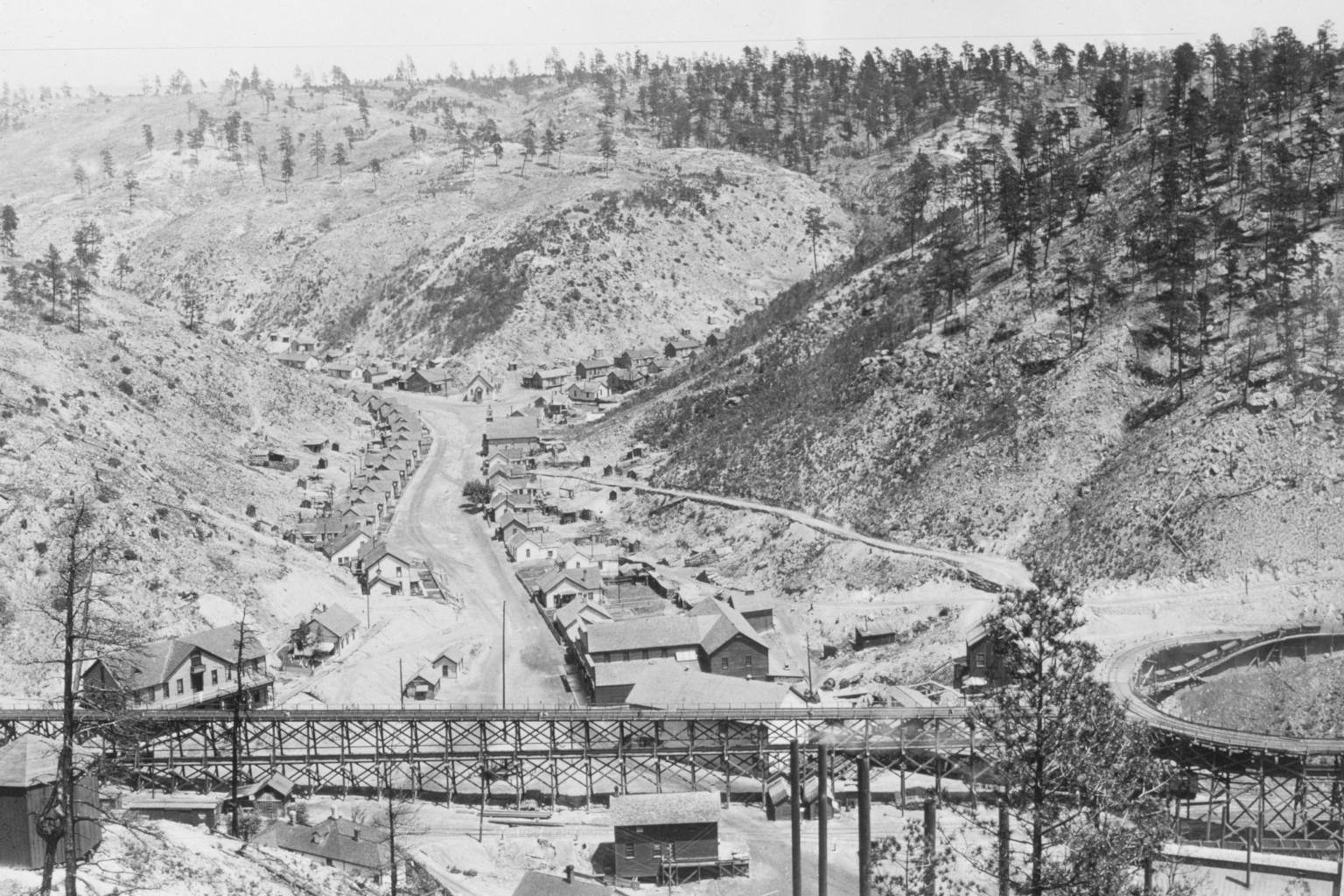
By 1912 most of the town's 150 or so company houses stood along the canyon floor, near a hotel, a hospital and the company store. The school was up on the plateau, reached by a wooden stairway the nomination puts at 365 steps. The Survey counted 400 to 450 miners, most of them born abroad, and about 1,400 people in all. The nomination's figures run higher: about 500 miners, drawn from 23 nationalities, and a peak population near 1,500. Because the land was the company's, it could keep liquor sales out of Cambria; Newcastle, at the foot of the spur, had the closest saloon.
The 1912 report, whose author thanked the company's secretary and superintendent for valuable information, credited the ban and fair treatment for the absence of strikes. The nomination labels the picture of a contented town with no unions, no strikes and no police the "Utopian vision" of the published accounts. The tale that Cambria's coal carried gold also comes from the company, but with numbers. By the superintendent's account, company assays found gold in boiler ash, and samples of the raw coal assayed at anywhere from no gold to $2 worth a ton.
The Last Whistle, and What It Left
Cambria closed because its workable coal ran short. The mines shut for good in 1928, according to the nomination and a 2024 post on WyoHistory, and the nomination puts the last whistle on March 15, with about 85 men still at work. A 2023 Wyoming Public Radio almanac, citing the Wyoming Historical Society, gives March 18, 1929. The nomination rules out rival coalfields and the later switch to diesel as causes. Coal remained, though: in 1950 the Geological Survey estimated about 15 million tons underground, mostly in small pockets that would be hard and expensive to work. Totals mined run from more than 10.5 million tons on the Survey's record to about 12.5 million by the nomination's estimate.
By 1980 almost nothing of the town or its mines survived, the nomination found. The stripping began in the early 1930s, when contractors were hired to carry off anything worth salvaging. Lee's 1937 photographs record what was still standing then: empty frame buildings, with loose lumber piled along the street.
While the mines were still running, the Cambria Fuel Company drew up plans for a resort in memory of its miners, in Salt Creek Canyon on the far side of the ridge from the townsite. Its centerpiece, the Cambria Casino, a sandstone lodge in English Tudor style, went up in 1928 and 1929 to a design by the New York architect Bruce Rabenold, the nomination says. Renamed the Flying V for the livestock brand of the outfit that leased it, the lodge was listed on the National Register on November 18, 1980, and the 2024 WyoHistory post called it "one of the architectural gems of Weston County." The town stood on the coal company's land, and the Casino was privately owned when it was listed.
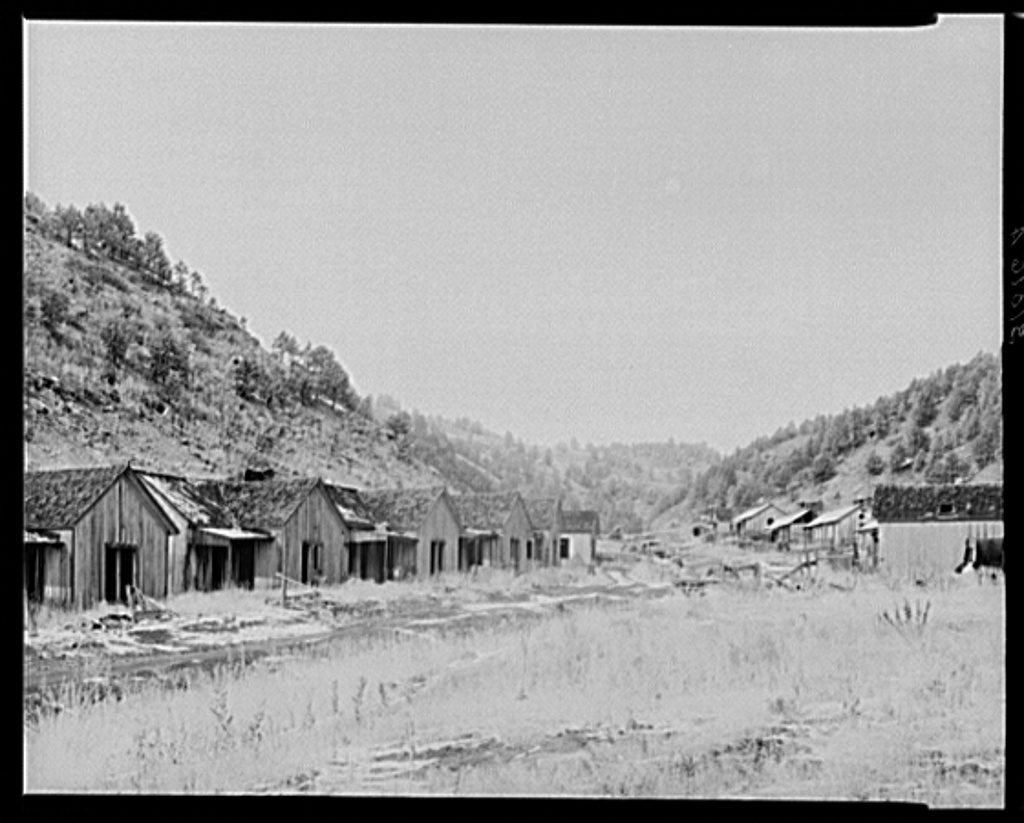
Lee's photographs are at the Library of Congress, and in 2024 the Wyoming Livestock Roundup, passing on visitors' accounts, reported a Cambria exhibit at the Anna Miller Museum in Newcastle, the junction town that grew where the coal spur met the main line.
Connected
- The Wyoming Side of the HillsThe region around Cambria, from Devils Tower to Newcastle.
- Newcastle, WyomingThe railroad town that grew where Cambria's coal spur met the main line.
- How the Black Hills FormedThe rings of rock, including the sandstone rim that holds Cambria's coal.
- Stagecoaches and RailroadsHow the Burlington and the other lines reached the Hills.
- Fossils and the Mammoth SiteDinosaurs from the Lakota Formation, the sandstone that holds the coal.
- Tinton, South DakotaThe tin camp near the state line, the region's other ghost town.
Sources
- National Register of Historic Places Inventory-Nomination Form: Cambria Casino (Flying V Guest Ranch), by Mark G. Junge and Gregory D. Kendrick. Wyoming State Historic Preservation Office for the National Park Service, 1980.
- Cambria Casino/Flying V Guest Ranch. Wyoming State Historic Preservation Office, National Register listings.
- Coal Near the Black Hills, Wyoming-South Dakota (Bulletin 499), by R.W. Stone, with a section by C.T. Lupton. U.S. Geological Survey, 1912.
- Coal Resources of Wyoming (Circular 81), by Henry L. Berryhill Jr., Donald M. Brown, Andrew Brown and Dorothy A. Taylor. U.S. Geological Survey, 1950.
- Newcastle, Wyoming, by Nicole Lebsack. WyoHistory.org, Wyoming State Historical Society, 2014.
- WHS annual meeting set for Sept. 6-8 in Newcastle, by Lucas Keeler. WyoHistory.org, Wyoming State Historical Society, 2024.
- Monday, March 13 (Around Wyoming), by Ivy Engel. Wyoming Public Radio, Wyoming Public Media, 2023.
- Cambria, Wyoming. November, 1937. Cambria, a ghost coal mining town, photographs by Russell Lee. Farm Security Administration - Office of War Information Collection, Library of Congress, 1937.
- Main street of Cambria, Wyoming. Ghost mining town, photograph by Russell Lee. Farm Security Administration - Office of War Information Collection, Library of Congress, 1937.
- A Hidden Wonder: Newcastle Museum draws visitors from across the country. Wyoming Livestock Roundup, 2024.
Last reviewed: