People
Doane Robinson
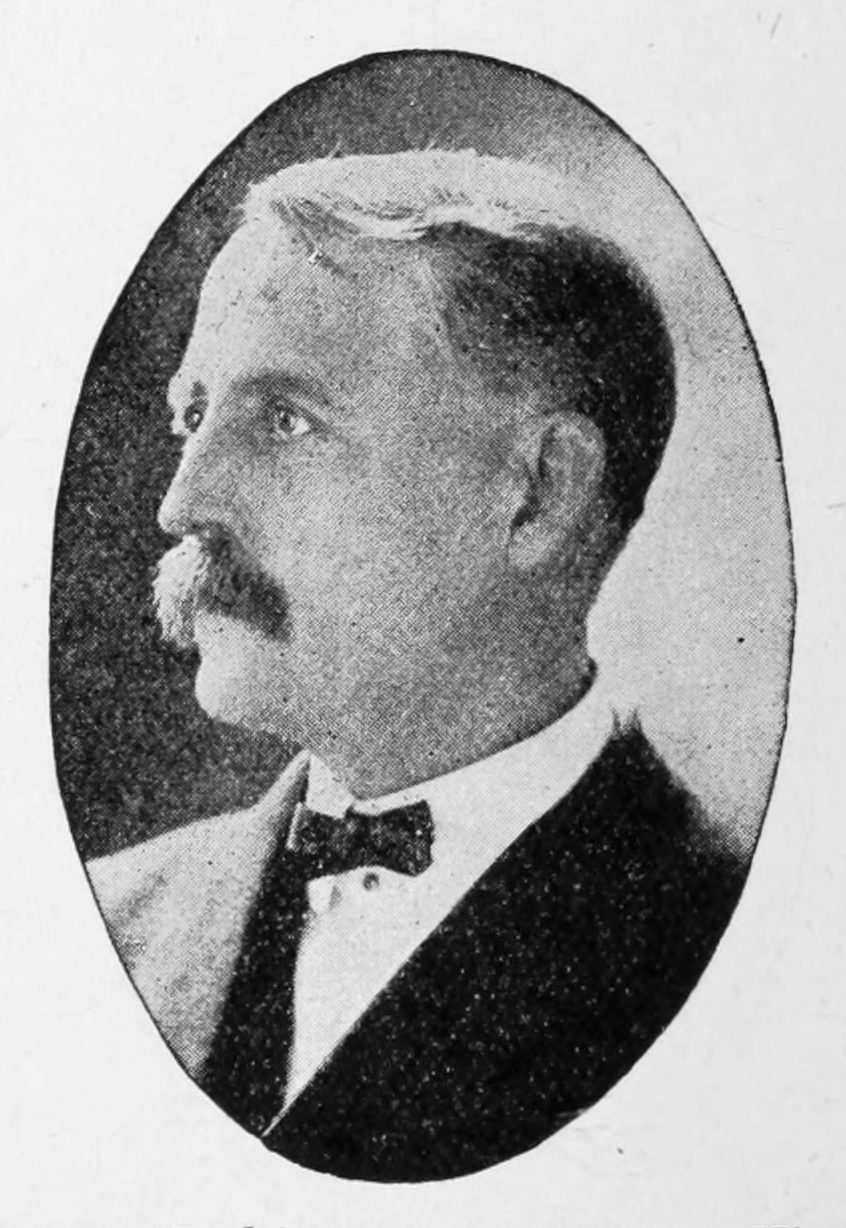
The crowds that come to see Mount Rushmore stand on a mountain named for Doane Robinson, and none of the four faces in front of them is one he first proposed. Robinson (1856 to 1946) ran South Dakota’s Department of History for 25 years, and in 1923 he began pressing for giant carvings in the Black Hills to draw visitors. What follows traces that idea from the Needles to Rushmore, along with his work building the state’s historical collections.
He was born Jonah Leroy Robinson near Sparta, Wisconsin, on October 19, 1856; a little sister’s way of saying Jonah turned into Doane. He homesteaded in Minnesota and practiced law at Gaylord there before moving in 1883 to Watertown, in Dakota Territory. He married Jennie Austin the next year, and they had two sons, Harry and Will. From 1898 to 1904 he published the Monthly South Dakotan, a magazine about the state, and in 1899 a book of his verse, Midst the Coteaus of Dakota.
Building the State’s Collections
In 1901 the legislature created a Department of History under the new South Dakota State Historical Society, with Robinson as secretary. The post paid nothing until 1903 and took in the State Library, the State Museum, the census and vital records, by the Society’s own accounts in its journal; he moved to Pierre in 1904. He started the South Dakota Historical Collections, first published in 1903, and the State Archives credits him with gathering the objects behind the Robinson Museum and the state’s portrait gallery. When the lead plate the La Vérendrye brothers buried above present-day Fort Pierre in 1743 turned up in 1913, he worked to win it for the Society. His books include a two-volume History of South Dakota (1904) and Doane Robinson’s Encyclopedia of South Dakota (1925).
What His History Said About the Hills
His account of the tribes, A History of the Dakota or Sioux Indians, filled nearly all of the Collections’ second volume in 1904. Custer’s 1874 expedition, Robinson wrote, broke the 1868 Fort Laramie Treaty, which kept white men off tribal land without the tribes’ consent. Of the 1876 agreement that gave up the Hills, he wrote that the treaty’s rule requiring three-fourths of the adult men to agree “was totally ignored,” and that the signing was forced on the tribes, who had no choice but to accept the terms. How the Hills were taken is told on The 1876 War and the Taking of the Hills.
His views of the tribes were mixed, Timothy G. Anderson writes in the Society’s journal. Robinson described their games in detail, yet he believed in Manifest Destiny, called tribal people primitives, savages and barbarians in other writings, and used a slur in a letter about the carving. At least one later writer has judged him hostile to tribal people.
Western Heroes for the Needles
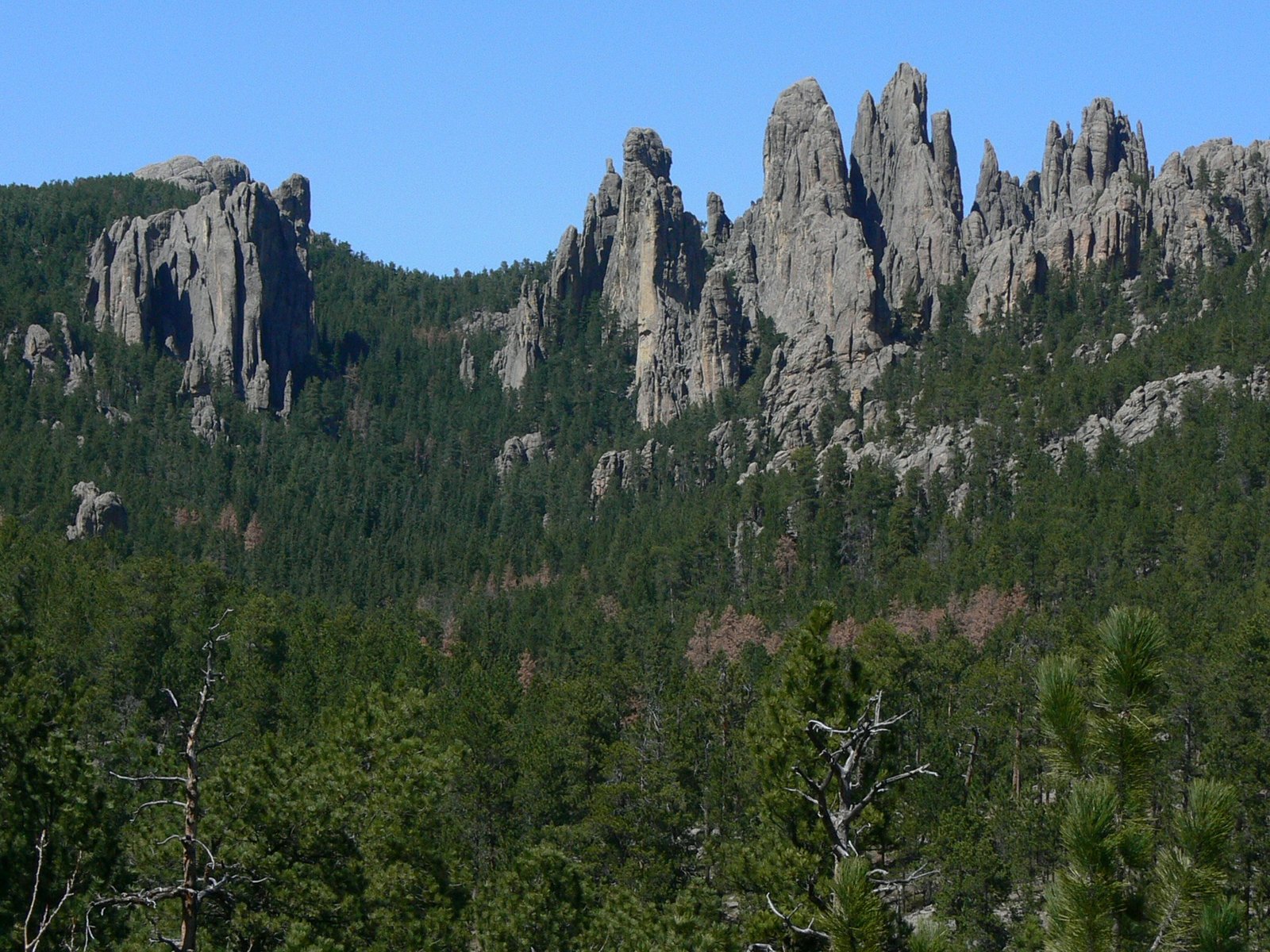
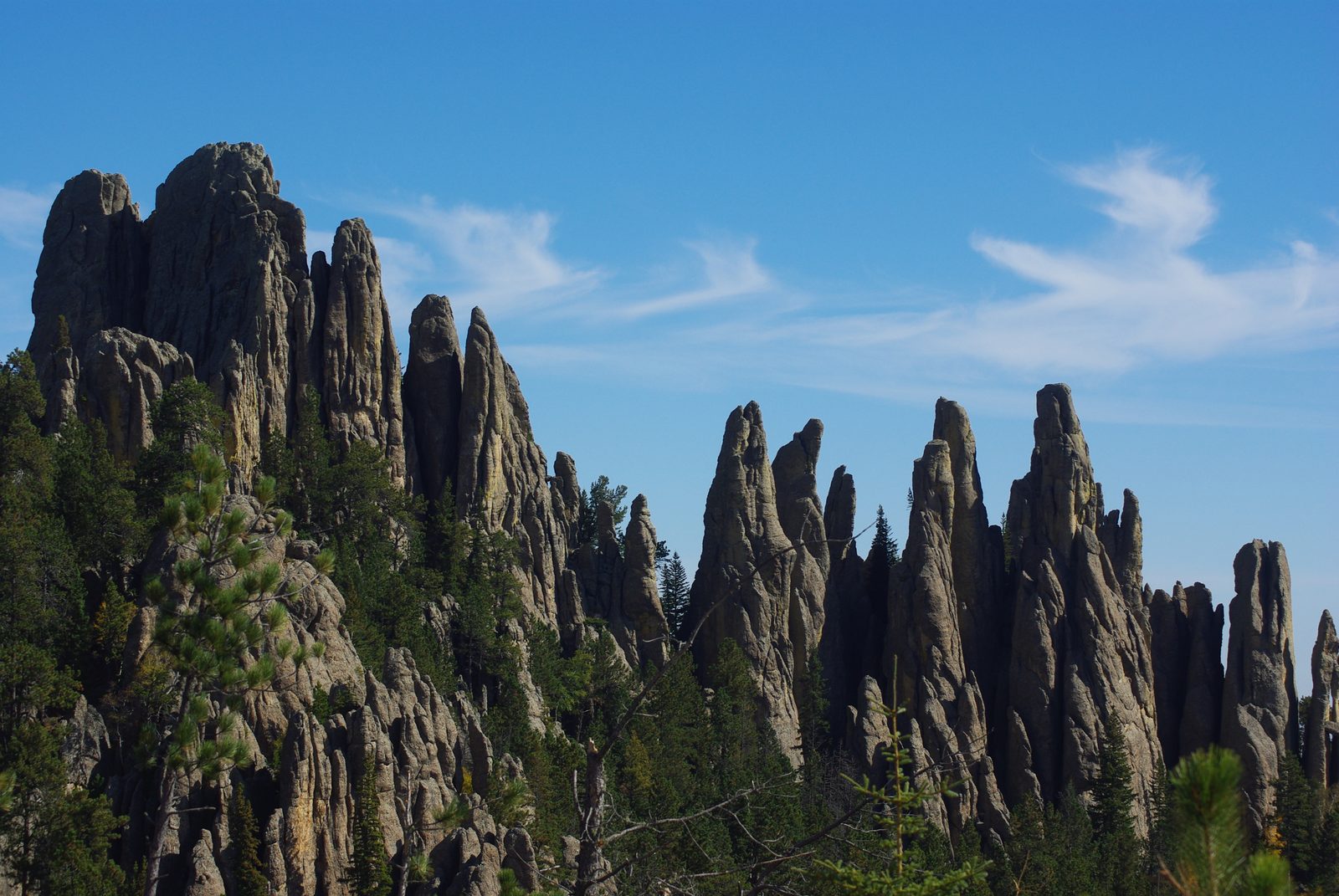
The granite pinnacles Robinson hoped to carve rise in the Black Hills, Hé Sápa, set apart for the tribes by the 1868 treaty and taken by the 1877 Act in violation of it. Scenery alone soon bored tourists, he believed, PBS’s American Experience reports; the Encyclopedia of the Great Plains adds that he wanted to widen a state economy built on mining and struggling farms. On December 28, 1923, a date the Park Service’s timeline also marks, he wrote to the sculptor Lorado Taft about the granite spires near Black Elk Peak (called Harney Peak until 2016). He was thinking, he wrote, of “some notable Sioux as Redcloud,” who he said had lived and died below those peaks. Red Cloud (Maȟpíya Lúta) had in fact died on the Pine Ridge Reservation in 1909.
Taft was ill, but Robinson pressed on. By January 26, 1924, his list ran to Lewis and Clark, John C. Frémont, Jedediah Smith, Jim Bridger, Sacagawea and Red Cloud, with Cody and the overland mail on horseback. Taft still declined. That January, a State Historical Society marker says, Robinson took the idea public in a speech to the Black and Yellow Trail Association, a group promoting tourist travel from Chicago to Yellowstone.
A second marker, put up beside the Needles Highway in 2019, tells a story: in 1923 Robinson’s Model T overheated below the Cathedral Spires, and while his son Will fetched water, Robinson pictured a westerner such as Jim Bridger, Kit Carson or Red Cloud carved there. The marker cites no source. The dated record of the idea is his letters.
From the Needles to Mount Rushmore
On August 20, 1924, Robinson wrote to Gutzon Borglum, then carving a Confederate memorial at Stone Mountain, Georgia. Borglum met him that September on a train between Pierre and Rapid City. He wanted national figures, not western ones, and by December he was writing of George Washington and Abraham Lincoln. Senator Peter Norbeck, whom Robinson had brought in early, gave the plan its political backing.
Not everyone wanted the granite cut. When Cora B. Johnson attacked the plan in the Hot Springs Star, Robinson asked her in a December 1924 letter “just how you hope to justify yourself to posterity.” The legislature voted the carving bill down twice before Governor Gunderson signed it on March 5, 1925, two days after Congress allowed a carving in the Harney National Forest. That August Borglum passed over the Needles for Mount Rushmore, near Keystone, and, PBS says, Robinson joined the party that climbed it.
Lakota people had their own name for the mountain, the Six Grandfathers, and to them, Christina Rose wrote for ICT in 2013, cutting into it was an act of disrespect in itself. Harold Frazier, chairman of the Cheyenne River Sioux Tribe, offered in 2020 to take the faces down himself at no charge; most tribal members who spoke with Voice of America that summer wanted the carving kept and used to teach. Mount Rushmore and Crazy Horse Memorial sets out the full range of views.
Robinson became the project’s manager on the ground, working with Norbeck to meet Borglum’s demands and to raise money, PBS reports. Yet when Congress created the Mount Rushmore National Memorial Commission in 1929, his name was not even on the list of candidates, the Park Service notes. South Dakota, he wrote, had “already forgotten that I ever had anything to do with the matter.” Norbeck refused a seat out of loyalty to him, PBS says, and later that year Robinson led a drive to sell $100 memberships in a Mount Rushmore National Memorial Society. Before long, the Park Service says, he began to drift away from the project.
Last Years in Pierre
Robinson retired in 1926, and his assistant, Lawrence K. Fox, took his place. He returned briefly to the department in 1946, lived to see Mount Rushmore finished, and died in Pierre on November 27, 1946, at 90. His son Will G. Robinson later led the Society until 1968.
On Iron Mountain Road, laid out under Norbeck so that its tunnels frame the carving, one of the three tunnels carries Robinson’s name. A state marker put up there in 2017 is titled “The Father of Mount Rushmore.”
Connected
- Mount Rushmore and Crazy Horse MemorialThe carving his idea began, and how tribes and tribal members see it.
- The Granite Core: Black Elk Peak and the NeedlesThe granite spires he first wanted carved, and why they break into columns.
- Gutzon BorglumThe sculptor Robinson wrote to in 1924, who chose presidents and Mount Rushmore.
- Peter NorbeckThe senator who backed Robinson’s plan and turned down a seat on the commission that left him out.
- Granite, Rushmore and Crazy HorseWhy the carving moved from the Needles to Rushmore’s sounder rock.
- Red CloudThe Oglala leader Robinson named first when he wrote to Lorado Taft in 1923.
- The 1876 War and the Taking of the HillsThe taking his 1904 history described, told in full.
- Scenic Drives: Needles Highway, Iron Mountain Road and MoreThe Needles Highway past the spires, and the Iron Mountain Road tunnel named for him.
Further reading
- Native History: Construction of Mount Rushmore Begins, Christina Rose, ICT
- Native Americans Angry Over Trump Visit to Mount Rushmore, Cecily Hilleary, Voice of America
- Memorializing a Mountain Man: John G. Neihardt, Doane Robinson, and Jedediah Smith, Timothy G. Anderson, South Dakota History
- Doane Robinson, American Experience, PBS
Sources
- Dakota Resources: The Doane Robinson Papers at the South Dakota State Historical Society, by Chelle Somsen. South Dakota History 39, no. 1, South Dakota State Historical Society, 2009.
- Memorializing a Mountain Man: John G. Neihardt, Doane Robinson, and Jedediah Smith, by Timothy G. Anderson. South Dakota History 39, no. 1, South Dakota State Historical Society, 2009.
- The South Dakota State Historical Society: The First Seventy Years, by the Society Evaluation Committee. South Dakota History 2, no. 4, South Dakota State Historical Society, 1972.
- A History of the Dakota or Sioux Indians, by Doane Robinson. South Dakota Historical Collections 2, South Dakota State Historical Society (News Printing Co., Aberdeen), 1904 (Harvard University copy, Internet Archive).
- Manuscript Collection Finding Aid (Doane Robinson Papers). South Dakota State Archives, South Dakota State Historical Society.
- South Dakota State Historical Society Markers (marker 713, “The Father of Mount Rushmore,” 2017, and marker 725, “Mount Rushmore Inspiration,” 2019). South Dakota State Historical Society, revised June 2020.
- Doane Robinson. American Experience, PBS (WGBH).
- Mount Rushmore National Memorial, by Sheila R. Aaker. Encyclopedia of the Great Plains, University of Nebraska–Lincoln.
- Doane Robinson. National Park Service, Mount Rushmore National Memorial, 2023.
- Timeline. National Park Service, Mount Rushmore National Memorial.
- Memorial History. National Park Service, Mount Rushmore National Memorial.
- Red Cloud (1821–1909), by Robert W. Larson. Encyclopedia of the Great Plains, University of Nebraska–Lincoln.
- Native History: Construction of Mount Rushmore Begins, by Christina Rose. ICT, 2013.
- Native Americans Angry Over Trump Visit to Mount Rushmore, by Cecily Hilleary. Voice of America, 2020.
- Treaty of Fort Laramie (1868), transcript. National Archives.
- Scenic Drives (Custer State Park). South Dakota Game, Fish and Parks, 2026.
- Peter Norbeck Scenic Byway: Cathedral Spires Skyline. Stephen Keegan, Federal Highway Administration; Records of the Federal Highway Administration, National Archives.
Last reviewed: