People
Fee Lee Wong and Deadwood's Chinese Community
Some of the bricks in the Chinese burner at Deadwood’s Mount Moriah Cemetery came from a building on lower Main Street. Chinese residents built the first burner in 1908 for their offerings; vandals later wrecked it. When the city rebuilt it in 2013, it used bricks saved from the Wing Tsue building, demolished in 2005. Wing Tsue was the name of Fee Lee Wong’s store and, around town, of the man himself. Wong (about 1846 to 1921) was a leading merchant of Deadwood’s Chinatown for more than 40 years, and his life runs through that community’s story.
From Canton to Deadwood Gulch
Wong was born in Canton, China, in 1846, by the State Historical Society journal’s account; family history gives 1841. He reached Deadwood Gulch in December 1876. Chinese prospectors and merchants had been coming since the winter of 1875 to 1876, most by rail to Cheyenne or Sidney and then by stage, the historian Liping Zhu writes (see Stagecoaches and Railroads). The gulch lay on land the 1868 Fort Laramie Treaty had set apart for the tribes, and the 1877 Act took the Hills without the consent the treaty required; The 1876 War and the Taking of the Hills tells how. The census and the deed books wrote his name Wong Fee Lee, family name first.
The Wing Tsue Store
Wong’s store stood at 566 Main Street, in Chinatown at the north end of Deadwood. It sold Chinese groceries, herbs, tea, silk and chinaware, and an 1898 advertisement added fireworks and Chinese medicines and asked Americans as well as Chinese to come in. He also traded in mining ground; by 1900 county records credited him with $3,620 in real estate and $9,000 in quartz mines, Zhu found.
Early on February 13, 1885, fire destroyed the store and nine other Chinatown buildings. The store also had a reputation for opium and gambling, the journal notes. The Black Hills Daily Times headlined the fire “A Blaze from Which Little Harm and Vast Good Resulted.” The city council then priced street work through Chinatown, a step meant to discourage rebuilding. Wong and other Chinese merchants proposed a deal: they would share the cost of modest street work, and respectable houses would go up on the west side of Main Street while the opium dens and brothels stayed on the east. Wong rebuilt in brick. The city counts two brick buildings, from 1885 and 1896, together called the Wing Tsue Bazaar.
A Family on Main Street
In 1882 Wong went back to China to marry. The journal names his bride Hal Shek; the city calls her Haw Soog Gain. They settled in Deadwood in 1883, and the city counts eight surviving children, born from 1884 to 1902, many of whom went to the public schools. The 1880 census found 202 Chinese men and only 19 Chinese women in Lawrence County, Zhu reports.
How Many Chinese Lived in the Hills?
Few, by the census. Zhu’s count of the 1880 returns found 221 Chinese in Lawrence County, or 1.7 percent of its people. The number fell to 152 in 1890, 120 in 1900 and 54 in 1910. Some stayed off the rolls, fearing what the law and their neighbors might do, the archaeologist Rose Estep Fosha writes. In 1880 half of the Black Hills Chinese worked in laundries. Others cooked, ran restaurants or kept stores, as Wong and Hi Kee & Company did.
Laws Aimed at Chinatown
Hostility came with the rush; the miners’ Caucasian League of 1878 is told on Deadwood’s Wild Years, 1876 to 1879. In 1885 the town council required every laundry to buy a $10 permit every four months. The Chinese refused and hired Judge Granville Bennett, paying only after several convictions, Zhu writes.
The federal Chinese Exclusion Act of May 6, 1882, shut Chinese laborers out of the country for ten years and barred Chinese immigrants from citizenship, the National Archives explains. The Geary Act of 1892 extended it and made residents register, and in 1902 exclusion became permanent. More than nine in ten Black Hills Chinese at first refused to register, Zhu found. With few women and few newcomers, the community aged and shrank.
Holidays and Hose Carts
Wong gave to the Independence Day fund, entered a Chinese hose team in the firemen’s races, and invited the town to Chinese New Year and the Hungry Ghost Festival, the city’s preservation office says. In Chinatown he raised money for New Year festivities and paid to bury the destitute.
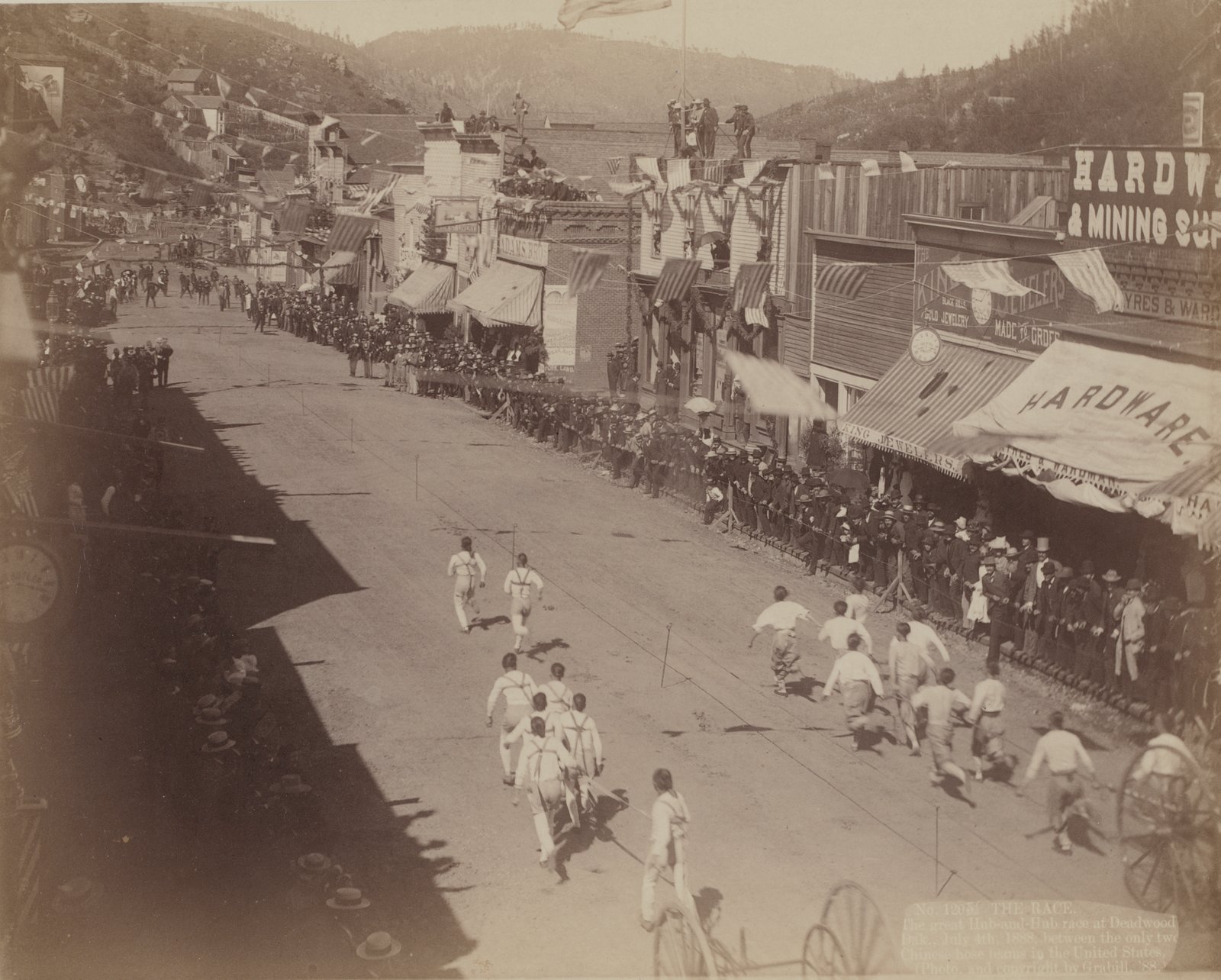
On July 4, 1888, two Chinese hose teams raced, one captained by Wing Tsue and one by Hi Kee. Wong’s team, the betting favorite, led for 150 yards until a man at the cart’s tongue dropped out and the crew fell, by the Black Hills Daily Times account the historian Grant K. Anderson quotes. Hi Kee’s team won in 30¼ seconds. A 2025 city announcement lists the 1888 championship among Wong’s achievements.
Turned Back at the Border
In 1902 Wong took his family to China. When he tried to return, in 1904 by the family’s accounts, officials enforcing the Exclusion Act turned him away. The city names two who spoke for him: Sol Star, Seth Bullock’s old partner and Deadwood’s longtime mayor, and Congressman Eben Martin. Wong was allowed back. His relatives say he wanted the children to speak Chinese and marry Chinese spouses, Ky-Phong Tran, whose wife descends from Wong, wrote in Alta Journal in 2025.
Most of Wong’s story comes from records and newspapers of his own day. That motive, his birth year and the count of his children (six, eight or eleven) rest partly on family memory. HBO’s Mr. Wu, the Chinatown boss in Deadwood, is fiction, a composite of several Chinese residents, Wong among them, Tran writes.
In 1915, after he defaulted on a loan, a Deadwood bank bought the Wing Tsue building for $1,055, the Encyclopedia of the Great Plains says. In 1919 he had a stroke at a meeting of the Society of Black Hills Pioneers and, once he could travel, left for China. He died in 1921, in Hong Kong by the journal’s account and in Canton by the encyclopedia’s. The Deadwood Daily Pioneer-Times called him “a man whose word was his bond, scrupulously honest.”
What Became of the Wing Tsue Building
Much of Chinatown was torn down in the 20th century, and the city paid for digs in its buried remains from 2001 (see Deadwood’s Wild Years). The Wing Tsue building came down on December 24, 2005, and by the city’s own timeline the demolition broke Deadwood’s historic preservation ordinance. Bricks salvaged by local residents went into the burner, rededicated on July 23, 2013, with Wong’s descendants. Beatrice Wong, 82, was there, and the Associated Press called the building the home of “her grandfather’s modest empire.” What gaming money has and has not saved is taken up on How Gambling Saved Old Deadwood.
In June 2025 the city dedicated a bronze statue of Wong by the sculptor James Michael Maher at 566 Main Street. He wears a braided queue and holds the hand of one of his sons, and both carry American flags.
Connected
- Deadwood’s Wild Years, 1876 to 1879The gold camp Wong reached in 1876, its Chinatown, the Caucasian League and the archaeology.
- Deadwood, South DakotaThe town as it stands, rebuilt in brick after the fire of 1879.
- How Gambling Saved Old DeadwoodGaming money and preservation, and the Wing Tsue building lost in 2005.
- The Black Hills Gold RushThe gold rush that Chinese miners and merchants followed into the Hills.
- Stagecoaches and RailroadsThe Cheyenne and Sidney stage roads most Chinese took to Deadwood.
- Seth BullockThe hardware merchant whose partner, Sol Star, helped Wong back into the country.
- The 1876 War and the Taking of the HillsThe 1877 Act that took Deadwood Gulch, with the rest of the Hills, from the tribes.
Sources
- Dakota Images: Fee Lee Wong, by Christopher Leatherman. South Dakota History 31, nos. 3 and 4, South Dakota State Historical Society, 2001.
- Fee Lee Wong (Wall of Fame). City of Deadwood Historic Preservation Commission.
- Wong, Fee Lee (Wing Tsue), by Rena Webb. Encyclopedia of the Great Plains, University of Nebraska–Lincoln.
- Ethnic Oasis: Chinese Immigrants in the Frontier Black Hills, by Liping Zhu. South Dakota History 33, no. 4, South Dakota State Historical Society, 2003.
- Deadwood Chinatown, by Liping Zhu. Encyclopedia of the Great Plains, University of Nebraska–Lincoln.
- The Archaeology of Deadwood’s Chinatown: A Prologue, by Rose Estep Fosha. South Dakota History 33, no. 4, South Dakota State Historical Society, 2003.
- Deadwood’s Chinatown, by Grant K. Anderson. South Dakota History 5, no. 3, South Dakota State Historical Society, 1975.
- Chinese Exclusion Act (1882). National Archives.
- Treaty of Fort Laramie (1868), transcript. National Archives.
- Timeline of Deadwood, South Dakota. City of Deadwood.
- S.D. City Dedicates Altar to First Chinese Immigrants. Associated Press, in Northwest Asian Weekly, 2013.
- Deadwood’s Chinese Ceremonial Burner (marker text). Transcribed by the Historical Marker Database.
- Deadwood, South Dakota, to Host Grand Celebration of Chinese Immigrant History (announcement attached to a city meeting agenda). City of Deadwood, 2025.
- City of Deadwood Newsletter, vol. 12, no. 5. City of Deadwood, June 2025.
- Letter from Deadwood: The Real Mr. Wu, by Ky-Phong Tran. Alta Journal, 2025.
- The Race. The great Hub-and-Hub race at Deadwood, Dak., July 4, 1888, between the only two Chinese hose teams in the United States. John C. H. Grabill, 1888; John C. H. Grabill Collection, Library of Congress Prints and Photographs Division.
Last reviewed: