People
Sitting Bull and the Fight for the Black Hills
Sitting Bull was born on the Grand River in the early 1830s, and in 1890 he was killed at his camp on the same river, not far from his birthplace. Most of his life between was lived north of the Black Hills: in the Hunkpapa country between the Cheyenne and Heart rivers, along the Yellowstone, and for four years in Canada. Yet the Hills were Lakota land, and he would not give them up. The Hunkpapa Lakota leader’s part in the story of the Hills runs from his refusal to sell them to his killing at Standing Rock on December 15, 1890.
A Hunkpapa Leader from the Grand River
Sitting Bull College, the tribal college at Standing Rock renamed in his honor, places his birth at Many Caches, near present-day Bullhead, South Dakota. The year is uncertain: the college gives 1834 and about 1831, and the National Park Service a range from 1831 to 1837. As a boy he was called Slow, for his deliberate ways. At 14 he counted his first coup, in a raid on the Crow, and his father gave him the name Sitting Bull.
The northern Lakota bands had come to see him as a leader in both war and council by 1866 or 1867, the college says. Some accounts call him a “supreme chief,” it notes, but among the Lakota, the State Historical Society of North Dakota points out, a group of men usually settled questions together after long talk. When Red Cloud and other leaders signed the Fort Laramie Treaty of 1868, Sitting Bull stayed out of the talks and came to lead what were known as the non-treaty bands, the Park Service says; Sitting Bull College adds that he refused to sign any treaty or give up any territory.
Why Did Sitting Bull Refuse to Sell the Black Hills?
To Sitting Bull the Hills were sacred ground, and a place where his people could always find food, as the State Historical Society of North Dakota sums up his view. The 1868 treaty had put them inside the Great Sioux Reservation, which the Standing Rock Sioux Tribe’s history describes as holding “the sacred Black Hills and the life-giving Missouri River.”
After the Custer Expedition of 1874 reported gold, miners rushed in. In 1875 a federal commission invited the Hunkpapa to a council at Red Cloud Agency, in Nebraska, to talk about selling the Hills. Sitting Bull, like many others, would not go, and the talks broke down.
On December 6, 1875, the government ordered the bands living off the reservation to come in to the agencies by January 31, 1876, or be treated as hostile. His words that winter come down at second hand: visitors to the winter camps reported that he would die before giving up the free life his father had lived, and that he had no quarrel with the Army as long as it let him alone. On the deadline, the Commissioner of Indian Affairs wired the Standing Rock agent: “Cannot recommend extension of Sitting Bull’s time to come in.” The war that followed is told on The 1876 War and the Taking of the Hills.
Greasy Grass and Slim Buttes
In June 1876 Sitting Bull performed the Sun Dance in the valley of the Rosebud, in what is now Montana, and reported a vision of soldiers falling into the camp, Sitting Bull College writes. When warriors turned back Gen. George Crook’s column on the Rosebud later that month, he said this fight was not the one in his vision.
The Battle of the Little Bighorn, which the Lakota call the Battle of the Greasy Grass, followed on June 25 and 26. The Hunkpapa camp was the first one struck by Maj. Marcus Reno’s attack, which killed several women and children there, the Park Service says. In 1980 the Supreme Court called the battle “Sitting Bull’s notable victory over Custer’s forces.” By the Park Service’s account he did not fight in it: past fighting age, he sent his nephews White Bull and One Bull into battle and directed warriors where to attack.
On a new campaign begun in August, Crook’s troops found Lakota hunting camps in the Slim Buttes, northeast of the Black Hills, whose leaders included Sitting Bull and Crazy Horse (Tȟašúŋke Witkó). The soldiers attacked, and some women and children were killed. Sitting Bull moved his Hunkpapa north, into the Yellowstone buffalo range. Chiefs at the agencies, told they would get no more rations unless they gave up the Hills, signed the agreement Congress demanded, and on February 28, 1877, the 1877 Act made it law, taking the Black Hills from the tribes in violation of the 1868 treaty.
Four Years in Canada
By May 1877, the month Crazy Horse surrendered at Camp Robinson, Sitting Bull and his followers, about 400 by the Encyclopedia of the Great Plains’ count, had crossed into what is now southern Saskatchewan and camped near Wood Mountain. Canada’s government would give them no food, and the buffalo herds there were thinning. As hunger grew, small groups slipped back to the agencies.
In July 1881 Sitting Bull came in to Fort Buford, where the Yellowstone meets the Missouri, with 187 people by the count in the State Historical Society of North Dakota’s history of the fort, or about 200 by other accounts. He handed his Winchester carbine to the post commander. By the society’s account, he called himself the last of his people to give up, and said he hoped his children would know peace.
Instead of the return to Standing Rock the government had promised, he and about 100 of his followers were kept as prisoners of war at Fort Randall, more than 300 miles to the south. There he drew the story of his life in pictures in a ledger book, which the Smithsonian Institution now holds. Not until May 1883 could he rejoin his people at Standing Rock.
Standing Rock, 1883 to 1890
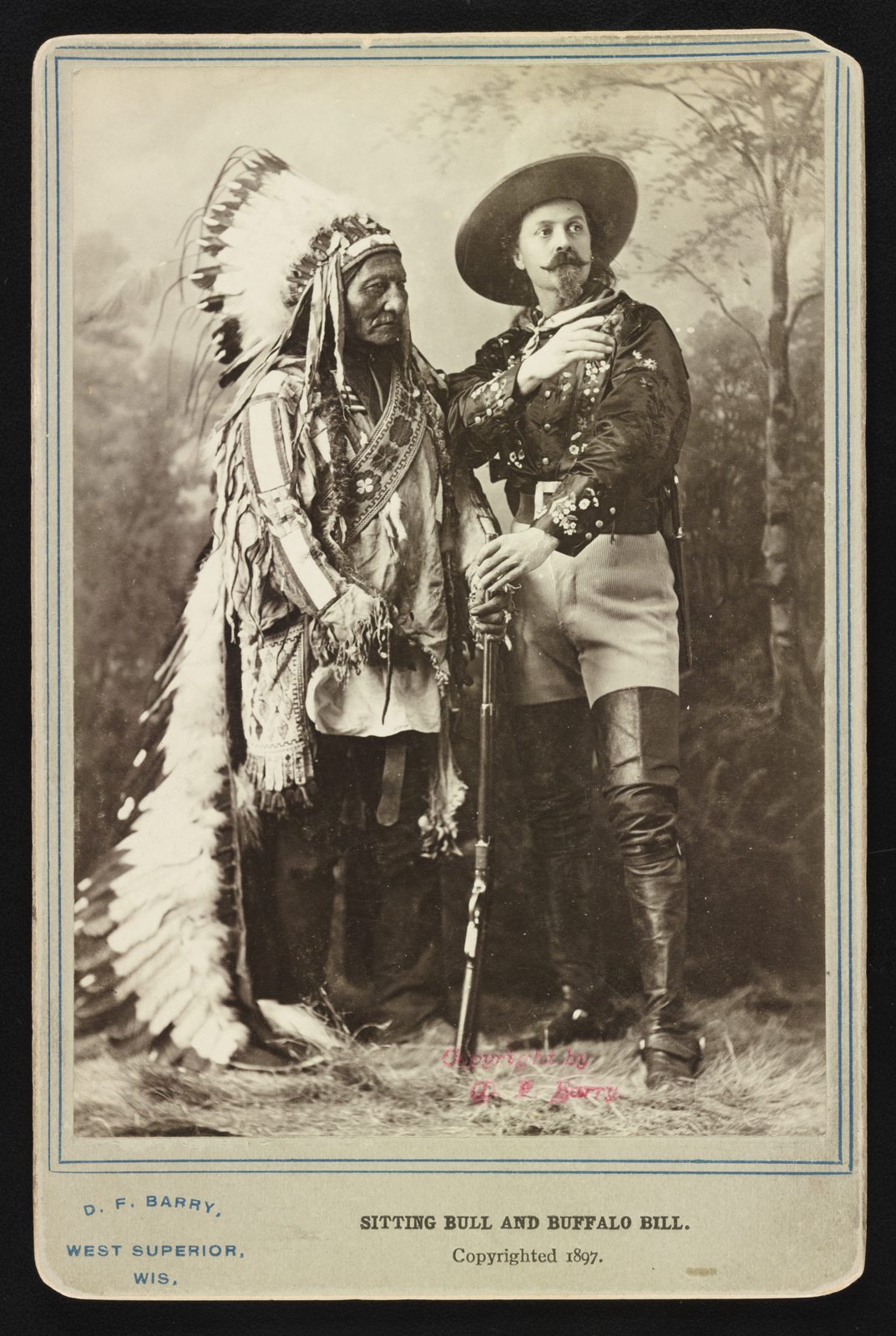
The agent there, James McLaughlin, refused to deal with him as a leader and put him to work in the fields, and the two men clashed for years. In 1885 he toured for four months with Buffalo Bill Cody’s Wild West show. He spoke out against the government’s drive to take nine million acres from the tribes, land lost anyway in 1889, when Congress broke the Great Sioux Reservation into six reservations.
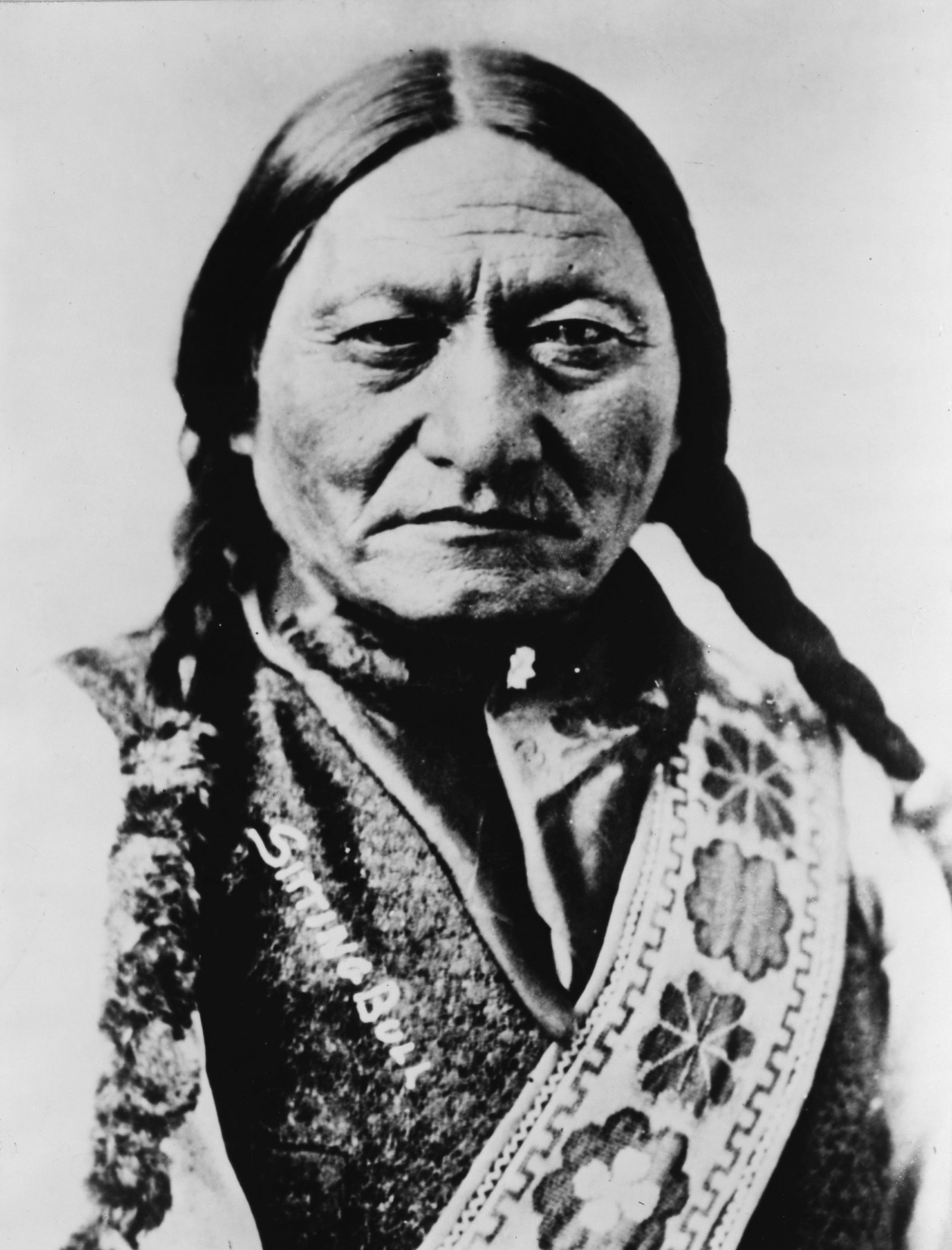
In 1890 Sitting Bull allowed the Ghost Dance in his camp on the Grand River, and McLaughlin asked the government to order his arrest. Early on December 15, 1890, about 40 Lakota police came to his cabin to take him; a crowd gathered, shooting broke out, and Sitting Bull, seven of his followers and six of the police were killed. Sitting Bull College counts his killing among the events that led directly to the Wounded Knee Massacre two weeks later.
His first grave lay near the military cemetery at Fort Yates, North Dakota. In 1953, the college writes, his remains were reportedly moved to a site near Mobridge, South Dakota, where a large memorial now stands. The State Historical Society of North Dakota says the exact site of his grave is still uncertain.
Connected
- The 1876 War and the Taking of the HillsThe war his bands fought, and the law that took the Hills while he was still out.
- The Fort Laramie Treaties of 1851 and 1868The 1868 treaty that put the Hills inside the Great Sioux Reservation, and that Sitting Bull refused.
- Wounded KneeThe massacre two weeks after his killing, of Spotted Elk’s band, which some of his people had joined.
- Crazy Horse and the Black HillsThe Oglala leader who held out with him in 1876 and surrendered the month Sitting Bull reached Canada.
- Red Cloud, Oglala Lakota LeaderThe Oglala leader who signed the 1868 treaty that Sitting Bull rejected.
- Black ElkThe Oglala holy man whose band went north to join Sitting Bull in Canada.
- The Custer Expedition of 1874The Army expedition whose gold reports brought miners onto treaty land.
Further reading
- Who Was Sitting Bull?, Sitting Bull College
- Sitting Bull, Sitting Bull College Visitor Center
- History, Standing Rock Sioux Tribe
- Sitting Bull, Little Bighorn Battlefield National Monument, National Park Service
- Sitting Bull (ca. 1831-1890), Carole A. Barrett, Encyclopedia of the Great Plains
Sources
- Who Was Sitting Bull? Sitting Bull College.
- Sitting Bull. Sitting Bull College, Visitor Center.
- History. Standing Rock Sioux Tribe.
- Sitting Bull. National Park Service, Little Bighorn Battlefield National Monument.
- Hunkpapa and Sihasapa. National Park Service, Little Bighorn Battlefield National Monument.
- United States v. Sioux Nation of Indians, 448 U.S. 371. Supreme Court of the United States, 1980 (Legal Information Institute, Cornell Law School).
- Sitting Bull (ca. 1831-1890). Carole A. Barrett, Encyclopedia of the Great Plains, University of Nebraska–Lincoln, 2011.
- Section 2: The Life of Tatanka Iyotanke, the Hunkpapa Leader known as Sitting Bull. North Dakota Studies, State Historical Society of North Dakota.
- Section 4: The Coming Battle. North Dakota Studies, State Historical Society of North Dakota.
- Section 6: After the Battle of the Little Big Horn. North Dakota Studies, State Historical Society of North Dakota.
- Section 7: The Ghost Dance. North Dakota Studies, State Historical Society of North Dakota.
- Fort Buford State Historic Site: History. State Historical Society of North Dakota.
- Ta-tanka I-yotank (Ta-tanka Yotanka) (Sitting Bull). J. W. Grant MacEwan, Dictionary of Canadian Biography, vol. 11, University of Toronto and Université Laval.
- MS 1929-B: Sitting Bull pictographic autobiography and related material, 1882–1923 (finding aid). National Anthropological Archives, Smithsonian Institution.
Last reviewed: